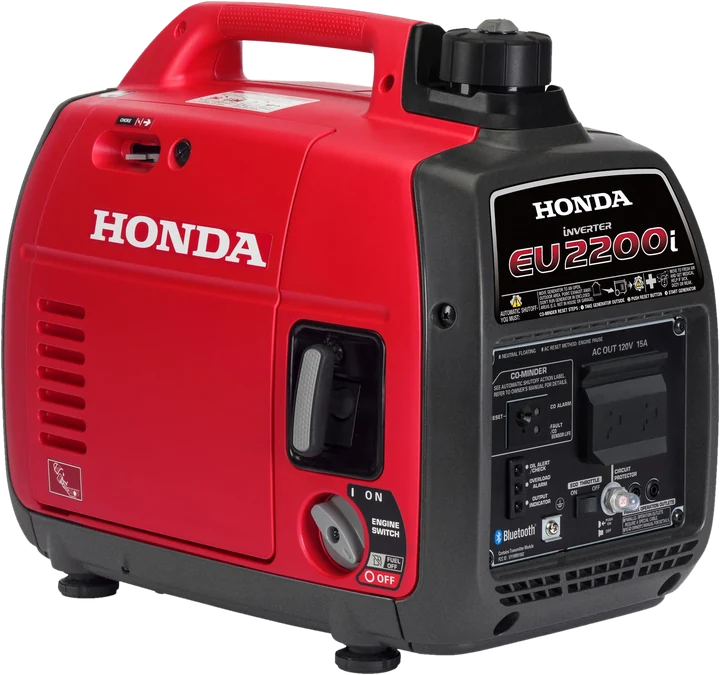
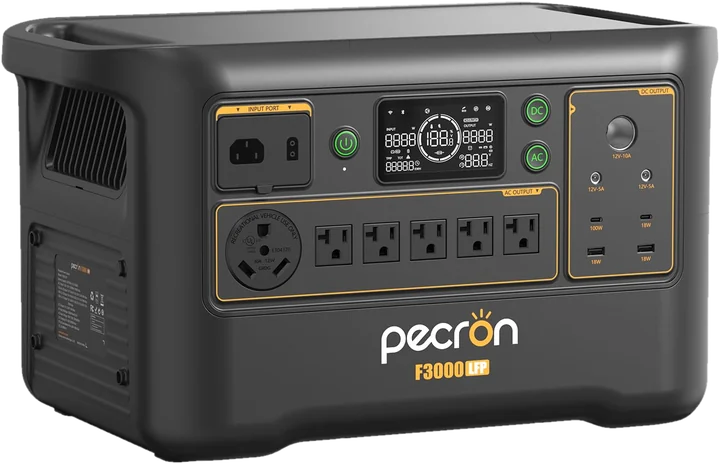
Whole house battery backup without solar: the modular 240 V units that run real home loads
As an Amazon Associate I earn from qualifying purchases.
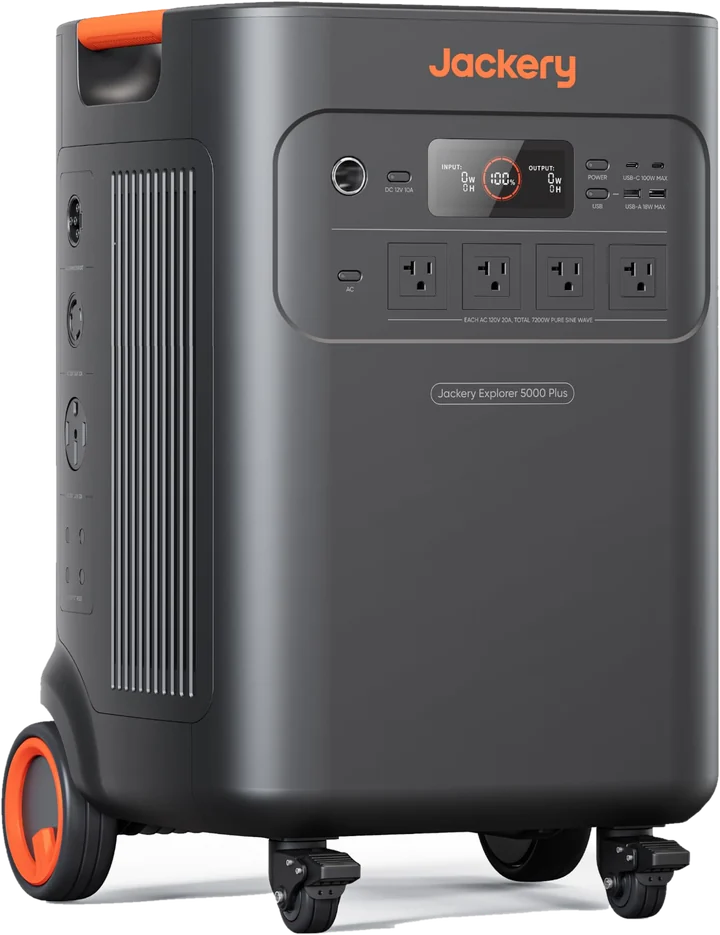 Best for the whole panel, well pump and central air includedJackery Explorer
5000 Plus Check price on Amazon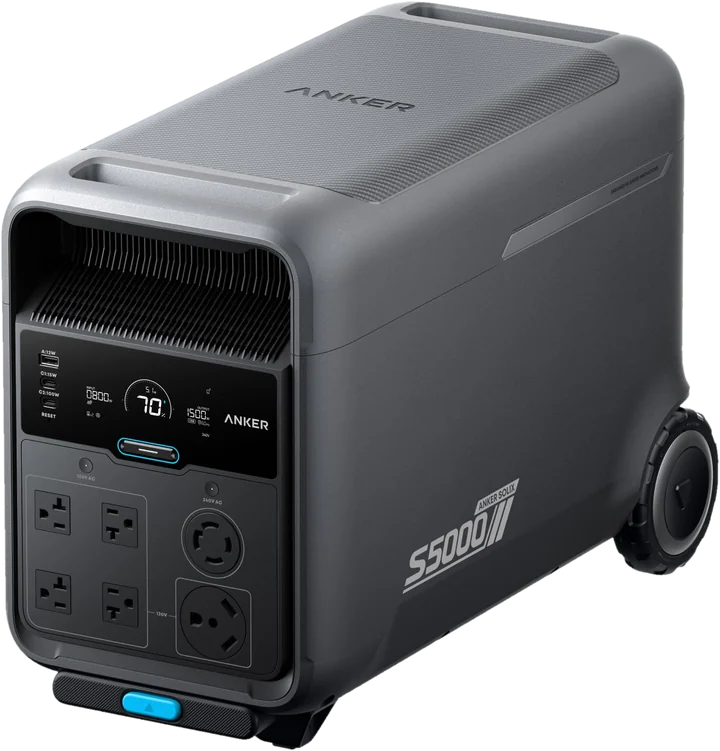 The new one to watchAnker SOLIX S5000
Porchlight's pick for whole house battery backup without solar is the Jackery Explorer
"Whole-home" costs a maker nothing to print on a box. Starting a 240-volt well pump in the dark costs plenty. Of the modular units we weighed, only one has done it in a real outage with no soft start fitted. Porchlight's pick for whole house battery backup without solar is the Jackery Explorer
What changes the answer for a 240V house
The installed alternative sets the bar. EnergySage's 2026 averages put a typical installed home battery well into five figures. Per kilowatt-hour stored, it costs more than any unit below does at the top of its price band. That's before any state or local rebate. The comparison isn't perfect: the installed price includes the crew, and a modular box still needs an electrician. The federal credit that once took nearly a third off is over. The IRS says it doesn't apply to anything placed in service after December 31, 2025. Our home battery tax credit guide has the detail.
Three things then pick the box.
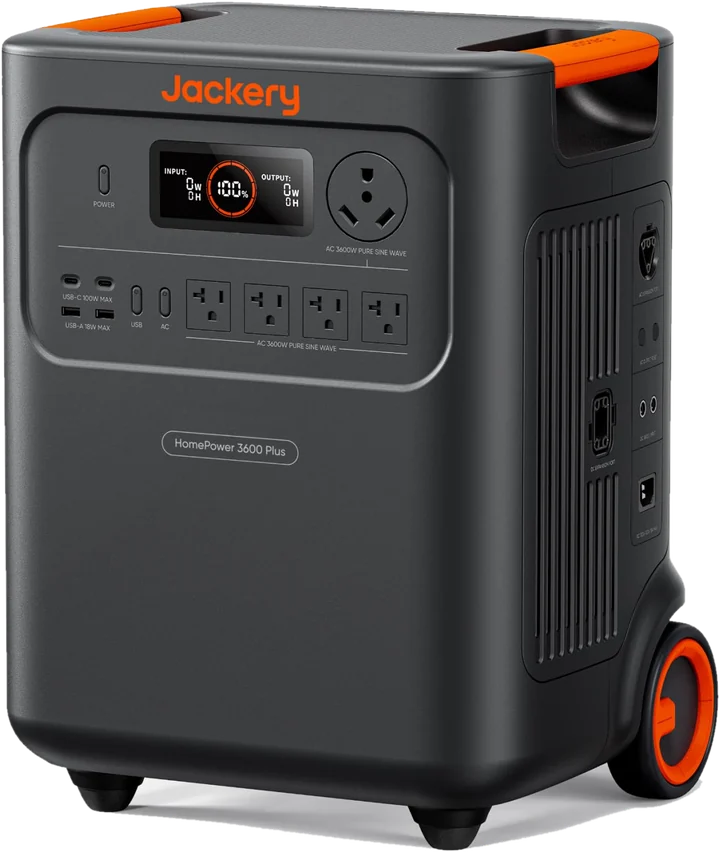
- One box or a pair. A well pump or central air runs across both legs of your panel. Several popular units reach 240V only as a matched pair. Nobody in our evidence has started a motor on one of those pairs, so we only picked boxes that make 240V alone. If your outage plan never touches the panel, you don't need any of this. The HomePower
3600 Plus keeps that home going with extension cords and no electrician. - What each side of the panel gets. A 240V box is really two 120V halves. If one half is small, a motor leaning on it at startup trips the box, whatever the label's total says. A soft start on the motor shrinks that startup gulp. In one test it cut a 2-ton central air unit's inrush by roughly two thirds.
- How it refills. With no solar, your fuel is a portable generator or the grid coming back. A box that takes 240V from a generator refills far faster.
Run your own loads through the home backup power calculator first. Both picks stop charging below
Best for the whole panel, well pump and central air included: Jackery Explorer 5000 Plus
For once, the big numbers on the box mostly survive contact with testers. Jackery promises
The motors are what earn it the win. In one owner's real install, a
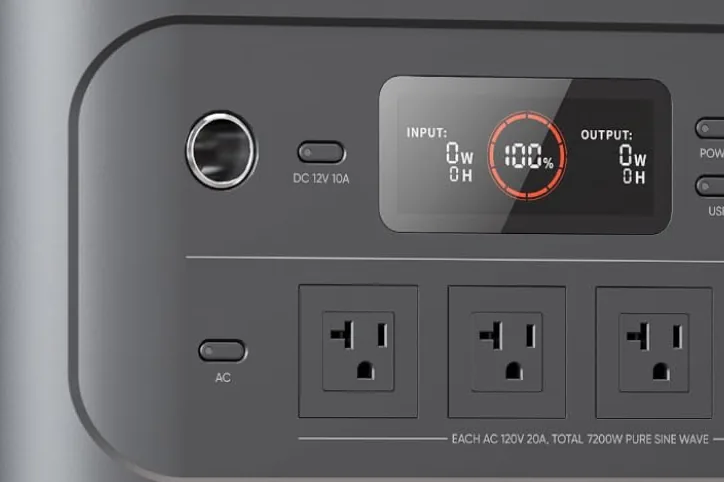
It isn't magic. The printed
Then there's the "True 0ms UPS switching" banner. The manual confines it to the 120V outlets in one particular mode. Through the transfer switch that feeds your panel, two testers timed about
Living with it means a
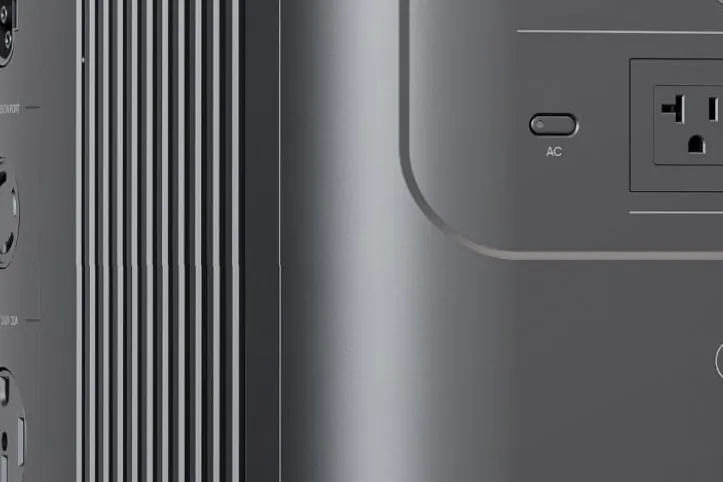
The one real catch is refilling. Jackery takes 240V input only through its own Smart Transfer Switch. From a portable generator it charges at 120V and
We'd buy it for any home that needs one box to start a 240V pump or central air. Buy.
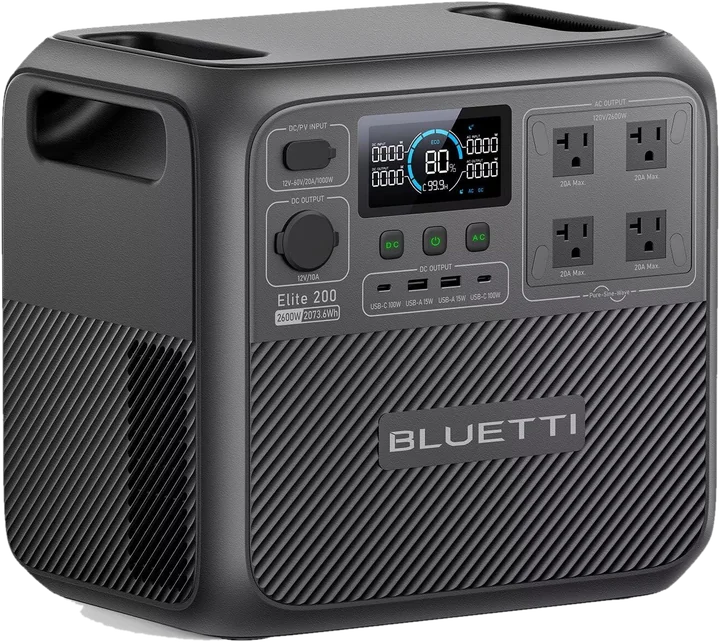
Best on a tighter budget, for a smaller 240V pump: BLUETTI Apex 300
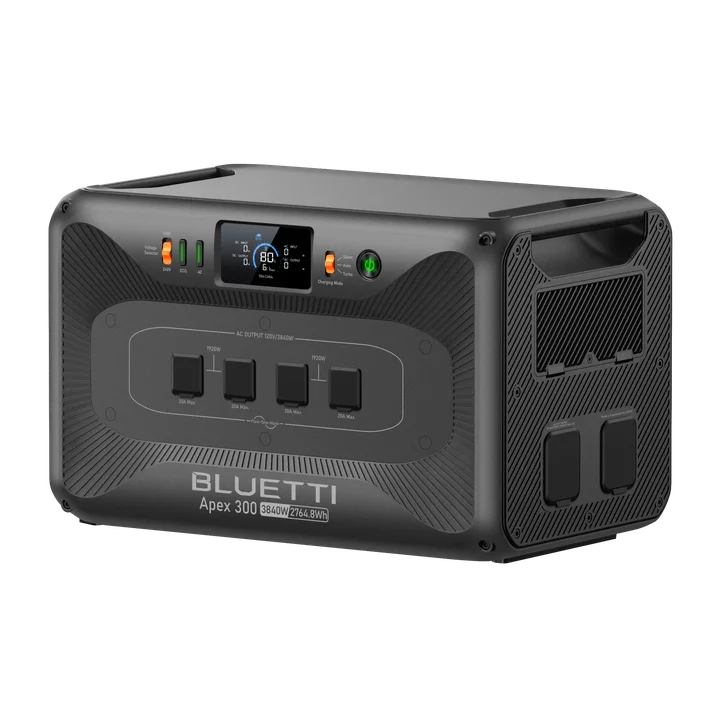
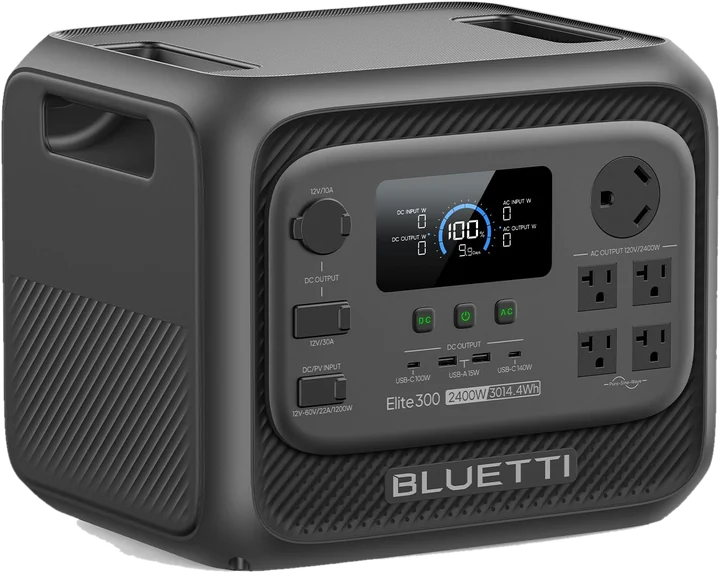
The BLUETTI Apex 300 does something rare at its size. Flip a selector and one box gives true 120/240V,
Read the fine print, though. That
BLUETTI's landing page sells
A small well pump is where it fits. For a 240V pump of three-quarter horsepower or less, Franklin's sizing table asks for less than the Apex 300 delivers in total. That's on paper: its record holds no pump start yet. A bigger pump is another matter. For a
Where it beats the Jackery is refilling. With BLUETTI's optional cable in its P050A port, it charges at up to
The catch is the
New this year, and what we're watching
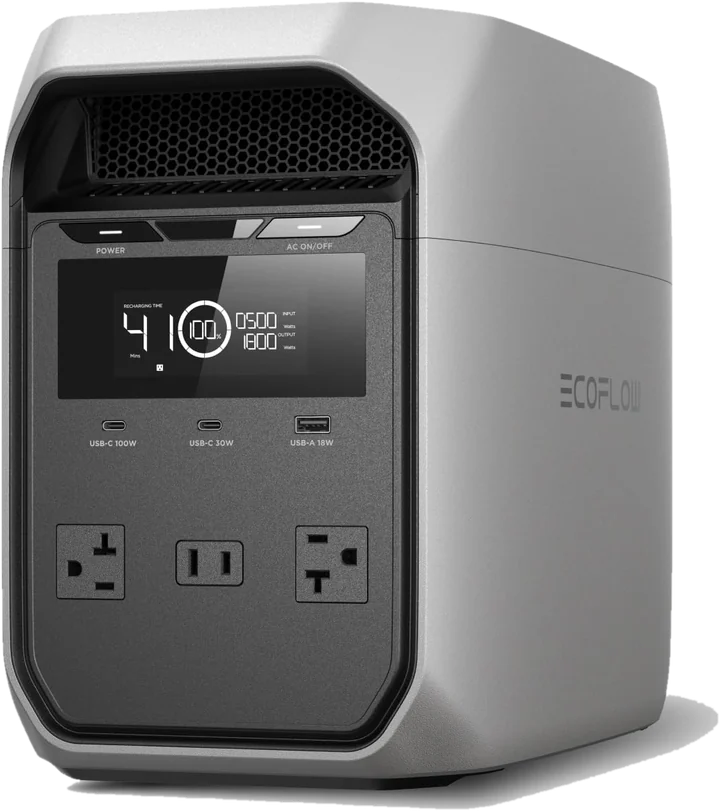
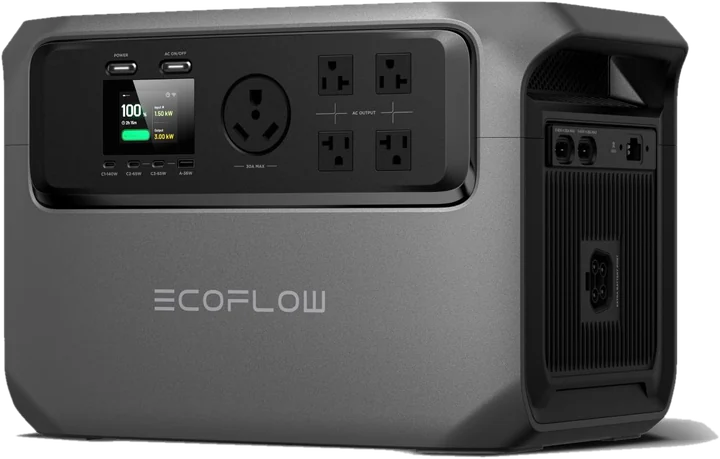
Two new units arrived this fall. EcoFlow's DELTA 3800 Gen4, new in November 2026, is one to watch as a big 120V box for the fridge. For this house it changes nothing, because EcoFlow's own spec sheet lists 120V only. The one that matters here is Anker's.
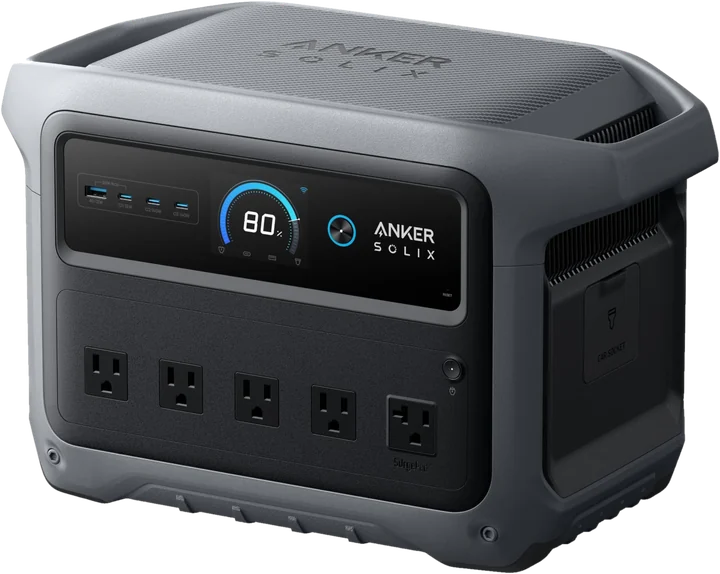
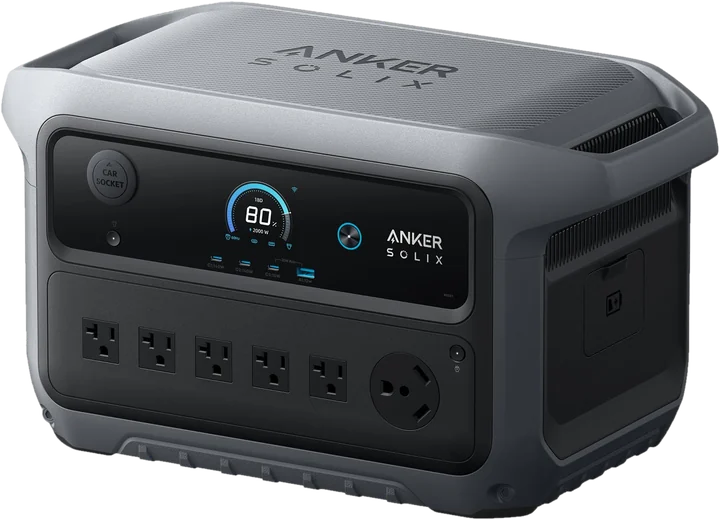
Anker SOLIX S5000
Price band: under $3,000
WaitReleased in October 2026, the S5000 is aimed squarely at this page, on paper. It holds
What's missing is everything this reader needs. Nobody whose work we could check has tested its 240V output. Anker hasn't published what each side of the panel gets. The manual sits sealed at the FCC until March 2027. Anker also says it won't work with its own Home Power Panel, so it connects through a transfer switch or inlet box.
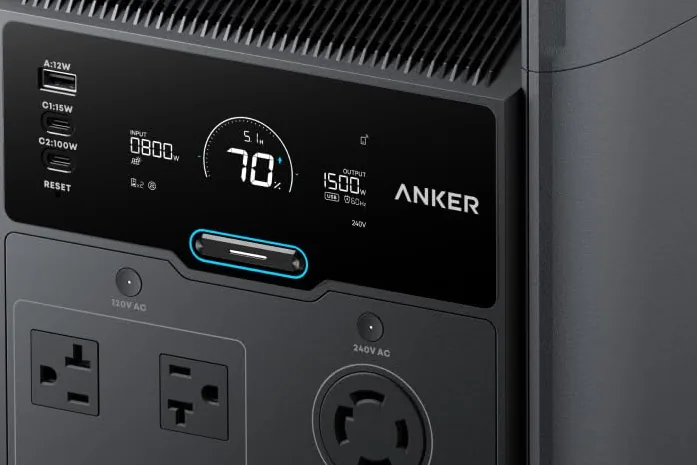
One 240V pump or central air start on a retail unit would change that. So would a per-side figure from Anker. Either would put it in contention with the Jackery. Until then, our call is wait.
How the picks were decided
To make the list, a box had to deliver 240V by itself. Someone independent of the maker also had to have started a 240V motor on the very model you'd buy. The one exception is the Apex 300's small-pump case, which rests on the pump maker's sizing table and is labeled as paper. The field was 7 models, 3 of them with a maker manual we could read. They were drawn from the 589 sources kept in full across our research.
Will one box start my well pump?
One unit here has done it on record: the Jackery Explorer
Will it start my central air?
A 3-ton unit started on the Jackery. On the Apex 300, a 3-ton unit started only with a soft start fitted, and a window unit without one tripped it. One other air conditioner failed on the Jackery. Compressors differ a lot, and a soft start is the dependable fix. For cooling, our air conditioner guide and this page agree: the Jackery.
Do I need an electrician to connect it?
Yes. Power fed into house wiring without a transfer switch or listed interlock can flow back up the utility line. One utility co-op warns that is enough to injure or kill a lineman working on it. It can also start a fire. Never use a cord with a plug on both ends. Code summaries say interlock kits must be listed for your panel and installed by a licensed electrician. They also say a permit is required, though local rules vary, so ask. BLUETTI's own manual wants a licensed electrician to check the feed circuit before the Apex 300 is hooked to it. Our portable vs standby generator guide explains when an interlock is enough, and it lands on the Jackery too for a home that wants power back at 240V without a standby install.
How do I recharge it without solar?
From the grid when it returns, or from a portable generator. With BLUETTI's optional cable, the Apex 300 takes 240V from a generator at up to
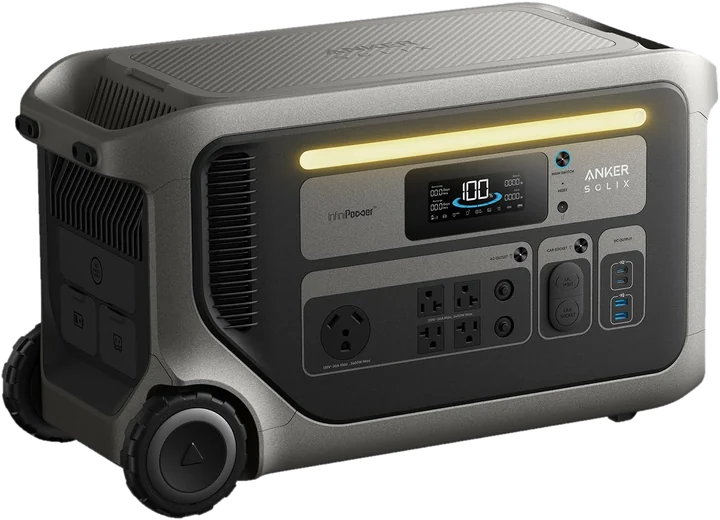
Why isn't the Anker SOLIX F3800 Plus a pick?
One thing about it earns real admiration. Its manual is the only one in this group to publish a motor-start rating:
Two things hold it back. First, no one has started a pump or central air on the Plus itself; the whole-house test often cited ran on the original F3800, a different model. Second, efficiency. At launch firmware it burned half its battery a day doing nothing, and Anker's update brought that to a quarter. Even so, a lab's fridge test still found close to half its energy lost to overhead. Our
The picks side by side
| Product | Each side of the panel | 240V motor start on record | Battery lost a day to idling | Our call | Where |
|---|---|---|---|---|---|
| Jackery Explorer | About a quarter | Buy | View on Amazon | ||
| BLUETTI Apex 300 | 3-ton central air, only with a soft start; no pump yet | About a sixth | Buy, for a smaller pump | View at BLUETTI | |
| Anker SOLIX S5000 | Not published | None yet | About a twentieth | Wait | Not yet |
Our pick: the Jackery Explorer 5000 Plus
An installed battery now costs what it costs, with no federal help. On the shelf, the Jackery Explorer
The evidence in full
Research for this page: 7 models weighed; 3 maker manuals among them; across this site's research, 589 sources kept in full. Reddit owner research failed this run, so owner evidence is thin for every unit.
Every unit considered, on the 240V questions
| Unit | How it makes 240V | Each 120V side | Idle | Charging from a 240V generator | 240V loads started on record |
|---|---|---|---|---|---|
| Jackery Explorer | One box ( | None; 240V input only through Jackery's Smart Transfer Switch; 120V generator charging at | |||
| BLUETTI Apex 300 | One box, voltage selector, | Up to | 3-ton central air with soft start; | ||
| Anker SOLIX S5000 | One box, | Not published | Claimed | None | |
| Anker SOLIX | One box, | 50 % of battery per | None on the Plus; motor rating | ||
| Jackery HomePower | Only as a paralleled pair | Paralleled pair charges from solar only (manual) | None for a pair | ||
| Anker SOLIX F3000 | Only as a pair plus Double Voltage Hub | Tested at | None; 120V only | None at 240V | |
| EcoFlow DELTA 3800 Gen4 | Not at all; 120V only | None; 120V only | None |
Set against all of these, EnergySage's 2026 average for an installed home battery costs more for each kilowatt-hour of storage than any unit in this table does at the top of its price band, with a typical system in five figures, before state or local incentives. There is no federal credit for anything placed in service after December 31, 2025 (IRS). Some IRS pages still carry older text about the credit running into the 2030s; the operative sentence is the end date.
The S5000's output per side of the panel is still unpublished by Anker. A summary channel has claimed a figure, but it names no tester behind it, so the page doesn't use it.
The Apex 300's small-pump call rests on Franklin's generator sizing table, which is written for engine generators, not battery inverters. It is a yardstick, not a pass. No pump start on an Apex 300 is on record from any source we kept.
On the Jackery's floating neutral: two testers (ReeWray and Will Prowse) found the outputs float, and GearDiary reports Jackery requires a neutral-switching transfer switch with its own Smart Transfer Switch setup. Where the hookup never breaks the house neutral, a floating station picks up its neutral-ground bond from the main panel. No furnace start on this unit is on record either way.
Skip these, and also considered
- Jackery HomePower
3600 Plus . Our pick for keeping food cold, lamps lit and the router up through a one-to-three-day outage, plugged straight into the box, and for a well pump whose label says 120V; our HomePower3600 Plus review explains where it shines. For this page's 240V house it needs a second unit, nobody has started a motor on a pair, and Jackery's manual says a paralleled pair charges from solar only, which leaves a no-solar home with no way to refill it while paired. - Anker SOLIX F3000. Our pick for multi-day and week-long outages on 120V essentials, refilled from a 120V generator; see our SOLIX F3000 review. For this page's reader it falls short: 240V takes two units plus Anker's Double Voltage Hub, and that setup has no test on record.
- Anker SOLIX
F3800 Plus . A wait for this house, not a skip. It makes 240V from one box, publishes a motor rating and supports Anker's Home Power Panel, but no motor start on the Plus itself is on record, and its efficiency is unproven: heavy idle at launch, and CNET's fridge test (firmware not stated) finding 46.63 % of the energy lost to overhead. Generator charging also falls short of Anker's footnote: The Solar Lab measured full 240V input only with two expansion batteries, and says Anker confirmed it. Discussed, not linked. - EcoFlow DELTA 3800 Gen4. New in November 2026 and one to watch as a big 120V fridge box, pending an independent lab test. It is 120V only per EcoFlow's spec sheet, so it is outside this page's job.
Testers, methods and units
| Tester | Unit and date | What they found |
|---|---|---|
| GearDiary | Explorer | Shared well with a |
| ReeWray Outdoors | Explorer | |
| The Solar Lab | Explorer | |
| Herb-O-Matic | Explorer | Overload at about |
| Snowstead | Jackery system, sponsored | A well pump cycled normally through a Jackery transfer panel beside a dryer and fridge; no pump size or numbers, so not counted. |
| There's A Trick For That | Apex 300, US, Oct 2025 | Fed a subpanel through an interlock; central air with a Micro-Air soft start started; a window unit without one failed on one side; held |
| StorageReview | Apex 300, Nov 2026 | Described the design as two inverters, one per line; measured |
| Backyard Solar Project | Apex 300 early test unit, Jun 2025 | Heat pump cooled; its |
| pv magazine USA and Bob Vila | S5000 pre-release units, Oct 2026 | Both tested 120V loads only. Bob Vila ran a fridge alone for |
| Benjamin Sahlstrom | Original F3800, Nov 2023 | Started a well pump and heat pump on a model that isn't the Plus; listed here only to say it doesn't count for the Plus. |
Disagreements that don't change the call
| Question | What the sources say | Where it stands |
|---|---|---|
| Jackery switchover through its transfer switch | About three seconds on Will Prowse's launch unit; about | Whether launch firmware was fixed is open |
| Jackery central air | One 3-ton start passed and one AC failed; different compressors, tested 17 months apart, firmware not stated | Open |
| Jackery warranty extension | The FAQ says extended warranty isn't supported, while the series page sells one | Open |
| Apex 300 efficiency | CNET measured 66.63 % round trip; discharge-only tests ran higher. Round trip includes charging losses, which a no-solar home pays for in generator fuel. | Explained in part |
| Apex 300 out-of-box faults | One US owner received two units in a row at empty with a battery-protection fault; BLUETTI replaced the first and offered a refund | One person's report |
| Silver Cymbal measured idle loss halved after Anker's update; CNET's later fridge test still found heavy overhead loss, firmware not stated | Open | |
| S5000 output per side | A summary channel's figure has no named tester behind it | Unverified |
Gaps
No source gives a clamp-meter peak for a pump start on any of these units, or runtime across pressure-tank cycles. No one has started a pump of any size on an Apex 300. Neutral-ground behavior in transfer-switch use is unstated for the Apex 300 and S5000, and no unit here has a furnace start on record.
Sources
- Jackery Explorer
5000 Plus US user manual(JE-5000A) (opens in a new tab) - BLUETTI Apex 300 US user manual
V3.1 (opens in a new tab) - Anker SOLIX
F3800 Plus US user guide(A1790P) (opens in a new tab) - Jackery HomePower
3600 Plus user manual(JHP-3600A) (opens in a new tab) - Jackery Explorer
5000 Plus US productpage (opens in a new tab) - Jackery FAQ: Explorer
5000 Plus basicinformation (opens in a new tab) - BLUETTI Apex 300 home backup
page (opens in a new tab) - Anker SOLIX S5000 US product
page (opens in a new tab) - Anker SOLIX S5000 FCC filing
(2AOKB-AS510) (opens in a new tab) Anker SOLIX F3800 Plus specs (opens in a new tab)- Anker SOLIX F3000 US product
page (opens in a new tab) - EcoFlow DELTA 3800 Gen4 US store
page (opens in a new tab) - IRS: Residential Clean Energy
Credit (opens in a new tab) - Franklin Electric AIM manual, generator sizing
table (opens in a new tab) - GearDiary: Jackery Explorer
5000 Plus ownerreview (opens in a new tab) - ReeWray Outdoors: Explorer
5000 Plus test (opens in a new tab) - The Solar Lab: Explorer
5000 Plus test (opens in a new tab) - The Solar Lab: What is a smart transfer
switch (opens in a new tab) - Will Prowse: Explorer
5000 Plus launchunit (opens in a new tab) - Herb-O-Matic: Explorer
5000 Plus test (opens in a new tab) - Snowstead: Jackery whole-house test
(sponsored) (opens in a new tab) - There's A Trick For That: Apex 300 whole-home
test (opens in a new tab) - StorageReview: BLUETTI Apex 300
review (opens in a new tab) - Backyard Solar Project: Apex 300
test (opens in a new tab) The Solar Lab: Apex 300 review (opens in a new tab) - Beer Money Cycle Works: Apex 300 owner
report (opens in a new tab) - CNET Labs: best portable power
stations (opens in a new tab) - pv magazine USA: Anker SOLIX S5000 deep
dive (opens in a new tab) - Bob Vila: Anker SOLIX S5000
review (opens in a new tab) - Silver Cymbal: Anker SOLIX
F3800 Plus test (opens in a new tab) - The Solar Lab: Anker SOLIX
F3800 Plus test (opens in a new tab) - Benjamin Sahlstrom: original Anker F3800 whole-house
test (opens in a new tab) - HOBOTECH: EcoFlow DELTA 3800 Gen4
test (opens in a new tab) - EnergySage: home energy storage
guide (opens in a new tab) - DEMCO: Backfeeding, when electricity flows
backward (opens in a new tab) - Jaspector: IRC 2024 generator transfer switch
rules (opens in a new tab) - RVelectricity: SoftStartHome test on a Honda
EU7000i (opens in a new tab)