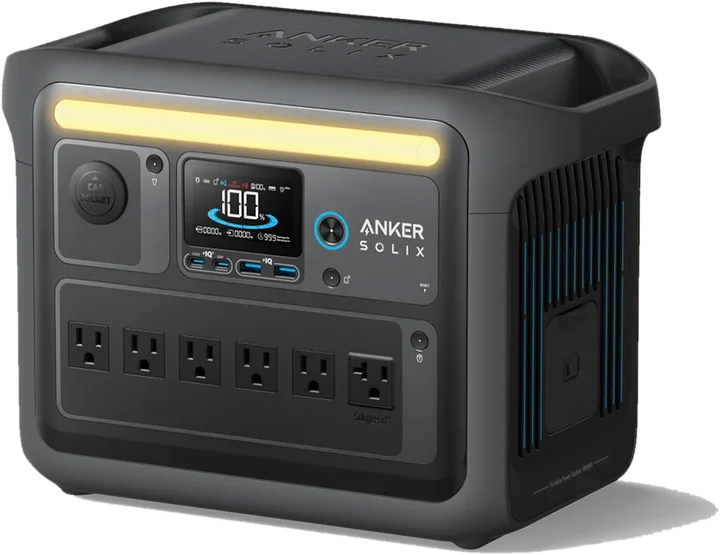
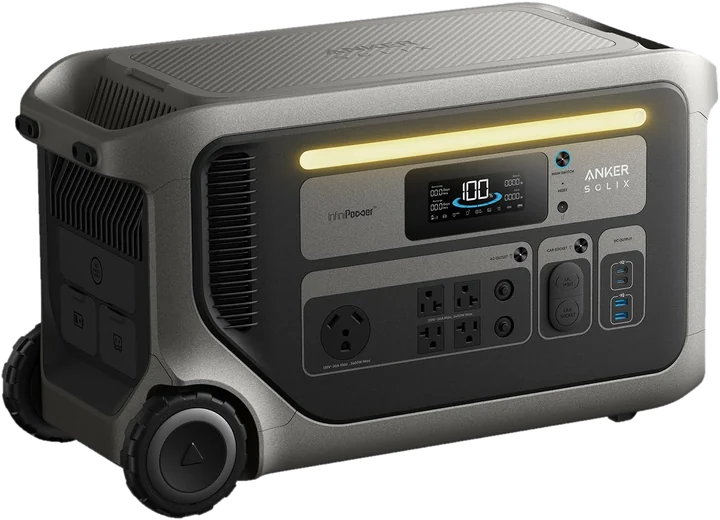
Anker SOLIX F3000 review for home backup: measured against the maker's claims
As an Amazon Associate I earn from qualifying purchases.
At Porchlight we'd buy the Anker SOLIX F3000 for a house that expects outages longer than any battery and keeps a
- Who it’s forHomes that expect week-long outages and will refill the battery from a
120 V generator - The catchIdle draw measured anywhere from
20 W to35 W , so how long it lasts on standby is unsettled;120 V only from one unit
In the evidence table
Open the full row- Idle draw with the AC on
20.5 W measured- Usable energy, measured
2,645.91 Wh measured- Rated capacity
3,072 Wh claimed- Continuous output (gas: running watts)
3,600 W claimed- Surge (gas: starting watts)
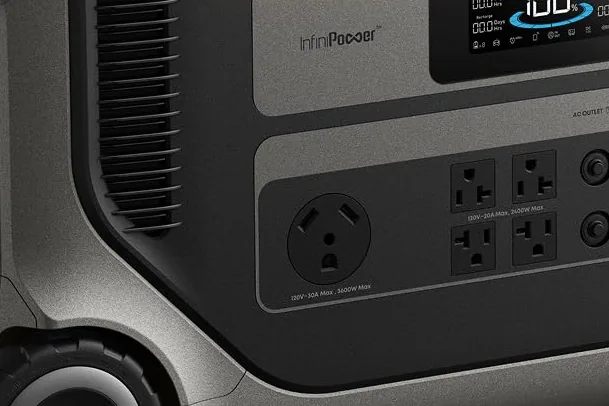
7,200 W claimed240 V output- 120V only (240V needs two units plus Double Voltage Hub)claimed
- Neutral-ground bond
- floatingmeasured
- UPS switchover
9.8 ms measured
Most big power stations are sold on how much they hold. The most useful thing about the Anker SOLIX F3000 is how fast it fills back up. Feed it from a
Anker's box against the measurements
Does it deliver what Anker promises?
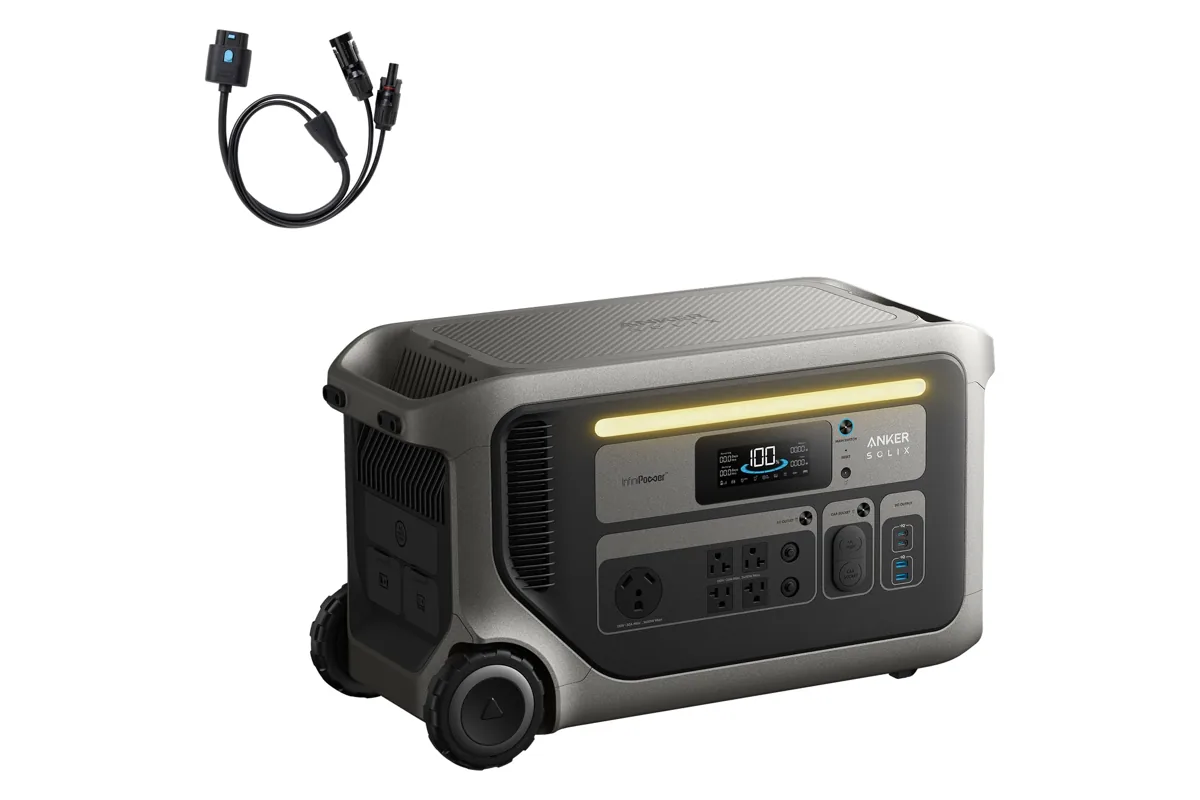
Mostly yes, and in two places it beats its own box. This is the US model, A1782: a
| What you care about | Anker says | What testers measured | Who measured, when |
|---|---|---|---|
| Battery you can actually use | CNET Labs, Jul and Aug 2026; Jasonoid, Jul 2025 | ||
| Output from the household outlets | Not load-tested to the limit | Anker's own spec table | |
| Surge for a hard-starting load | The Solar Lab, Oct 2026 (unit a year old) | ||
| Switchover when the grid drops | Jasonoid, Jul 2025 | ||
| Wall charging, standard cable | CNET Labs, 2026; The Solar Lab, 2025 | ||
| Generator charging, | Under an hour | The Solar Lab | |
| Fridge runtime | CNET Labs, Jul and Aug 2026 | ||
| Idle draw, AC on, nothing plugged in | Up to five days of standby | Jasonoid, The Solar Lab (twice), HOBOTECH | |
| Charging in the cold | Not below | Not tested | Anker |
| Fan noise | Not stated | Jasonoid; HOBOTECH |
None of these testers says who supplied its F3000, and neither does CNET. That's worth knowing, though the agreement between them counts for more.
The battery comes in at about six-sevenths of the box figure. That's the inverter's cut for turning battery power into wall power, not a con. The surge result came from heat guns, not a motor, so it proves a strong inverter rather than a particular compressor start. The switchover is the one I'd frame. Anker promises
The fine print sits on the output. The
How long will it keep my fridge cold?
Plan on a bit more than a day, which is less than Anker suggests. CNET ran a full-size Whirlpool fridge until the battery quit, and it lasted
Can a generator refill it in under an hour?
Yes, and this is the reason to buy it. Anker claims
How much battery does it burn doing nothing?
This is its one real catch: nobody agrees. Four tests of the same model:
| Tester | Idle draw | How it was read |
|---|---|---|
| Jasonoid, Jul 2025 | Battery gauge over half a day | |
| The Solar Lab, 2025 review | Three runs from full | |
| The Solar Lab, Oct 2026, one year on | Average of two runs, one more than double the other | |
| HOBOTECH, firmware as of Aug 2025 | Energy metered back in through the solar port |
At the low end, that tax is about a sixth of the rated battery every day before you plug anything in. At the high end it's over a quarter. Every one of these tests measured a pace over part of the battery, and nobody has run an F3000 down to empty at idle. At the low
With a generator in the plan, this matters less, because an hour of refilling covers a day of idle tax. Without one, it decides whether a long outage outlasts your battery.
Where it won't fit
Will it run my well pump or central AC?
Not on its own. A single F3000 is
Will it light my gas furnace?
It can, once one wiring question is settled, and this needs a straight answer. Our furnace guide counts the F3000 as a buy for a day or more of furnace and fridge on battery. The wiring question is the neutral. Jasonoid measured the outlets and the
Two other setups suit different homes. If the furnace has to come back together with big
Owning an Anker SOLIX F3000
What is it like to live with?
Heavy, quiet and well built, as far as one year shows. At
The only long-term record is The Solar Lab's own unit after a year. Its inverter efficiency read 84% at both ends of the year and its wall charging time barely moved. A rubber port flap broke, and the tester says they'd buy it again. Anker backs it for 5 years and rates the battery for 4,000 cycles. Neither has been checked independently.
The rest is ownership friction. Anker says it won't take a charge below
What nobody has measured yet
Owner reports at scale are missing, because owner forums couldn't be read for this page. Nobody in our evidence has tested it on a furnace, the two-unit
Our call on the Anker SOLIX F3000
Most of the claims we could check against a measurement held, and the switchover beat Anker's own figure. The fridge runtime is the exception: CNET's full-size Whirlpool ran
The evidence in full
Identity. US model A1782, sold on Amazon US and listed on Anker's US collection page as the F3000 (
Lab by lab:
| Measure | Result | Tester | Method and date |
|---|---|---|---|
| Usable capacity | CNET Labs | Steady mid-size resistive load, data logger, run to empty; Jul and Aug 2026 | |
| Usable capacity | 89% | Jasonoid | AC discharge to shutoff; Jul 2025 |
| Round-trip efficiency | 74.62% | CNET Labs | Energy out divided by |
| Inverter efficiency | 84% | The Solar Lab | Same at first test and after a year (Oct 2026) |
| Wall charger efficiency | 84.6% | Jasonoid | Wall energy needed to fill the |
| Fridge runtime | CNET Labs | Full-size Whirlpool, run to empty; 37.81% overhead loss | |
| Wall charge, empty to full | CNET Labs | ||
| Wall charge, empty to full | The Solar Lab | Standard cable; almost unchanged a year later | |
| Generator charge | Under an hour | The Solar Lab | |
| Surge | The Solar Lab | Five heat guns at once, unit a year old; the screen lagged behind | |
| UPS switchover | Jasonoid | Oscilloscope on the outlet, PC under stress test, three grid cuts; Jul 2025 | |
| UPS pass-through | Passed | HOBOTECH | PC on pass-through |
| Fan noise | Jasonoid | Full load after ten minutes, about three feet | |
| Fan noise | HOBOTECH | Inverter fan under load, one meter | |
| Neutral and ground | Floating on battery | Jasonoid | Outlets and |
| Idle draw | Jasonoid; The Solar Lab (2025, Oct 2026); HOBOTECH | See below |
The idle draw disagreement is still open. Jasonoid read the battery gauge over half a day. The Solar Lab ran three idle runs from full in its 2025 review. A year later its two runs disagreed by more than double, and it calls the result inconsistent. HOBOTECH metered the energy needed to refill through the solar port on firmware current as of August 2025, a method that counts the charger's own losses too and so likely reads high. HOBOTECH's pace projects to well short of Anker's standby claim. Method and firmware both differ between testers, yet The Solar Lab's same-method runs on one unit still split, which puts some of the cause in the unit or its firmware.
The output rating disagreement is explained. CNET lists the F3000 at
CNET's fridge figure is explained too. Its pros list gives a runtime an hour longer than its body text and results table, which both give
Other views: Minute Man Solar recommends it as a 120 V-only essentials unit and criticizes the low-voltage solar input and the lack of split-phase output from one unit. The Solar Lab flags the proprietary twist-lock charge plug, the proprietary solar connector and BP3000-only expansion.
On furnaces, a floating neutral on battery is a known cause of furnace control-board lockout. No furnace test was found for this unit.
On recalls, the CPSC listing downloaded 13 November 2026 (10,134 recalls, newest 5 November 2026) holds no recall naming an Anker SOLIX power station or the F3000. Every Anker recall in it is a power bank, speaker or EverFrost cooler battery.
None of the four sources that tested an F3000 says where its unit came from.
Owner forums couldn't be read for this page, so long-term owner evidence comes from one tester-owner, The Solar Lab, after a year of use.
Research behind this page: 1 models weighed; 0 maker manuals among them; across this site's research, 589 sources kept in full.
Sources
- Anker SOLIX F3000 product page and specifications
(Anker) (opens in a new tab) - Anker SOLIX US power station collection
(Anker) (opens in a new tab) - FCC ID 2AOKB-A1782 filing
(fccid.io) (opens in a new tab) CPSC recall listing (opens in a new tab) - Best portable power stations (CNET
Labs) (opens in a new tab) - Anker F3000 review (The Solar
Lab) (opens in a new tab) - Anker F3000 after one year (The Solar Lab,
YouTube) (opens in a new tab) - Anker SOLIX F3000 tests (Jasonoid,
YouTube) (opens in a new tab) - Anker SOLIX F3000 tests (HOBOTECH,
YouTube) (opens in a new tab) - Anker F3000 review (Minute Man Solar,
YouTube) (opens in a new tab) - Floating neutral and furnace control boards
(YouTube) (opens in a new tab)