Inverter generator vs regular generator for home backup: clean power, noise and the furnace
As an Amazon Associate I earn from qualifying purchases.
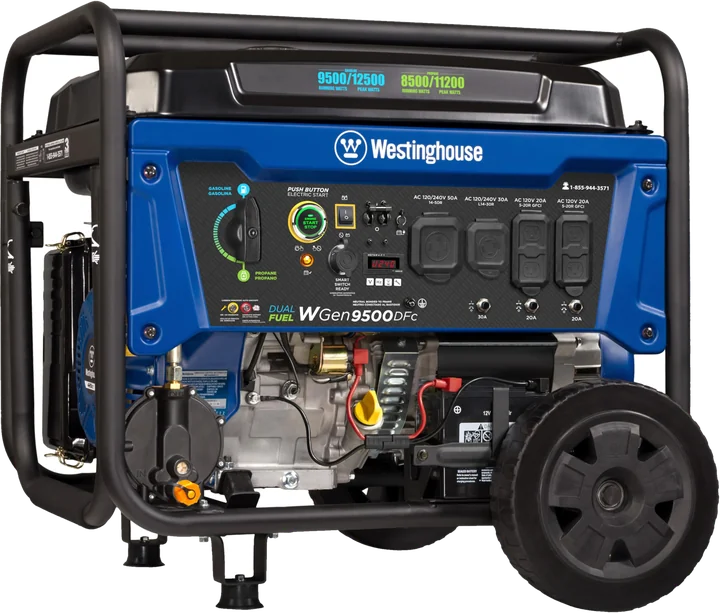 Most watts in its price bandWestinghouse WGen9500DFc
Buy an inverter and feed the panel through an inlet and interlock, where the house supplies the neutral bond. Porchlight's pick is the Westinghouse iGen5000DFc: the most independently tested inverter here, in the under $1,000 band.
Buy the inverter, but don't stop at the word. On the makers' figures, the open frame offers more than twice the watts in the same price band. Westinghouse's WGen9500DFc and Generac's
How is an inverter generator different from a regular one?
A regular open-frame generator spins a brushed alternator, with a voltage regulator keeping its output in line. That is how Westinghouse's manual describes the WGen9500DFc. An inverter generator builds its output electronically inside a closed case, so the engine can slow down when the house asks for little. The difference shows in total harmonic distortion: how far the power's shape strays from the utility's smooth wave. Westinghouse prints "up to 23%" for its open frame. The iGen5000DFc, the
I'll give Westinghouse credit for printing its own worst case. On a supplier's spec sheet, that line tells you an engineer wrote the rest. Remember it when you're standing next to a furnace board.
Why can a clean inverter still leave the furnace dark?
Because the furnace checks something else first. Goodman's and Rheem's furnace paperwork lists a grounding or polarity error among the faults their boards flag. A board that sees no tie between neutral and ground won't light. Your house panel makes that tie. Many generators leave the neutral "floating" instead. Honda's manual says the EU2200i does. So does Westinghouse's manual for the iGen5000DFcv, the iGen5000DFc on a wheel kit.
Every furnace start on a floating source that we read failed at ignition until someone added a bond. On what appears to be a Honda EU2200i Companion, the furnace ran half its cycle, threw a polarity error and quit. A bonding plug in the spare outlet fixed it. So the standard advice, buy the clean inverter, can leave you in a cold house staring at a blinking light.
How you connect matters as much as what you buy. A furnace converted to plug in sees only what the generator gives it, so it needs a bonded generator. Through a panel inlet and interlock, the house panel supplies the bond. Trystar's explanation of the electrical code says a floating neutral is the expected arrangement there. A bonded generator on that setup needs a transfer switch that also switches the neutral.
What this means for what you buy
Buy an inverter, and connect it the way its neutral expects. Our pick assumes an inlet and interlock at the panel, and the Westinghouse iGen5000DFc. The manual for its wheel-kit DFcv edition says the neutral floats; we couldn't find the DFc's own. On an inlet and interlock, a floating neutral is exactly what the code anticipates, so the furnace sees the panel's bond. It's the one inverter here that an independent tester has run hard on the exact model, and its price band is under $1,000. Our gas furnace backup guide picks it for the same inlet-and-interlock home. That wheel-kit manual lists
The five generators side by side: distortion and neutral
| Generator | Type | Maker's distortion | Neutral | Output |
|---|---|---|---|---|
| Westinghouse iGen5000DFc | Inverter | Under 3% | Floating (DFcv edition's manual) | |
| Generac | Inverter | Under 3% | Bonded | |
| Champion 201175 | Inverter | Under 3% | Bonded | 120/ |
| Honda EU2200i | Inverter | None found | Floating | |
| Westinghouse WGen9500DFc | Open frame | Up to 23% | Bonded | 120/ |
The open frame's distortion ceiling is close to eight times the inverters' promise. Noise is murkier. Only Champion says how far away its meter stood:
Is an inverter generator quieter?
On the makers' figures, yes, but the small print works hard. Westinghouse's "as low as
Westinghouse iGen5000DFc: the best-tested inverter here, with a floating neutral in its wheel-kit edition's manual
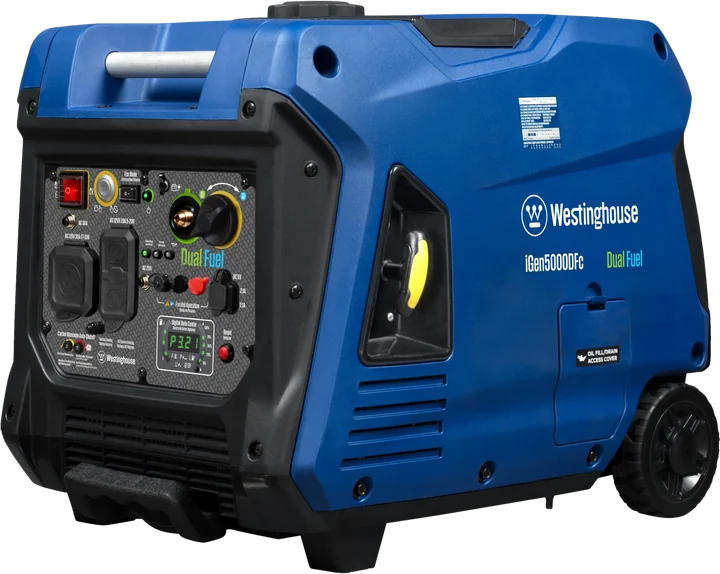
Westinghouse promises under 3% distortion, "as low as
The catch is the neutral. The wheel-kit edition's manual says "Neutral floating", as does every Westinghouse inverter manual we read. We couldn't find the DFc's own manual, so that is the best word we have for this machine. Plug a converted furnace into it and expect the blinking light. Through an inlet and interlock, the house supplies the bond, which is what a floating neutral is built for.
We'd buy it for a furnace and the essentials on
Honda EU2200i: quietest on paper, smallest in practice
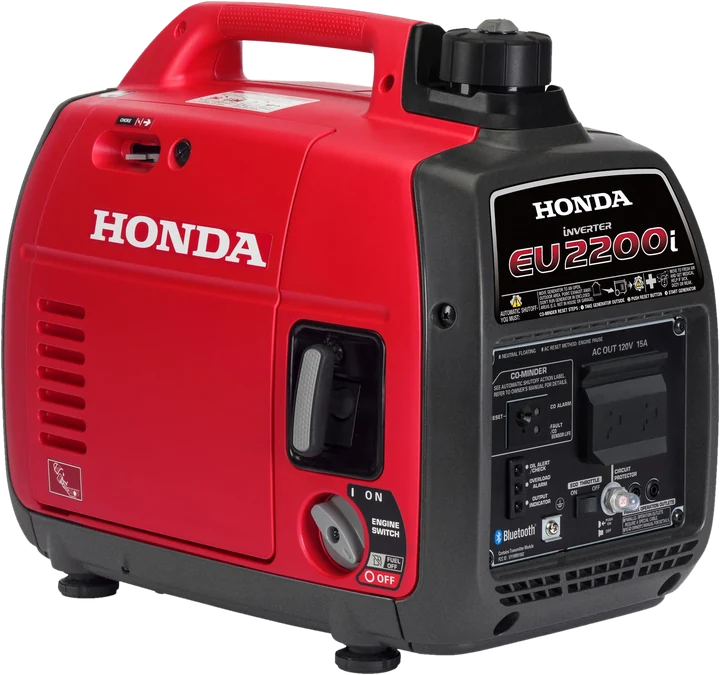
Honda claims
The catch is size, which is exactly what this page's reader worries about. It makes
We'd buy it for a short list and close neighbors: the fridge, the furnace and little else. Our gas furnace guide picks it for exactly that quiet household. If you came here for the most watts for the money, it's the wrong machine, and the iGen5000DFc is the right one. Our EU2200i review covers the quiet-nights buyer, and our battery and generator guide pairs it with a power station.
Generac iQ5200 DF : bonded on paper, unproven in practice
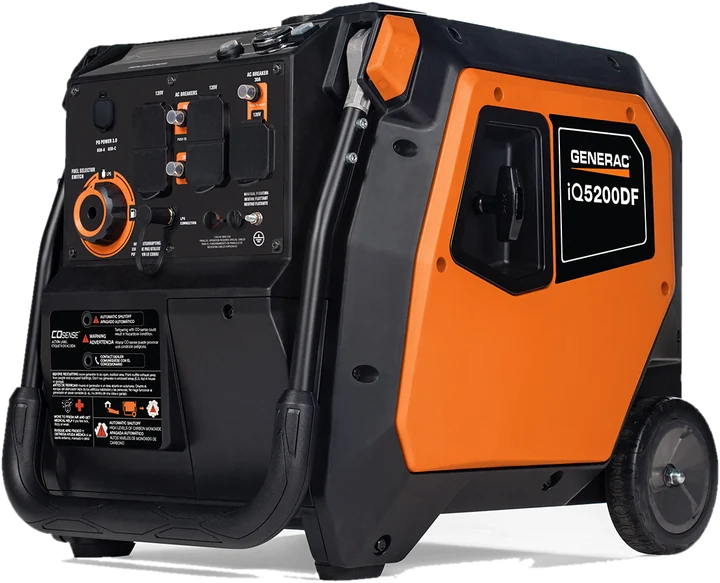
On paper this is the machine a cord-connected furnace wants. Generac promises under 3% distortion and states plainly on its spec sheet that the neutral is bonded. It claims
Here is what we don't know. No lab has put a meter on this exact 49-state model, and we found no record of a furnace lit from one. Wirecutter's test unit was the 50-state CARB model 8947, not this 8945. The owner evidence is thin too: of 165 reviews on its Lowe's page, only ten clearly belong to the iQ5200. One describes a unit that failed after a month, with the nearest authorized repair shop 102 miles away. Another, whose review doesn't say whether it is the 8945 or the CARB 8947, was asked to pay labor upfront for a unit that arrived dead on propane.
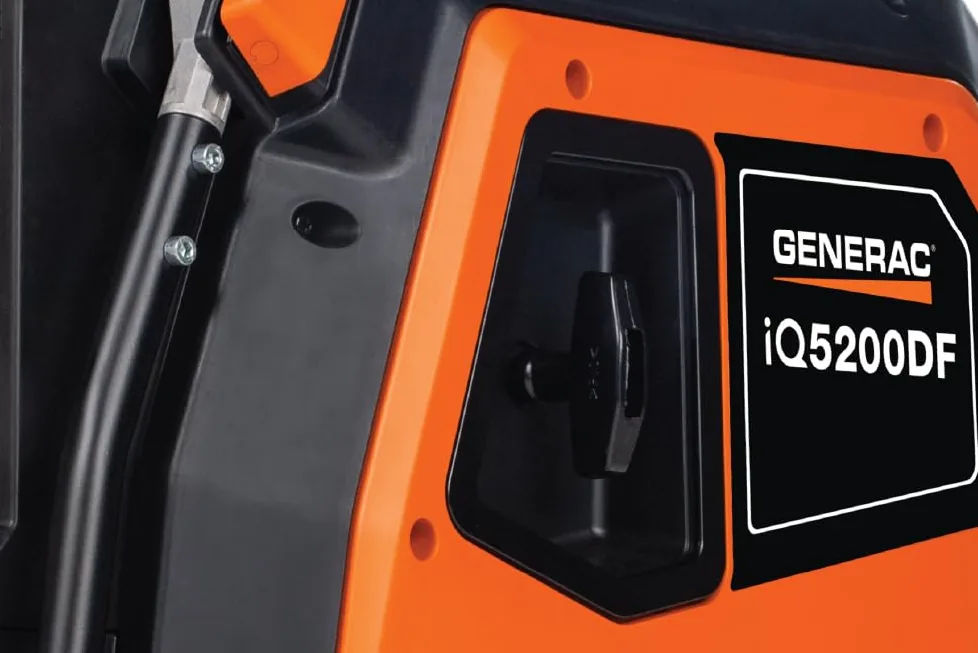
So every promise that matters here is still Generac's own. It isn't a pick on this page. Our gas furnace backup guide, our home backup generator guide and our
Westinghouse WGen9500DFc: 9,500 W on paper, and up to 23% distortion by its own figure
On the box it's a lot of machine:
Do you need the open frame's extra watts?
Only if you need
Skip it for a furnace and electronics. For that job on
Champion 201175: clean power at 240 V , for a different buyer
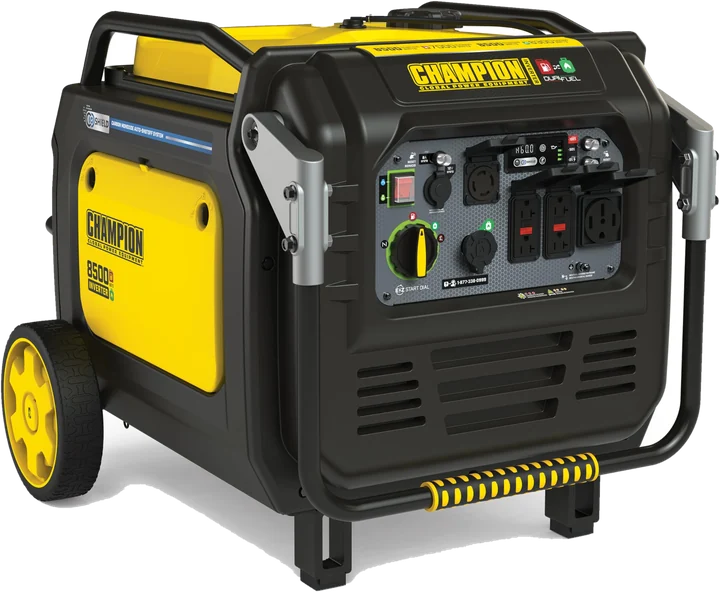
Champion makes the most complete promise here. It offers under 3% distortion, a bonded neutral, 120/
For a furnace and a short
Will the generator hurt anyone?
Where should the generator sit?
Carbon monoxide is the danger that kills, and distance is your defense. CPSC wants the generator in open air, twenty feet or more from your walls, with its exhaust aimed away. Never put it in a garage, basement, crawlspace, shed, porch or carport. Opening doors and windows does not make a garage safe. CPSC counts nearly 100 US deaths a year from generator carbon monoxide. Every generator here has a CO shutoff. Every manual that addresses it, Champion's and Generac's included, says the shutoff doesn't replace indoor CO alarms. CPSC wants battery-backed, interconnected alarms on every level.
How should it connect to the house?
Through a proper switch, fitted by an electrician. Generac's manual points you to a manual transfer switch and a qualified electrician to put it in. Honda's says only a qualified electrician should connect it, with the generator isolated from utility power. Tell the electrician whether your neutral is bonded or floating. That decides the switch. Per Trystar's reading of the code, a bonding plug added to a setup that already bonds at the panel creates a second, unwanted path.
Our pick: Westinghouse iGen5000DFc
The open frame is rated for far more watts, and Westinghouse is honest about what they cost in power quality. Buy the inverter instead, and let your house panel do the bonding. The iGen5000DFc is the inverter here with independent proof behind its rated output, and the one under $1,000. Book the electrician for the inlet box and interlock before the storm rather than during it, check the model label when the generator arrives, and keep it a long way from the back door.
The evidence in full
Research count for this page: 5 models weighed; 6 maker manuals among them; across this site's research, 589 sources kept in full.
Distortion, neutral and noise for all five
| Generator | Type | Maker's distortion | Neutral | Maker's noise figure | Measured noise | Output |
|---|---|---|---|---|---|---|
| Westinghouse iGen5000DFc | Inverter | Under 3% | Floating (DFcv edition's manual) | "As low as" | Never above | |
| Generac | Inverter | Under 3% | Bonded | None found | Not measured | |
| Champion 201175 | Inverter | Under 3% | Bonded | Not measured on a confirmed unit | 120/ | |
| Honda EU2200i | Inverter | None found | Floating | |||
| Westinghouse WGen9500DFc | Open frame | Up to 23% | Bonded | None found | Not measured | 120/ |
Who measured what
| Generator | Evidence on the exact model | Sibling or unconfirmed evidence (labelled, not used for a call) |
|---|---|---|
| Westinghouse iGen5000DFc (4523) | Wirecutter ran the exact DFc at low, medium and heavy loads with workshop and household appliances, and reports that it delivered rated power, stayed at or below | Running watts, propane watts, grounding and temperature range come from the iGen5000DFcv manual (DFc with wheel-and-handle kit). The DFc's own manual was not obtained. Lowe's review pool mixes the iGen4500 and iGen5000 families. |
| Generac | Generac spec sheet A0006743922 and owner's manual: under 3% distortion, "Neutral Bonded to Ground: Yes", | Wirecutter's test unit was the 50-state CARB model 8947. In its write-up the unit handled large loads, including a pressure washer switched on and off near capacity; its testers struggled to pull-start it on several occasions while the electric start worked; the propane hose blocks the outlet above it. Wirecutter published no dB figures. A Lowe's review naming only "iQ5200", with no 49-state or 50-state detail, describes a unit dead on propane and a shop that wanted labor paid upfront; we treat it as an unconfirmed unit. Two more syndicated reviews with no model named describe propane failures. |
| Westinghouse WGen9500DFc (9523) | Maker manual and store page only. No independent test found, including of its rated output. | Bob Vila on the WGen9500DF (no CO sensor): |
| Champion 201175 | Maker page and manual. Lowe's owners (231 reviews): prompt starts at freezing on propane and only three problem reports (oil use after a year with a backed-up repair network; overloads near its limit; a proprietary propane quick-connect). | The Solar Lab and Signature Solar reviewed a Champion |
| Honda EU2200i (EU2200ITAN) | Manual: neutral floating, "The system ground is not connected to the AC neutral wire". Johnny's Weekends (current CO-MINDER and Bluetooth unit, 2021, sponsored by Generator Bible): | Furnace start on a new "Honda EU 2200" whose app suggests the EU2200i Companion: stopped partway with a polarity error without a bond, ran with a bonding plug. Fuel-use videos did not show the model suffix. |
Where the furnace explanation comes from
- Goodman GR9S80/GD9S80 specifications list "REVERSED LINE POLARITY OR GROUNDING ERROR" among board faults; Rheem FG6T technical specifications say diagnostic flashes identify improper ground and polarization.
- Owner and installer furnace starts on floating sources (two power stations and the Honda above) all failed at ignition until a bond was added by a bonding plug or a tie to the house panel ground. A furnace-only transfer switch did not supply the bond in The Chief's Way's setup. No exact-variant furnace start exists for any generator on this page.
- Trystar, citing the 2020 NEC (702.7(C) and 445.11): a non-separately derived connection works with a floating neutral that stays connected to the house panel; a bonded generator needs a switch that disconnects the neutral. The code also requires the maker to mark whether the neutral is bonded. Section numbers have changed across code editions, so check with your local inspector.
Disagreements that don't change the call
- Noise claims against measurements differ mainly by distance and load: Westinghouse's "as low as
52 dBA " (quarter load, no distance) against Wirecutter's80 dBA at5 ft under heavy load; Honda's48 dBA (no distance) against57 dB measured at23 ft . - Champion's under 3% against Signature Solar's scope trace showing some distortion under heavy load: open until someone measures a percentage on a confirmed 201175.
- Generac's web page lists "Liquid Propane or Natural Gas" as the fuel; the spec sheet and manual say gasoline or propane. We trust the manual. It does not run on natural gas.
Variant and retail notes
- The iGen5000DFc and the 49-state
iQ5200 DF (8945) are not sold in California. The CARB version of the Generac is model 8947, a separate product. - Lowe's item 6021833 is titled iGen5000DFc but its model field reads IGEN4500DFC, and one reviewer says he received the smaller iGen4500. Check the label on any delivery.
- The WGen9500DF (no CO sensor) is a different product from the WGen9500DFc, and Lowe's DFc review page mixes the two. Among the lowest-rated reviews there, 13 describe the engine running with no power output, 3 of them naming the DFc, one in a winter storm.
Recalls and safety notes
- CPSC lists no recall naming the iGen5000DFc, WGen9500DFc,
iQ5200 DF or Champion 201175. Generac's 2026 recall 26-407 covers GP-series models only. - Honda recall 20-090 (2020) covered EU2200i units with serials EAMT-1000001 to 2098790, sold February 2018 to January 2020, for an inverter short circuit with salt water; current CO-MINDER units carry later serials.
- Honda's manual says the CO-MINDER sensor has a finite life, warns as it nears the end, and is replaced through a dealer.
- The WGen9500DFc and
iQ5200 DF manuals both say a yellow CO-sensor light means a sensor fault that only an authorized service center or dealer can repair.
Sources
- Westinghouse iGen5000DFcv owner's manual (Home Depot
copy) (opens in a new tab) - Westinghouse iGen5000DFc product
page (opens in a new tab) - Westinghouse WGen9500DFc owner's manual (Lowe's
copy) (opens in a new tab) - Westinghouse WGen9500DFc product
page (opens in a new tab) - Generac
iQ5200 DF spec sheetA0006743922 (opens in a new tab) - Generac iQ3800DF / iQ5200DF owner's
manual (opens in a new tab) - Champion 201175 operator's
manual (opens in a new tab) Champion 201175 product page (opens in a new tab) - Honda EU2200i owner's manual
00X31-Z44-6100 (opens in a new tab) Honda EU2200i product page (opens in a new tab) - Goodman GR9S80 / GD9S80 furnace
specifications (opens in a new tab) - Rheem FG6T 80+ furnace technical
specifications (opens in a new tab) - CPSC: Winter storms aren't over, CO risks during outages
(2026) (opens in a new tab) - CPSC: American Honda generator recall
(2020) (opens in a new tab) - Trystar: Separately derived and non-separately derived portable generator
connections (opens in a new tab) - Wirecutter: The best portable
generator (opens in a new tab) - Bob Vila: Westinghouse WGen9500DF
review (opens in a new tab) - Johnny's Weekends: generator noise
comparison (opens in a new tab) - Computer Creationz: furnace on a Honda EU2200 with and without a bonding
plug (opens in a new tab) - Ray Loveless: why a furnace won't run on a
generator (opens in a new tab) - The Chief's Way: furnace on a power station, with and without a
bond (opens in a new tab) - Andy Lippold: iGen5000DFc owner
video (opens in a new tab) - Signature Solar: Champion
8500 W inverter on anoscilloscope (opens in a new tab) - Lowe's reviews: Westinghouse
iGen5000DFc (opens in a new tab) Lowe's reviews: Generac iQ5200 (opens in a new tab) Lowe's reviews: Champion 201175 (opens in a new tab)