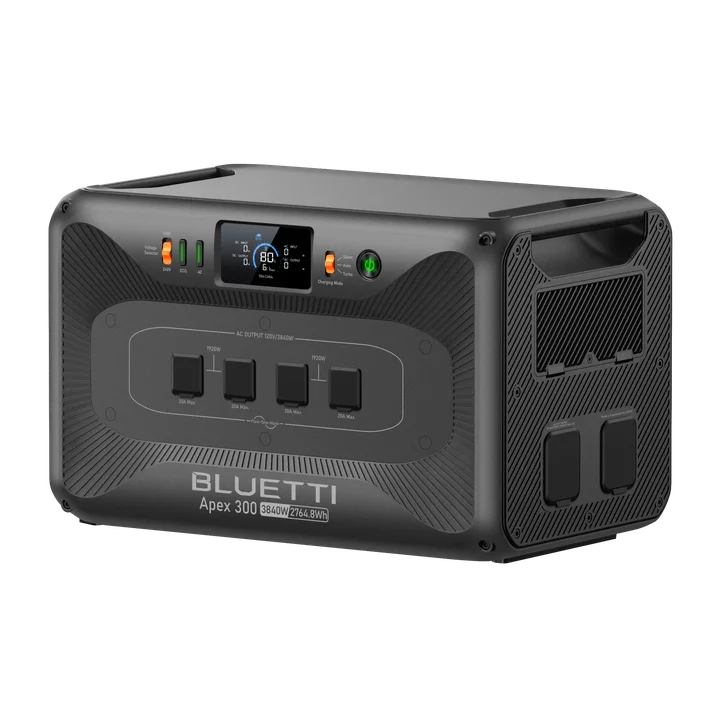
BLUETTI Apex 300 review for home backup: measured against the maker's claims
As an Amazon Associate I earn from qualifying purchases.
Porchlight's call on the BLUETTI Apex 300 is buy, for a house that wants one battery box, wired in by an electrician, to carry its essentials and a soft-started central AC at
- Who it’s forA house with an electrician-installed transfer switch or subpanel, backing up essentials and a soft-started central AC
- The catchEach
120 V leg carries only1,920 W , so a motor without a soft start can trip it
In the evidence table
Open the full row- Idle draw with the AC on
20 W measured- Usable energy, measured
2,480 Wh measured- Rated capacity
2,764.8 Wh claimed- Continuous output (gas: running watts)
3,840 W claimed- Surge (gas: starting watts)
7,680 W claimed240 V output- yesclaimed
- Neutral-ground bond
- not stated by the maker
- UPS switchover
16 ms measured
Most power stations need a second unit and a hub before they will make
What you get with the BLUETTI Apex 300
Think of it as an appliance with handles. It weighs
BLUETTI's manual asks for a dedicated two-pole breaker upstream and a licensed electrician to confirm the circuit. Take that literally. Wired wrong, a box that pushes
Day to day it is quiet and quick to refill: about two and a half hours from empty on the cable in the box, by three testers' clocks. For a house with an electrician lined up, we'd buy it.
BLUETTI's claims, and what testers actually measured
Every row is the US unit, model APEX300. None of these testers says BLUETTI paid for the review. Most don't say where their unit came from, and one used an early test unit.
| What BLUETTI promises | What testers got | Who measured it, and when |
|---|---|---|
| A | There's A Trick For That, Oct 2025; StorageReview, Nov 2026 | |
| Held | There's A Trick For That, Oct 2025 | |
| A large window AC with no soft start overloaded one leg; it started fine in | There's A Trick For That, Oct 2025 | |
| No one has measured a motor start against it | Not tested | |
| About | Paces of | The Solar Lab, Oct 2025; There's A Trick For That, Oct 2025 |
| StorageReview, Nov 2026; There's A Trick For That, Oct 2025 | ||
| Four fifths full in three quarters of an hour, on an optional heavy cable | CNET Labs, Aug 2026; There's A Trick For That, Oct 2025; The Solar Lab, Oct 2025 | |
| No efficiency figure | 66.63% round trip, wall to battery to outlet; 85% on discharge alone | CNET Labs, Aug 2026; The Solar Lab, Oct 2025 |
| No fridge figure | CNET Labs, Aug 2026; There's A Trick For That, Oct 2025 | |
| No light-load figure | A single bulb ran | Backyard Solar Project, early test unit, Jun 2025 |
| 6,000 cycles of battery life | Not tested; no one has owned one long enough | Not tested |
Will the Apex 300 start a well pump or an air conditioner?
Sometimes. Why it sometimes doesn't is the most important thing on this page.
The surge figure on BLUETTI's landing page,
The deeper limit is how it makes
Two real starts are on record, both feeding a subpanel at
No test in our evidence puts a well pump on an Apex 300. Against pump maker Franklin's generator sizing, one Apex 300 has room for a smaller
How long will it keep the fridge cold?
A day and a quarter to two days on the fridge alone, depending on the fridge. Full rundowns at heavy loads drew close to nine tenths of the labeled battery.
BLUETTI also prints a number most makers hide: about
One setting can spoil food. BLUETTI's manual says ECO mode is on out of the box and cuts the AC outlets after four hours of near-zero draw. It tells you to switch ECO off for a fridge or any small load. A fridge resting overnight can be unplugged by its own battery.
The weakest number is the round trip. CNET measured 66.63%: of every three units you put in, about two come back out. Charging losses and idle draw explain much of that. It is still low against CNET's other stations, and nobody knows why. Refill it from a gas generator and that loss is fuel you pay for; our page on pairing a home battery with a generator works through it. A house with nothing on
Will it keep a computer or CPAP running when the power goes out?
A computer, probably. A CPAP, untested. The manual promises
Will it run my gas furnace?
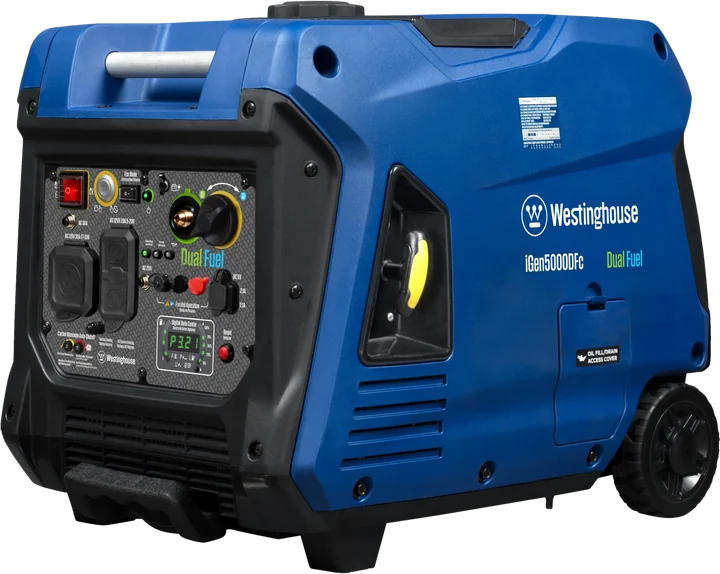
We don't know. A furnace's control board can refuse to light without the right neutral and ground arrangement. BLUETTI doesn't say whether the Apex 300 bonds its neutral; the manual covers only grounding the chassis. Nothing we found shows a furnace igniting on this unit. If the furnace is the reason you're buying, two of our guides answer it with other machines. For a hard-wired furnace outside California, our gas furnace guide sends you to an engine instead: the Westinghouse iGen5000DFc, connected to the panel by an electrician through an inlet box and interlock. For a household set on battery, our interlock-versus-transfer-switch guide backs the bigger Jackery Explorer
Living with it: weight, cold garages and support
With no wheels it is a two-person lift, though once wired in you won't want to move it. Keep it somewhere above freezing. The manual sets
The software needs watching. One licensed electrician wiring his own, with an add-on battery, found the app set to the European grid frequency. He fixed it before switching over. One RV owner fared worse. Two units arrived dead with a battery-protection fault, and a later overnight shutdown ended only after a firmware update that needed
The CPSC's recall listing, checked
Should you buy the BLUETTI Apex 300?
Yes, for the right house. It is one of the few single boxes that puts real
What separates its buyer is the soft start. A house that wants a single box strong enough to get a
Trust its manual over its landing page. Do that, and it is the box we'd buy to wire in for
The evidence in full
Research count: 1 models weighed; 1 maker manuals among them; across this site's research, 589 sources kept in full.
Who measured what
- CNET Labs (US site, article dated Aug 2026): round-trip efficiency 66.63%, which the lab itself called mediocre; fridge test
30.43 h ; AC recharge2.42 h , standard cable implied. CNET's method page wasn't found, so its method is inferred from its list page. How the unit was supplied isn't stated. - StorageReview (Nov 2026):
2,390 Wh delivered in its lab test; switchover16 ms on a Quarch analyzer in120 V mode, at idle and under load. The0 ms path in240 V mode was not captured. Its one-inverter-per-line description comes from testing, not a teardown. - The Solar Lab (US, Oct 2025): idle
20 W ; discharge efficiency 85%, method not stated;2.5 h to charge on the standard120 V cable. Found running120 V loads in240 V mode "finicky", and found the phone line sales-only. It says it buys many of its units and receives some free; which applies here isn't stated. - There's A Trick For That (US, Oct 2025): idle
16 W from the fall in charge over half a day with the inverter on, a pace rather than a rundown;2,480 Wh from a power meter at a heavy load into a charger; his kitchen fridge ran47.6 h ;2.49 h empty to full on the standard cable, and raising the app's input setting did not raise the charging rate; held4,300 W in240 V mode for about two minutes before shutting off; started his two-stage central AC, with its air handler running, with a Micro-Air soft start; the window AC with no soft start overloaded one leg in240 V mode and started in120 V mode; briefly ran a240 V induction burner and oven and started a gas dryer; a desktop PC stayed on with both kinds of UPS outlet. On generator pass-through, he saw it cut charging briefly to help start a compressor. - Backyard Solar Project (US, early test unit, Jun 2025): a single bulb ran
35.2 h to shutdown; the video's own energy caption is garbled, so we multiplied runtime by load ourselves. That run delivered less total energy than the heavy-load rundowns, consistent with idle draw taking a bigger share at light loads, which is what most home backup is. A heat pump ran in cooling with the load split across both lines; its electric heat strip tripped the unit, which needed a reset. Each solar input caps its current, so the2,400 W solar total is hard to reach with common panels. - The Solar Pit (US, Jun 2025):
53 dB while charging in Turbo from a240 V outlet; quieter in Standard; below the meter's floor in Silent. - Owners: Landers Electric, a licensed electrician in San Diego, installed an Apex 300 with a B300K add-on through a Reliance transfer switch to a critical-loads subpanel (Mar 2026). Beer Money Cycle Works reported six months of RV use: BLUETTI replaced the first faulty unit and offered a refund, and the second recovered after days on solar and shore power. Both are single reports.
- Well pump sizing: the three-quarter horsepower line comes from setting the Apex 300's per-line and total output against Franklin's generator sizing by pump horsepower. It is an inference, not a measured pump start.
Where sources disagree
- Efficiency. CNET's round trip includes charging losses and idle draw; the discharge-only figures do not. That explains part of the gap, but CNET's figure is still low against its other stations, and whether the unit, its firmware or the test setup is responsible remains open.
- Surge. The landing page ties
7,680 W to "high startup power demands"; the manual limits it to resistive loads. No motor-surge rating is published. Open. - Charge speed. The fast figure needs the optional
TT-30 orL14-50 cable into the P050A port; the standard cable caps charging well below Turbo. Explained. - Switchover.
0 ms depends on mode and outlet, per the manual. Explained. - Solar. BLUETTI's larger solar figures are system totals across three linked units with add-on chargers; one box takes
2,400 W through its own inputs. Explained. - Capacity. Popular Science quoted the battery with one B300K add-on counted in. The base unit is
2,764.8 Wh . Explained.
Kept apart
- The European, UK and Australian Apex 300 versions use different outlets and a different switchover; no measurement on them is used here.
- Apex 300 bundles with B300K or B500K batteries add capacity to the same unit; results from bundle installs are labeled.
- The older AC300 and AC500 are inverter-only boxes with no built-in battery, and a single AC300 had no
240 V . - The Apex 200 is a new sibling and wasn't researched.
What isn't known
- A measured motor start, locked-rotor figure or well-pump start on this unit, with or without an add-on battery.
- Whether the neutral is bonded in
120 V mode,240 V mode or on a transfer switch; no furnace test. UL 9540 orUL 1741 listing status, which wasn't checked.- Generator auto-start support.
- The warranty term: reviewers report five years, not confirmed on BLUETTI's own page in this research.
- Owner experience at scale, since Reddit and BLUETTI's forums couldn't be read.
- No sump pump or CPAP test.
Sources
- BLUETTI Apex 300 User Manual, US
(V3.1) (opens in a new tab) - BLUETTI: Apex 300 home backup
power (opens in a new tab) CPSC recall listing (opens in a new tab) - CNET Labs: Best portable power
stations (opens in a new tab) - StorageReview: BLUETTI Apex 300
review (opens in a new tab) The Solar Lab: BLUETTI Apex 300 (opens in a new tab) - There's A Trick For That: BLUETTI Apex
300 (opens in a new tab) - Backyard Solar Project: BLUETTI Apex
300 (opens in a new tab) The Solar Pit: BLUETTI Apex 300 (opens in a new tab) - Landers Electric: Apex 300 home
install (opens in a new tab) Beer Money Cycle Works: Apex 300 (opens in a new tab) - Beer Money Cycle Works: Apex 300
update (opens in a new tab) - Popular Science: Best portable power
stations (opens in a new tab)