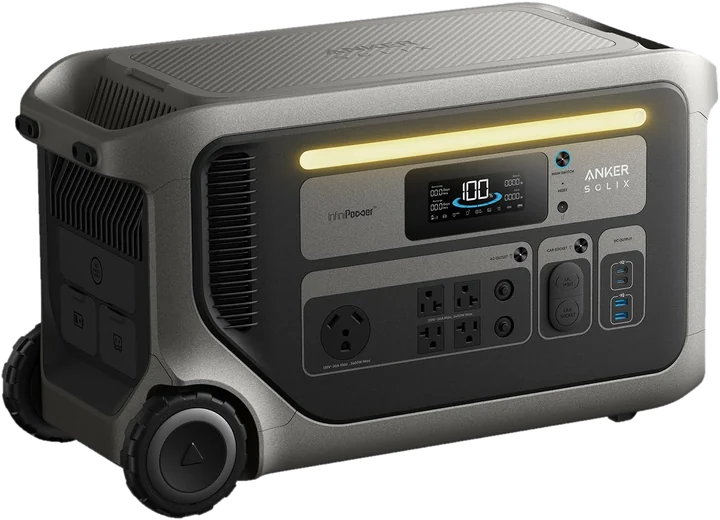
Anker SOLIX F3800 Plus review for home backup: measured against the maker's claims
As an Amazon Associate I earn from qualifying purchases.
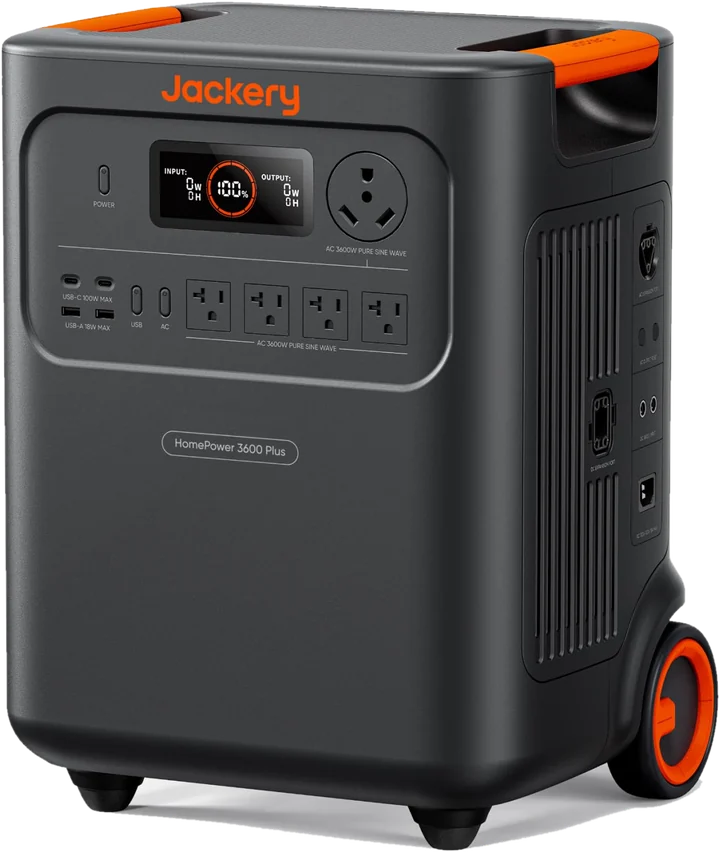
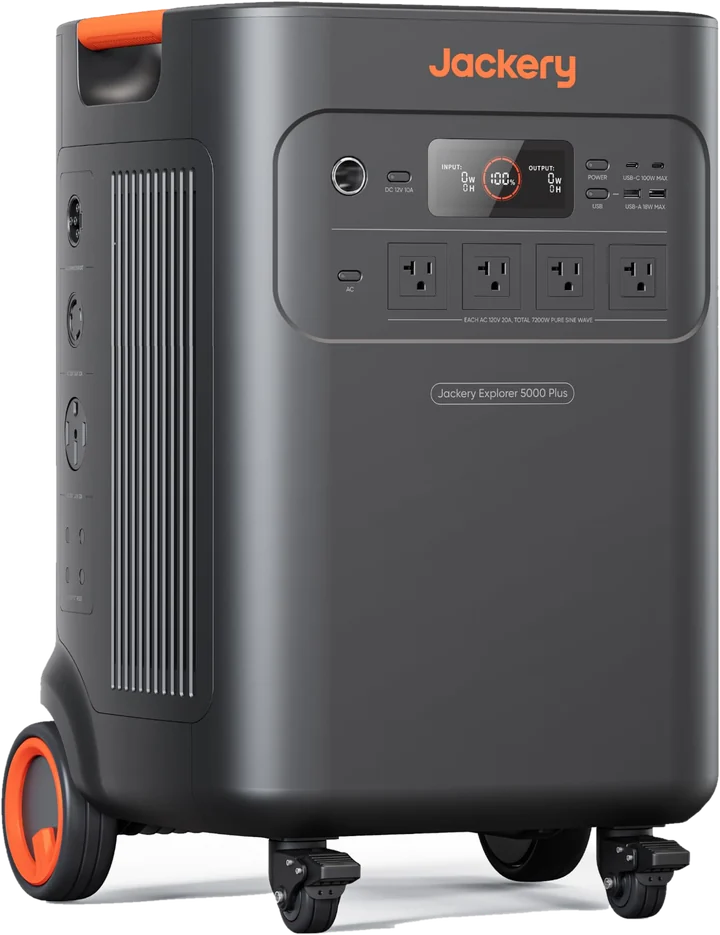 Jackery Explorer
If the job is a double-breaker pump or central AC, the Jackery Explorer
Porchlight's call on the Anker SOLIX
- Who it’s forHouses whose deep-well pump or central AC sits on a double breaker, wired in through a transfer switch or Anker's panel and refilled from a
240 V generator - The catchNo measured pump or compressor start on this model, and heavy overhead on a lab's fridge test
In the evidence table
Open the full row- Idle draw with the AC on
40 W measured- Usable energy, measured
3,235 Wh measured- Rated capacity
3,840 Wh claimed- Continuous output (gas: running watts)
6,000 W claimed- Surge (gas: starting watts)
- not measured
240 V output- 120V/240V split-phase from one unit (NEMA
L14-30R , 25A)claimed - Neutral-ground bond
- not stated by the maker
- UPS switchover
20 ms claimed
Anker did something almost no maker in this field does. It printed a motor-start rating for the SOLIX
What owning the Anker SOLIX F3800 Plus is like
It is a
Getting it into the house is an electrician's job. It connects through a transfer switch, an inlet box or Anker's own Home Power Panel. The one reviewer who fitted the panel and two extra batteries needed a certified technician, and the bill ran to five figures. Testers call it quiet, though nobody published a decibel figure. The app matters only for firmware updates.
The annoyances are in the fine print. The twist-lock
The one long-term owner in our evidence came through three outages in about a year. Each ended the same day. After the update, the app's runtime estimate roughly doubled. That's one home's story, but a calm one. This is a machine for a house that can give it a permanent spot and an electrician's afternoon. For now, our call is wait.
The F3800 Plus : what Anker claims against what testers measured
Every figure is for the US model, A1790P. Results for the original F3800 (A1790) are left out; it is a different machine.
| What you'd ask | Anker claims | What testers got | Who measured, when | Unit supplied by |
|---|---|---|---|---|
| How much energy can I use? | Silver Cymbal, Apr 2025 | Not stated | ||
| Will it carry a big | A | Silver Cymbal, Apr 2025 | Not stated | |
| Is the power clean? | No figure | 3% voltage distortion | Silver Cymbal, Apr 2025 | Not stated |
| Will it start a motor? | No pump or compressor start measured | Nobody yet | n/a | |
| Surge rating? | None published | Not measured | Nobody yet | n/a |
| What does it burn doing nothing? | Update "reduces idle consumption by 50%" | 50% of the battery a day at launch; 25% after the update | Silver Cymbal, Apr 2025 | Not stated |
| How long on a fridge? | No claim | CNET Labs, Jul to Aug 2026 | Not stated | |
| How fast from a | The Solar Lab, Mar 2025 | Not stated | ||
| Same question, second tester | As above | Silver Cymbal, Apr 2025 | Not stated | |
| Switchover on the outlets | Not measured | Nobody yet | n/a | |
| Switchover through the Home Power Panel | Felt faster; not timed | Android Authority, May 2025 | Anker (video sponsored) | |
| Any recall? | n/a | None found in the CPSC listing | Checked | n/a |
Will it start my well pump?
On paper, it is the most honest answer in the field. Anker's US user guide says the box can start a motor drawing up to
Two things keep it a promise. The guide never says whether
How long will it keep my fridge cold?
CNET's full-size fridge ran for
Did the firmware update fix the idle drain?
At rest, yes. At launch the
What nobody knows is whether the fix helps a load that cycles, like a fridge. CNET's write-up doesn't name the software version. So its heavy overhead could be old firmware, or a limit the update never touched.
How fast does it refill from a generator?
Slower than Anker's footnote implies. The footnote promises the full
What we don't know yet
There is no surge figure and no measured motor start. Nobody knows whether neutral and ground are bonded on battery. That decides whether some gas furnaces will light on it. There's also no cold-charging limit, no decibel reading, and no metered idle figure in watts after the update. Owner evidence is thin. On safety, the CPSC listing shows no recall for any Anker SOLIX power station. Until those blanks fill in, our call stays at wait. Anyone counting on it to light a furnace has the most reason to hold off.
Our call on the Anker SOLIX F3800 Plus : wait
If the start test comes back clean, this would suit a house whose deep-well pump or central AC sits on a double breaker. It would be wired in through a transfer switch or Anker's panel, and refilled from a
What to do now
Watch for that start test. No tester in our evidence has one scheduled, so there is no date to circle. Your outage season may arrive first. If the job is a double-breaker pump or central AC, the Jackery Explorer
Anker has printed the right number. Now someone has to hold a pump to it.
The evidence in full
Research behind this page: 1 models weighed; 0 maker manuals among them; across this site's research, 589 sources kept in full.
Identity. The US model code is A1790P. The original F3800 is A1790; Anker's own comparison lists it with no generator bypass, lower solar input via
Anker's spec page and FAQ (read
Anker's US user guide (A1790P_UG_EN_V2,
Silver Cymbal (YouTube, Apr 2025). Unit source not stated. Idle test: AC inverter on, no load,
The Solar Lab (Mar 2025). Unit source not stated for this review; the lab says it buys many units and receives some free.
CNET Labs (Jul to Aug 2026). Full-size fridge run of
Android Authority (Jonathan Feist, May 2025). Unit supplied by Anker; the accompanying video was sponsored by Anker. Installed with the Home Power Panel and two BP3800 batteries, backing up an office, fridge and furnace; a certified technician was needed and the install cost ran to five figures. Panel switchover is rated
One owner (Bertel King, Yahoo Tech, Jul 2025). About a year of ownership, three outages each restored within the day. Reports idle drain before the update quoted at
Look-alike, not counted (Benjamin Sahlstrom, YouTube, Nov 2023). The original F3800 (A1790), on a whole-house interlock, started a well pump and a central heat pump at
Disagreements that don't change the call. Idle versus efficiency: Silver Cymbal measured the idle loss halved after the update, while CNET's later fridge test still found heavy overhead. Possible reasons: CNET ran launch firmware, the fix only helps at zero load, or the units differ. Unresolved. Generator tiers: Anker's footnote says one expansion battery unlocks
Recall. The CPSC recall listing downloaded
Gaps. Surge rating; a measured well-pump or central air start on the Plus; whether
Sources
- Anker SOLIX
F3800 Plus : specs, comparison andFAQ (opens in a new tab) - Anker SOLIX
F3800 Plus user guide (A1790P_UG_EN_V2,2025-05-12 ) (opens in a new tab) - Anker: Increase
F3800 Plus standby time with the latest firmwareupdate (opens in a new tab) CPSC recall listing (opens in a new tab) fccid.io search for 2AOKB-A1790P (opens in a new tab) - Silver Cymbal: Anker SOLIX
F3800 Plus test(YouTube) (opens in a new tab) - The Solar Lab: Anker SOLIX
F3800 Plus review(video) (opens in a new tab) - The Solar Lab: Anker SOLIX
F3800 Plus review(written) (opens in a new tab) - CNET: Best portable power
stations (opens in a new tab) - Android Authority: Anker SOLIX
F3800 Plus review (opens in a new tab) - Yahoo Tech: One software update fixed the biggest problem with my power
station (opens in a new tab) - Benjamin Sahlstrom: original Anker SOLIX F3800 whole-house test
(YouTube) (opens in a new tab)