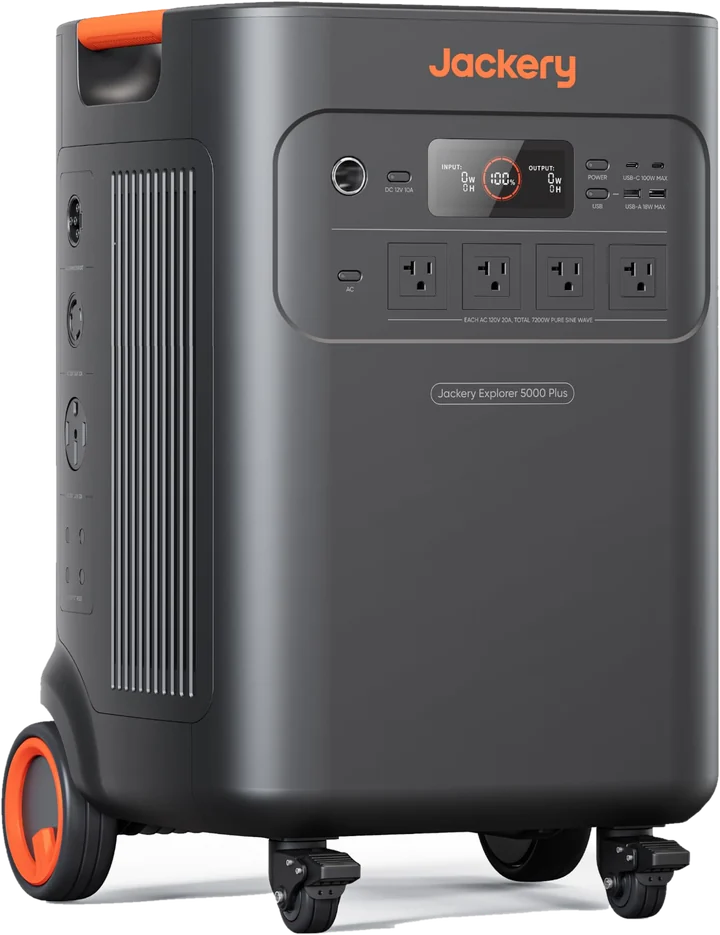
Jackery Explorer 5000 Plus review for home backup: measured against the maker's claims
As an Amazon Associate I earn from qualifying purchases.
Porchlight's call on the Jackery Explorer
- Who it’s forHomes that want a well pump and essential double-breaker circuits back the instant the grid drops, with no engine running, installed through Jackery's Smart Transfer Switch
- The catchA portable generator can refill it only through its household-voltage input at
1,750 W , so long-outage top-ups are slow
In the evidence table
Open the full row- Idle draw with the AC on
58 W measured- Usable energy, measured
4,374 Wh measured- Rated capacity
5,040 Wh claimed- Continuous output (gas: running watts)
7,200 W claimed- Surge (gas: starting watts)
14,400 W claimed240 V output- yes, single unitclaimed
- Neutral-ground bond
- floating (no ground-neutral bond)measured
- UPS switchover
20 ms measured
The Explorer
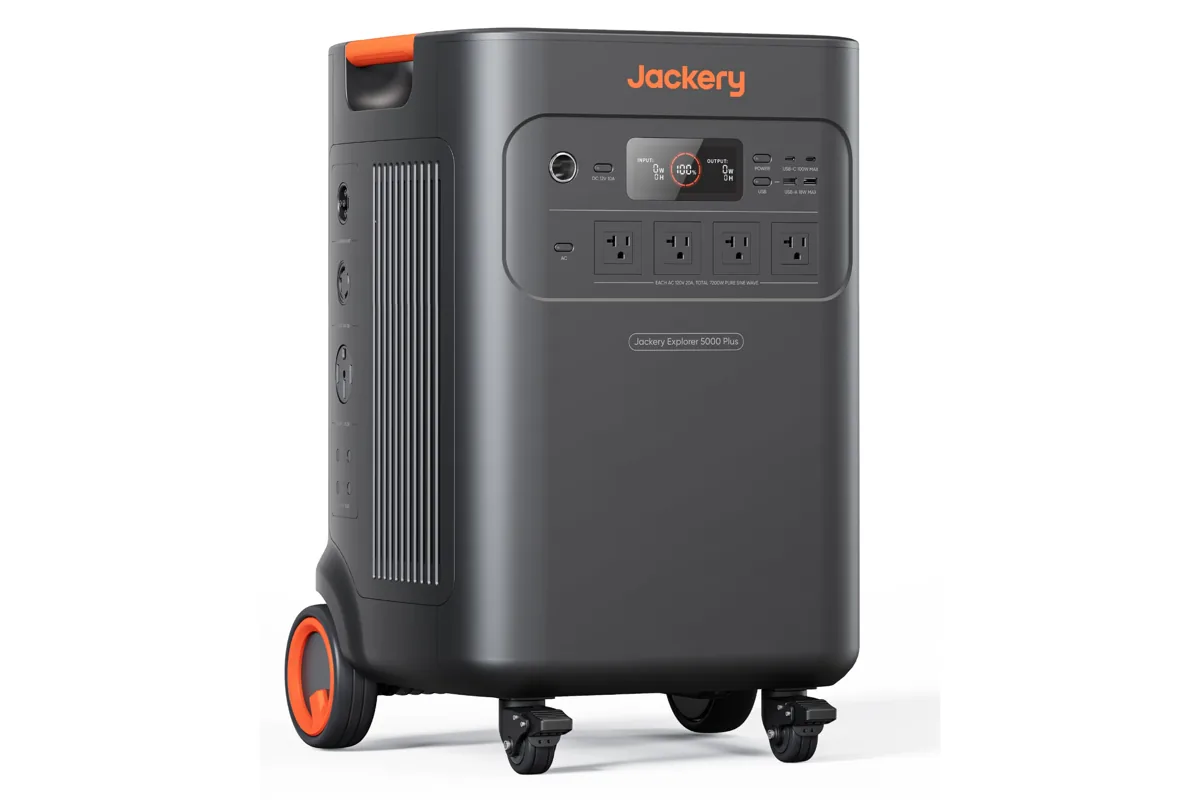
What the Jackery Explorer 5000 Plus is, and what it's like to own
It's a
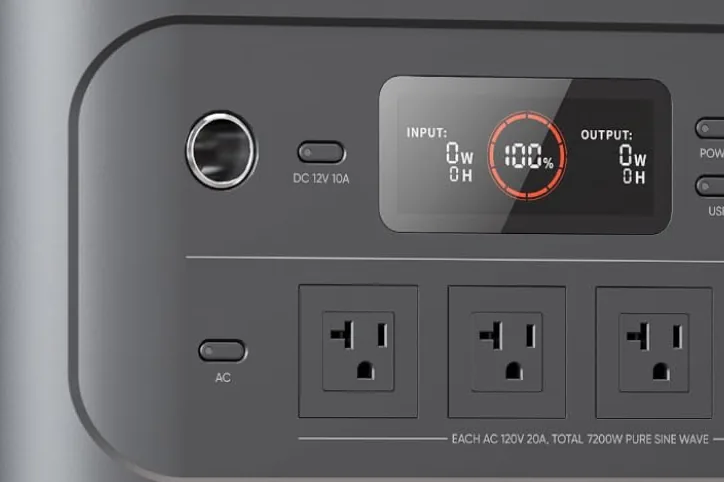
It's built to sit beside your breaker panel and feed Jackery's Smart Transfer Switch. That subpanel takes a dozen single-breaker circuits or six double-breaker ones. It swaps them over by itself when the grid drops. It's also the only way to charge the unit from the house's split-phase supply.
Once it's in, it mostly disappears. Testers call it quiet even near full output. Compare it with the other split-phase units in our whole-house battery backup guide. For a house with a well and a panel to feed, we'd buy it.
Jackery's claims against the measurements
Every figure comes from a tester working on the US model, JE-5000A.
| What Jackery claims | What was measured | Who measured it, and when | Who paid for the test |
|---|---|---|---|
| ReeWray Outdoors, Sep 2026 | Not stated | ||
| Just under | ReeWray Outdoors, Sep 2026; Herb-O-Matic, Oct 2026 | Not stated | |
| The Solar Lab, Apr 2025 | Not stated for this unit; the lab says it buys many units and receives some free | ||
| The Solar Lab, Apr 2025; ReeWray Outdoors, Sep 2026 | Not stated | ||
| "True 0ms UPS" headline; manual: under | About | The Solar Lab, 2025; GearDiary, Sep 2026; Will Prowse, Nov 2024 | GearDiary: paid by advertising, unit supplied; others not stated |
| About | The Solar Lab, Apr 2025 | Not stated | |
| Fan up to | A peak well above that at full output in a hot room | ReeWray Outdoors, Sep 2026 | Not stated |
| No neutral-ground spec in our evidence | Floating neutral: EV chargers balked until a bonding plug was added | ReeWray Outdoors, Sep 2026; Will Prowse, Nov 2024 | Not stated |
| No motor-start claim in our evidence | Started a | GearDiary, Sep 2026; ReeWray Outdoors, Sep 2026; The Solar Lab, Apr 2025 | GearDiary as above; others not stated |
Jackery deserves credit. The plain figures mostly survived the meters, and the wall charge finished early. The two that fall apart are the two on the banner.
Will it start my well pump?
Yes, for a
The headroom is what reassures us. Testers ran the full
Unheated well houses need a warning. The manual says it won't charge below 32°F. In its coldest running band, it cuts output to
Will it run my central air?
Probably, though this is the shakier of its two big jobs. One tester got a 3-ton central system going, fed by a hand-thrown switch, with no trip. Another started an AC compressor. A third could not start its own AC. Those tests were more than a year apart on different compressors. Nobody stated the firmware, so that failure is still unexplained.
The surge figure is the heart of it. Jackery's
How long will it keep my house going?
Less than "
The series page promises up to
Refilling is the real catch. There's no split-phase generator inlet. A portable generator can only feed the household-voltage input, at
Will my lights blink when the power goes out?
Barely, if the transfer switch is in UPS mode. Testers measured about
The "0ms" headline belongs to the manual's Online UPS mode. It serves only the four household outlets, and only while they share no more than
Is it safe to wire into my house?
It passed every safety check we could make, but the wiring needs care. Its outputs have a floating neutral: neutral and ground aren't tied together inside. Two testers' EV chargers balked until a neutral-ground bonding plug was added. The GearDiary owner reports that Jackery requires a neutral-switching transfer switch.
That matters for a gas furnace, because some furnace boards check for the neutral-ground tie before they light. Nobody has run this unit on a furnace yet. Whether the furnace sees the house's own bond comes down to how the box meets your panel. Our guide to generator interlocks versus transfer switches works through that wiring, and it backs this box for keeping a furnace lit when fed in the way it describes.
A search of CPSC's recall records on November 13, 2026 turned up nothing for Jackery. Jackery's own US page warns against powering medical or life-support equipment with its stations. It also tells anyone with an implanted pacemaker not to use them.
What do owners come to dislike?
The software, mostly. The GearDiary owner found the app needs a cloud account and explains its settings poorly. After a dropped connection, the unit had to be restarted to rejoin
Should you buy the Jackery Explorer 5000 Plus ?
Yes, if your house runs on split-phase loads and the box goes in properly at the panel. Five separate testers and owners have measured this exact US model. The plain numbers on its box mostly survived their meters. Central air is the less certain job: one 3-ton system started, and one other AC didn't. This is the box for someone who wants the well, the cooling and the big circuits back by themselves, with no engine to start and no standby install. A split-phase house can ride a long outage on it too, as long as you'll refill it from a generator or solar panels. Just plan for that refill to come at the pace of a kitchen outlet.
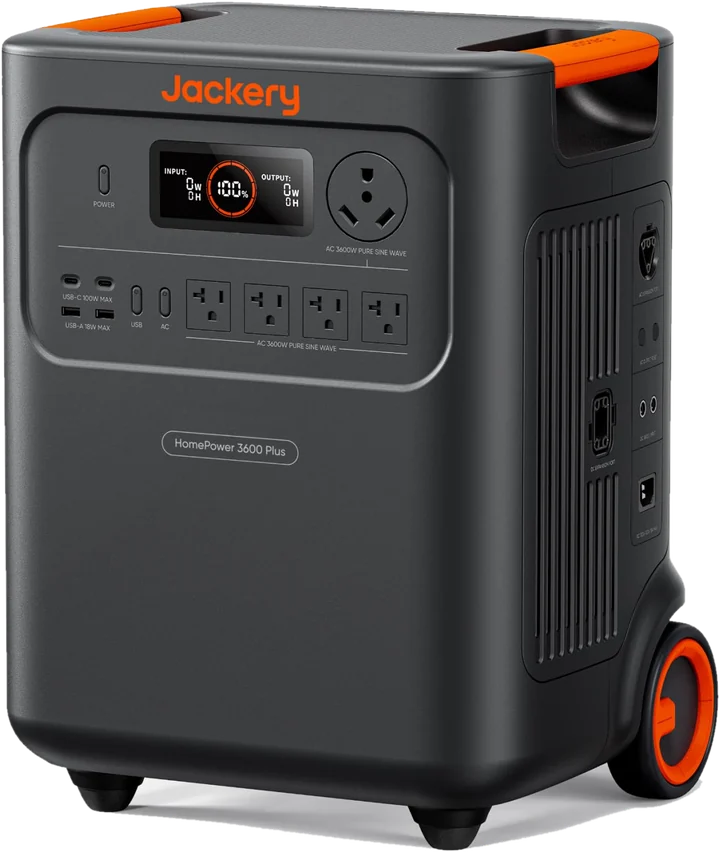
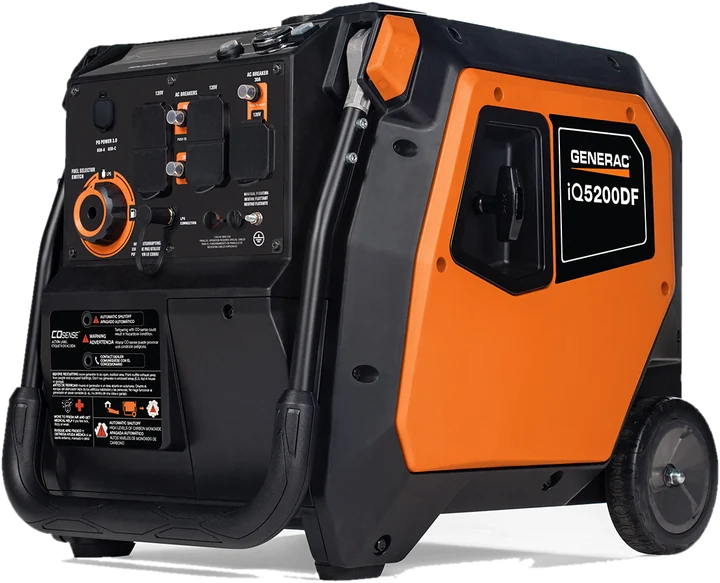
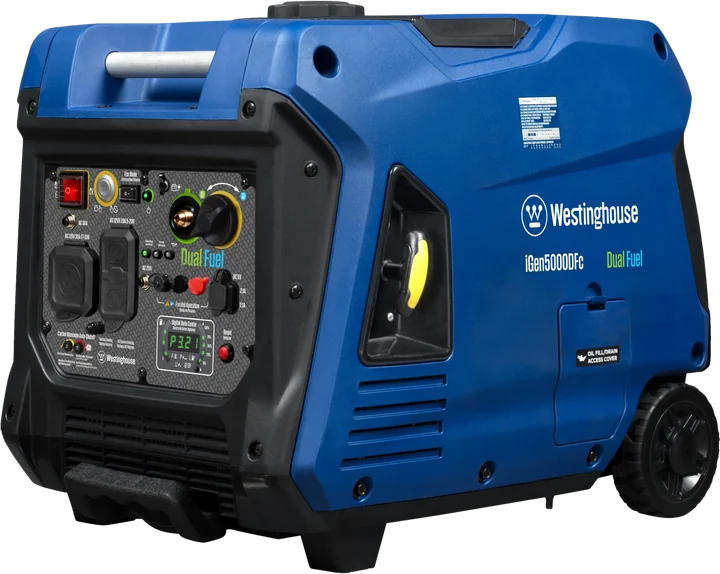
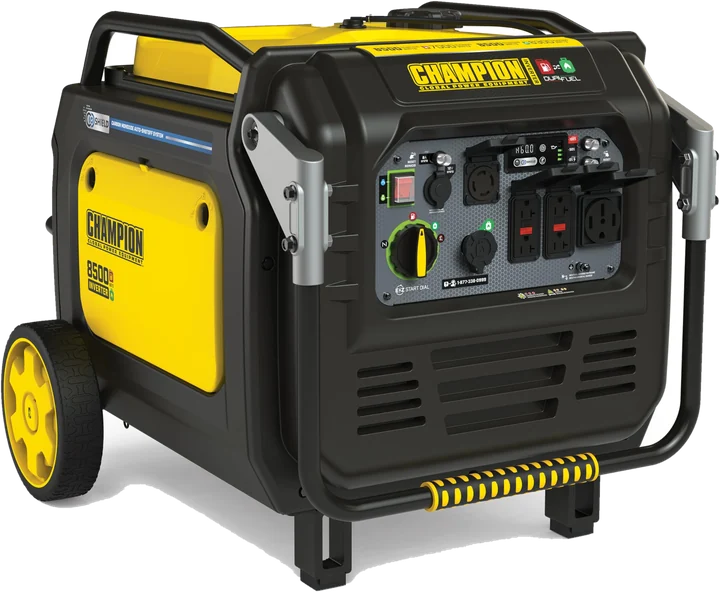
Four other buyers should look elsewhere. The first wants a pump on a generator. If you'd rather wire a gas or propane engine to your panel to run the well, you're shopping for a generator, not this battery, and our well-pump guide is the place to size one against Franklin's table. The second runs only single-breaker circuits from a generator. A house outside California with nothing split-phase, feeding its furnace, fridge and lights through a wall inlet and a breaker interlock, is the reader our generator guides send to Westinghouse's iGen5000DFc. The third needs very little. Some homes only want a cold refrigerator, a few lamps and a live router through a one-to-three-day outage, all plugged into plain household outlets. That's the reader our home page sends to Jackery's smaller HomePower
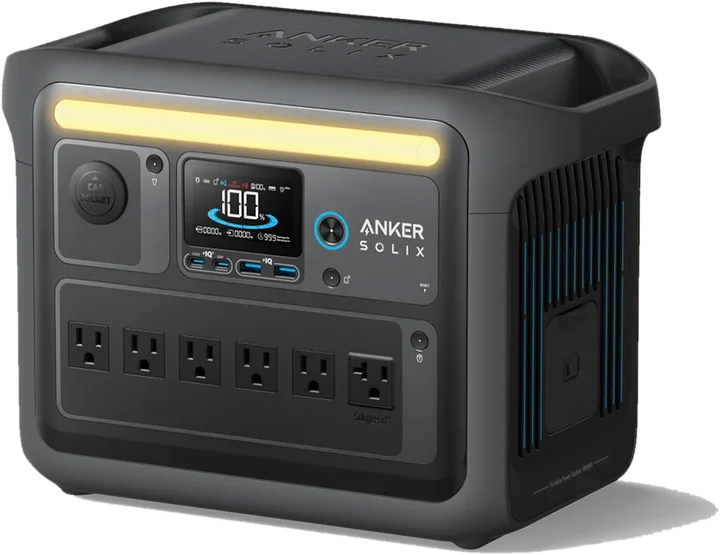
Weighing Anker's split-phase box too? See our Explorer
It's a better battery than its banner, which is the right way round. For a house with a well and a split-phase panel to keep alive without an engine, we'd buy the Explorer
The evidence in full
Every result below comes from the US model, JE-5000A. The HomePower
| Tester | Date | What they measured | Funding as disclosed |
|---|---|---|---|
| The Solar Lab (video) | Apr 2025 | Wall charge | Not stated for this unit |
| The Solar Lab (transfer switch article) | 2025 | Switchover through the Smart Transfer Switch about | Not stated |
| ReeWray Outdoors | Sep 2026 | Not stated | |
| Will Prowse | Nov 2024, launch unit | "Dead silent" near full rated output; Tesla mobile connector refused it for grounding; transfer switch switchover about | Not stated |
| Herb-O-Matic | Oct 2026 | Started an AC compressor ( | Not stated |
| GearDiary (M Thorne) | Sep 2026, about four weeks of use | Real install: | Site paid by advertising; review product supplied |
| Snowstead | Mar 2026 | Well pump cycled normally beside a dryer, fridge, lights and internet through a Jackery transfer panel; no pump size, voltage or current given | Sponsored by Jackery |
| Brian's Farming Videos | Mar 2026, one year in a barn | Won't charge in freezing weather; kept in a box with a pet heat pad; otherwise ran lights, a blower and tank heaters for a year | Jackery partner |
Manual details moved from the main text
- The split-phase outlets can't be used in bypass while the unit charges from an ordinary wall outlet, which matches what Herb-O-Matic saw. With a wall-charged unit, grid power reaches only the household outlets.
- The
14,400 W surge is the sum of two halves, each rated3,600 W continuous and7,200 W surge. - In its coldest discharge band, the manual cuts output to
3,600 W . - The warranty is 5 years standard.
Disagreements and how they resolve
- Switchover. About
20 ms (The Solar Lab; GearDiary with UPS mode on) against about3,000 ms and a failed takeover (Will Prowse, launch unit). GearDiary's mode-dependent timings explain part of the gap. Will Prowse did not mention the switch's UPS setting. Whether launch firmware was fixed is open. - "0ms" against the manual. The
0 ms figure is Online UPS on the four household outlets only. The default Backup UPS is under20 ms , and Jackery's own FAQ gives20 ms through the transfer switch. Explained by mode. - Surge. Jackery claims
14,400 W . The Solar Lab held9,500 W for about 20 seconds, and ReeWray's trip just past the rated7,200 W came after about2 minutes . Both were sustained overloads, not instantaneous surges, so neither tests the claim directly. Explained by test type. - Central AC. ReeWray started a 3-ton unit. The video's translated captions once say 4-ton, but the title says 3-ton. The roughly
74 A figure he shows on screen is the compressor's locked-rotor nameplate value, not a measured inrush; he says the app was too slow to catch the start, and soft start is not mentioned. The Solar Lab's failed start was on an unstated AC size, with its own surge estimate. Open. - Idle draw. Jackery's
50 W , The Solar Lab's58 W and ReeWray's about 1% an hour broadly agree. Explained. - Warranty extension. The FAQ says extended warranty is not supported, while the series page lists a two-year extension fee. Open.
- Neutral and ground. Jackery's manual lists the inverter topology as non-isolated. Two testers confirmed a floating neutral with EV chargers. GearDiary reports Jackery requires a neutral-switching transfer switch; no source in this pack tested the unit on a furnace under any wiring.
What isn't known
- Peak current at a well pump start, measured with a clamp meter.
- Pump runtime across pressure-tank cycles per charge.
- Whether furnace boards accept the floating neutral.
- Sump pump switchover in a real storm.
- Whether firmware fixed the launch unit's switch and app faults.
- Patterns across many households: our Reddit research job failed this run, so nothing here is counted.
- No FCC ID was found in Jackery's documents or by a model search on fccid.io.
- The 4,000-cycle life (to 70%) is Jackery's claim; nobody has tested it.
Research count: 1 models weighed; 1 maker manuals among them; across this site's research, 589 sources kept in full.
Sources
- Jackery Explorer
5000 Plus User Manual (US, modelJE-5000A) (opens in a new tab) - Jackery Explorer
5000 Plus US productpage (opens in a new tab) - Jackery FAQ: Explorer
5000 Plus basicinformation (opens in a new tab) - CPSC recall database search:
Jackery (opens in a new tab) - ReeWray Outdoors: Jackery Explorer
5000 Plus test (Sep2026) (opens in a new tab) - The Solar Lab: Jackery Explorer
5000 Plus review (Apr2025) (opens in a new tab) - The Solar Lab: What is a smart transfer
switch (opens in a new tab) - Will Prowse: Jackery Explorer
5000 Plus launch unit test (Nov2024) (opens in a new tab) - Herb-O-Matic: Jackery Explorer
5000 Plus test (Oct2026) (opens in a new tab) - GearDiary: Jackery Explorer
5000 Plus review, M Thorne (Sep2026) (opens in a new tab) - Snowstead: whole-house test through a Jackery transfer panel (Mar 2026,
Jackery-sponsored) (opens in a new tab) - Brian's Farming Videos: one year in a barn (Mar 2026, Jackery
partner) (opens in a new tab)