VTOMAN FlashSpeed 600 vs Jump 600X: More Capacity for Less, or the All-in-One Kit?
Same brand. Same 600W output. Same 1,200W surge. Same LiFePO4 chemistry. But the VTOMAN FlashSpeed 600 and Jump 600X are designed for fundamentally different buyers. The FlashSpeed 600 delivers 67% more battery capacity at a lower price with blazing fast charging. The Jump 600X bundles a car jump starter and 110W solar panel — features no other portable power station offers.
This is not a better-versus-worse comparison. It is a priorities comparison. Here is how to pick the right one.
The FlashSpeed 600 is the better power station. The Jump 600X is the better emergency kit.
If you are buying a portable power station to store and deliver energy — camping, home backup, remote work — the FlashSpeed 600 delivers 67% more capacity, charges 2.5x faster, accepts double the solar input, and costs less. It wins on every pure power station metric. But if you drive remote roads and want a single device that jump-starts your car, charges your gear, and harvests solar energy — the Jump 600X's unique feature combination is worth the premium.
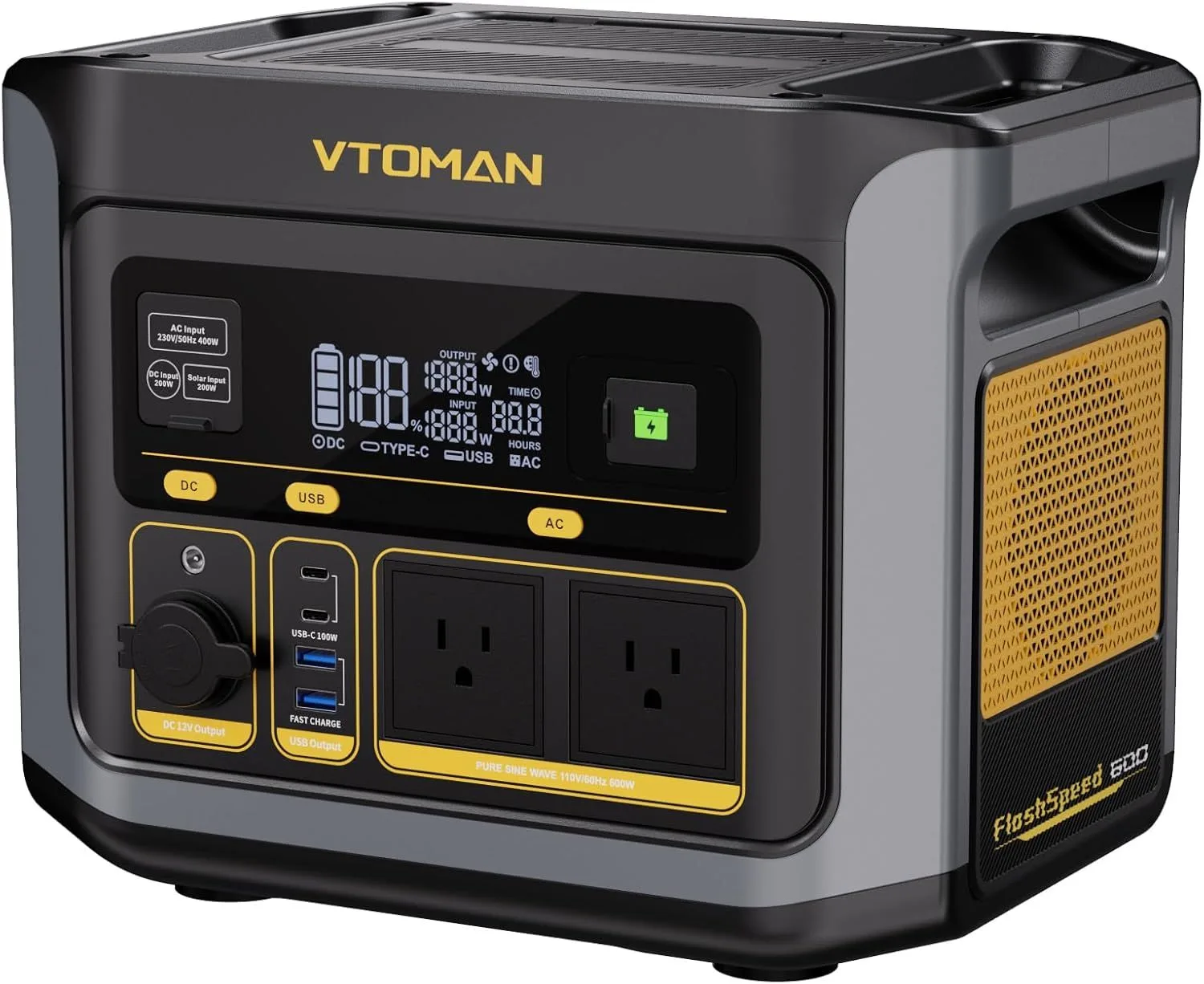
VTOMAN FlashSpeed 600
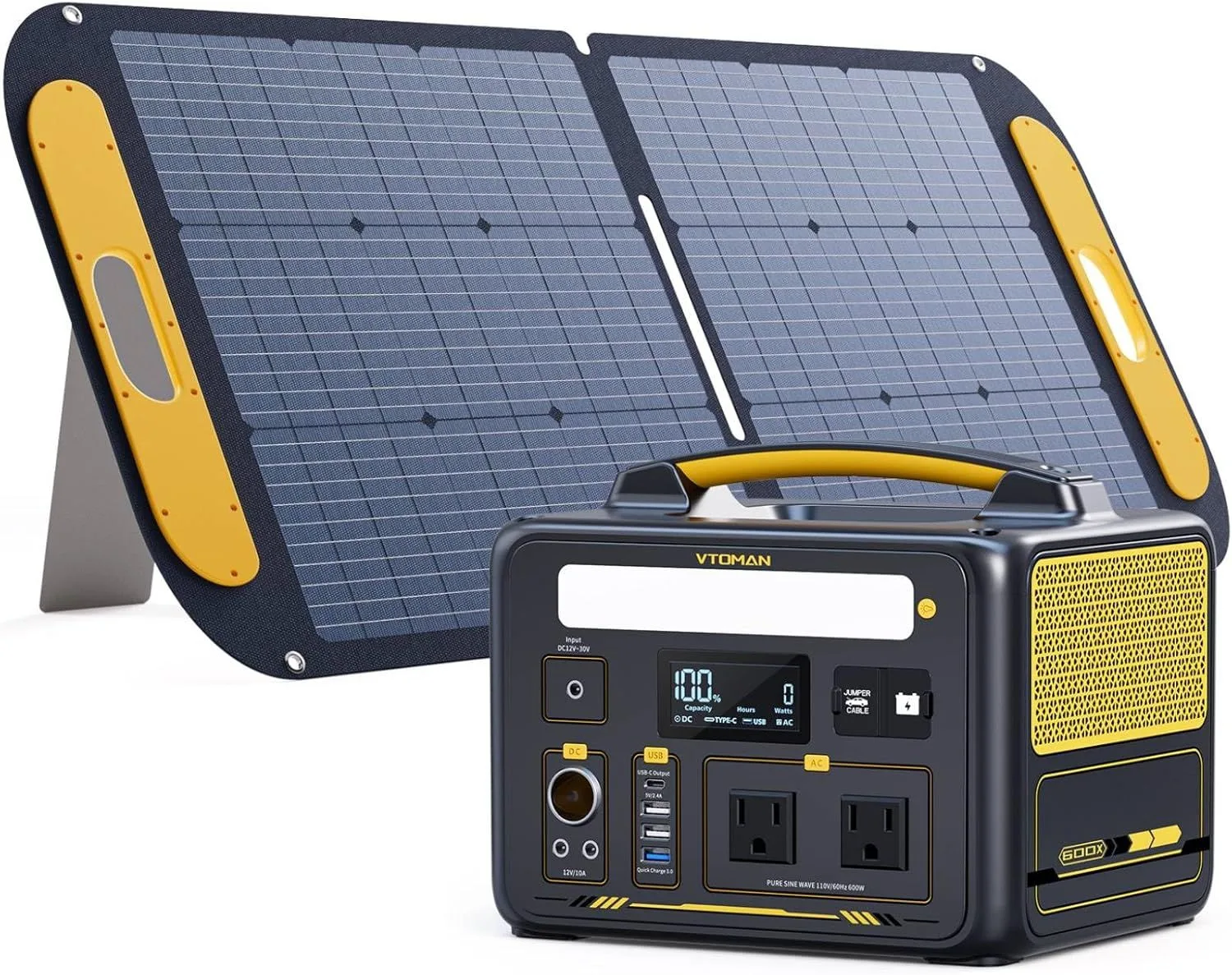
VTOMAN Jump 600X
The Numbers Side by Side
On paper, these two stations from the same manufacturer look like they should not be compared — the FlashSpeed 600 has far more capacity at a lower price. But the Jump 600X's unique feature set (car jump starter, included panel) makes a raw spec comparison incomplete. Both sit in the compact portable generator category, and here is the full picture.
The FlashSpeed 600 sits in the $250–$500 price range while the Jump 600X commands $250–$500. That puts the Jump 600X at modestly more expensive — a steep premium for less battery capacity but more bundled accessories and features.
| Feature | VTOMAN FlashSpeed 600 Portable Power Station | VTOMAN Jump 600X Portable Power Station with 110W Solar Panel |
|---|---|---|
| Price Range | $250–$500 | $250–$500 |
| Battery Capacity | 499Wh | 299Wh |
| Battery Type | LiFePO4 | LiFePO4 |
| Output Power | 600W | 600W |
| Surge Power | 1,200W (V-Beyond) | 1,200W (V-Beyond) |
| Weight | 15.9 lbs | ~14.8 lbs (station) |
| Solar Input | 200W max (Anderson + DC5521, 10-50V) | 100W max (DC5521, 12-30V) |
| Check Price | Check Price |
Feature-by-Feature Analysis
Battery Capacity and Runtime
FlashSpeed 600 WinsThe FlashSpeed 600 packs 499Wh — 67% more stored energy than the Jump 600X's 299Wh. At 600W continuous draw, the FlashSpeed runs for approximately 50 minutes. The Jump 600X runs for approximately 30 minutes at the same load. For lower-draw devices like phone charging (10-15W), the gap stretches to days of difference.
In camping terms, the FlashSpeed 600 charges a phone approximately 40 times from full. The Jump 600X manages approximately 24. Running a 12V camping fridge (50-60W average), the FlashSpeed powers it for roughly 8-9 hours versus the Jump 600X's 5 hours. That difference can mean keeping food cold through a full overnight period versus waking up to a warm cooler.
Both stations are expandable — the FlashSpeed to 2,047Wh and the Jump 600X to 939Wh. Even expanded, the FlashSpeed's ceiling is more than double the Jump 600X's maximum. For pure runtime and capacity, the FlashSpeed 600 dominates this comparison by a wide margin.
The capacity gap hits hardest during multi-day camping without access to shore power. A FlashSpeed 600 paired with a 200W solar panel harvests enough in 4-5 hours of sun to replace a full day's moderate use (300-400Wh). The Jump 600X paired with its included 110W panel (bottlenecked to 100W input) needs 5-6 hours of sun to refill just 299Wh — and if you are running a fridge or charging devices during the day, net solar recovery drops to almost nothing. For trips longer than one overnight, the FlashSpeed's capacity advantage compounds.
Wall Charging Speed
FlashSpeed 600 WinsThe FlashSpeed 600 charges from dead to full in approximately 70 minutes via its 400W fast-charge input — verified by The Gadgeteer. The Jump 600X takes approximately 3 hours from empty. That is a 2.5x speed difference for a station with 67% more capacity.
The math here is striking. In 70 minutes, the FlashSpeed stores 499Wh. In the same 70 minutes, the Jump 600X stores roughly 170Wh (about 57% of its capacity). The FlashSpeed is not just faster — it is faster while filling a larger tank.
For scenarios where you have limited access to wall power — a campground shore power connection, a rest stop outlet, a friend's house during an outage — the FlashSpeed's charging speed is a genuine practical advantage. You can grab a full charge during a lunch stop. The Jump 600X needs a half-day at the outlet.
Charging efficiency adds another dimension. The FlashSpeed 600's 400W fast-charge circuit stores 499Wh in 70 minutes — roughly 7.1Wh per minute of charging. The Jump 600X at roughly 100Wh per hour stores 1.67Wh per minute. The FlashSpeed charges more than four times faster per watt-hour stored. During a two-hour window at a campground outlet, the FlashSpeed banks a full charge plus has time to spare. The Jump 600X reaches about 67% — enough for a morning's use but not a full day.
Solar Charging Capability
FlashSpeed 600 WinsThe FlashSpeed 600 accepts up to 200W of solar input through dual ports — one Anderson connector and one DC5521 — with a broad 10-50V voltage window. This wide range means compatibility with most portable and rigid solar panels on the market.
The Jump 600X caps solar input at 100W through a single DC5521 port with a narrow 12-30V range. This creates an awkward situation: VTOMAN bundles a 110W solar panel with the Jump 600X, but the station itself bottlenecks the panel at 100W. You are carrying a panel that delivers more power than the station can accept.
Solar recharge times reflect this gap. With a 200W panel, the FlashSpeed 600 refills its 499Wh battery in roughly 2-4 hours. The Jump 600X needs 5-6 hours with its included 110W panel to fill just 299Wh. On a per-watt-hour basis, the FlashSpeed harvests solar energy more than three times faster.
Gough's Tech Zone also documented a solar wake/sleep bug on the Jump 600X — the unit repeatedly fails to start charging at sunrise, losing 1-2 hours of morning solar each day. This firmware issue has not been reported on the FlashSpeed 600.
The Jump Starter Factor
Jump 600X WinsThe VTOMAN Jump 600X is the only portable power station on the market with a built-in car jump starter. This is not a gimmick — it is a dedicated high-current circuit designed to crank vehicle starter motors. For overlanders, backcountry drivers, and anyone who parks in remote locations during winter, a dead battery can turn from an inconvenience into a safety emergency.
A standalone portable jump starter typically costs between forty and eighty dollars. A 110W solar panel runs another hundred or more. The Jump 600X bundles both of these into a single device alongside a 299Wh LiFePO4 power station. For buyers who would purchase all three items separately anyway, the Jump 600X's total package cost starts to look more reasonable.
The FlashSpeed 600 cannot jump-start a vehicle. Period. If jump-starting capability matters to you, this is the only comparison category that matters — and the Jump 600X wins it by default because it is the only product offering the feature.
The practical value of a built-in jump starter depends on where and how you drive. For suburban commuters who are always within AAA range, it is a nice-to-have. For someone who parks at a remote trailhead in January, drives unimproved forest roads, or camps in areas with no cell service, it is a potential lifesaver. A dead battery 40 miles from the nearest town and outside cell range turns a camping trip into a survival situation. The Jump 600X eliminates that scenario entirely — as long as you keep the station charged above 30%.
What You Get in the Box
Jump 600X WinsThe Jump 600X comes with a 110W solar panel featuring 23% efficiency and universal MC4 adapters for Anderson, XT60, and DC5521 connectors. That panel works with most portable power stations — not just the Jump 600X. If you sell the VTOMAN station later, the panel retains universal utility.
The FlashSpeed 600 ships as a standalone power station with no solar panel included. You get the station, its wall charger, and cables — that is it. Any solar charging requires a separate panel purchase.
For buyers who already own a solar panel, the FlashSpeed 600's lower price and higher capacity make it the clear winner. For first-time buyers who need a complete off-grid kit, the Jump 600X eliminates the panel-shopping step entirely and adds the jump-start bonus.
Size and Portability
TieThe FlashSpeed 600 weighs 15.9 lbs. The Jump 600X weighs approximately 14.8 lbs for the station alone. Both are heavy for the "compact" category — they are closer to mid-range territory in terms of heft. Neither is a grab-and-go unit for hiking or backpacking.
The FlashSpeed 600 is slightly larger in overall footprint (12.4 x 9.5 x 7.9 in vs 10.2 x 8.7 x 8.6 in) but stores 67% more energy per cubic inch. The Jump 600X is more compact but carries substantially less power. For car camping and trunk storage, neither size is an issue. For anything requiring a carry beyond 100 feet, both stations will remind you they are there.
The weight-per-watt-hour ratio tells a more useful story. The FlashSpeed 600 stores 31.4Wh per pound of weight. The Jump 600X stores 20.2Wh per pound. You carry roughly the same weight in both cases but get 55% more stored energy from the FlashSpeed. For someone optimizing a camping loadout where every pound must justify itself, the FlashSpeed delivers far more runtime for its share of your pack weight.
Build quality feels similar on both units — solid plastic housings with rubberized feet and metal internal frames. Neither has an IP rating for dust or water resistance, which is a notable omission for products marketed toward outdoor use. A water spill near the exposed ports could damage either station. If you camp near water or in rainy conditions, keep both units inside a dry shelter or wrap them in a waterproof bag during transport.
Port Layout and Output Options
FlashSpeed 600 WinsThe FlashSpeed 600 provides 9 total output ports: two AC outlets (600W continuous, 1,200W surge), two USB-A ports (5V/2.4A each), two USB-C ports (one at 100W PD, one at 20W), one car cigarette lighter socket (12V/10A), and two DC5521 ports. The 100W USB-C PD port is the standout — it can fast-charge a MacBook Air to 50% in about 30 minutes, run a USB-C monitor, or power a portable projector directly.
The Jump 600X offers 10 ports: two AC outlets (600W/1,200W surge), two USB-A ports (5V/2.4A), one USB-C port (100W PD), three regulated 12V DC outputs (car socket, two DC5521), one Anderson connector, and the jump-start terminal. The three regulated 12V DC outputs give the Jump 600X an edge for 12V camping gear — portable fridges, CB radios, LED light strips, and CPAP machines that accept direct 12V input all run more efficiently from a regulated DC port than from the AC outlet, which wastes 10-15% of energy in the DC-to-AC conversion process.
The FlashSpeed 600 has two USB-C ports versus one on the Jump 600X. For households where multiple people charge USB-C devices simultaneously — two phones, a tablet, a laptop — the extra USB-C port eliminates the need for a USB splitter or hub. A single 100W USB-C port forces a choice between fast-charging a laptop and charging a phone; two ports handle both at the same time.
Both stations output pure sine wave AC power, which is required for sensitive electronics like CPAP machines, medical devices, and audio equipment. Modified sine wave — common on cheaper inverters — causes audible buzzing in speakers and can damage sensitive circuitry over time. Pure sine wave output from both VTOMAN units eliminates that risk entirely.
Charging port placement differs between the two units in a way that affects daily use. The FlashSpeed 600 groups all input ports on the rear panel, keeping the front face clean for output access. The Jump 600X spreads ports across both sides and the front, which makes cable management messier when multiple devices are connected simultaneously. In a tight van setup or on a small camping table, the FlashSpeed's rear-input design keeps cables out of the way. The Jump 600X's distributed layout works fine in open spaces but creates a tangle of cables in confined quarters. Neither layout is objectively wrong — it depends on where you plan to set the station during regular use.
Picking the Right VTOMAN
Get the FlashSpeed 600 if...
- → Maximum capacity per dollar is your priority — 499Wh for less than the Jump 600X's 299Wh
- → You need fast wall charging — 70 minutes from dead to full
- → You plan to invest in high-wattage solar panels (up to 200W input accepted)
- → Long-term expandability matters — 2,047Wh ceiling vs 939Wh
- → You already own a solar panel or do not need one included
Get the Jump 600X if...
- → You need a car jump starter — no other power station includes this feature
- → You want a complete kit — station, 110W solar panel, and jump cables in one purchase
- → You drive in remote areas where a dead car battery could be a safety risk
- → Three regulated 12V DC outputs matter for camping fridges, CB radios, or CPAP machines
- → The convenience of one device covering multiple emergency needs outweighs raw capacity
If you drive a vehicle into remote areas as part of your lifestyle — overlanding, forestry work, ranch access roads, winter mountain driving — the Jump 600X's car jump starter is not a luxury feature. It is insurance against being stranded. A standalone jump starter plus a comparable solar panel would cost close to the price difference between these two stations. The Jump 600X consolidates three devices into one, reducing gear weight, bag space, and the chance of forgetting a critical piece at home.
Questions Buyers Ask About These Two
Why would anyone buy the VTOMAN Jump 600X when the FlashSpeed 600 has more capacity for less money?
The Jump 600X includes two things the FlashSpeed 600 does not: a built-in car jump starter and a bundled 110W solar panel. If you drive in remote areas where a dead car battery is a real possibility, the jump-start feature alone can justify the purchase. The included solar panel also saves a separate purchase. Buyers who do not need jump-starting or an included panel should choose the FlashSpeed 600 — the math overwhelmingly favors it on pure power station metrics.
Can the VTOMAN FlashSpeed 600 really charge in 70 minutes?
Yes. The Gadgeteer independently verified the 70-minute full charge claim using the 400W fast-charge input. That is a verified wall-to-full time from 0% — one of the fastest in any portable power station category. The Jump 600X takes approximately 3 hours for the same 0-100% charge via its wall adapter.
Do both VTOMAN stations have the same battery chemistry?
Yes. Both the FlashSpeed 600 and Jump 600X use LiFePO4 (lithium iron phosphate) batteries rated for 3,000+ charge cycles to 80% capacity. The battery chemistry is identical — the difference is in capacity (499Wh vs 299Wh) and feature set.
Can the VTOMAN Jump 600X really jump-start a car?
Yes. The Jump 600X includes a dedicated jump-start function that delivers a high-current burst sufficient to start most passenger vehicles with dead batteries. This is a separate circuit from the power station output — designed specifically for cranking vehicle starter motors. No other portable power station in our catalog includes this feature.
Are the expansion batteries compatible between these two VTOMAN models?
No. The FlashSpeed 600 expands using FlashSpeed 1500 extra batteries up to 2,047Wh total. The Jump 600X uses its own 640Wh expansion battery to reach 939Wh. The expansion ecosystems are not cross-compatible between the two product lines.
Which VTOMAN station is better for solar charging?
The FlashSpeed 600 accepts up to 200W solar input through dual ports (Anderson + DC5521) with a wide 10-50V voltage range. The Jump 600X caps at 100W via a single DC5521 port with a narrower 12-30V range. For solar charging, the FlashSpeed 600 is substantially better — double the input and broader panel compatibility. The Jump 600X even bottlenecks its own included 110W panel at the 100W cap.
How do the two stations compare for running a CPAP machine overnight?
A standard CPAP draws 30-50W depending on pressure settings and heated humidifier use. The FlashSpeed 600 at 499Wh runs a 40W CPAP for roughly 10-11 hours — enough for a full night with margin. The Jump 600X at 299Wh delivers about 6-7 hours under the same load, which cuts it close for 8-hour sleep cycles and may not last until morning if the humidifier runs all night. For reliable CPAP use, the FlashSpeed 600 is the safer choice.
Can either VTOMAN station charge while powering devices at the same time?
Yes, both support pass-through charging — they can charge from a wall outlet or solar panel while simultaneously powering connected devices. The FlashSpeed 600 handles this better in practice because its 400W input minus, say, a 100W load still delivers 300W net charging. The Jump 600X at 100W solar input minus the same 100W load achieves near-zero net charging. If you plan to run loads while solar charging, the FlashSpeed 600 is far more practical.
What happens if the Jump 600X jump starter fails to start my car?
The jump starter function draws a large burst from the LiFePO4 battery. If it fails on the first attempt, wait 30 seconds and try again — the battery recovers quickly. After 3-4 failed attempts, stop trying and let the station rest for 10 minutes. Repeated failed jump attempts drain the battery quickly. Keep the station above 30% charge for reliable jump-starting. If the battery is too low, it may not deliver enough peak current to crank the engine.
The Dollar-Per-Watt-Hour Reality Check
Pure cost-per-watt-hour favors the FlashSpeed 600 by a wide margin. You get 499Wh at a lower price point, which means each stored watt-hour costs less. The Jump 600X at 299Wh and a higher price delivers fewer watt-hours per dollar spent. On energy storage value alone, this is not close.
But the Jump 600X bundles accessories that have real standalone value. A 110W solar panel with universal MC4 adapters costs roughly $80-120 purchased separately. A quality LiFePO4 portable jump starter runs $40-80. If you would buy both of those items anyway, the effective station cost of the Jump 600X drops into a range that is more competitive with the FlashSpeed 600.
The honest calculation: if you do not need a jump starter and already own a solar panel, the FlashSpeed 600 is the better buy by every measure. Our solar generator buying guide walks through how to match features to your actual needs. If you need both accessories and prefer a single integrated device, the Jump 600X's bundle math makes sense — but only if you will actually use the jump starter. Buying it "just in case" when you never leave paved roads means paying a premium for a feature that sits unused.
See Current Amazon Pricing
VTOMAN FlashSpeed 600
$250–$500 · 499Wh · 70-Min Charge
Best for: maximum capacity and fastest charging per dollar
Check PriceVTOMAN Jump 600X
$250–$500 · 299Wh · Jump Starter + 110W Panel
Best for: overlanders who need jump-start + solar in one kit
Check PricePrices and availability change frequently. Both links go to Amazon where you can verify current pricing. As an Amazon Associate, Solar Power Guides earns from qualifying purchases — this does not affect our analysis or recommendations.