Solar Generator Sizing Guide: Match Capacity to Your Real Power Needs
The most expensive solar generator mistake is buying the wrong size. Too small, and you run out of power when it matters. Too large, and you overpay for capacity that sits unused. This guide gives you the math to calculate exactly what you need — no guessing, no overselling.
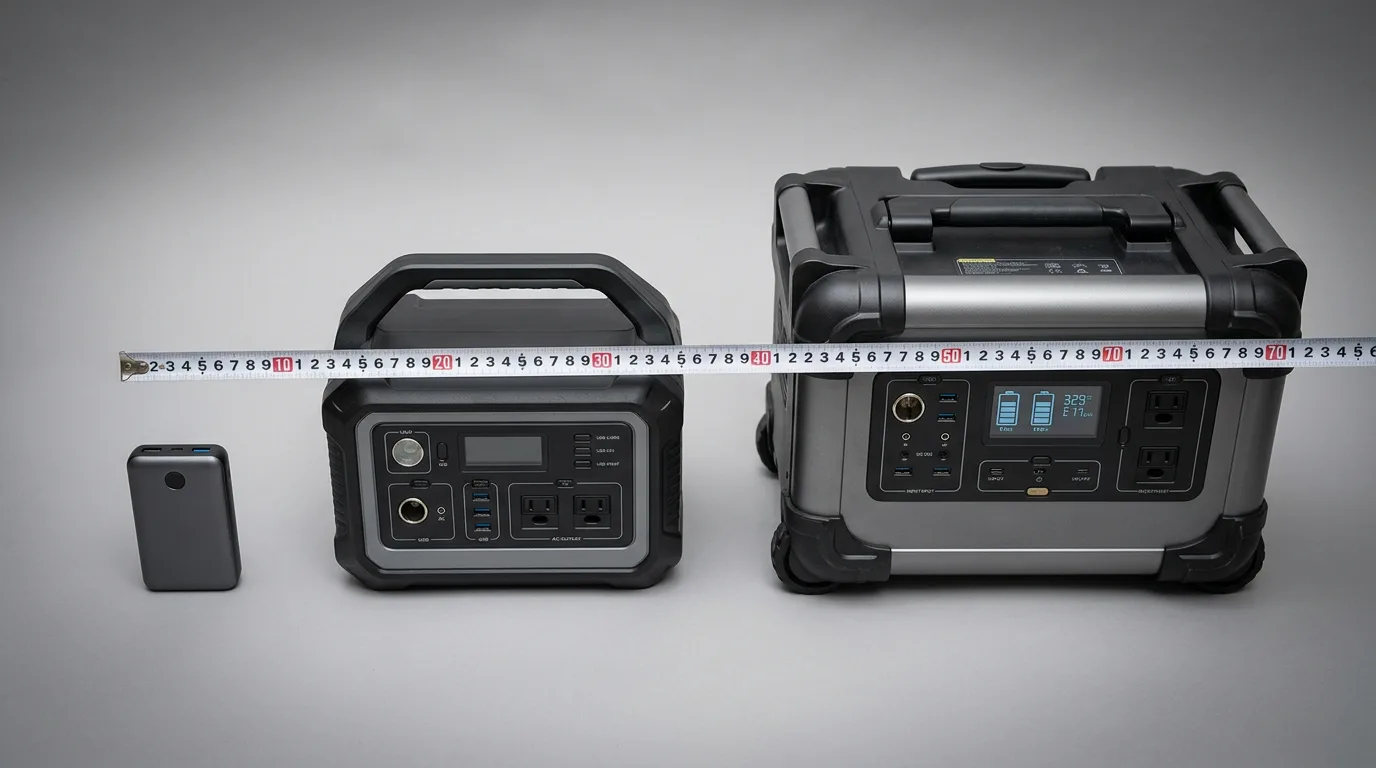
After reviewing 35 generators, the pattern is clear: buyers who calculate their watt-hour needs before shopping make better purchases. Buyers who browse first and rationalize second end up with expensive regrets. One takes 15 minutes of math. The other costs real money.
The Watt-Hour Calculation: Your Starting Point
Every sizing decision begins with Watts x Hours = Watt-Hours (Wh). A device averaging 60W for 5 hours uses 300Wh; a 10W light for 8 hours uses 80Wh. A refrigerator cycles on and off, so use measured daily energy where possible. As an illustration only, 150W running for 35% of a 24-hour day uses 1,260Wh. Your appliance may differ.
The process for calculating your daily requirement:
- List every device you intend to power during a typical use session (one camping day, one workday, one outage day).
- Find each device wattage. Check the label on the power adapter, the device manual, or search "[device model] wattage" online. When in doubt, use a Kill A Watt meter to measure actual draw.
- Estimate daily hours of use for each device. Be realistic — not aspirational.
- Multiply and add. Watts times hours equals watt-hours. Sum all devices for your daily total.
- Multiply by days between recharges. This gives device energy for the whole period.
- Convert to rated battery capacity. Divide that energy by the usable fraction. We assume 0.80 throughout these examples: 80% of rated capacity reaches the devices after conversion losses and unavailable battery energy. This is an illustrative planning assumption, not a measured specification for every unit or port.
- Add contingency separately. Multiply the result by 1.20 if you choose 20% extra reserve for longer use or uncertain consumption. Reserve is additional capacity, not another allowance for the same losses.
Common Device Power Draws: The Reference Table
Use these ranges only as starting estimates to check against your own equipment. They are not measurements of your devices. For each example, specify the average draw and operating hours, or use measured watt-hours directly. Do not apply the 0.80 usable fraction twice if your measurement already includes power-station losses.
Low-power devices (under 50W):
- Smartphone charge: 10-25W (15Wh per full charge)
- Tablet charge: 15-30W (25-40Wh per full charge)
- LED camping lantern: 5-15W
- USB fan: 3-10W
- CPAP: use model-specific consumption at your settings; an assumed 40W average for 8 hours equals 320Wh
- Wi-Fi router: 6-12W
- Camera battery charger: 8-15W
Medium-power devices (50-300W):
- Laptop (working): 30-65W (150-350Wh per workday)
- Desktop monitor: 20-60W
- Portable fridge/cooler: measure energy across its on/off cycles; do not apply a second cycling adjustment to measured average watts
- CPAP with heated humidifier: measure at your settings; an assumed 60W average for 8 hours equals 480Wh
- Small TV (32-inch): 30-55W
- Blender: 300-600W (used in bursts — 5-10Wh per smoothie)
- Drone charger: 60-100W (40-80Wh per charge cycle)
High-power devices (300W+):
- Full-size refrigerator: 100-400W running, 1,200W+ startup surge (1,000-1,800Wh per day)
- Microwave: 600-1,200W (short bursts — 50-150Wh per use)
- Coffee maker: 600-1,200W (30-100Wh per pot)
- Space heater: 750-1,500W continuous (750-1,500Wh per hour — extremely power-hungry)
- Hair dryer: 1,000-1,800W (50-100Wh per use)
- Window AC unit: 500-1,500W (3,000-12,000Wh per day — the most demanding common appliance)
- Well pump: 750-2,000W running, 3,000W+ startup surge
The Four Capacity Tiers: Where Your Number Lands
Your watt-hour calculation places you in one of four tiers. Each tier has distinct products, price ranges, and compromises. Understanding the boundaries helps you shop in the right category.
Tier 1: Under 500Wh — The Day-Trip Range
A 200-500Wh generator handles daily charging for phones, tablets, laptops, LED lights, USB fans, and camera batteries. This is the camping and road-trip tier — devices you recharge from the car or wall outlet every day or two.
Illustrative daily load: 100-350Wh. At a 0.80 usable fraction, a 200-500Wh battery delivers 160-400Wh before any contingency reserve. Divide that usable energy by your daily load to estimate days between recharges. Units in this range weigh 3-16 lbs and are easy to carry one-handed.
For 100-400Wh of device use per day, calculate 125-500Wh rated capacity for one day before reserve, or 150-600Wh with 20% reserve. Two days without recharging doubles those figures. Products like the BLUETTI Elite 30 V2 (288Wh, 600W output) and the VTOMAN FlashSpeed 600 (499Wh, 600W output) represent the range extremes.
Tier 2: 500-1,200Wh — The Weekend Warrior
The most popular tier covers extended camping trips, RV supplemental power, CPAP users needing multiple nights, and basic home backup for outages lasting 6-12 hours. You can run a portable fridge, charge laptops, keep lights on, and still have reserves.
Illustrative daily load: 300-800Wh. A 500-1,200Wh battery delivers 400-960Wh at the assumed usable fraction. For example, an 800Wh day needs 1,000Wh rated capacity before reserve, or 1,200Wh with 20% reserve. Weight ranges from 24-30 lbs, so portability is a consideration.
The EcoFlow DELTA 2 (1,024Wh with X-Boost to 2,200W) and the Anker SOLIX C1000 Gen 2 (1,024Wh, 2,000W output) are the benchmarks here.
Tier 3: 1,200-3,000Wh — The Serious Backup
This range handles full-size refrigerators, medical equipment, multiple simultaneous appliances, and multi-day outages. Off-grid cabin users and emergency preparedness enthusiasts often land here.
Illustrative daily load: 800-2,000Wh. A 1,200-3,000Wh battery delivers 960-2,400Wh at the assumed usable fraction. A 2,000Wh day needs 2,500Wh rated capacity before reserve, or 3,000Wh with 20% reserve. Multi-day use requires proportionally more energy or verified recharging. Weight increases to 40-70 lbs; these units usually stay in place.
Tier 4: 3,000Wh+ — Whole-Home Territory
Full home backup including 240V appliances: central AC, well pumps, electric water heaters, EV chargers. These are expandable systems that can scale to 10,000-40,000Wh+ with add-on batteries.
Illustrative daily load: 2,000-10,000Wh or more. At the assumed usable fraction, one day requires 2,500-12,500Wh rated capacity before reserve. Check output, voltage and installation compatibility separately; capacity alone does not establish whole-home coverage. Weight: 60-135 lbs for the base unit alone. The Anker SOLIX F3800 and EcoFlow DELTA Pro 3 are the leading options, with expandability to 12-16kWh.
Oversizing vs. Undersizing: Which Mistake Is Worse?
Undersizing is the more dangerous mistake. Running out of power during a medical emergency, a winter outage, or a remote camping trip has real consequences. An oversized generator just costs more money and weighs more.
But oversizing comes with its own problems. Larger units are heavier, harder to transport, and more expensive. They also take longer to recharge — a 3,000Wh battery needs either a massive solar array or hours of wall charging. For car camping where you recharge between trips, hauling unnecessary capacity is wasteful. For home backup where the unit stays plugged in, capacity is cheap insurance.
Rated capacity = daily device Wh x days between recharges / usable fraction x (1 + contingency reserve). Here, the usable fraction is an illustrative 0.80 and a 20% reserve is written as 0.20. For a 750Wh day: 750 / 0.80 = 937.5Wh before reserve; 937.5 x 1.20 = 1,125Wh with reserve. Round up to a suitable capacity after the calculation. Adding 20% to device consumption alone does not compensate for losing 20% of rated battery energy.
When Bigger Makes Sense — And When It Does Not
There are legitimate reasons to buy more capacity than your daily math suggests:
- Multi-day trips without recharging: A 3-day trip at 400Wh/day uses 1,200Wh at the devices. At 0.80 usable energy, it needs 1,500Wh rated capacity before reserve, or 1,800Wh with 20% reserve. Only count solar recharging that your conditions and equipment can support.
- Infrequent but critical use: Emergency generators that sit in a closet for months should cover worst-case scenarios, not average ones.
- Expandable needs: Adding a portable fridge next year? An electric blanket for winter camping? Size for where you are heading, not just where you are today.
- Shared use: A generator powering devices for a family of four uses 2-3x what a solo user does. Multiply your per-person calculation by headcount.
Bigger does not make sense when:
- You only charge phones and laptops: At 0.80 usable energy, a 300Wh unit supplies 240Wh, equivalent to 16 assumed 15Wh charges before reserve. Buying 3,000Wh for USB devices is like renting a moving truck to carry a backpack.
- Weight is a constraint: A 60-pound generator does not help if it stays home because carrying it is impractical.
- Daily recharging is available: Car campers near outlets or with reliable solar can recharge daily, making massive capacity unnecessary.
- Budget is tight: A well-sized mid-range unit serves better than a stretched-budget whole-home system missing the solar panels to recharge it.
Sizing for Specific Scenarios
Weekend Car Camping (2-3 days)
Illustrative device energy per day: phone charging (15Wh x 2), laptop (200Wh), LED lights (40Wh), USB fan (80Wh). Total: 350Wh, not 335Wh. Two days use 700Wh; 700 / 0.80 = 875Wh rated capacity before reserve, or 1,050Wh with 20% reserve. Three days need 1,312.5Wh before reserve, or 1,575Wh with reserve. A 1,000Wh unit covers the two-day example under these assumptions but does not meet its 20% reserve target. A 500Wh unit requires a verified recharge during the trip.
RV Extended Trip (5-7 days)
Illustrative device energy per day: fridge (1,200Wh), phones and tablets (50Wh), laptop (200Wh), lights (60Wh), water pump (20Wh). Total: 1,530Wh. One day needs 1,912.5Wh rated capacity before reserve, or 2,295Wh with 20% reserve. Seven days without recharging need 13,387.5Wh before reserve, or 16,065Wh with reserve. A nominal 400W array multiplied by four assumed sun-hours gives 1,600Wh before charging losses and weather effects. That calculation alone cannot establish sustainable daily operation. Check energy actually stored, overnight demand and charging limits.
Home Power Outage (24 hours)
Illustrative device energy for 24 hours: refrigerator (1,500Wh), Wi-Fi router (150Wh), phone charging (30Wh), LED lights (100Wh), CPAP (200Wh). Total: 1,980Wh. These are hypothetical inputs, including the CPAP value; replace them with consumption for your equipment and settings. Required rated capacity: 1,980 / 0.80 = 2,475Wh before reserve; with 20% extra reserve, 2,475 x 1.20 = 2,970Wh. A 2,000Wh battery supplies only 1,600Wh under this assumption, leaving a 380Wh shortfall. Check continuous output and startup surge separately. Plan recharging or additional capacity for longer outages; solar availability is not guaranteed.
CPAP Therapy (Camping or Outage)
Use the energy consumed at your actual therapy settings. As an arithmetic example only, an average 40W for 8 hours uses 320Wh: 320 / 0.80 = 400Wh rated capacity before reserve, or 480Wh with 20% reserve. A 300Wh unit supplies 240Wh at this assumption, which is insufficient for that example. Humidification, heated tubing and connection type can change consumption. Use only a manufacturer-approved connection; do not assume a fixed runtime gain from a DC port.
Sizing Mistakes That Cost Money
Three patterns emerge from buyer reviews and returns data:
Mistake 1: Using peak wattage instead of average. A blender rated at 600W runs for 30 seconds at a time. Its actual daily consumption is under 10Wh. Sizing your generator as though you will blend continuously for hours wastes capacity budget on a non-issue.
Mistake 2: Forgetting simultaneous load. Your generator can store 2,000Wh and deliver 1,500W continuous. But if you try to run a microwave (1,200W), fridge (150W), and hair dryer (1,500W) at the same time, you need 2,850W of output — which exceeds the inverter capacity regardless of the battery size. Stagger high-draw devices.
Mistake 3: Ignoring recharge availability. At the illustrative usable fraction, a 500Wh battery supplies 400Wh before recharging. Repeated operation requires enough energy actually stored each day, plus capacity to cover gaps in charging. A 3,000Wh battery supplies 2,400Wh under the same assumption. Solar panels do not make either battery unlimited.
Questions About Solar Generator Sizing
How do I calculate the watt-hours I need per day?
List each device and multiply its average watts by hours of use per day. Add those watt-hours, then multiply by days between recharges. Divide by the assumed usable fraction: this guide uses 0.80 for illustration. Add any contingency reserve separately. For example, 1,980Wh / 0.80 = 2,475Wh rated capacity before reserve, or 2,970Wh with 20% extra reserve.
What size solar generator runs a full-size refrigerator?
Measure your refrigerator over a representative day. If it uses 1,500Wh, the illustrative 0.80 usable fraction gives 1,875Wh rated capacity before reserve, or 2,250Wh with 20% extra reserve. A 2,000Wh battery supplies about 1,600Wh at that assumption. Check continuous output and compressor startup requirements separately; solar replenishment depends on actual conditions.
Can I just buy the biggest generator to be safe?
Choose capacity from your expected consumption and time between recharges, divided by the usable fraction. Add a separate contingency reserve for uncertainty or extra runtime. The 20% reserve used in our examples is a planning choice, not an efficiency allowance or a guarantee. Expandable systems can help if your needs change.
How many watt-hours does a CPAP machine use per night?
Use consumption measured at your intended settings or figures from your machine manufacturer. Watts are power; watt-hours are energy over time. If a machine averages 40W for eight hours, it uses 320Wh. At the illustrative 0.80 usable fraction, that needs 400Wh rated capacity before reserve, or 480Wh with 20% reserve. This is an arithmetic example, not a medical-device runtime guarantee.
Should I size my generator for peak load or average load?
Check both separately. Continuous output must cover the combined running watts of devices used together, and startup surge capability must suit their starting requirements. Rated battery capacity must cover device watt-hours between recharges divided by the usable fraction, with any contingency reserve added separately.
Does altitude or temperature affect sizing?
Use the power station and panel manufacturer specifications for your expected temperature and altitude. Usable battery energy and charging performance vary with conditions. The illustrative 0.80 fraction and 20% reserve in this guide do not replace those specifications or prove a system suitable for extreme conditions.
Run the Numbers, Then Shop
Grab a piece of paper. List your devices. Look up wattages. Multiply by hours and days between recharges. Divide by the usable fraction, then add your separate contingency reserve. That rated-capacity target is your answer — and it takes less time than reading one misleading product listing. Every hour spent on this math saves days of buyer remorse.
Ready to turn your number into a product? Our How to Choose guide walks through the next decisions — output, chemistry, ports, and features — once you know your capacity target. Or jump straight to our Best Mid-Range Power Stations if your math landed in the most popular 1,000Wh tier.
Get Our Top 3 Picks
Get our top 3 picks for your budget — one email, then only updates.
Only when something changes. Unsubscribe anytime.
Ready to Buy? Start Here
Based on this guide, our #1 recommendation:
Anker SOLIX C1000 Gen 2 Expandable from 1kWh to 2kWh — the best starting point for most households Read Full Review →