Solar Generators for Outdoor Events: Silent Power at Scale
Outdoor events have a noise problem, and it is not the music. Gas generators droning at 60-80 decibels behind every vendor booth, food truck, and stage setup create a constant industrial hum that degrades the event experience. Solar generators eliminate that noise entirely — zero decibels at idle, a faint fan hum under load — while powering everything from card readers to concert-grade PA systems.
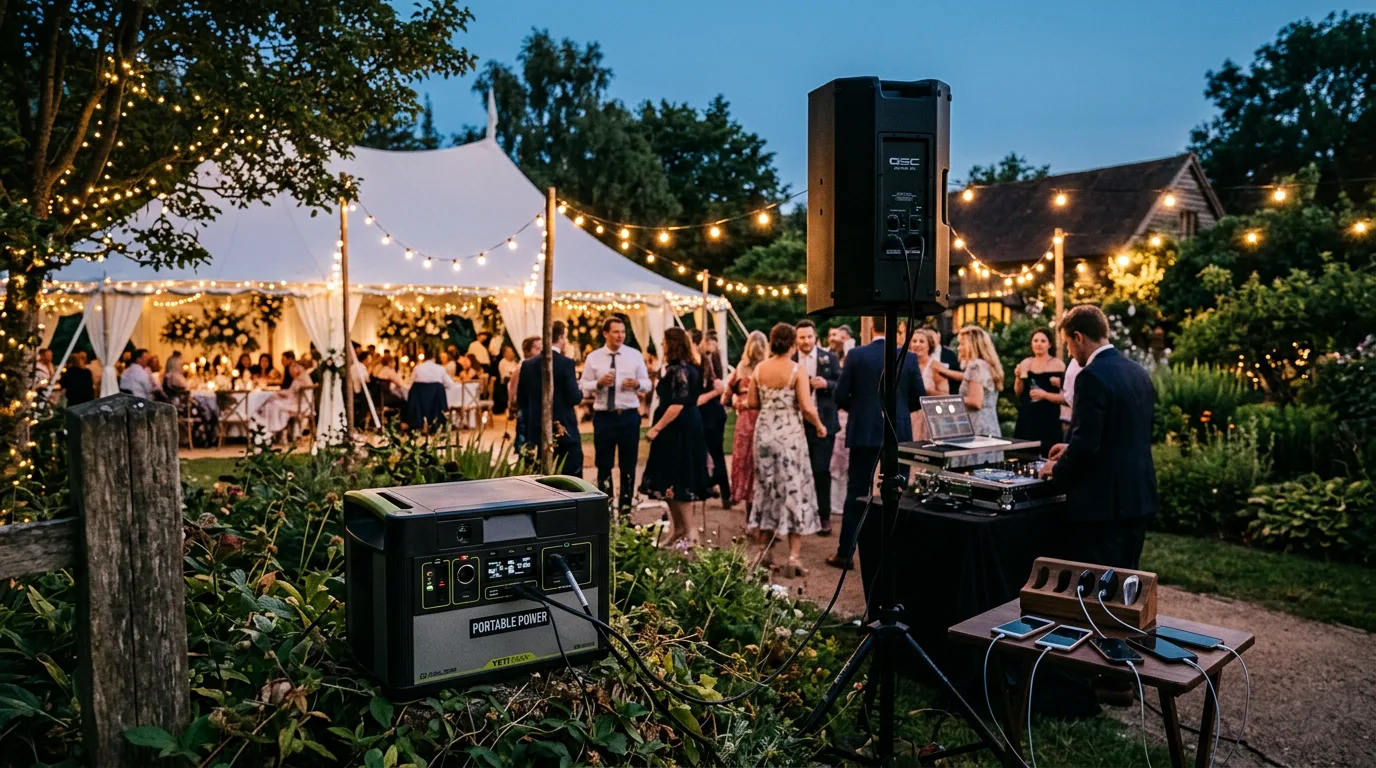
The event power market is shifting fast. Farmers markets, craft fairs, outdoor weddings, music festivals, corporate retreats, and community gatherings are all discovering that portable solar generators handle their power needs without the noise, exhaust, and refueling logistics of gas alternatives. The question is not whether solar works for events — it is which size and configuration works for your specific event type.
Event Power Profiles: Know Your Load
Different event types have wildly different power requirements. A craft booth selling jewelry needs a phone charger and LED lights. A DJ at a wedding reception needs 2,000W of continuous power for speakers, subwoofer, and a laptop. The same generator that overpowers one is laughably inadequate for the other.
Craft booth or vendor table: LED display lighting (50-100W), phone/tablet for payments (10-20W), small fan (30W), phone charging station (30-50W). Total: 120-200W continuous. For a 6-8 hour event: 720-1,600Wh. A 1,000Wh generator covers a full day with margin. This is the sweet spot for market vendors — portable, affordable, and entirely sufficient.
Food vendor (supplemental power): Most cooking runs on propane. The generator powers: LED menu board (20W), card reader (5W), warming tray (200-400W), mini fridge for drinks (60W), string lights (20W). Total: 300-500W continuous. For a full day: 2,400-4,000Wh. A 2,000-3,000Wh generator handles this with the warming tray as the dominant load.
Small sound system: Powered speakers for background music or a presenter (200-400W). For 4-6 hours: 800-2,400Wh. A 1,500-2,000Wh generator with 1,500W+ output covers small to medium sound systems comfortably.
DJ/live music setup: Powered speakers + subwoofer (800-1,500W), mixer/laptop (100W), lighting effects (200-500W). Total: 1,100-2,100W continuous. For a 4-hour set: 4,400-8,400Wh. This requires high-capacity generators — 3,000Wh minimum, and ideally expandable for longer events.
Outdoor wedding reception: String light canopy (100-200W), sound system (300-600W), phone charging station (50W), warming trays for food (400-800W), centerpiece LED candles (negligible). Total: 850-1,650W continuous. For a 5-hour reception: 4,250-8,250Wh. Two 3,000Wh generators or one expandable system handles the full reception.
Generator Picks for Event Use
Best for a single vendor booth: The Anker SOLIX C1000 Gen 2 Portable Power Station at 1,056Wh with 2,000W output runs a full vendor setup (lights, payments, fan, charging) for 6-8 hours. Anker's mobile app shows remaining runtime for each connected device — useful for managing power throughout a market day. Weighs about 29 lbs: portable enough for one person.
Best for food vendors and small PA systems: The Anker SOLIX F2000 (PowerHouse 767) Portable Power Station delivers 2,048Wh with 2,400W output — enough for warming trays, a mini-fridge, and a medium PA system simultaneously. The high output handles everything short of commercial kitchen equipment. A serious workhorse for all-day events.
Best value for large events: The pecron F3000LFP Portable Power Station packs 3,000Wh with 3,000W output at a competitive price point. Expandable to 9,216Wh for multi-day events. The 3,000W output runs a DJ setup, full lighting rig, and food service equipment simultaneously. The value proposition stands out against premium brands at similar capacity.
Best for concert-scale power: The EcoFlow DELTA Pro 3 Portable Power Station with 4,000Wh expanding to 30,000Wh and 4,000W output handles full-scale outdoor production — concert-grade PA, professional lighting, multiple vendor booths. The 240V output powers equipment that smaller generators cannot even attempt. For event production companies moving away from gas generators, this is the replacement.
The Noise Advantage: Why Events Are Switching
A single gas generator behind a vendor booth produces 60-70 decibels — equivalent to normal conversation volume. Ten gas generators at a farmers market create a 70-80 dB background drone that visitors endure for the entire event. Conversations compete with generator noise. Music competes with generator noise. The experience suffers even though most attendees cannot identify the source of their discomfort.
Solar generators at idle produce zero measurable noise. Under heavy load, a cooling fan adds 25-40 dB — quieter than a whisper across a room. Ten solar generators at a farmers market produce less noise than one gas generator. The acoustic difference is not subtle — it transforms the event atmosphere.
This is why many event organizers now mandate solar or battery generators and ban gas alternatives. The policy benefits everyone: vendors, attendees, performers, and neighboring properties. Several major outdoor venue chains have adopted no-gas-generator policies within the last two years, and municipal parks departments are following.
Logistics: Getting Power to the Event
Transport: Generators under 30 lbs (compact category) are a one-person carry. Units in the 40-60 lb range need a hand truck or two-person carry. Whole-home systems above 80 lbs require a dolly and a vehicle with adequate cargo space. Plan the transport before buying — a generator that requires a pickup truck and two people to move may not be practical for weekly market setups.
Weather protection: Most portable generators are NOT waterproof. A sudden rain shower during an outdoor event can damage exposed electronics and create electrical safety hazards. Keep generators under canopies, table covers, or portable tents. In wet conditions, elevate the generator on a platform or pallet to prevent standing water contact.
Cable management: Run power cables under rubber cable protectors across walkways. Tape cables to the ground or table legs to prevent trip hazards. For vendor booths, run a single power strip from the generator and keep the generator behind the booth where attendees cannot access it. Never run cables through standing water.
Solar Recharging at Multi-Day Events
Single-day events typically rely on overnight charging from a wall outlet. Multi-day festivals, fairs, and markets benefit from on-site solar recharging between sessions. A 400W folding panel deployed during setup hours (9 AM to 3 PM) produces roughly 1,400-1,800Wh — enough to offset a full day of vendor booth consumption.
Position panels where they will not interfere with foot traffic or event operations. Behind booth tents, on vehicle roofs in the parking area, or in designated solar charging zones all work. Some events now designate solar charging areas near vendor rows, recognizing that solar-equipped vendors need less infrastructure support.
Budgeting Runtime for Common Event Types
Farmers market vendor booth (6-hour day): A typical setup — phone for payment processing, LED strip lighting, small fan — draws 50-80W continuously. Over 6 hours, that is 300-480Wh. Any 500Wh+ generator handles this with room to spare. A 288Wh compact unit like the Anker SOLIX C300 covers a lights-and-phone setup but cuts it close if you add a fan.
Outdoor music performance (4-hour set): A powered speaker system (200-400W), stage lighting (100-200W), and mixer (50W) draw 350-650W combined. Over 4 hours, that is 1,400-2,600Wh. A mid-range generator (1,000-2,000Wh) handles most band setups. For amplified bass rigs drawing 800W+, step up to a high-capacity unit.
Food truck or catering (8-hour shift): Refrigeration (80-150W continuous), warming trays (200-500W intermittent), POS system (30W), and lighting (50W) sum to 360-730W average. Over 8 hours, that is 2,880-5,840Wh. Most food service operations need at least a 3,000Wh unit, and many pair two mid-range generators to separate refrigeration from cooking appliances.
Corporate or wedding event (10+ hours): String lights (100-300W), PA system (200-400W), phone/laptop charging station (100W), photo booth (150W), and seasonal fans or heaters (500-1,500W) can total 1,050-2,450W continuous. A whole-home backup system is the only realistic portable option for this scale. Alternatively, two mid-range units running separate circuits provide redundancy — if one unit dies, the lights stay on while the photo booth goes offline.
Event Power Questions
Can a solar generator power a PA system for an outdoor event?
A typical portable PA system draws 200-500W. A powered speaker pair for a small outdoor gathering draws 100-300W. A full DJ setup with subwoofer can draw 800-2,000W. For a 4-hour event, a small PA (300W) needs 1,200Wh. A medium PA (600W) needs 2,400Wh. A full DJ setup (1,500W) needs 6,000Wh. Match the generator capacity and output to the size of the sound system.
How many solar generators do I need for a vendor booth?
Most vendor booths need one generator. A typical booth runs a card reader (5W), LED display lighting (50-100W), phone charging (10W), and maybe a small fan (30W). That is 100-150W of continuous draw — roughly 600-900Wh over a 6-hour event. A 1,000Wh generator covers a full day with capacity to spare. Food vendors with heating equipment (heat lamps, warming trays at 500-1,000W each) may need a 2,000-3,000Wh system.
Are solar generators allowed at festivals and public events?
Most festivals, farmers markets, and outdoor events allow solar generators because they produce no noise and no exhaust. Many events actually prefer them — gas generators are increasingly banned due to noise complaints, fire risk, and emissions in crowded areas. Check with the event organizer, but solar generators rarely face restrictions. Some large events provide power hookups, making a generator unnecessary.
Can a solar generator power event lighting?
LED string lights draw 5-20W per strand. A strand of 100 LED bulbs covering 30 feet draws about 10W. Ten strands covering an outdoor dining area draw 100W — a 1,000Wh generator runs them for 10 hours, well beyond any evening event. LED spotlights and uplights draw 10-50W each. Even elaborate lighting setups rarely exceed 300-500W total with modern LED technology.
How do I keep a solar generator secure at an outdoor event?
Use a cable lock through the carry handle and attach it to a table leg, tent pole, or ground stake. Keep the generator under a table or behind the booth where it is out of sight and foot traffic. Some event organizers provide secure power stations. For high-value generators at multi-day events, consider generator insurance — most homeowner or renter policies cover portable electronics with documentation.
What size solar generator runs a food truck?
A food truck with commercial kitchen equipment (griddles, fryers, refrigeration units) draws 3,000-8,000W — beyond any single portable generator. But many food trucks only need supplemental power for lighting, card readers, display screens, and small warming trays while the main cooking equipment runs on propane. A 1,500-2,000Wh generator handles the supplemental electrical load for a full day.
Power Your Next Event Silently
Browse our best high-capacity generators for PA systems and full-day vendor power, or our mid-range roundup for single-booth solutions. Need to size the system precisely? Our watt-hours guide walks through the calculation for any event load.
Ready to Buy? Start Here
Based on this guide, our #1 recommendation:
Anker SOLIX C1000 Expandable from 1,056Wh to 2,112Wh for extended outdoor events Read Full Review →