Solar Generators for Off-Grid Living: Full-Time Portable Power
Off-grid living demands something fundamentally different from a solar generator than a weekend camping trip. You are not running lights for two nights — you are powering a household every day, indefinitely. The battery is not a convenience; it is your utility company. That changes the math, the priorities, and the price range dramatically.
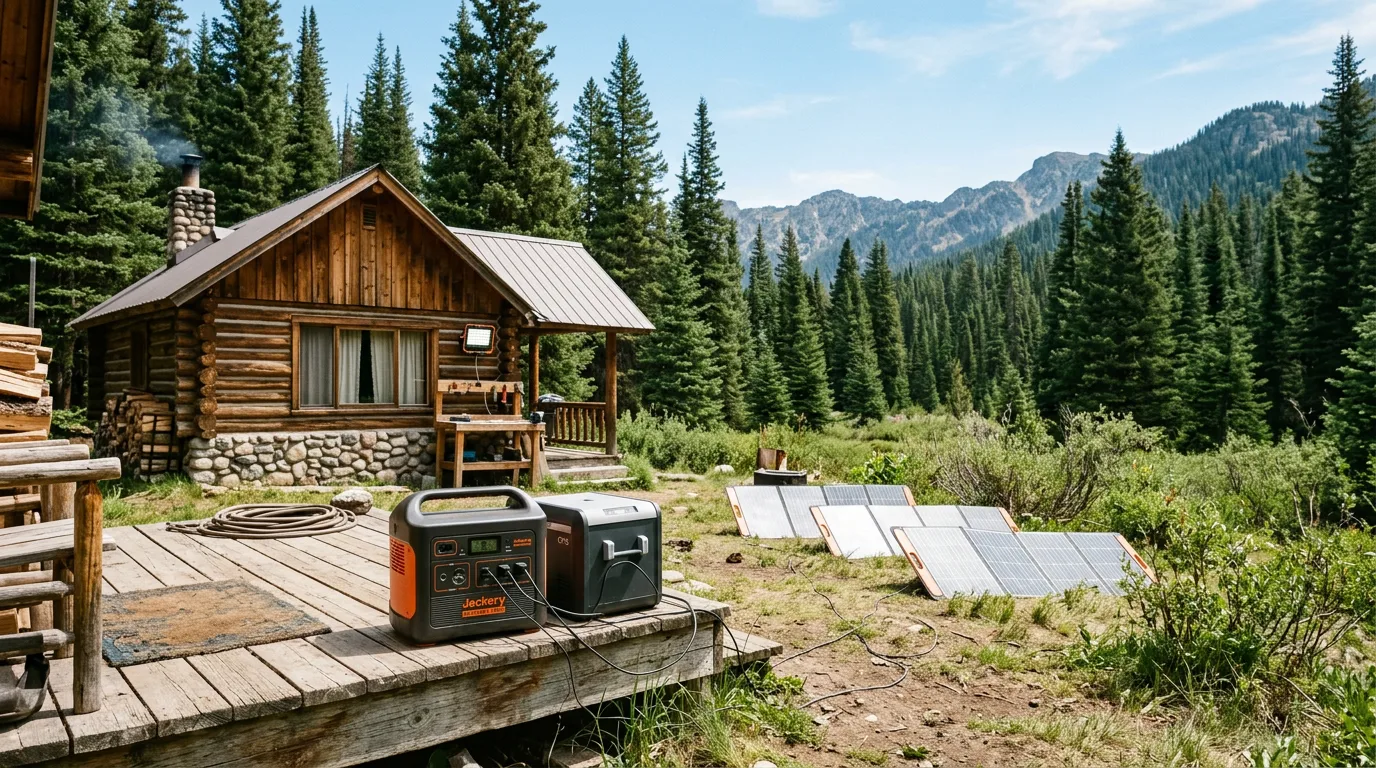
Portable solar generators were originally designed for temporary, intermittent use. But expandable systems from Anker, EcoFlow, and others have pushed capacity into the 10-50+ kWh range — territory that starts to overlap with dedicated off-grid solar installations. For small cabins, tiny homes, workshops, and partial off-grid setups, these portable systems offer a genuine alternative to permanent wiring and panel mounting.
The Daily Watt-Hour Budget: Your Foundation Number
Everything in off-grid power planning starts with one number: your daily watt-hour consumption. Not your peak draw, not your monthly average — your daily total. This number determines how much battery capacity you need, how many solar panels to buy, and how much money to spend.
Minimal off-grid cabin (1-2 people): LED lighting (50Wh), phone charging (30Wh), laptop (200Wh), small fan (100Wh), portable fridge (600Wh), water pump (150Wh). Total: roughly 1,100-1,500Wh per day. A 3,000Wh system with 400-600W of solar panels handles this comfortably, with a buffer day of stored energy for cloudy weather.
Comfortable off-grid home (2-4 people): All of the above plus a full-size fridge (1,200Wh), TV (300Wh), washing machine (500Wh per load, 2-3 loads per week), microwave (200Wh per day), Wi-Fi router (150Wh). Total: roughly 3,000-5,000Wh per day. You need 8-12kWh of battery storage and 1,000-1,500W of solar panels.
Full-scale off-grid household: Everything above plus a well pump (1,500Wh), water heater supplement (2,000-4,000Wh), air conditioning (3,000-8,000Wh), electric cooking (1,000-2,000Wh). Total: 10,000-20,000Wh per day. At this level, portable solar generators alone cannot meet the demand — you need a permanent solar installation or a hybrid approach with the portable system covering essential loads.
Expandable Systems: The Off-Grid Sweet Spot
The key feature for off-grid use is expandability — the ability to add battery capacity without buying a completely new system. Fixed-capacity generators cap out at whatever the manufacturer built in. Expandable systems let you start with a base unit and add battery modules as your needs grow or your budget allows.
Largest expandable capacity: The Anker SOLIX F3800 Portable Power Station starts at 3,840Wh and expands to 53,800Wh (53.8kWh) with expansion batteries. That is enough to power a comfortable off-grid cabin for 10+ days without solar input. The 3,600W continuous output with 6,600W surge handles every standard household appliance. At the top capacity tier, this is effectively a portable whole-home battery system.
Best 240V capability: The EcoFlow DELTA Pro 3 Portable Power Station delivers 4,000Wh base capacity expanding to 30,000Wh, with 240V output that powers well pumps, dryers, and other heavy loads that 120V-only generators cannot touch. The 4,000W continuous output with 8,000W surge starts virtually any motor-driven appliance. For off-grid homes with a well, 240V output is not optional — it is mandatory.
Best non-expandable high capacity: The OUPES Guardian 6000 Portable Power Station delivers 6,000Wh in a single unit — enough for a small cabin running 1,500-2,000Wh per day with a 3-day buffer. Not expandable, but no additional purchases needed. The 3,600W output with 7,200W surge handles the full range of 120V household loads.
Solar Panel Array Sizing for Continuous Use
Weekend users get away with small panels because they charge from the grid before leaving and only need to top up partially. Off-grid living means 100% of your charging comes from the sun (or a backup gas generator during extended overcast periods). The panel array must fully replenish daily consumption during daylight hours.
The solar math: Start with the daily watt-hour consumption figure, divide by the location's average peak sun hours (PSH), and add 30% for real-world losses. Peak sun hours vary by location: Arizona averages 6-7 PSH, the Pacific Northwest averages 3-4 PSH, and most of the continental US falls in the 4-5.5 PSH range. Use your winter PSH for year-round sizing — summer produces surplus, winter is the constraint.
Example: A cabin using 3,000Wh per day in a location with 4 peak sun hours needs 3,000 ÷ 4 = 750W of panels. Add 30% for losses: 975W of panels. Rounding up to 1,000W of panels provides the required daily recharge with a small surplus for cloudy days.
Panel placement for off-grid: Permanent or semi-permanent installations can use ground mounts or roof mounts angled for your latitude. South-facing at your latitude angle is optimal year-round. Adjustable ground mounts let you change the angle seasonally — steeper in winter (sun is low), flatter in summer (sun is high). Even a 10-degree adjustment between summer and winter angles improves annual yield by 5-10%.
Battery Cycling and Longevity for Daily Use
Off-grid living means cycling the battery daily — sometimes more than once if evening consumption depletes the daytime solar gains. This is where LiFePO4 chemistry earns its keep. Rated for 3,000-3,500+ cycles to 80% capacity, a daily-cycled LiFePO4 battery lasts 8-10+ years.
After 3,000 cycles, the battery still works — it just holds 80% of its original capacity. A 3,840Wh battery at 80% still provides 3,072Wh. For most off-grid users, that degraded capacity is still sufficient. The battery does not stop working at 80% — it continues degrading gradually, and many users report usable capacity at 70% or lower.
Cycle depth matters. A shallow cycle (20% to 80%) causes less wear than a deep cycle (0% to 100%). If your daily consumption uses 60% of your battery, you are running a 60% depth-of-discharge (DoD) cycle. At 60% DoD, LiFePO4 batteries can exceed their rated cycle count because the rating assumes 100% DoD cycles. Oversizing your battery means shallower daily cycles and longer total lifespan.
The Hybrid Approach: When Portable Meets Permanent
Many off-grid households use a hybrid setup: a permanent solar panel array mounted on the roof or ground, wired to a portable generator system that functions as the battery and inverter. This combines the efficiency of fixed panels (optimal angle, no setup/takedown) with the flexibility of a portable generator (can be moved, replaced, or upgraded).
The portable generator stays in a protected location — a utility closet, shed, or covered porch — connected permanently to the panel array via MC4 cables. Household circuits run from the generator's AC outlets through an extension cord system or a transfer switch. When the generator needs maintenance or the battery needs replacement in 8-10 years, you swap the portable unit instead of rewiring a permanent battery bank.
This hybrid approach works best at the 3,000-8,000Wh daily consumption level. Below 3,000Wh, a standalone portable system handles everything. Above 8,000Wh, a permanent installation with a hardwired battery bank and inverter is more cost-effective and efficient.
Seasonal Considerations for Year-Round Off-Grid Power
Winter is the critical season. Shorter days, lower sun angles, snow cover on panels, and cold temperatures all reduce solar production simultaneously. A system that produces 4,000Wh daily in July might produce 1,500Wh in December at the same location. Size your system for winter — summer surplus is a bonus, not a problem.
Cold weather reduces available capacity by 20-30%. LiFePO4 batteries deliver less energy in cold temperatures. A 3,840Wh battery in a 30°F garage provides roughly 2,700-3,000Wh of usable energy. Keeping the generator indoors or in an insulated space solves this — but adds ventilation requirements (the inverter generates heat during operation, which is actually beneficial in winter).
Summer overproduction is an asset. Excess solar production during long summer days can power additional loads — running the air conditioning harder, batch-charging power tool batteries, or running a dehumidifier in the basement. Some expandable systems can even feed surplus power back to a grid-tied connection if you maintain a utility hookup for emergencies.
Off-Grid Power Questions
Can a solar generator power a home off-grid full time?
A single portable solar generator cannot replace a dedicated off-grid solar installation with a roof-mounted panel array and battery bank. But expandable systems like the Anker SOLIX F3800 (up to 53.8kWh with expansion batteries) bridge the gap for small cabins, tiny homes, and partial off-grid setups. The key is matching your daily watt-hour consumption to the system capacity and solar recharge rate. A household using 5-10kWh per day needs a system that can store at least 2 days of consumption and recharge fully during daylight hours.
How many solar panels do I need for off-grid living?
Calculate your daily consumption in watt-hours, then divide by the average peak sun hours for your location (3-6 hours depending on region and season). That gives you the minimum panel wattage. Add 30% for real-world losses (clouds, angle, heat). Example: 5,000Wh daily use ÷ 5 peak sun hours = 1,000W of panels minimum, plus 30% = 1,300W of panels recommended. For year-round off-grid living, size for your worst solar month (usually December-January).
What is the best expandable solar generator for off-grid use?
The Anker SOLIX F3800 expands to 53.8kWh with expansion batteries — the largest capacity in our catalog. The EcoFlow DELTA Pro 3 expands to 30kWh and offers 240V output for well pumps and other heavy loads. The choice depends on how much total capacity you need and whether 120V or 240V output matters for your setup.
How long will a solar generator last with daily off-grid use?
LiFePO4 batteries are rated for 3,000-3,500+ charge cycles to 80% capacity. One full cycle per day means roughly 8-10 years before the battery degrades to 80% of original capacity — and the battery still works after that, just with reduced storage. Partial cycles count proportionally: using 50% of the battery daily counts as half a cycle, effectively doubling the lifespan in years.
Can I run a well pump with a solar generator?
Standard well pumps require 240V power and draw 750-1,500W with startup surges of 3,000-5,000W. Only a few portable generators offer 240V output — the EcoFlow DELTA Pro 3 with its 240V capability and 7,200W surge can handle most residential well pumps. Most other portable generators are 120V only and cannot power a 240V well pump regardless of wattage rating.
Is a portable solar generator cheaper than a permanent solar installation?
For small setups (under 5kWh daily use), a portable solar generator system can be comparable in cost to a basic permanent installation — with the advantage of portability and no permitting. For larger setups (10-20kWh daily use), permanent solar installations with roof-mounted panels and wall-mounted battery banks are more cost-effective per kWh and more efficient. The crossover point varies by location and installer pricing, but roughly 5-8kWh daily use is where permanent installations start making more financial sense.
Plan Your Off-Grid Power System
Start with our sizing guide to calculate your daily watt-hour budget. Then browse our best whole-home backup systems for the expandable generators that handle off-grid demand. For smaller cabin setups, our high-capacity roundup covers the 2,000-4,000Wh range.
Ready to Buy? Start Here
Based on this guide, our #1 recommendation:
EcoFlow DELTA Pro 3 Maximum capacity and 240V output for serious off-grid living Read Full Review →