Solar Generators for Emergency Prep: Power When the Grid Goes Down
FEMA recommends every household prepare for 72 hours without utility services. Power outages from hurricanes, ice storms, wildfires, and aging grid infrastructure are increasing in both frequency and duration. A solar generator does not prevent the outage — but it keeps your refrigerator cold, your phone charged, your medical devices running, and your lights on while you wait for restoration.
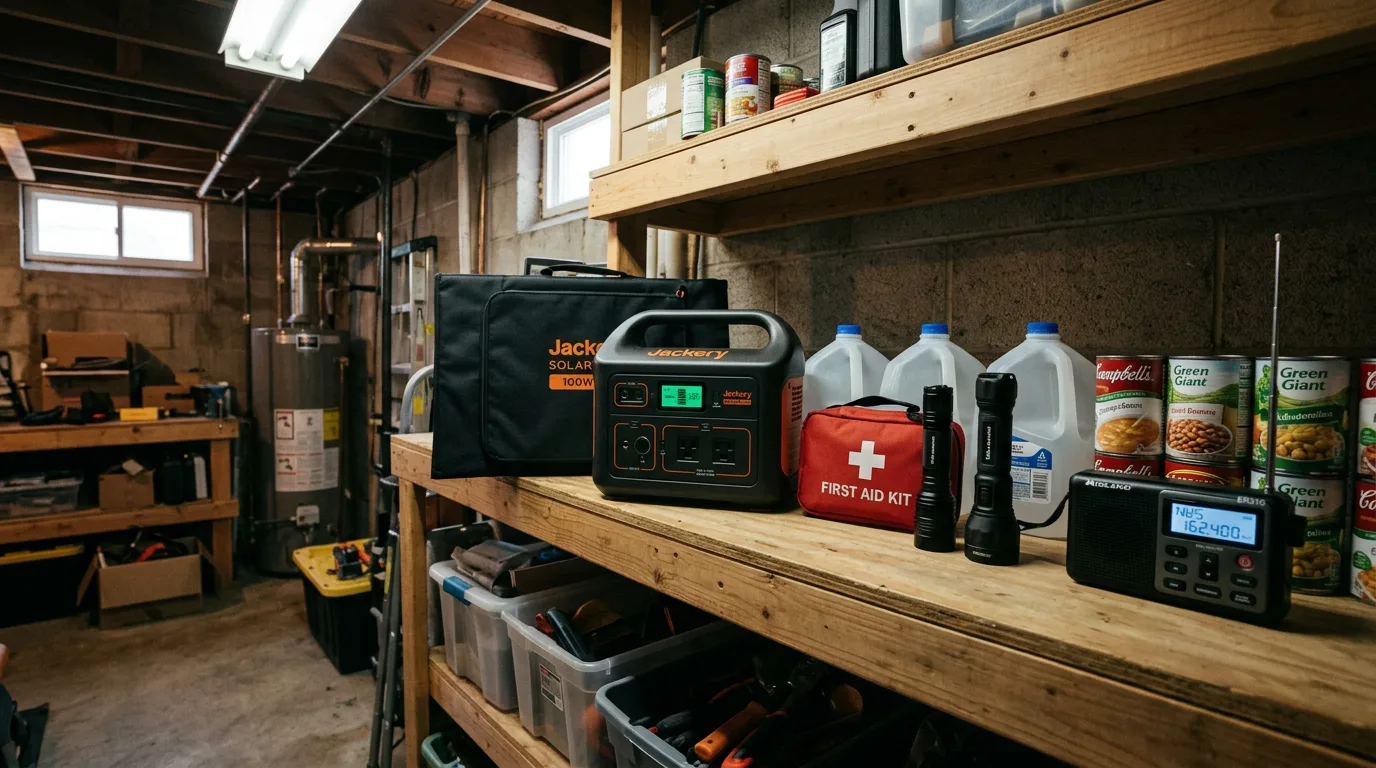
Emergency power planning is fundamentally different from camping or tailgating power. You are not choosing what to bring — you are protecting what you cannot lose. A spoiled refrigerator full of food costs more than many generators. A CPAP machine that dies at 2 AM is a medical emergency. A dead phone when you need to reach emergency services is dangerous. The generator is insurance, and the sizing question is: what are you insuring against?
The Emergency Priority List: What to Power First
When the grid goes down, not every appliance deserves power. Triage your loads into three tiers — this determines how much generator you need.
Tier 1 — Life Safety (non-negotiable): Medical devices (CPAP, oxygen concentrator, insulin refrigerator, nebulizer), communication (phone charging, Wi-Fi router for emergency alerts), and minimal lighting (one LED light per occupied room). Tier 1 draws roughly 200-600Wh per day depending on medical needs. Almost any generator in our catalog handles Tier 1.
Tier 2 — Essential Comfort: Refrigerator (prevents food spoilage), additional phone/tablet charging for the household, a fan in hot weather or a heated blanket in cold weather. Tier 2 adds roughly 1,500-2,500Wh per day, mostly from the fridge. You need at least a 1,000Wh generator to sustain Tier 1 + Tier 2 through a 24-hour outage, or a smaller generator with solar panels for multi-day coverage.
Tier 3 — Convenience: TV for news/entertainment, microwave for hot meals, laptop for work, additional lighting, powering a garage door opener. Tier 3 adds another 1,000-2,000Wh per day. Full Tier 1 + 2 + 3 coverage requires a 3,000-5,000Wh system for 24-hour autonomy without solar, or a 2,000Wh system with 200-400W of solar panels for multi-day coverage.
Sizing Your Emergency Generator
For a 24-hour outage (most common scenario): Add up your Tier 1 + Tier 2 daily consumption. A household fridge (1,200Wh/day) plus phone charging (100Wh) plus Wi-Fi router (150Wh) plus LED lights (50Wh) totals roughly 1,500Wh per day. A 2,000Wh generator handles 24 hours comfortably. Add a 200W solar panel and the same generator covers 3-5 days with good sun.
For a 72-hour outage (FEMA recommendation): Without solar, you need 3x your daily consumption: 1,500Wh/day × 3 = 4,500Wh. That requires a high-capacity or whole-home system. With a 200-400W solar panel producing 800-1,600Wh per day (accounting for real-world losses and partial cloud cover), a 2,000-3,000Wh generator can sustain the same load for 72+ hours because each day's solar input replaces much of the previous night's consumption.
For extended outages (hurricane aftermath, ice storms): Major disasters can knock out power for 1-2 weeks. Solar becomes essential at this duration — no fixed battery lasts two weeks. A 3,000Wh generator with 400-600W of solar panels provides indefinite Tier 1 + 2 coverage in most US locations, even with cloudy days reducing solar production.
Our Emergency Prep Picks
Best for Tier 1 medical/communication backup: The VTOMAN FlashSpeed 600 Portable Power Station at 600Wh runs a CPAP for 10+ hours, keeps phones charged, and powers a Wi-Fi router and LED lights through a full night. The 1,200W surge handles startup spikes. Light enough for one person to carry. Pair with a 100W folding panel for multi-day coverage.
Best for Tier 1 + 2 whole-household essentials: The Anker SOLIX C1000 Gen 2 Portable Power Station delivers 1,056Wh with 2,000W output — enough to run a fridge, charge multiple devices, and power lights for 24 hours. Fast AC charging fills it in under an hour, and Anker's app monitors remaining runtime per connected device. A 200W solar panel extends coverage to 3+ days.
Best mid-range emergency capacity: The VTOMAN FlashSpeed 1500 Portable Power Station packs 1,500Wh with 1,500W output at a competitive price point. Runs a fridge for 30+ hours alone, or a full Tier 1 + 2 setup for 24 hours. The value-per-watt-hour in this unit makes it a strong choice for households that need real capacity without premium brand pricing.
Best for extended multi-day outages: The EcoFlow DELTA Pro 3 Portable Power Station starts at 4,000Wh and expands to 30,000Wh. The 4,000W output with 8,000W surge runs every household appliance including well pumps (240V capable). For regions with frequent extended outages — hurricane country, rural areas with aging infrastructure — this system replaces the need for a whole-house gas generator.
The Pre-Storm Preparation Checklist
Emergency preparedness only works if the generator is ready when the emergency arrives. Storing a dead generator in the garage and scrambling to charge it when the storm hits defeats the purpose.
Ongoing maintenance (every 3 months): Check the charge level. LiFePO4 batteries self-discharge roughly 2-3% per month — a unit stored at 60% should still be above 50% after 3 months. If it has dipped below 30%, top it up to 50-60%. This 5-minute check prevents the worst-case scenario: pulling out the generator during an emergency and finding it dead.
When severe weather is forecast (24-48 hours before): Charge the generator to 100% from the wall outlet. Move it to the location where it will be used (near the fridge, in the bedroom for CPAP, etc.). Plug critical devices into the generator's pass-through outlets if it has EPS/UPS mode. Test that the solar panel connections work and the panel is accessible for deployment.
When the power goes out: Turn on the generator's inverter. If devices are already plugged into pass-through outlets, they switch over automatically (EPS-equipped units) or within seconds of you flipping the inverter on. Deploy the solar panel in a sunny location if weather permits. Ration Tier 3 loads — save capacity for Tier 1 and 2 overnight when solar is unavailable.
Solar Panels as Emergency Insurance
A generator without a solar panel is a battery with a fixed amount of energy. A generator with a solar panel is a renewable power system that can sustain essential loads indefinitely. For emergency prep, the solar panel transforms a 24-hour solution into a weeks-long solution.
Panel sizing for emergency use: A 200W panel produces roughly 700-900Wh per day in average US sun conditions (accounting for 70% real-world efficiency and 5 peak sun hours). That is enough to offset a fridge's daily consumption (1,200Wh) by 60-75%, stretching a 2,000Wh generator from 36 hours to 5+ days. A 400W panel produces 1,400-1,800Wh per day — enough to match or exceed a typical Tier 1 + 2 load, making the system self-sustaining during daylight.
Folding vs rigid panels for emergency use: Folding panels store in a closet and deploy in minutes — ideal for emergency prep. Rigid panels mounted on a roof or ground frame are more efficient but require permanent installation. For dedicated emergency prep, a folding panel stored with the generator is the practical choice. You want the entire system grabbable and deployable in under 5 minutes.
What a Solar Generator Cannot Do in an Emergency
Honest limitations matter more in emergencies than in any other use case. Knowing what your generator cannot do prevents dangerous assumptions.
Central air conditioning is off the table. A central AC system draws 3,000-5,000W continuous. No single portable generator runs one, and even the largest expandable systems drain in hours. Use a portable fan (20-50W) or a window AC unit on the lowest setting (500-800W on a high-capacity generator) instead.
Electric water heaters draw too much power. A standard tank water heater element draws 4,000-5,500W — beyond any portable generator's output. Heat water on a gas stove, camp stove, or accept cold showers during the outage.
Sump pumps may or may not work. A typical 1/3 HP sump pump draws 800W continuous with 1,500-2,000W startup surge. Many high-capacity generators can handle this. But the sump pump runs cyclically during flooding — consuming substantial energy if the water table is high. Budget 2,000-3,000Wh per day for a sump pump during heavy rain, which may exceed your generator's daily solar recharge rate.
What Buyers Ask About Emergency Generators
How many watt-hours do I need for a 3-day power outage?
FEMA recommends preparing for 72 hours without utility services. A minimal emergency setup — fridge, phone charging, LED lights, and a Wi-Fi router — uses roughly 2,000-3,000Wh per day, or 6,000-9,000Wh over 3 days. A medical equipment household (CPAP, oxygen concentrator, medication fridge) may need 3,000-4,000Wh per day. Solar recharging during daylight hours reduces the required battery capacity — with good sun, a 3,000Wh generator with 400W of panels can sustain a minimal setup indefinitely.
Can a solar generator keep a refrigerator running during an outage?
A standard household refrigerator draws 100-400W continuous with startup surges of 800-1,200W. It cycles on and off, averaging about 1,200Wh per day. A 2,000Wh generator runs a fridge for roughly 36-40 hours. Adding a 200W solar panel extends that to 3-5 days with good sun. For the fridge alone, a 1,000-2,000Wh generator with 200W solar panel is sufficient. The startup surge is the critical spec — your generator needs at least 1,500W surge to reliably start a fridge compressor.
Should I buy a solar generator or a gas generator for emergencies?
Solar generators start instantly, run silently, produce no exhaust (safe indoors), require no fuel storage, and recharge from the sun indefinitely. Gas generators deliver more continuous power and are cheaper per watt. For 1-3 day outages with a focus on essentials (fridge, lights, phone, medical devices), a solar generator is usually the better choice. For extended outages powering high-draw appliances (well pump, HVAC, electric water heater), a gas generator or the combination of both is more practical.
How do I keep a solar generator ready for emergencies?
Store at 50-60% charge in a cool, dry location. Check the charge level every 3 months and top up if it has drifted below 30%. LiFePO4 batteries self-discharge very slowly — roughly 2-3% per month — so a fully charged unit still holds 85-90% after 6 months of storage. When a storm is forecast, charge to 100% and plug critical devices into the generator pass-through outlets so the switchover is immediate when the grid drops.
What medical devices can a solar generator power?
A CPAP machine draws 30-60W and runs all night on a 500Wh generator. A portable oxygen concentrator draws 100-300W and needs a 1,000Wh+ generator for 8 hours. A medication refrigerator draws 50-100W and runs continuously. Nebulizers draw 200-400W but run for only 10-15 minutes per treatment. For any life-sustaining medical device, test the generator with the device BEFORE an emergency. Verify the generator provides clean sine wave power — most LiFePO4 generators do, but check the spec sheet.
Do I need a transfer switch for emergency solar generator use?
A transfer switch lets you connect a generator directly to your home electrical panel, powering circuits throughout the house instead of running extension cords to individual devices. It is not required for basic emergency use (plugging devices directly into the generator), but it is more convenient and safer for extended outages. Professional installation costs typically range from several hundred to over a thousand dollars. For most homeowners using a portable generator for essentials only, extension cords to the fridge, router, and charging station are simpler and adequate.
Build Your Emergency Power Plan
Start by calculating your household's emergency power needs with our sizing guide. Then browse our best mid-range stations for 24-hour coverage or our whole-home systems for multi-day protection. The best time to buy an emergency generator is before you need one.
Ready to Buy? Start Here
Based on this guide, our #1 recommendation:
Anker SOLIX C1000 Gen 2 The fastest-charging, most expandable mid-range station for emergency readiness Read Full Review →