Solar Generators for Boating: Portable Power on the Water
Boats have a unique power problem. The engine alternator charges the main battery bank while running, but the moment you cut the motor to fish, anchor, or drift, the battery starts draining. Fish finders, GPS chartplotters, VHF radios, live well pumps, LED lights, and phone chargers all draw from that finite pool. A portable solar generator adds a completely independent power source that keeps your electronics alive without touching the cranking battery — and the engine stays off.
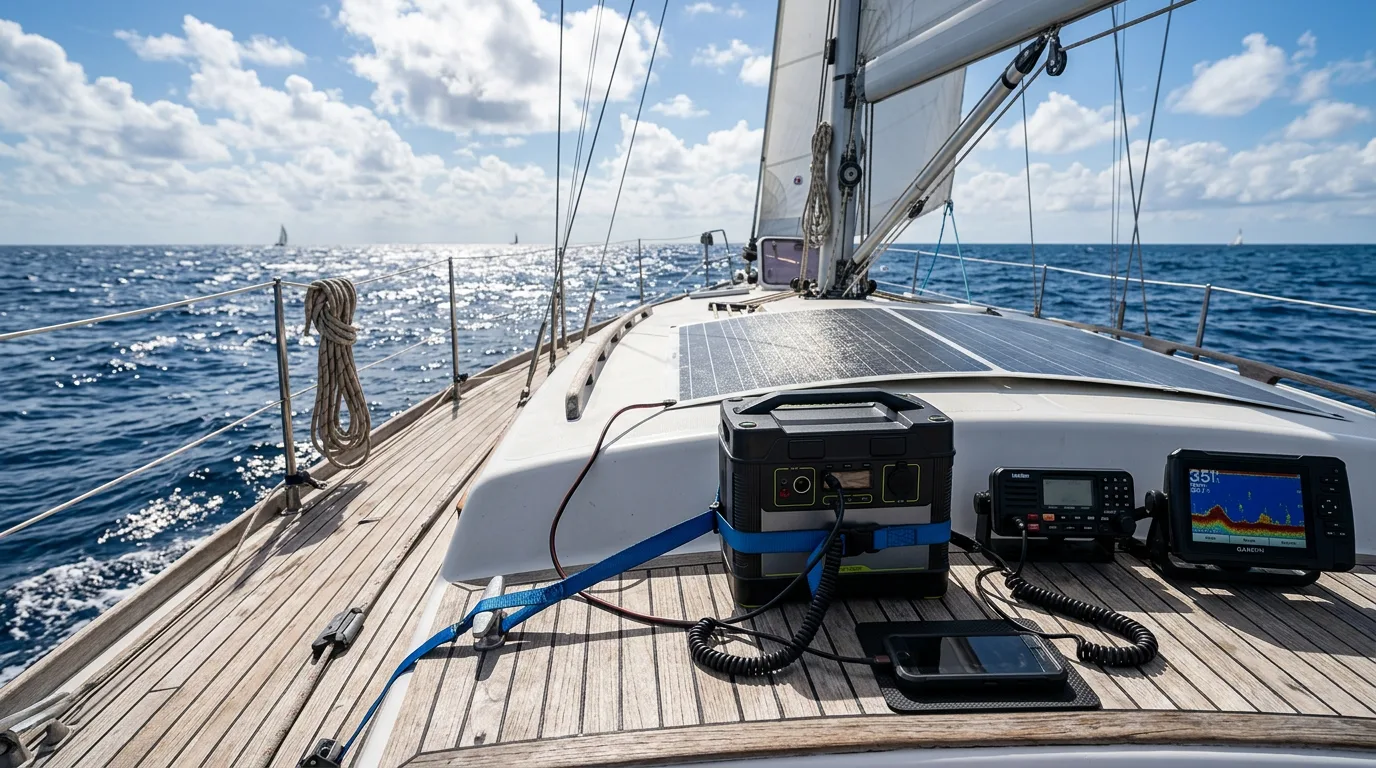
The marine environment is hard on electronics. Salt spray corrodes contacts. Wave action vibrates loose connections. Humidity seeps into ventilation openings. Rain, splash, and the occasional rogue wave threaten anything not sealed. None of this disqualifies solar generators from boat use — it just means you need to think about placement, protection, and maintenance differently than you would in a campsite or a backyard.
What Marine Electronics Actually Draw
Boat electronics are surprisingly modest in power consumption. Manufacturers have been optimizing for 12V marine battery efficiency for decades. The result: most fishing and cruising electronics draw less than a laptop.
Fish finder / depth sounder (15-40W). A basic depth sounder draws 10-15W. A mid-range color fish finder (Garmin Striker, Lowrance Hook) draws 15-25W. A large-screen unit with CHIRP sonar and side imaging (Humminbird Helix, Garmin LiveScope) draws 25-40W. Over a 6-hour fishing trip, the fish finder uses 90-240Wh — a modest load for any generator above 300Wh.
GPS chartplotter (10-30W). Standalone GPS units draw 10-15W. Multifunction displays (MFDs) combining chart, radar, and sonar draw 20-30W. If your fish finder has built-in GPS (most modern units do), the combined draw is already counted above.
VHF radio (5W receive, 25-50W transmit). A VHF marine radio draws almost nothing while monitoring a channel — 3-5W in receive mode. During transmission, it spikes to 25W (low power) or 50W (high power 25W setting). Transmissions last seconds at a time. Over a full day, a VHF radio uses 30-60Wh. Not worth worrying about in the sizing calculation.
Live well pump (25-50W). A recirculating live well pump runs intermittently — 15 minutes on, 15 minutes off is typical. Average draw: 15-25W effective. Over 6 hours of fishing, that is 90-150Wh. If you run the pump continuously in hot weather, double the number.
LED navigation and cabin lights (10-30W total). LED nav lights draw 2-5W per fixture. An anchor light draws 1-3W. Cabin courtesy lights and deck floods collectively add 10-20W. Even running everything at night, total lighting draw stays under 30W. LED technology is the reason boats stopped burning through battery banks for overnight lighting.
Phone and device charging (10-30W). Phone USB charging, tablet, Bluetooth speaker, action camera charging — collectively 10-30W. Budget 100-200Wh for a full day of device topping.
The totals: A minimal fishing setup (fish finder + VHF + phone) needs 150-300Wh per day. A fully loaded center console (fish finder + GPS + live well + lights + devices) needs 400-800Wh per day. A pontoon or cabin cruiser with entertainment systems and multiple accessories needs 600-1,200Wh per day. Match the generator to the boat and the trip length.
The Salt Air Problem — and How to Manage It
Salt air is corrosive. Marine-grade electronics cost more specifically because manufacturers seal connections, use coated circuit boards, and spec corrosion-resistant housings. Portable solar generators are NOT designed for marine environments. They are consumer electronics built for dry, land-based use.
That does not make them unusable on boats. It means you take precautions. Thousands of boaters use portable power stations on the water without issues — the difference between a generator that lasts one season and one that lasts five is maintenance and placement.
Placement matters most. Inside a center console storage compartment, under a hardtop, inside a cabin, or in a sealed deck box — any covered location that shields the generator from direct spray. Open bow riders and inflatable boats have fewer options: a dry bag rated for electronics or a custom-fit waterproof case is the minimum protection. Never place the generator where it can take a wave over the bow or spray from the stern.
Post-trip maintenance is non-negotiable. After every saltwater trip, wipe all exposed surfaces with a damp freshwater cloth. Salt crystals left on metal contacts corrode within days. Cover unused ports with silicone dust caps (most generators include these — do not throw them away). Store the generator indoors between trips, not in the boat. Boats sitting in a marina accumulate salt moisture overnight even when dry-docked.
Generator Picks for Boat Use
Best for kayaks and small boats: The Jackery Explorer 300 Portable Power Station weighs 7.5 lbs and fits inside a kayak hatch or under a jon boat seat. At 293Wh, it powers a fish finder for 8-12 hours or charges phones all day. The compact size means it stows without stealing rod storage or deck space. No live well pump on a kayak — this is pure electronics power.
Best for center consoles and bass boats: The VTOMAN FlashSpeed 600 Portable Power Station at 600Wh handles a full day of electronics — fish finder, GPS, live well pump, VHF, and device charging — with room to spare. Under 20 lbs, it fits in a center console compartment or a leaning post rod holder cavity. The 1,200W surge rating means it starts a stubborn live well pump without tripping.
Best for pontoons and cabin cruisers: The Anker SOLIX C1000 Gen 2 Portable Power Station with 1,056Wh powers the full suite — electronics, entertainment system, cabin lights, mini fridge for drinks, and charging station for every device onboard. The Anker app lets you monitor draw and remaining runtime from your phone while you fish or entertain. At about 29 lbs, it needs a dedicated spot but is manageable for one person to carry aboard.
Best for overnight anchoring: The EcoFlow DELTA 2 Portable Power Station at 1,024Wh keeps navigation lights, anchor light, cabin lights, and a phone charger running through the night while preserving the cranking battery for morning startup. The fast AC recharge (80% in under an hour at the dock) means you can top off between day trips quickly. The 1,800W output handles a small electric cooler for overnight provisions.
Solar Panels on the Water: Higher Output Than Land
Here is a fact that surprises most boaters: solar panels produce more energy on the water than on land. Water reflects UV light upward, adding reflected radiation to the direct sunlight hitting the panel. On a sunny day, a 100W panel on a boat produces 10-15% more than the same panel on a lawn. The cooling effect of water breeze also helps — solar panels lose efficiency as they heat up, and ocean or lake air keeps them cooler than rooftop installations.
Rigid panels mount to T-tops, radar arches, and hardtop roofs with standard marine mounting hardware. A 100W rigid panel (roughly 40 x 20 inches) fits across most center console T-tops. Two panels on a catamaran arch provide 200W — enough to offset a full day of electronics and keep the generator near full charge by sunset.
Flexible panels conform to curved surfaces. Bimini tops, cabin roofs, and pontoon canopies all work. Flexible 100W panels weigh under 5 lbs and can be temporarily secured with suction cups or bungee cords for day trips, then removed for storage. They are less efficient than rigid panels (15-18% vs 20-22% cell efficiency) but the weight and form factor advantage on boats is substantial.
Folding panels deploy on the bow, the dock, or the swim platform while anchored. A 60-100W folding panel propped against the center console or laid flat on the bow adds useful charge during lunch stops and anchoring. Stows flat under a seat or in a locker when the boat is moving.
The Trolling Motor Question
Trolling motors are the most common power-hungry device boaters want to run from a solar generator. The math works for small motors on short runs — but requires honest expectations.
A 30 lb thrust trolling motor draws about 30A at 12V on full speed — 360W. At half speed (the most common trolling setting), it drops to 10-15A (120-180W). Running at half speed for 4 hours uses 480-720Wh. A 1,000Wh generator handles this — barely. At full speed, the same motor drains the generator in under 3 hours.
The complication: most portable generators output 120V AC, not 12V DC. Running a 12V trolling motor from an AC generator requires an inverter-to-battery step that wastes 20-30% of the energy. The generator's 12V car port is a better option, but most are rated for only 10-15A (120-180W) — not enough for a motor pulling 30A. Check the generator's 12V output specifications carefully. The 12V port on many generators is designed for phone charging and car accessories, not high-amperage loads.
For serious trolling, a dedicated deep-cycle marine battery connected directly to the motor is still the better tool. A solar generator's strength is electronics, not propulsion. Use the generator for fish finders, GPS, lights, and creature comforts — let the marine battery bank handle the trolling motor.
Securing the Generator: Boats Move
A 20 lb generator sitting on a flat surface in a campsite stays put. That same generator on a boat at speed, in chop, or during a sharp turn becomes a 20 lb projectile. Securing it is mandatory, not optional.
Ratchet straps through carry handles. Loop straps through the generator's carry handles and around a fixed point — a seat base bolt, a deck cleat, or a leaning post frame. Tighten until the generator does not shift when you push it with your hand. Two straps (crossed in an X pattern) prevent movement in any direction.
Non-slip matting underneath. Marine non-skid matting (the rubberized mesh used under tackle trays) prevents the generator from walking across the deck during normal vibration. Combined with straps, the generator stays locked in position even in rough water.
Storage compartment fit. Center console boats often have a compartment behind the helm or under the leaning post that fits a mid-size generator perfectly. Measure the compartment dimensions before buying — a generator that slides snugly into an existing compartment needs minimal additional securing and stays protected from spray.
Freshwater vs Saltwater: Different Concerns
Freshwater boating (lakes, rivers, reservoirs) is kinder to electronics. No salt corrosion, less humidity in most climates, calmer conditions on protected waters. A solar generator on a freshwater fishing boat needs the same spray protection and securing as saltwater, but the post-trip maintenance is simpler. Wipe it down if it got wet, store it dry, and it will last for years.
Saltwater boating adds the corrosion factor described above. It also brings higher humidity, stronger UV exposure (open ocean reflects more UV than a tree-lined lake), and generally rougher conditions. Budget for replacement silicone port covers annually. Inspect metal contacts and charging port pins for green corrosion at the start of each season. A generator that works fine in a freshwater bass boat might need replacement after two saltwater seasons without proper care.
The generator itself does not care what water it is near — the battery and electronics are sealed inside. The vulnerable points are external: charging ports, AC outlets, ventilation grilles, and the display screen. Protect these and the generator performs identically on salt or fresh water.
Marine Power Questions
Can a solar generator power a trolling motor?
A small trolling motor draws 20-30A at 12V (240-360W). A medium motor pulls 40-50A (480-600W). Running a small motor at half throttle for 4 hours uses roughly 500-700Wh. A 1,000Wh generator handles 3-5 hours of low-speed trolling. But here is the catch: most portable generators output AC, not 12V DC — you would need the 12V car port or a DC output. Check that the generator has a 12V output rated for continuous high-amperage draw before buying.
Are portable solar generators waterproof?
No. Not a single portable solar generator on the market carries an IP67 or IP68 waterproof rating. Most are rated IP21 at best — protection against dripping water, nothing more. Spray, splash, or submersion will damage the electronics. On a boat, this means keeping the generator under a hardtop, inside a cabin, or inside a waterproof deck box. A dry bag rated for electronics adds extra protection on open boats.
Will salt air damage a solar generator?
Salt air accelerates corrosion on exposed metal contacts, ventilation grilles, and charging ports. It will not destroy a generator overnight, but a season of salt exposure without protection will corrode the AC outlet contacts and degrade the port connections. After every saltwater trip, wipe exposed surfaces with a damp cloth to remove salt residue. Cover unused ports with silicone caps. Store the generator in a climate-controlled space between trips.
Can I charge a solar generator from a boat engine alternator?
Yes — using the 12V car charging cable plugged into a cigarette lighter socket or wired to the boat battery bank via an adapter. Charge rates from 12V are typically 60-120W, so a 1,000Wh generator takes 8-15 hours from empty. Running the engine while fishing charges the generator passively. Some generators also accept 24V input — check compatibility before wiring to a 24V marine electrical system.
What size solar panel works on a boat?
A rigid 100W panel is roughly 40 x 20 inches — that fits across most center console T-tops and pontoon roofs. Flexible panels conform to curved cabin roofs and bimini tops — 100W flexible panels weigh under 5 lbs. On a sunny day, a 100W panel on the water (higher UV reflectance than land) adds 350-450Wh over 5 hours. A 200W setup offsets a full day of fish finder and electronics use.
How do I secure a solar generator on a boat?
Vibration and wave action will walk an unsecured generator across the deck. Use ratchet straps through the carry handles and around a fixed point — a deck cleat, seat mount bolt, or T-top leg. Non-slip rubber matting underneath prevents sliding. Some boaters build a simple plywood box with a lip that the generator sits inside, strapped to the deck. The box also protects against spray from the sides.
Find Your Marine Power Solution
Browse our best mid-range generators for the sweet spot of boat-friendly capacity and portability, or calculate your exact electronics load with our watt-hours guide. Need the lightest option for a kayak or canoe? Check our compact generator roundup.
Ready to Buy? Start Here
Based on this guide, our #1 recommendation:
VTOMAN Jump 600X Power station, car jump starter, and solar panel in one all-in-one marine kit Read Full Review →