Zerokor 300W Portable Solar Generator with 60W Panel Review 2026
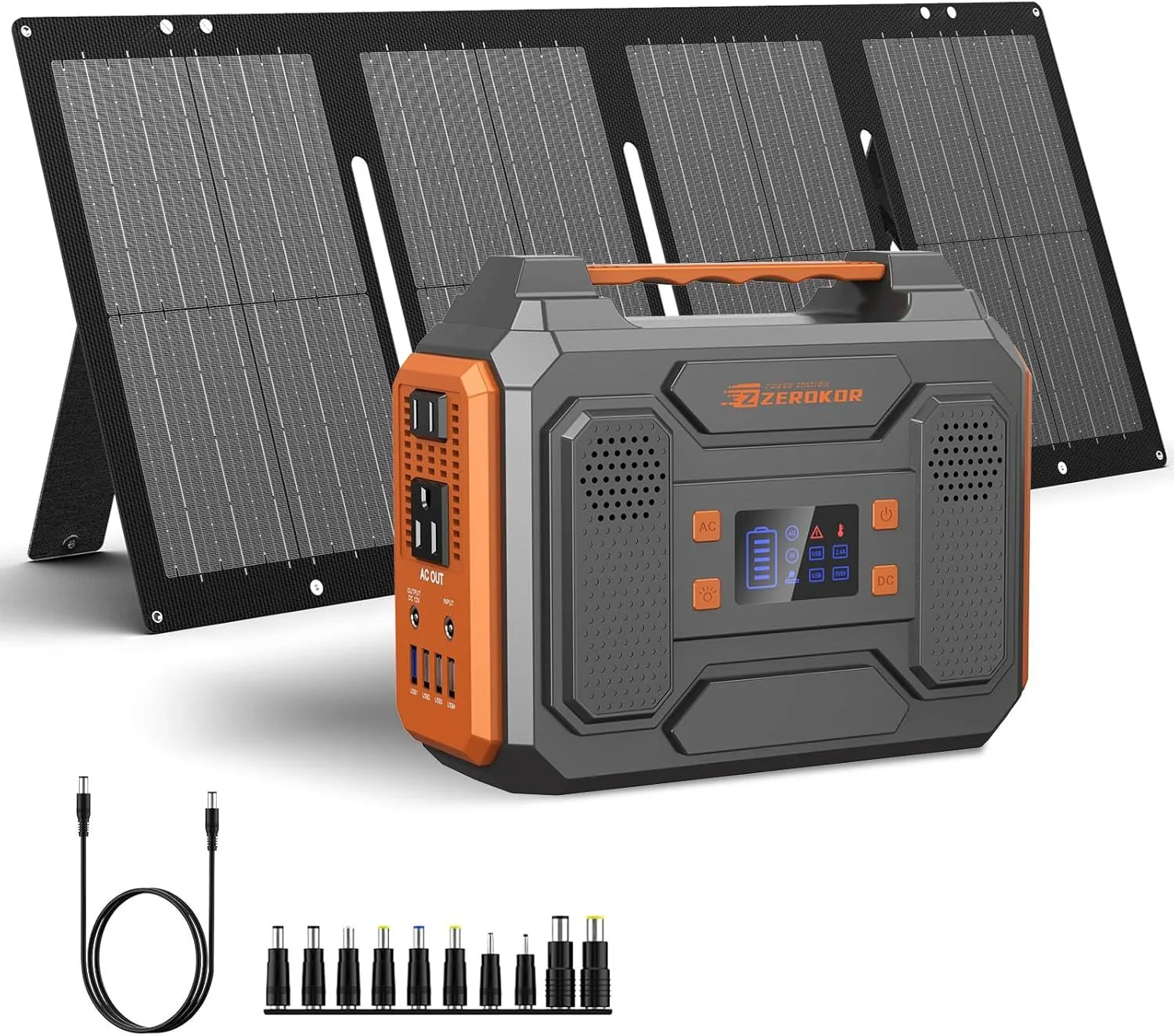
The Zerokor 300W wins on weight and price — 5 lbs and a bundled 60W panel for $177 is hard to match. But the slow charging, short-lived NMC battery, and 12-month warranty from a lesser-known brand mean buyers are trading long-term reliability for short-term savings. Good for occasional use, risky for daily reliance.
We researched 680+ Amazon ratings (as of 2026-01-29), 3 expert reviews, and comparison with 5 products in the Compact Portable Generators category. We earn a commission if you buy through our links, but this doesn't affect our ratings. Read our full methodology →
This review is based on analysis of 680+ Amazon ratings, expert reviews, and comparison with products in the Compact Portable Generators category. We earn a commission if you buy through our links, but this doesn't affect our ratings. Read our full methodology →
An Unknown Brand With Surprising Numbers
Zerokor is not a name that appears on any "best portable power brands" list. No booth at CES. No influencer partnership campaigns. No retail presence outside of Amazon. And yet the Zerokor 300W has accumulated 680+ Amazon reviews with a 4.2-star average — which puts its review count above the Arkpax Core 300W, the EBL 300W, and many products from established brands.
The product itself raises eyebrows before you even turn it on. At 5 lbs, it is the lightest power station in the entire compact portable class. The bundled 60W solar panel — with its own built-in USB and DC ports — makes this the cheapest complete solar kit we have reviewed. And the kit price sits at premium, undercutting LiFePO4 competitors by $30-70 depending on the comparison.
Those numbers tell one story. The specs sheet tells another. Lithium-ion NMC chemistry with 1,000 cycles. A 12-month warranty. Glacially slow 6-7 hour AC charging. Reports of dead-on-arrival units in Amazon reviews. The Zerokor 300W is a study in compromises — it wins on weight and price while losing on longevity and trust. The question is whether those compromises make sense for your use case.
Walk through the Amazon listing photos and you see a product designed for visual appeal: clean lines, an orange accent strip, a digital display that lights up with battery percentage and wattage draw. It looks like a miniature version of units that cost three or four times more. The physical build is middling — thin ABS plastic that flexes slightly under grip pressure, no rubber bumpers on the corners, and a carry handle that feels functional but not overbuilt. The display is readable in daylight but washes out in direct sun. For a budget kit, the presentation overperforms. For a camping tool that gets tossed in a truck bed, the durability is a question mark.
Five Pounds: Why the Weight Matters
Five pounds. Pick up a bag of flour. That is the Zerokor 300W. Carry it in one hand to the campsite. Toss it in a day pack without restructuring your load. Slide it into a carry-on for airline travel. The weight difference between the 5 lb Zerokor and the 9+ lb Anker SOLIX C300 or BLUETTI Elite 30 V2 is the difference between a product you grab without thinking and one you plan around.
The weight advantage comes from lithium-ion NMC chemistry. NMC cells pack more energy per gram than LiFePO4 — that is basic electrochemistry, not engineering magic. The Zerokor uses this density advantage to deliver 280Wh in a 5 lb package, while the LiFePO4-based EBL 300W needs approximately 7 lbs for its 268Wh. Comparable energy, 2 lbs lighter. For backpackers, cyclists, and anyone who carries their power station by hand over any distance, those 2 lbs add up.
Why is the Zerokor 300W so much lighter than competitors?
At 5 lbs, the Zerokor uses a lithium-ion NMC battery chemistry which is inherently lighter per watt-hour than LiFePO4. NMC cells have higher energy density — more energy packed into less weight. The cost is shorter cycle life (1,000 vs 3,000+ for LiFePO4) and less thermal stability. The lighter weight is a physics-driven advantage of the chemistry choice, not a design innovation.
The 60W Panel: More Than a Kit Filler
Bundled solar panels in budget kits are often afterthoughts — undersized, cheaply constructed panels that check a box on the product listing. The Zerokor's 60W panel is a genuine surprise. It is a folding monocrystalline panel with its own built-in USB-A, USB-C, and DC output ports. That means the panel functions independently as a solar charger for phones and tablets, even without the power station connected.
In direct sunlight, the panel pushes 42-50W of real output — a solid 70-83% of its rated capacity, which is normal for portable solar panels. Charging the 280Wh station from empty takes 5-6 hours of good sun. On partly cloudy days, output drops to 15-25W and charge times stretch to 8-10 hours or more. Under heavy overcast, solar charging becomes impractical. Temperature also plays a role: solar cell efficiency drops by roughly 0.4% per degree Celsius above 25C (77F). On a hot summer afternoon with the panel sitting on asphalt or a car hood, surface temperatures can push 60-70C, reducing output by 15-20% compared to a cool morning at the same sun angle.
Compared to the 40W panels bundled with the EBL 300W and Apowking 300W, the Zerokor's 60W panel provides roughly 50% more output in the same conditions. That translates to noticeably faster solar charging — a full charge in 5-6 hours versus 7-9 hours. For camping trips where sun exposure is limited to a few hours between activities, the larger panel recovers more energy during each window.
How much does the included 60W solar panel actually produce?
Under ideal conditions — direct overhead sun, clear sky, 70-80F ambient temperature — the 60W panel delivers 42-50W of actual output. Cloud cover drops this to 15-25W. Shade, suboptimal angles, and high temperatures reduce output further. Expect 5-6 hours for a full charge of the 280Wh battery in good sun. The panel itself has USB-A, USB-C, and DC outputs, so it doubles as a standalone device charger.
ZeroKor Strengths
- Lightest power station in the compact class at just 5 lbs — lighter than a gallon of milk for one-handed carry
- Bundled 60W solar panel at $177 makes this the cheapest complete solar kit — the panel alone has USB-A, USB-C, and DC outputs
- Handles practical loads well — users report powering 100W LED bulbs, charging DJI drones, and running laptop workstations
- Built-in LED flashlight with SOS mode adds emergency functionality the pricier Jackery Explorer 300 lacks entirely
ZeroKor Weaknesses
- Glacially slow 6-7 hour AC charging — the slowest wall charge time among all compact portables we reviewed
- Li-ion NMC battery with only 1,000 cycles is one-third the lifespan of LiFePO4 alternatives at similar prices
- User-reported reliability concerns — some Amazon reviews cite dead-on-arrival units and startup failures
- Only 12-month warranty — the shortest in the compact class, where Anker and BLUETTI offer 5 years
The 6-7 Hour AC Charge Problem
The Zerokor's slowest metric is its wall charging speed. At 6-7 hours from empty to full, it is the slowest AC charge time among every compact portable we reviewed. The Arkpax Core 300W charges in 1.5 hours. The BLUETTI Elite 30 V2 hits 80% in 45 minutes. The Anker SOLIX C300 reaches 80% in 50 minutes. Even the budget EBL 300W fills in 4-5 hours.
In practical terms, a 6-7 hour charge means you plug in the Zerokor before bed and unplug it in the morning. It cannot be quickly topped off during a lunch stop or between activities. For road trippers who refuel at rest stops, this is a real limitation. For campers who charge overnight at a powered campsite, it is a non-issue — the station charges while you sleep.
The charging bottleneck: The Zerokor uses an approximately 40W AC charger — less than a quarter of the Arkpax's ~180W charger. This is the primary reason for the slow charge time. A higher-wattage charger would add cost to a unit that competes on price, so Zerokor chose the slower, cheaper option. Buyers should weigh whether fast AC charging matters for their specific use pattern.
1,000 Cycles: The Lifespan Question
Battery cycle life is where the Zerokor makes its most controversial trade-off. At 1,000 cycles to 80% capacity, the NMC battery lasts roughly one-third as long as the 3,000+ cycle LiFePO4 batteries in the EBL 300W, Apowking 300W, and Arkpax Core 300W.
What does 1,000 cycles mean in practice? If you use and recharge the Zerokor once a week (typical for weekend camping), 1,000 cycles is about 19 years — long enough that the electronics will likely fail before the battery degrades. If you use it daily (van life, daily remote work), 1,000 cycles is about 2.7 years before the battery drops to 80% of its original capacity. Not dead — just holding 224Wh instead of 280Wh.
The cycle life matters most for heavy users. Weekend campers and occasional emergency users will never approach 1,000 cycles. Daily users, commuters, and van lifers will hit the wall within 3 years. At that point, the Zerokor's capacity decline becomes noticeable, and the 12-month warranty has long expired. The cost-per-cycle math favors LiFePO4 heavily — the Zerokor costs roughly four times more per charge cycle than the EBL 300W when you factor in total lifespan. For anyone who expects regular use over several years, that gap is decisive.
Is the Zerokor 300W reliable enough for emergency backup?
For occasional emergency use — power outages a few times a year — the Zerokor 300W can keep phones charged, run LED lights, and power a small radio for several hours. But its lithium-ion NMC battery with only 1,000 cycles and 12-month warranty make it a poor choice for dedicated emergency preparedness where you need a unit that sits charged and ready for years. LiFePO4 alternatives like the EBL 300W or Apowking 300W hold charge longer in storage and last 3x as many cycles.
The Reliability Reports: What Amazon Reviews Reveal
Among the 680+ Amazon reviews, the Zerokor 300W maintains a 4.2-star average. But the distribution curve is bimodal — a large cluster of 5-star reviews praising the weight and value, and a smaller but notable cluster of 1-star reviews reporting dead-on-arrival units, startup failures, and rapid capacity loss.
The most common complaints from negative reviews center on three issues. First, units that arrive dead and will not turn on — a quality control problem suggesting inconsistent factory testing. Second, the power station turning off unexpectedly under moderate load, possibly indicating an aggressive BMS protection threshold. Third, the solar charge controller accepting input erratically, sometimes refusing to charge from the included panel until the unit is power-cycled.
These issues are not universal — the majority of buyers report normal operation. But the pattern suggests that Zerokor's quality control allows a higher percentage of defective units to ship than what you would see from Anker, BLUETTI, or Jackery. The 12-month warranty provides recourse within the first year, but buyers who discover problems at month 13 are on their own.
Who This Kit Actually Serves
The Zerokor 300W makes the most sense for three specific buyer profiles, and falls apart for everyone else. Understanding which camp you fall into determines whether this is a smart purchase or a frustrating one.
The festival-goer: Three-day music festivals where you need phones charged, a Bluetooth speaker running, and LED strip lights for the tent. The 5 lb weight means it fits in your festival bag alongside everything else. The 280Wh battery covers three days of moderate phone and speaker use without needing a solar recharge. The included panel sits on your tent or car roof during the day as insurance. At the end of the weekend, you pack it up and do not think about it until the next event — which is exactly the low-frequency use pattern where the 1,000-cycle battery never becomes a concern.
The air traveler: At 280Wh, the Zerokor fits under the TSA's 300Wh carry-on limit. At 5 lbs, it adds minimal weight to your luggage. For photographers, remote workers, and digital nomads who need portable AC power during layovers, hotel rooms with limited outlets, or outdoor shoots — the Zerokor provides 300W of clean power in an airline-legal package. Most LiFePO4 competitors in the 280-300Wh range weigh 7-10 lbs and eat into your baggage allowance.
The emergency kit builder: A power station that sits in a closet for 50 weeks a year and comes out during a blackout. The Zerokor's NMC battery holds charge well in storage (2-3% drain per month), and the 12-month warranty covers the most likely failure window for a stored unit. The 60W panel provides a recharging path if the outage outlasts the battery. For this use case, the 1,000-cycle limit and slow AC charging are irrelevant — you will charge this unit a handful of times per year at most.
The Zerokor Gamble: Worth It or Not?
The Zerokor 300W is the cheapest complete solar generator kit we have reviewed, the lightest power station in its class, and it includes a surprisingly capable 60W panel. For budget-conscious occasional users who want solar charging without a separate panel purchase, the value proposition is hard to argue with. Five pounds, a capable panel, 280Wh of storage, and enough output for phones, laptops, and LEDs — all at an entry-level price.
But "cheapest" and "best value" are different things. The NMC battery's 1,000-cycle lifespan, the glacial 6-7 hour AC charge time, the 12-month warranty, and the elevated rate of quality control complaints from Amazon reviews all point to corners cut to reach the price point. Buyers are trading long-term reliability for short-term savings.
If you camp a dozen weekends a year and want the lightest, cheapest kit that includes a solar panel — the Zerokor delivers. If you need daily reliability, fast charging, or a unit that will perform consistently for 5+ years, spend the extra money on the EBL 300W (LiFePO4, 3,000 cycles, 2-year warranty) or the BLUETTI Elite 30 V2 (double the output, turbo charging, 5-year warranty). The Zerokor is a gamble that pays off for light users and goes sideways for heavy ones.
The Zerokor 300W wins on weight and price — 5 lbs and a bundled 60W panel for $177 is hard to match. But the slow charging, short-lived NMC battery, and 12-month warranty from a lesser-known brand mean buyers are trading long-term reliability for short-term savings. Good for occasional use, risky for daily reliance.
Best for: Budget-conscious campers who want the lightest power station with a bundled solar panel for weekend trips
Questions About the Zerokor 300W
What appliances can the Zerokor 300W actually run?
The 300W pure sine wave output handles: smartphones, tablets, laptops (via AC or USB), LED lights, portable fans, drone chargers, camera batteries, Bluetooth speakers, and small kitchen gadgets under 300W like a personal blender. It cannot run: hair dryers (1000-1800W), full-size blenders (600+W), space heaters (750-1500W), microwaves (700-1200W), or most portable AC units (500+W).
Does the Zerokor 300W have a warranty and customer support?
Zerokor offers a 12-month warranty — the shortest in the compact portable class. Anker and BLUETTI offer 5 years, EBL and Arkpax offer 2 years. Customer support is available through Amazon and email, but Zerokor does not have a dedicated support center or phone line. For warranty claims, you will work through Amazon customer service in most cases.
Can the Zerokor solar panel charge other devices directly?
Yes. The included 60W panel has its own USB-A, USB-C, and DC output ports built in. This means you can use the panel as a standalone solar charger for phones and tablets without connecting it to the power station at all — a useful feature if you want to charge gadgets during the day while keeping the station in reserve for nighttime use.