VTOMAN FlashSpeed 600 Portable Power Station Review 2026
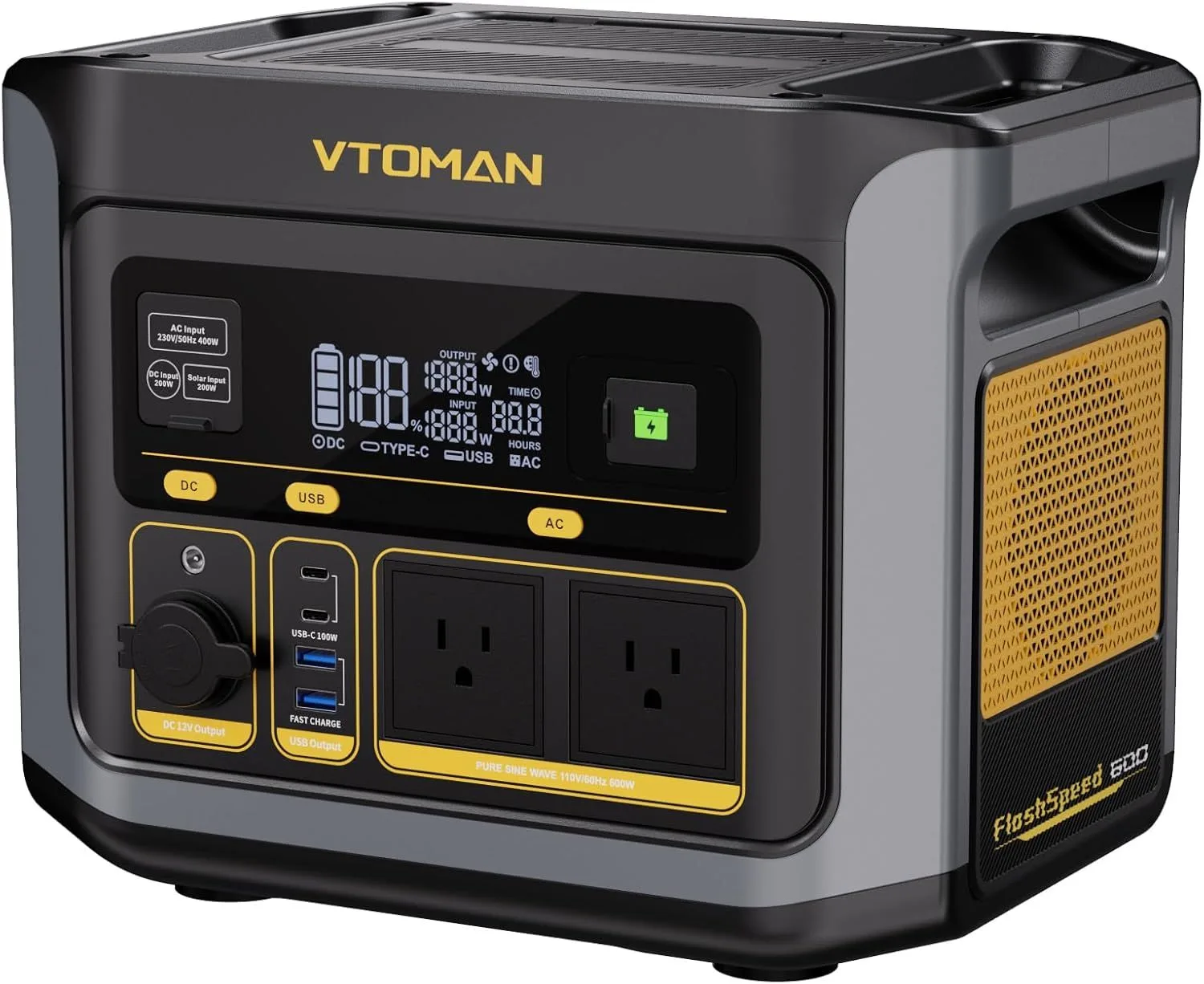
The VTOMAN FlashSpeed 600 fills the gap between compact portables and mid-range power stations — 499Wh of LiFePO4 at $300 with expansion to 2kWh. The 70-minute charge time and 200W solar input are excellent. But the bizarre power button, disappointing USB-C speeds, and noticeable fan noise reveal rough edges where VTOMAN prioritized specs over user experience.
This review is based on analysis of 1320+ Amazon ratings, expert reviews, and comparison with products in the Compact Portable Generators category. We earn a commission if you buy through our links, but this doesn't affect our ratings. Read our full methodology →
499Wh of LiFePO4 at a Compact Price
The VTOMAN FlashSpeed 600 sits in a gap that most manufacturers ignore. Below it, the 288-293Wh compact portables handle phone and laptop charging for a night or two. Above it, the 1,000Wh mid-range stations weigh 25+ lbs and cost twice as much. The FlashSpeed 600 splits the difference: 499Wh of LiFePO4 capacity in a package that weighs 15.9 lbs and charges from dead to full in 70 minutes.
That capacity number matters more than it looks on paper. At 499Wh, the FlashSpeed 600 holds nearly double the energy of the Jackery Explorer 300, the Anker SOLIX C300, and the BLUETTI Elite 30 V2 — all priced within the same general range. That extra capacity translates directly to real-world scenarios: two nights of CPAP instead of one, a full weekend of phone and laptop charging without solar, or running a camping mini fridge for 8-12 hours.
VTOMAN is not a household name. They do not have Jackery's retail presence or Anker's brand trust. But the FlashSpeed 600 represents an interesting bet: can a lesser-known brand win on specs and speed where established names coast on familiarity?
Answering Common FlashSpeed Questions Early
How fast does the VTOMAN FlashSpeed 600 charge from a wall outlet?
The FlashSpeed 600 charges from 0 to 100% in approximately 70 minutes using the included 400W AC adapter. The Gadgeteer independently confirmed this claim. That is faster than most mid-range power stations, let alone compact portables.
Speed Is the Story Here
The name is not subtle. "FlashSpeed" is a promise, and VTOMAN delivers on it. The 400W AC adapter fills the 499Wh battery from zero to full in approximately 70 minutes. The Gadgeteer tested this independently and confirmed the claim. To put that in context: the Jackery Explorer 300 — with 40% less capacity — takes 4 hours to charge. The Anker SOLIX C300 takes 70 minutes to reach only 80%, and it has 211Wh less capacity.
The 200W solar input is the other speed advantage. With dual input ports (Anderson and DC5521), the FlashSpeed 600 accepts a wider range of third-party panels than any other compact portable. A 200W panel in full sun can fill the battery in 2-4 hours depending on conditions. Jackery's proprietary connector limits you to 90W max. Anker's XT60 input caps at 100W. VTOMAN gives you twice the solar ceiling and standard connectors to access it.
But speed comes with an audible cost. The fan cycles every 10-15 minutes during charging and under moderate load — a click-whir-hum pattern that is barely noticeable outdoors but clearly audible in a quiet tent or bedroom. This is not the whisper-quiet 25dB experience of the Anker SOLIX C300. If you need silent nighttime operation for CPAP use, the fan cycling will wake you up. For camping use at a busy campsite, the noise blends into the background.
FlashSpeed 600 Pros
- 499Wh capacity is nearly double any other compact unit — charges a phone 40+ times or sustains a laptop for a multi-day weekend trip
- 70-minute full AC charge from dead — The Gadgeteer confirmed the 400W fast-charge claim, one of the fastest in any portable category
- Expandable to 2,047Wh by connecting to the FlashSpeed 1500 extra battery — turns a day-trip station into a multi-day off-grid system
- Broad 10-50V solar input with dual ports (Anderson + DC5521) accepts a wider range of third-party panels than Anker or Jackery
FlashSpeed 600 Cons
- No dedicated power button — The Gadgeteer called it "a bizarre design choice" that forces users to press output buttons to wake the station
- USB-C charging falls short of the 100W rating — TechWalls measured only 12W to an iPhone, while the AC outlet with a charger hit 22W
- Fan cycling every 10-15 minutes is noticeable indoors — audible click-whir-hum pattern that disappears outdoors but disrupts quiet spaces
- At 15.9 lbs, it is the heaviest "compact" unit — more than triple the Zerokor and double the Jackery Explorer 300
Watch: Watch VTOMAN FlashSpeed 600 Review

Why is there no dedicated power button on the VTOMAN FlashSpeed 600?
This is a design choice that frustrated multiple reviewers. Instead of a master power button, you wake the FlashSpeed 600 by pressing one of the output group buttons (AC, DC, or USB). The Gadgeteer specifically called this "a bizarre design choice." It works, but it is counterintuitive — especially when you just want to check the battery level without activating outputs.
The Expansion That Changes the Math
Here is where the FlashSpeed 600 separates itself from every other compact portable: expandability. Connect it to the VTOMAN FlashSpeed 1500 extra battery and total capacity jumps to 2,047Wh. No other compact unit under 500Wh offers this kind of upgrade path.
That expansion changes the use case entirely. A 499Wh station handles a weekend camping trip. A 2,047Wh system handles a multi-day off-grid expedition or a serious power outage at home. You buy the FlashSpeed 600 as your entry point, then expand if your needs grow — without replacing the entire unit.
The catch is cost. The extra battery is sold separately and is not cheap. But compared to buying a completely new 2,000Wh power station, the incremental expansion is more financially flexible. You spend the money when you need the capacity, not upfront.
Where the USB-C Falls Short
This is the FlashSpeed 600's most frustrating flaw. The spec sheet lists two USB-C ports at 100W. In practice, the power delivery is inconsistent. TechWalls tested iPhone charging through the USB-C port and measured just 12W — far below what even a basic 20W USB-C charger delivers. Using the same phone with a wall charger plugged into the AC outlet produced 22W. That means the AC outlet with a dedicated charger outperforms the supposedly faster USB-C port by nearly 2x.
The likely culprit is power delivery negotiation. The FlashSpeed 600's USB-C implementation does not consistently negotiate the highest available wattage with connected devices. It can deliver 100W to devices that explicitly request it (like a MacBook Pro), but many phones and tablets receive far less than they would from a simple wall adapter.
For a station that brands itself around speed, this USB-C performance undercuts the promise. If fast phone charging matters to you, plug your wall charger into the AC outlet instead of using the USB-C port directly.
The Missing Power Button
No master power button. You read that correctly. To wake the FlashSpeed 600, you press one of the output group buttons — AC, DC, or USB. The Gadgeteer called this "a bizarre design choice," and that assessment is accurate. Every other portable power station in our catalog has a master power button. The FlashSpeed 600 makes you activate an output group just to see the battery level on the screen.
In practice, this means you are always turning on outputs to interact with the unit. If you want to check how much charge remains without powering any ports, you cannot. The first interaction is always "turn something on." It works, and you get used to it after a few days. But it is a rough edge that suggests VTOMAN prioritized internal component layout over user interface.
LiFePO4 at 499Wh: What That Capacity Actually Powers
Battery chemistry matters as much as capacity numbers. The FlashSpeed 600 uses LiFePO4 cells rated for 3,000+ cycles to 80% capacity retention. At one cycle per day, that is over 8 years before any measurable degradation. Most camping and emergency users cycle far less frequently — maybe 50-80 times per year — pushing the practical lifespan well past a decade.
LiFePO4 also handles temperature swings better than the NMC lithium-ion used in the Jackery Explorer 300 and most budget compacts. The FlashSpeed 600 operates from 32°F to 113°F for discharge and 32°F to 104°F for charging. That range covers most real-world scenarios: a garage in Arizona summer, a car trunk in Colorado winter, or a storage bin in a Florida hurricane preparedness closet. NMC cells degrade faster at temperature extremes and carry a higher thermal runaway risk — neither concern applies to LiFePO4.
At 499Wh, the real-world runtime numbers break down clearly. A 12V mini fridge pulling 50W average runs for roughly 8-9 hours after inverter losses. A CPAP machine at 40W stretches to 10-11 hours through the DC port (bypassing the inverter saves 10-15% energy). Charging a MacBook Air (30W draw) gives you about 14 hours of continuous laptop use. Running a 100W LED work light delivers approximately 4.5 hours. For mixed use at a campsite — phone charging, LED lights, and a Bluetooth speaker — the 499Wh comfortably covers a full weekend without a recharge.
The Weight Question: Still "Compact"?
At 15.9 lbs, the FlashSpeed 600 pushes the definition of "compact portable." The Jackery Explorer 300 weighs 7.1 lbs. The BLUETTI Elite 30 V2 weighs 9.48 lbs. The Anker SOLIX C300 weighs about 9 lbs. The FlashSpeed 600 is nearly double the weight of its closest competitor in this class.
The extra weight makes sense given the extra capacity — 499Wh of LiFePO4 cells are physically heavier than 288Wh of the same chemistry. And 15.9 lbs is still portable by any reasonable definition. But if you are backpacking or carrying gear any distance from a parking lot, the weight difference adds up. This is a car-camping and tailgating unit, not a backcountry pack-in.
The dimensions tell a similar story. At 12.4 x 9.5 x 7.9 inches, the FlashSpeed 600 is physically larger than the 288Wh class units. It fits in a car trunk or on a camping table, but it will not slide into a backpack side pocket the way the Zerokor or Jackery can.
How the FlashSpeed 600 Stacks Up on Value
At one of the priciest in its class, the FlashSpeed 600 delivers the lowest cost per watt-hour of any compact portable in our catalog. The math is simple: you get 499Wh of LiFePO4 battery, 600W continuous output, 70-minute charging, 200W solar input, and expansion to 2,047Wh — all for what Jackery charges for 293Wh of NMC lithium-ion with no expansion option.
The comparison to its sibling, the VTOMAN Jump 600X, is telling. The Jump 600X costs more for 299Wh — 200Wh less capacity — plus slower charging, lower solar input, and the documented solar wake/sleep bug. See our FlashSpeed 600 vs Jump 600X comparison for the full breakdown. The Jump 600X bundles a solar panel and car jump starter, which add value for a specific buyer. But on raw power-station specs, the FlashSpeed 600 wins decisively.
Against the mid-range class, the FlashSpeed 600 is the bridge product. The UPOPOWER S1200 offers 1,190Wh for below average for its category, but it weighs 26 lbs and is not designed for portability. The EcoFlow DELTA 2 costs more for 1,024Wh but brings an app ecosystem, X-Boost, and expandability. If you need under 500Wh with the option to grow, the FlashSpeed 600 occupies that niche alone.
The build quality reflects VTOMAN's position as an emerging brand. The enclosure is functional ABS plastic — no rubberized corners, no premium textures, no design awards. The display is a basic LCD showing battery percentage and output wattage. It does the job, but next to an Anker or EcoFlow unit, the FlashSpeed 600 looks like what it is: an engineering-first product where the budget went into batteries and charging circuits rather than industrial design. For buyers who care about specs over aesthetics, that allocation makes sense. For buyers who want a product that looks premium on a shelf or in a living room, the FlashSpeed 600 is utilitarian at best.
Who Should Buy the VTOMAN FlashSpeed 600?
Rating: 4.4/5
The VTOMAN FlashSpeed 600 fills the gap between compact portables and mid-range power stations — 499Wh of LiFePO4 at $300 with expansion to 2kWh. The 70-minute charge time and 200W solar input are excellent. But the bizarre power button, disappointing USB-C speeds, and noticeable fan noise reveal rough edges where VTOMAN prioritized specs over user experience.
The FlashSpeed 600 is right for you if:
- You want more capacity than the 288Wh class without stepping up to a 25+ lb mid-range unit
- Fast wall charging (70 minutes to full) is a priority for between-trip turnarounds
- You own or plan to buy high-wattage third-party solar panels and need standard connectors
- You want the option to expand to 2,047Wh later without replacing your entire station
Look elsewhere if:
- Quiet nighttime operation matters — the fan cycling will bother light sleepers
- USB-C charging speed is critical — the AC outlet outperforms the USB-C ports
- You need the lightest possible unit — at 15.9 lbs, this is twice the weight of most compacts
- A dedicated power button is a basic expectation for you
Compare with the VTOMAN Jump 600X → | See all compact portable generators →
VTOMAN FlashSpeed 600 FAQ
Can the VTOMAN FlashSpeed 600 power a mini fridge?
Yes. Most 12V camping mini fridges draw 40-60W continuously. With 499Wh of capacity, the FlashSpeed 600 can run a typical mini fridge for 8-12 hours. A standard dorm-size fridge drawing 80-100W would last about 5-6 hours before the battery runs out.
What is V-Beyond surge technology?
V-Beyond is VTOMAN's marketing name for their surge handling system. It allows the FlashSpeed 600 to briefly handle loads up to 1,200W — double its 600W continuous rating. This lets it start compressor-based appliances like mini fridges that have a momentary startup spike. But sustained loads must stay under 600W or the unit will shut down.
Is the VTOMAN FlashSpeed 600 expandable?
Yes. The FlashSpeed 600 connects to the VTOMAN FlashSpeed 1500 extra battery to expand capacity up to 2,047Wh. This turns a compact unit into a multi-day off-grid system without buying a completely new power station. No other compact portable offers this kind of expansion.
How does the FlashSpeed 600 compare to the VTOMAN Jump 600X?
They share a brand name but target different buyers. The FlashSpeed 600 offers 499Wh (vs 299Wh), faster 70-minute charging (vs 3 hours), 200W solar input (vs 100W), and expandability. The Jump 600X bundles a solar panel and car jump starter. If you need raw power and speed, the FlashSpeed wins. If you need a multi-tool that also jump-starts vehicles, the Jump 600X has a unique feature set.
What warranty does VTOMAN offer on the FlashSpeed 600?
VTOMAN provides a 2-year warranty on the FlashSpeed 600. That is shorter than the 5-year coverage from Anker and BLUETTI, but matches most competitors in the compact portable class. VTOMAN customer support operates primarily through Amazon and email — not the phone-and-chat infrastructure that Anker or EcoFlow maintain. If long-term warranty coverage is a priority, Anker and BLUETTI offer better protection at a higher price point.
The Speed Demon's Downsides
The VTOMAN FlashSpeed 600 is a station built around two numbers: 499Wh and 70 minutes. Nearly double the capacity of its compact peers, charged from dead in just over an hour. That combination alone sets it apart in a crowded category where most units share the same 288Wh capacity and compete on smaller differentiators.
The trade-offs are real: fan noise that eliminates it from bedside duty, USB-C performance that does not match the spec sheet, a missing power button that annoys daily, and 15.9 lbs that pushes the "portable" designation. These are user-experience rough edges that established brands like Anker and Jackery have polished away through years of iteration.
But specs do not lie. At its price point, nothing else delivers 499Wh of LiFePO4, 200W solar input, expansion to 2,047Wh, and 70-minute charging. If raw capability per dollar is your metric, the FlashSpeed 600 wins the compact portable category outright. Just keep a USB wall charger handy for your phone.