VTOMAN FlashSpeed 1500 Portable Power Station Review 2026
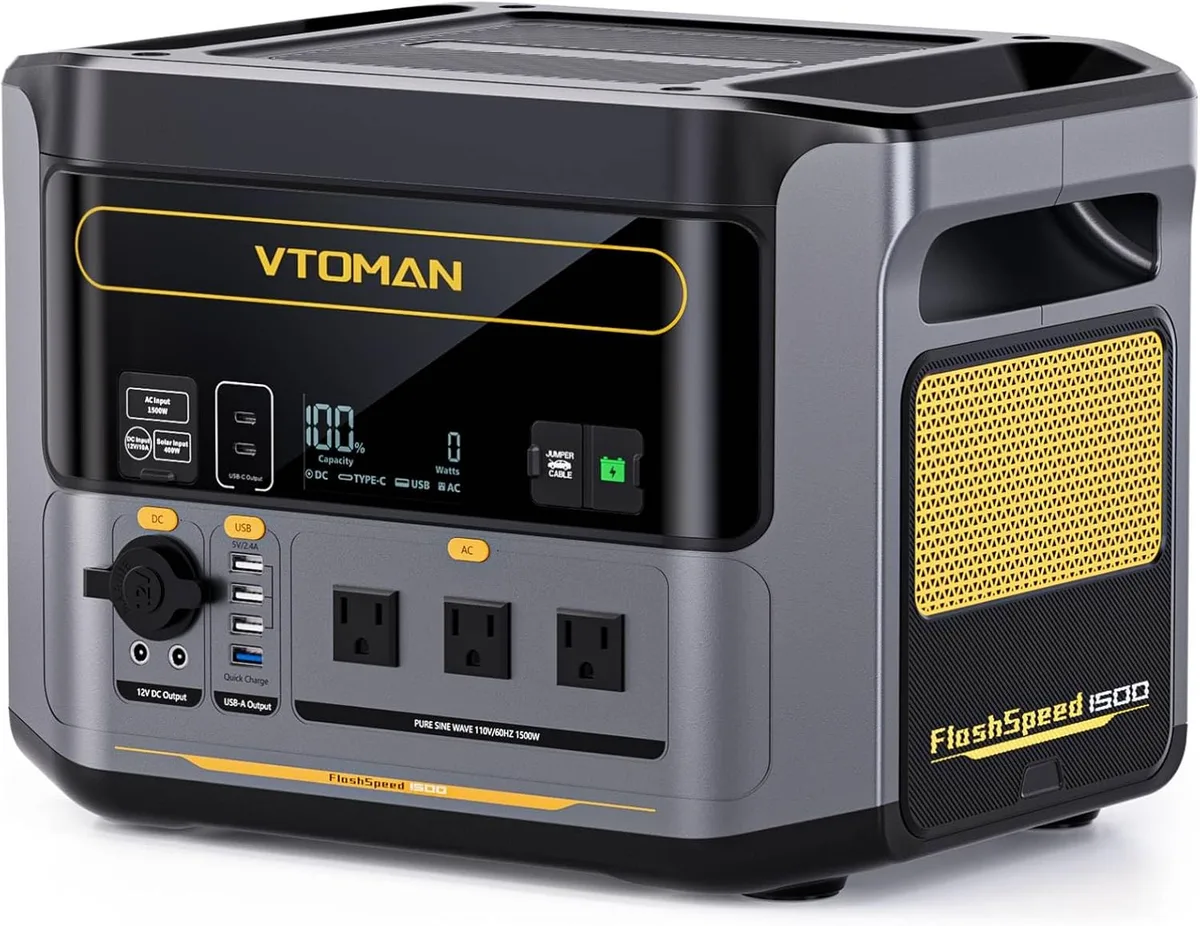
The VTOMAN FlashSpeed 1500 delivers more capacity and faster charging than anything near its price point. The 1,548Wh battery and sub-hour AC recharge embarrass units twice its cost. V-Beyond surge handling and expansion to 3,096Wh sweeten the deal. But the dim screen, loud fans, and reliability concerns keep it from worry-free status — this is a value play for buyers who prioritize speed and capacity over premium polish.
This review is based on analysis of 1200+ Amazon ratings, expert reviews, and comparison with products in the High-Capacity Power Stations category. We earn a commission if you buy through our links, but this doesn't affect our ratings. Read our full methodology →
The Budget Powerhouse That Charges in Under an Hour
The VTOMAN FlashSpeed 1500 delivers 1,548Wh of LiFePO4 battery for a budget-tier price — less than most 1,000Wh mid-range stations while packing 50% more capacity. That math is hard to argue with. Add a sub-hour wall charge that CNET ranked fastest among 90+ tested units, and you start to see why this station has carved out a loyal following among campers and budget-conscious preppers.
The 1,500W continuous inverter handles standard household loads — laptops, TVs, mini-fridges, CPAP machines. But the V-Beyond Technology pushes that to 3,000W for resistive appliances like space heaters and coffee makers. It is not magic — it works by managing voltage to the appliance — but it effectively doubles the useful output for the devices people actually want to run during outages.
Twelve output ports cover every charging scenario: three AC outlets, three USB-A, one Quick Charge USB-A, two USB-C at 100W each, two DC barrels, and a car socket. The flat-top design includes a recessed cable storage compartment — a practical touch that keeps cords organized during transport.
At 41.5 lbs, the FlashSpeed 1500 is not a grab-and-go portable. It is a semi-portable workhorse — the kind of unit you load into a truck bed, set in a camp kitchen, or park next to your circuit breaker during storms. The dual fold-down handles are sturdy but require two hands for a comfortable carry. For comparison, the Anker C1000 Gen 2 weighs 24.9 lbs with 1,024Wh — roughly 60% of the weight with 66% of the capacity. The VTOMAN trades portability for raw watt-hours-per-dollar performance.
VTOMAN positions itself as the value brand, and the FlashSpeed 1500 is their flagship argument. Their smaller FlashSpeed 600 serves as a lighter option for day trips. The company has been shipping portable power stations since 2021 and has built a reasonable Amazon presence. But they lack the retail distribution of Jackery (Best Buy, Costco, Home Depot) and the consumer electronics pedigree of Anker. You are buying from a power-station-only brand with a shorter track record — which is why warranty length and post-sale support matter more here than with an established name.
What Works and What Doesn't
✓ Strengths
- ✓ Sub-hour AC charging (0-100% in ~67 minutes) — CNET called it the fastest among 90+ portable power stations tested
- ✓ Outsized 1,548Wh battery dwarfs most 1500W competitors that typically ship with ~1,000Wh cells
- ✓ V-Beyond Technology powers resistive loads up to 3,000W — space heaters, coffee makers, and toasters run reliably
- ✓ Flat-top design with cable storage compartment and stackable form factor with the expansion battery
✗ Weaknesses
- ✗ LCD screen is frustratingly dim — difficult to read outdoors and sometimes even indoors, with no ETA-to-empty display
- ✗ Cooling fans run noticeably loud during charging and high-output operations
- ✗ Inverter efficiency around 80% under sustained load — below the 85%+ that premium competitors achieve
- ✗ Mixed reliability reports on Trustpilot with a shorter 2-year warranty than most competitors in this tier
Charging Speed and Real-World Efficiency
The headline number is real: 0-100% in about 67 minutes from a wall outlet. CNET's lab testing confirmed 0-50% in 33 minutes and 0-80% in 53 minutes. That is faster than the Anker SOLIX F2000 (which takes over an hour for 2,048Wh) and far faster than the BLAVOR 1600W (3.5+ hours). For users who need a quick top-up before heading out, the FlashSpeed 1500 earns its name. The fast-charging circuitry does generate noticeable heat and fan noise during the 1,500W wall charge — this is expected behavior, not a defect, but it means you will hear the unit working hard during that 67-minute sprint.
Solar input maxes out at 400W through the Anderson connector (30-60V range). With a 400W panel, expect about 4 hours from empty to full — roughly twice as long as the AC option. The Anderson port is reliable but less common than the XT-60 and MC4 connectors used by Anker and EcoFlow panels, which means you may need an adapter for third-party panels.
The dim LCD screen is a real frustration. PhoneArena flagged it as hard to read outdoors, and The Gadgeteer's biggest complaint was the missing ETA-to-empty readout. You get a percentage and input/output wattage, but you have to estimate how long your devices will run. In 2026, at any price, this feels like a cost-cutting decision that hurts the daily experience.
No companion app exists for the FlashSpeed 1500 — all monitoring and control happens through the physical LCD and buttons on the unit itself. Anker, Jackery, and EcoFlow all offer smartphone apps with remote monitoring, scheduled charging, and firmware updates. The VTOMAN approach is simpler (no Bluetooth pairing headaches, no app permission requests), but you lose the ability to check battery status from across the campsite or schedule off-peak charging from your couch. For tech-forward users, the missing app is a step backward. For buyers who prefer physical controls without software complications, it is a non-issue.
V-Beyond in Practice: Which Appliances Actually Work?
V-Beyond Technology is the feature that most confuses first-time buyers, so here is the practical breakdown. The 1,500W continuous inverter limits motor-driven devices (compressors, power tools, vacuum cleaners) to 1,500W. V-Beyond doubles that limit to 3,000W specifically for resistive loads — appliances that convert electricity directly to heat without a motor. Space heaters, coffee makers, toasters, electric kettles, hair dryers, and curling irons all qualify.
In practice, a 1,500W space heater runs through V-Beyond without issue. A 1,800W hair dryer runs, but the reduced voltage means it blows slightly less hot — functional but not at full performance. A 2,500W induction cooktop works through V-Beyond for short cook sessions, though extended use at near-maximum draw heats up the inverter and triggers the fan to a loud whir. CNET tested a 2,600W dryer element and confirmed operation, but noted audible strain from the cooling system.
What V-Beyond cannot do: run a 1,800W power tool (motor-driven, not resistive), start a refrigerator compressor drawing 2,000W surge (motors need full voltage for startup torque), or power a window AC unit rated above 1,500W. If your primary need involves motor-driven appliances above 1,500W, the Anker C1000 Gen 2 at 2,000W continuous or the pecron F3000LFP at 3,600W are better options.
Camping and Home Backup Scenarios
For extended car camping, the FlashSpeed 1500's 1,548Wh battery provides serious endurance. A typical camp setup — 12V fridge (45W), LED string lights (10W), phone charging (20W), and a portable fan (15W) — draws about 90W combined. At that rate, the battery lasts roughly 13-14 hours through the night. A 400W solar panel during 5-6 hours of daytime sun recovers most of what you used overnight. The math works for indefinite summer camping without shore power.
Home backup during winter storms is where the V-Beyond feature earns its keep. A 1,500W space heater running through V-Beyond drains the battery in about 1 hour — not enough for overnight warmth. But cycling the heater on a timer (15 minutes on, 45 minutes off) to maintain room temperature in a well-insulated room stretches that to 4 hours of intermittent heating. Combined with blankets and layering, the FlashSpeed 1500 provides real emergency warmth when grid power fails. Add a 200W solar panel during daylight hours and you extend that window further.
Off Road Xtreme tested the unit during a 5-day overland trip and praised the flat-top cable compartment as "the best cord management solution on any power station we've tested." Small detail, big quality-of-life improvement. Every other station in this class leaves you wrapping the AC cable around the body or stuffing it in a separate bag. The recessed compartment holds the AC adapter, solar cable, and a USB cable without adding any bulk to the station's footprint.
Build Quality and Expansion
The unit feels solid at 41.5 lbs. Dual fold-down handles provide a secure grip, and the flat-top design isn't just aesthetic — it allows the expansion battery to stack directly on top, creating a clean two-unit tower. TechWalls praised the build quality after several months of regular use, noting no rattles, loose ports, or cosmetic degradation.
Adding the expansion battery doubles capacity to 3,096Wh — putting the system in the same territory as standalone 3,000Wh units that cost twice as much. The expanded setup maintains the 1,500W continuous output (it adds capacity, not power), but for extended outages or multi-day camping, the extra energy reserve is substantial.
The port count of 12 is generous for the price tier. Three AC outlets handle simultaneous appliance use — a mini-fridge, a laptop charger, and a phone charger all at once without an adapter strip. Two 100W USB-C ports charge modern laptops at full speed, matching the Anker C1000's output. The DC barrel ports are useful for 12V devices like camping lights and tire inflators. One omission: no Anderson power connector for direct-wiring into RV or van electrical systems. If you plan an RV install, you will need an adapter or a station with built-in Anderson ports like the FOSSiBOT F2400.
The 3,000W peak surge rating handles motor startup loads for standard household compressors — most refrigerators draw 800-1,200W surge on startup, well within the 3,000W envelope. What the peak surge cannot handle: large well pumps, heavy-duty shop tools, or multiple motor loads starting simultaneously. The FlashSpeed 1500 is best treated as a single-circuit backup rather than a whole-house solution. For multi-circuit coverage, step up to the pecron F3000LFP at 3,600W continuous.
The Warranty Question
The 2-year warranty is the shortest in our high-capacity lineup. Anker offers 5 years. EcoFlow offers 5 years. Jackery offers 3-5 years. VTOMAN's 2-year coverage feels thin for a unit that buyers expect to last 8+ years based on its 3,000-cycle battery rating. That mismatch between expected lifespan and warranty length raises a simple question: if VTOMAN is confident in the LiFePO4 cells lasting 3,000 cycles, why not back it for at least 3 years? The short coverage period is the single biggest hesitation point for budget-minded buyers who would otherwise choose this station without a second thought.
Professional reviewers report solid build quality, but Trustpilot shows some concerning patterns — error codes appearing after months of use, units failing under specific load conditions. This does not mean every unit has problems, but the shorter warranty combined with mixed user reports makes it a factor worth weighing against the price savings. VTOMAN's customer service is email-based with response times averaging 24-48 hours — adequate but slower than Anker's phone support and chat options. For buyers who value quick resolution when something goes wrong, the warranty gap and support speed are tangible risks that the lower purchase price does not eliminate.
Is the FlashSpeed 1500 the Right Buy?
Our Verdict: 7.5/10
The VTOMAN FlashSpeed 1500 delivers more capacity and faster charging than anything near its price point. The 1,548Wh battery and sub-hour AC recharge embarrass units twice its cost. V-Beyond surge handling and expansion to 3,096Wh sweeten the deal. But the dim screen, loud fans, and reliability concerns keep it from worry-free status — this is a value play for buyers who prioritize speed and capacity over premium polish.
Buy it if: You want the most watt-hours per dollar with the fastest AC charging available. The 1,548Wh battery, sub-hour charge, and V-Beyond 3,000W surge make this the clear value leader in the 1,500W class. Expandability to 3,096Wh future-proofs the investment. Weekend campers, tailgaters, and emergency preparedness buyers who prioritize capacity and speed over brand polish will find nothing better at this price.
Skip it if: Warranty and brand confidence matter more than raw specs. The 2-year coverage and mixed long-term reliability reports mean you are taking on more risk than you would with Anker or EcoFlow. If the dim screen and loud fans are dealbreakers, consider the OUPES Mega 1 or Anker C1000 Gen 2 — they cost more per watt-hour but deliver a more polished experience.
FlashSpeed 1500 FAQ
How fast does the VTOMAN FlashSpeed 1500 charge from a wall outlet?
From empty to full in approximately 67 minutes via 1,500W AC input. CNET clocked it as the fastest charging portable power station among 90+ models tested. It hits 50% in about 33 minutes and 80% in 53 minutes — fast enough for a mid-day top-up before heading out.
What is V-Beyond Technology and how does it work?
V-Beyond is VTOMAN's proprietary power management that allows the 1,500W inverter to handle resistive loads up to 3,000W. It works by managing voltage to devices like space heaters, coffee makers, and toasters that don't have motors. Inductive loads (compressors, power tools) are still limited to the 1,500W continuous rating.
Can the VTOMAN FlashSpeed 1500 be expanded with extra batteries?
Yes — the FlashSpeed 1500 Extra Battery expands total capacity from 1,548Wh to 3,096Wh. The expansion battery stacks on top of the main unit thanks to the flat-top design. This puts the expanded system squarely in the 3,000Wh tier at a fraction of the cost of standalone 3kWh units.
Is the VTOMAN FlashSpeed 1500 reliable long-term?
Reliability reports are mixed. Professional reviewers like CNET, TechWalls, and Off Road Xtreme praised build quality after months of testing. But Trustpilot shows some concerning reports of error codes and early failures. The 2-year warranty is shorter than Anker's 5-year and EcoFlow's 5-year offerings in the same tier. Factor in the warranty difference when comparing value.
How does the FlashSpeed 1500 compare to the VTOMAN FlashSpeed 600?
The FlashSpeed 1500 offers 2.5x the battery capacity (1,548Wh vs 600Wh), 2.5x the continuous output (1,500W vs 600W), V-Beyond 3,000W surge capability, and expandability. The FlashSpeed 600 is a compact portable unit at 16.1 lbs; the 1500 is a semi-portable workhorse at 41.5 lbs. Different tools for different jobs — the 600 is for day trips, the 1500 is for extended camping and home backup.
Can the FlashSpeed 1500 run a portable air conditioner?
Small portable AC units drawing 800-1,200W run fine on the 1,500W continuous inverter. Larger units drawing 1,500W+ sit right at the limit and may trip the overload protection during sustained use. Window AC units with compressors exceeding 1,500W startup surge will not work — V-Beyond does not apply to motor-driven loads. For reliable AC cooling, you need a station with at least 2,000W continuous output like the Anker C1000 Gen 2 or the FOSSiBOT F2400.
How long does the VTOMAN FlashSpeed 1500 last in storage?
LiFePO4 batteries self-discharge at about 3-5% per month. A fully charged FlashSpeed 1500 stored at room temperature will retain about 70-80% charge after 6 months without use. VTOMAN recommends storing the unit between 40-80% charge in a cool, dry location. Recharge every 3-4 months during extended storage to prevent the battery management system from entering a low-voltage protection state, which requires a wall-outlet reset to clear.
Speed and Value Over Polish
The VTOMAN FlashSpeed 1500 is the best capacity-per-dollar play in the portable power station market. Fastest charging, outsized battery, expandable design, and V-Beyond surge handling — all at a price that undercuts the competition. The trade-offs are real: a dim screen, loud fans, shorter warranty, and some reliability question marks. For buyers who do the math and prioritize raw performance value, this is hard to beat.