pecron F3000LFP Portable Power Station Review 2026
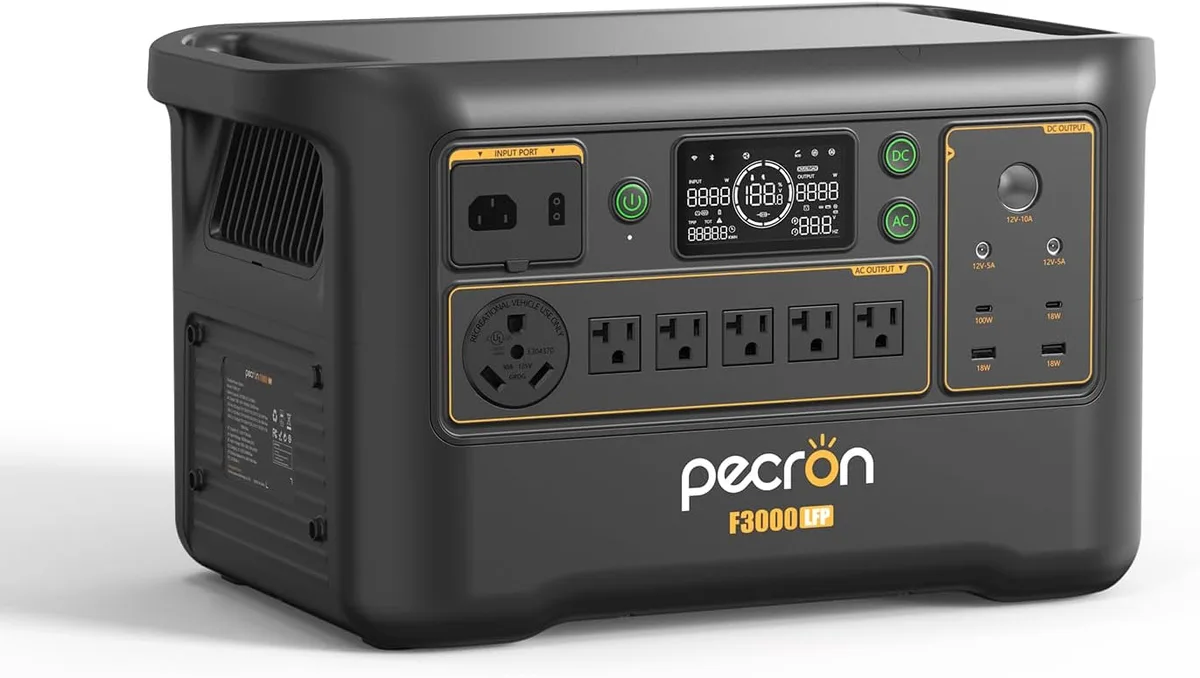
The pecron F3000LFP is the price-to-performance champion of the high-capacity class. It delivers 3,072Wh and 3,600W output at a price that embarrasses premium brands. The 1,600W solar input and true 30A plug make it a genuine RV and off-grid workhorse. The 63-lb weight means it stays put once placed and the app needs work, but for raw power per dollar, nothing else comes close.
This review is based on analysis of 250+ Amazon ratings, expert reviews, and comparison with products in the High-Capacity Power Stations category. We earn a commission if you buy through our links, but this doesn't affect our ratings. Read our full methodology →
The Value Play That Embarrasses Premium Brands
The pecron F3000LFP delivers 3,072Wh of LiFePO4 battery, 3,600W continuous output, a true 30A NEMA TT-30 plug, and 1,600W solar input — all at a price that undercuts the Anker SOLIX F2000 while delivering 50% more capacity and 50% more output. The Solar Lab put it bluntly: the F3000LFP "beats power stations from more established and premium brands like Jackery and Anker." See how it stacks up in our pecron F3000LFP vs GROWATT HELIOS 3600 comparison.
This is not a station that wins on fit and finish. The app is rough, the idle draw is above average, and at 63 lbs it stays wherever you put it. But on the metrics that matter for home backup and RV use — capacity, output, solar input, and price — the F3000LFP is in a category of one. The 3,600W continuous inverter runs power tools, RV air conditioners, and full-size kitchen appliances — loads that trip the protection on most 2,000-2,400W competitors.
Thirteen ports handle most scenarios: five standard AC outlets, the standout 30A NEMA TT-30 plug, two USB-C at 100W, two USB-A at 18W, a car port, and two DC5525 barrels. The 30A plug is the feature that separates this from nearly every competitor — plug it directly into your RV's shore power inlet with no adapter. That alone makes it the default choice for RV owners who boondock.
pecron has been manufacturing portable power stations since 2017 — longer than many of the "challenger brands" in the space. Their product line spans from 300Wh portables to the 3,000Wh F3000LFP, and they have carved out a niche among the DIY solar community and RV forums. They lack the retail storefront presence of Jackery and the consumer electronics halo of Anker, but their engineering team clearly understands what high-capacity buyers want: more watts, more watt-hours, and a proper RV connection — all at a price that leaves money in the budget for solar panels.
The physical design is utilitarian. No rounded corners or premium textures here — this is a rectangular metal-and-plastic box with a large front LCD display, heavy-gauge carrying handles, and wheels on the bottom. Yes, wheels. At 63 lbs, the F3000LFP is the only station in our high-capacity lineup that ships with integrated wheels, and you will appreciate them every time you move the unit between your garage and your RV. The wheels are small — think rolling cooler, not suitcase — but they turn a two-person lift into a one-person roll. Every competitor in this weight class should copy this design choice.
The Honest Assessment
✓ Strengths
- ✓ Best value in the 3kWh class — lowest cost per watt-hour in the category, undercutting premium brands by hundreds of dollars
- ✓ True 30A NEMA TT-30 outlet for direct RV hookup without adapters — a standout feature most competitors lack
- ✓ Massive 1,600W solar input — the highest in its class, confirmed at full capacity by The Solar Lab
- ✓ 83% efficiency at sustained 3,600W output with reliable 4,500W surge handling for compressor startups
✗ Weaknesses
- ✗ Heavy at 63 lbs — a stationary or vehicle-transported unit that requires two-person lifting
- ✗ 37W idle power draw is higher than modern competitors pulling single-digit watts in standby
- ✗ Bluetooth app gives false readings off-grid — WiFi connectivity works better but requires network access
- ✗ No battery charge level limits for optimizing longevity — cannot set minimum or maximum charge cutoffs
3,600W Under Load: What The Solar Lab Measured
To understand what those watt-hours mean in practice, consider The Solar Lab's sustained 3,600W load test which measured 83% efficiency — "really respectable for a budget LiFePO4 power station." That means 3,072Wh of battery delivers roughly 2,550Wh of usable AC power. The unit held 3,600W continuously without tripping and tolerated a 4,500W surge for approximately 10 seconds — enough for refrigerator compressors, AC units, and power tool startups.
A DIY Solar Forum member connected the F3000LFP to their RV via the 30A plug and ran the air conditioner, refrigerator, microwave, and lighting during a 2-day boondocking trip in Arizona. With 1,600W of rooftop solar, the battery never dropped below 40% during daytime. The full 3,600W output handled the AC compressor startup without hesitation — something their previous 2,400W station could not manage. The 4,500W surge tolerance is what makes this possible. An RV air conditioner can pull 2,800-3,500W for the first 2-3 seconds when the compressor kicks in, and most stations in the 2,000W class either trip their overload protection or refuse to start the load entirely. The pecron absorbs those spikes without breaking stride, and that difference between "rated for 3,600W" and "actually handles 4,500W startup surges" is the gap between a spec-sheet station and a real-world performer.
Solar Input: 1,600W Changes the Off-Grid Equation
Most high-capacity competitors cap solar input at 500-1,000W. The F3000LFP accepts 1,600W of solar input through its XT60-to-MC4 connector with a 25-120V input range. The Solar Lab confirmed hitting the full 1,600W from a 2,000W panel array on a sunny day. A full recharge from solar takes roughly 2.5 hours under optimal conditions — half the time of competitors with 800W solar ceilings.
AC charging brings the battery from empty to full in about 2 hours via the 1,800W wall input. During a winter ice storm, one owner ran their home's essential circuit — refrigerator, furnace blower, router, and lights — for over 24 hours on a single charge. When power briefly returned, the 1,800W AC input brought the battery from 15% back to full in just over 2 hours, ready for the next potential outage.
Dual charging works simultaneously — AC and solar inputs can operate at the same time, pushing total input up to 3,400W combined. On a partly cloudy day where solar harvest fluctuates between 600W and 1,200W, supplementing with AC input from a generator or wall outlet keeps the battery filling at maximum speed. This dual-input capability is standard on most high-capacity stations, but the sheer wattage ceiling on both inputs (1,800W AC + 1,600W solar) gives the pecron faster combined recharge times than anything in its price class.
The 5,000-cycle battery rating at 80% depth of discharge is the highest longevity spec in our high-capacity lineup. At one full cycle per day, the LiFePO4 cells retain 80% capacity for 13.7 years. Even aggressive daily cycling for whole-home backup or off-grid cabin use leaves you with a decade of reliable service before capacity noticeably degrades. Competitors like the Anker SOLIX F2000 rate at 3,500 cycles, and the GROWATT HELIOS 3600 at 3,500 cycles. The pecron's battery chemistry and BMS tuning are a genuine long-term advantage that offsets concerns about the brand's newer market presence.
The App Problem and the Expansion Opportunity
The pecron app works over both Bluetooth and WiFi, but Bluetooth connectivity is unreliable off-grid. DIY Solar Forum users reported false readings during camping use — showing incorrect charge percentages and output wattage. WiFi mode works better but requires network access, which defeats the purpose for off-grid use. pecron needs to fix the Bluetooth stack. For now, rely on the built-in LCD screen for accurate readings when off-grid.
On the expansion side, the F3000LFP supports up to two EP3000-48V expansion batteries for a total of 9,216Wh. A fully expanded system delivers the lowest cost per watt-hour of any expandable station in the portable power station market. For a cabin or RV that needs multi-day autonomy, the expansion path makes the F3000LFP a foundation you build around.
The front LCD panel displays battery percentage, input/output wattage, active port indicators, and estimated time remaining. The screen is adequately bright for indoor use and readable at oblique angles, though in direct sunlight it washes out slightly. Physical power buttons for AC, DC, and USB circuits let you disable unused output groups to reduce idle drain — a practical detail when you only need the 12V port overnight and want to keep the AC inverter off. Most competitors require app-based or menu-based switching to toggle individual output groups, which is slower when your hands are full.
Home Backup and Off-Grid Cabin Use
At 3,072Wh, the F3000LFP is sized for real home backup — not just keeping phones charged during a 4-hour flicker. A standard household refrigerator (100-200W cycling average), a WiFi router (12W), four LED bulbs (40W total), and a laptop (65W) pull roughly 250-320W combined. At that load, the F3000LFP runs your essential circuit for 8-10 hours on a single charge. That covers a full overnight outage with capacity to spare for morning coffee (if you have a low-watt drip machine at 600-800W).
For extended multi-day outages — ice storms, hurricanes, prolonged grid failures — the 1,600W solar input changes the equation. With 1,600W of rooftop panels, a sunny 5-hour day produces roughly 5-6kWh of solar harvest (accounting for panel efficiency and angle losses). That exceeds the daily consumption of a rationed essential circuit, meaning you can run indefinitely on solar alone during sunny weather. Cloudy days cut harvest by 50-70%, so having the full 3,072Wh buffer absorbs 1-2 overcast days before you need to conserve.
Off-grid cabin builders have adopted the F3000LFP as a starter battery bank. Unlike traditional lead-acid battery banks that require charge controllers, fuse boxes, and wiring knowledge, the pecron is a plug-and-play system. Connect your solar panels to the XT60 input, plug your cabin's essential outlets into the AC ports, and you have a functional off-grid electrical system. It is not a permanent solution — a proper battery bank with a hybrid inverter scales better for full-time off-grid living — but for weekend cabins, hunting lodges, and seasonal shelters, the pecron gets you running in an afternoon instead of a weekend of electrical work.
Should You Buy the pecron F3000LFP?
Our Verdict: 8.0/10
The pecron F3000LFP is the price-to-performance champion of the high-capacity class. It delivers 3,072Wh and 3,600W output at a price that embarrasses premium brands. The 1,600W solar input and true 30A plug make it a genuine RV and off-grid workhorse. The 63-lb weight means it stays put once placed and the app needs work, but for raw power per dollar, nothing else comes close.
Buy it if: You want maximum capacity and output per dollar. The 3,072Wh battery, 3,600W output, true 30A plug, and 1,600W solar input at a budget-tier price is a combination no competitor matches. RV boondockers, home backup planners, and off-grid cabin owners get more usable power for less money than any alternative. The expandability to 9,216Wh means you can start with the base unit and scale up as your needs grow — the cheapest path to a 9kWh portable battery bank on the market.
Skip it if: App quality, brand reputation, and low idle draw matter to you. The Anker SOLIX C2000 Gen 2 has 9W idle, a polished app, and Anker's 5-year warranty track record. The EcoFlow DELTA 3 MAX includes a solar panel. Both cost more per watt-hour, but deliver a more refined ownership experience. If portability matters — anything you need to lift regularly — the 63 lbs is a real obstacle. The Anker SOLIX F2000 at 67 lbs is similar, but lighter options in the 2,000Wh range start at 40-50 lbs.
Common Questions About the pecron F3000LFP
Is pecron a reliable power station brand?
pecron has been manufacturing portable power stations since 2017 and has a growing presence on Amazon with generally positive reviews. They are not as established as Anker or EcoFlow, but The Solar Lab specifically noted the F3000LFP "beats power stations from more established and premium brands like Jackery and Anker" on raw specs and value. The 5-year warranty (2+3 with registration) provides reasonable coverage. The main risk is app quality and customer support — larger brands have more mature ecosystems.
Can the pecron F3000LFP power an RV air conditioner?
Yes. The true 30A NEMA TT-30 outlet connects directly to a standard RV shore power inlet. A DIY Solar Forum member ran their RV air conditioner, refrigerator, microwave, and lighting during a 2-day boondocking trip in Arizona. The 3,600W continuous output and 4,500W surge handled the AC compressor startup without tripping — something that 2,400W stations cannot reliably do. With 1,600W of rooftop solar, the battery never dropped below 40% during daytime.
How does the pecron F3000LFP compare to the Anker SOLIX F2000?
The F3000LFP delivers 50% more capacity (3,072Wh vs 2,048Wh), 50% more output (3,600W vs 2,400W), and 60% more solar input (1,600W vs 1,000W) for $100 less ($800 vs $900). The Anker wins on brand reputation, app quality, build refinement, and lighter weight (67 lbs vs 63 lbs — close). If raw specs and value drive your decision, the pecron wins. If brand trust and polish matter more, the Anker F2000 or C2000 Gen 2 are safer bets.
What is the idle power draw and does it matter?
The Solar Lab measured 37W idle draw — meaning when the unit is on but nothing is plugged in, it consumes 37 watts continuously. Over a 3-day weekend without load, that drains roughly 2.6kWh — about 85% of a small power station's entire battery. For daily use or short outages, 37W is negligible. For multi-day storage without use, turn the unit off. Modern premium units like the Anker C2000 Gen 2 pull just 9W idle — a significant difference for standby scenarios.
Can the pecron F3000LFP be expanded with extra batteries?
Yes — pecron offers EP3000-48V expansion batteries that connect to the main unit. With two expansion batteries, total capacity reaches 9,216Wh — enough for 2-3 days of whole-home essential loads. The expansion batteries stack or sit adjacent to the main unit. The fully-expanded system delivers the best cost-per-watt-hour expansion value in the portable power station market.
How heavy is the pecron F3000LFP and can one person move it?
At 63 lbs, the F3000LFP is the heaviest station in our lineup. The integrated wheels on the bottom and sturdy top handles make it manageable for one person on flat surfaces — roll it like a heavy cooler. Getting it in and out of a truck bed or up stairs requires two people. For RV use, most owners load it once and leave it in place near the shore power inlet. Compare this to the GROWATT HELIOS 3600 at 77.2 lbs, which is even heavier and does not include wheels.
Does the pecron F3000LFP work with third-party solar panels?
Yes. The solar input uses an XT60-to-MC4 connector, which is compatible with most major-brand solar panels including those from Renogy, BougeRV, and Rich Solar. The input range is 25-120V at up to 1,600W. For maximum solar harvest, pair it with four 400W panels wired in a 2S2P configuration (two series strings of two panels each). Confirm your panel array voltage stays within the 25-120V window before connecting.
Raw Power, No Pretense
The pecron F3000LFP does not try to be elegant. It is a 63-lb box that delivers 3,072Wh and 3,600W at a price that makes premium brands look overpriced. The true 30A plug, 1,600W solar input, and expandability to 9,216Wh make it a genuine workhorse for RV owners, cabin builders, and anyone who prioritizes capacity over brand cachet. Fix the app, lower the idle draw, and pecron has a category killer. Even without those fixes, the value proposition is hard to argue with.
The 5-year warranty (2 years standard plus 3 years with online registration) matches Anker and EcoFlow for coverage length. Registration takes about 5 minutes on pecron's website. Given that the 5,000-cycle battery outlasts most competitors' cells by 30-40%, the long-term cost of ownership tilts further in the F3000LFP's favor for buyers who keep their equipment for the full warranty term. The real question is whether pecron's customer service infrastructure will match the warranty promise when you need it — and on that front, the jury is still out for a brand with less than a decade of consumer-facing history.