OUPES Mega 1 Portable Power Station with 100W Solar Panel Review 2026
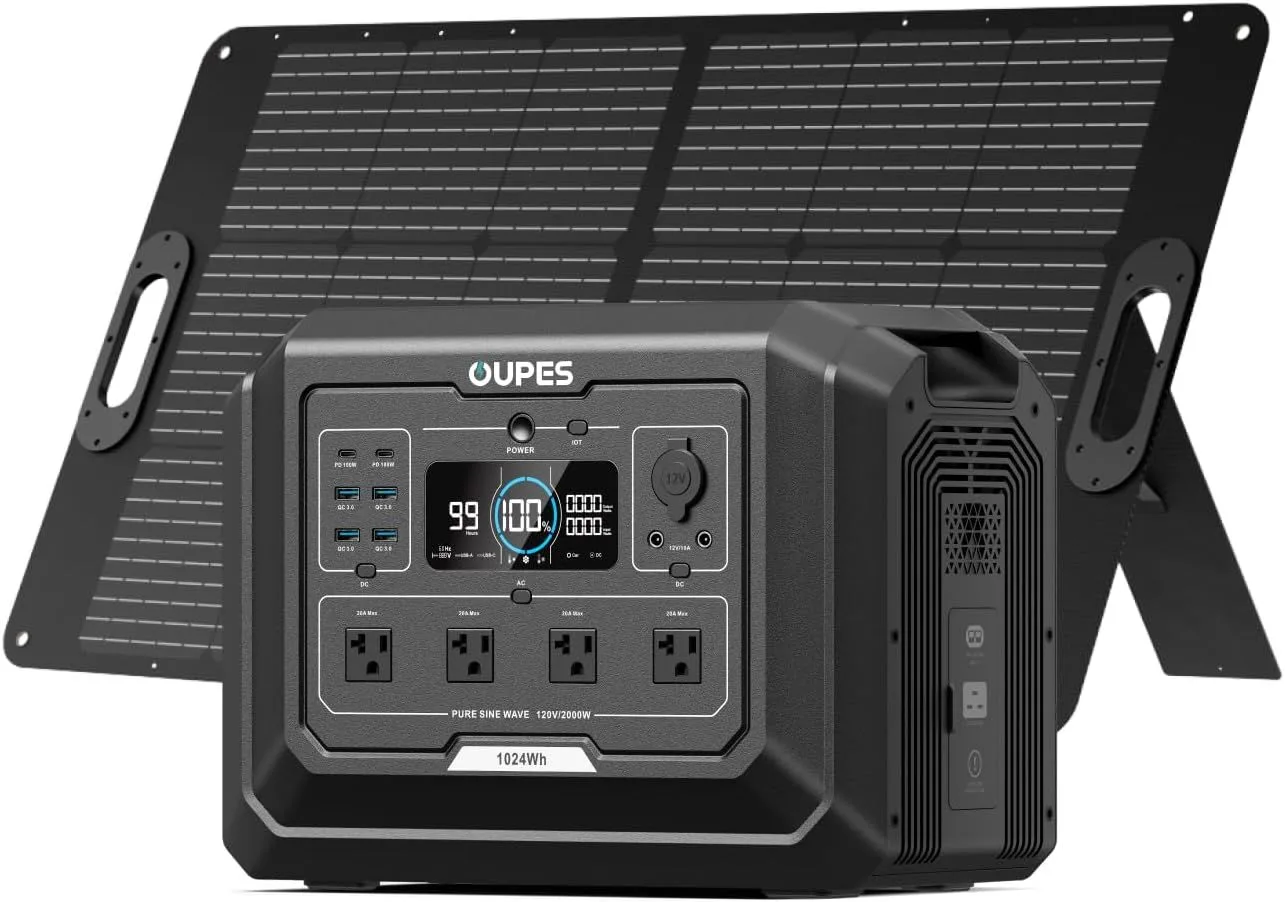
The OUPES Mega 1 is the power champion of the mid-range class, delivering a genuine 2,000W continuous with an industry-best 4,500W surge and 800W solar input. The expandability to 5,120Wh makes it uniquely future-proof. But the noisy fan, lower heavy-load efficiency, outdated app, and proprietary charger hold it back from matching EcoFlow or Anker on polish. At its price with a solar panel included, it is outstanding value for buyers who prioritize raw power over refinement.
We based this review on 800+ Amazon ratings (as of 2026-02-05), expert evaluations from The Solar Lab, CleanTechnica, and Solar Generator Guide, and direct comparison with 5 competing mid-range power stations. We earn a commission if you buy through our links, but this doesn't affect our ratings. Read our full methodology →
This review is based on analysis of 800+ Amazon ratings, expert reviews, and comparison with products in the Mid-Range Power Stations category. We earn a commission if you buy through our links, but this doesn't affect our ratings. Read our full methodology →
2,000 Watts and 800W Solar From a Mid-Range Bundle
The OUPES Mega 1 does not compete on elegance. It competes on numbers. 2,000W continuous output. 4,500W surge. 800W solar input. Expandable to 5,120Wh. And it ships with a 100W solar panel for mid-range for its category. Every one of those figures either matches or beats the EcoFlow DELTA 2, the Anker SOLIX C1000 Gen 2, and the OUKITEL P1000 Plus — stations that cost the same or more.
OUPES entered the US market by building what established players were not offering: maximum specs at minimum cost. The Mega 1 reflects that philosophy without apology. The app looks like it was designed in a different era. The fan means business. The AC adapter is proprietary and losing it is a genuine headache. But the raw capability-per-dollar equation is impossible to ignore if output power is your priority.
This is a power station for buyers who read spec sheets first and packaging second. If you need 2,000W, expandability, and 800W solar input without crossing into $500+ territory, the Mega 1 is the machine that does it. It just asks you to accept real compromises on refinement in exchange.
The 4,500W Surge Advantage, Explained
The 2,000W continuous and 4,500W surge numbers are not marketing inflation. The Solar Lab and CleanTechnica both independently verified the output figures. The 4,500W surge is the highest in the mid-range class by a wide margin: the Anker C1000 Gen 2 surges to 3,000W, the EcoFlow DELTA 2 hits 2,700W, and the OUKITEL P1000 Plus reaches 3,600W. That 900W surge gap between the Mega 1 and its nearest rival translates to starting heavier motors, larger compressors, and power tools without tripping the overload protector.
What buyers keep asking: How many solar panels do I need?
The included 100W panel charges the Mega 1 in 6-8 hours under good conditions — functional for weekend camping. For faster solar charging, pair two 200W panels (total 400W input) for 2.5-3 hour charges. Maxing the 800W input requires four 200W panels, which is overkill for most portable use but makes sense for semi-permanent off-grid setups or extended boondocking.
800W Solar Input Changes Everything for Off-Grid Users
Solar input capacity is the most underrated spec in portable power stations, and the Mega 1 dominates this metric. Its 800W maximum solar input accepts 33-60% more solar power than every competitor in the mid-range class. The OUKITEL P1000 Plus and EcoFlow DELTA 2 max out at 500W. The Anker C1000 Gen 2 tops at 600W.
With an 800W panel array in direct sunlight, the Mega 1 charges from empty to full in roughly 1.5 hours via solar alone. That is faster than most stations charge from a wall outlet. For off-grid applications — remote cabins, extended camping, van life — the 800W solar input turns the Mega 1 from a battery that eventually dies into a system that sustains itself indefinitely with adequate sunlight.
Real-World Scenario: Weekend Camping With the Mega 1
A two-night car camping trip exposes the Mega 1's strengths and weaknesses in roughly equal measure. Night one: the 1,024Wh battery powers an ARB portable fridge (45-60W), two USB-C device chargers (15W each), a string of LED camp lights (8W), and a Bluetooth speaker (5W). Total draw sits around 100W. After 8 hours of overnight use, the battery shows roughly 22% capacity consumed — leaving 78% for day two.
Morning highlights the solar advantage. The included 100W panel propped against the windshield starts pulling 60-80W by 9am. By noon, the overnight draw is recovered. A second 200W panel pushes input to 260-280W combined, and by 2pm the battery reads 100% again. The camp neighbors running an EcoFlow DELTA 2 from a 200W panel are still at 85% — their 500W solar cap means slower recovery even with a larger panel.
Night two is where the fan becomes an issue. With the fridge compressor cycling, the Mega 1's cooling fan kicks on every 15-20 minutes. In a quiet campsite at 11pm, the fan is audible inside a tent pitched 6 feet away. A light sleeper in the group moved the station to the far side of the vehicle to dampen the sound. The OUKITEL P1000 Plus, by comparison, runs at 29dB — barely perceptible from inside a vehicle with the windows closed.
Home Backup Runtime: What 1,024Wh Actually Delivers
The base 1,024Wh capacity is modest for home backup, but the math works for essential-circuit scenarios. A refrigerator averaging 100-150W, a Wi-Fi router at 12W, a cable modem at 8W, and LED lighting across two rooms at 30W totals roughly 200W. At that sustained draw, the Mega 1 delivers approximately 4-5 hours of coverage — enough to ride out a typical rolling blackout or a brief storm outage, but not a full overnight event. Adding a single B2 expansion battery (2,048Wh) extends that same load to 12-15 hours, which covers a full overnight outage with margin — a strong fit for home backup scenarios. The fully expanded 5,120Wh configuration at 200W sustains essential circuits for over 24 hours — genuine whole-day backup from a system that started as a mid-range portable.
Charging speed from a wall outlet is competitive for the class. The 1,400W AC input fills the base 1,024Wh battery from 0-80% in approximately 50 minutes, with a full charge completing around 70-75 minutes. That is faster than the EcoFlow DELTA 2's 80-minute 0-80% time and trails only the Anker C1000 Gen 2's 58-minute full charge in this capacity bracket. If you run the Mega 1 down during an overnight outage and grid power returns in the morning, you are back to full capacity before lunch — fast enough to prepare for another outage cycle the same day.
Build Quality: Functional, Not Flashy
The Mega 1's chassis is thick ABS plastic with rubberized corner bumpers and a fold-flat carry handle on top. At 25.4 lbs, it sits in the middle of the mid-range weight class — lighter than the EcoFlow DELTA 2 (27 lbs) but heavier than the Anker C1000 Gen 2 (21.8 lbs). The port layout groups all outputs on the front face: four AC outlets across the top row, two USB-A and two USB-C ports below, and a 12V car outlet on the side. The power button and LCD display sit at center-front. The LCD shows battery percentage, input/output wattage, and estimated time remaining — adequate information, though the screen is dimmer than the DELTA 2's and harder to read in direct sunlight. The Anderson solar input port on the rear panel is recessed and well-protected against accidental contact, which is a smart design choice that the proprietary AC charger port does not share.
The Proprietary Charger Dilemma
OUPES ships the Mega 1 with a proprietary AC charging brick. It is not a standard IEC or NEMA plug — it is a custom barrel connector that connects to a dedicated charging port on the unit. Lose it, and you cannot charge from a wall outlet until OUPES ships a replacement. Standard USB-C or Anderson solar input still works for partial recharging, but the 1,400W AC fast-charge capability depends entirely on that single proprietary adapter.
Every competing station in this class uses either a standard IEC C13 cable (like a desktop computer uses) or an integrated AC plug. The Anker C1000 Gen 2 and EcoFlow DELTA 2 both use cables you can buy at any electronics store. The OUPES approach saves manufacturing cost but transfers risk to the buyer. Keep the charger in a dedicated bag. Pack a backup if you travel with the Mega 1 regularly. And consider the 800W solar input as your true backup charging method — the sun does not require proprietary connectors.
The Raw Power Play: Is It Worth the Rough Edges?
The OUPES Mega 1 is the power champion of the mid-range class, delivering a genuine 2,000W continuous with an industry-best 4,500W surge and 800W solar input. The expandability to 5,120Wh makes it uniquely future-proof. But the noisy fan, lower heavy-load efficiency, outdated app, and proprietary charger hold it back from matching EcoFlow or Anker on polish. At its price with a solar panel included, it is outstanding value for buyers who prioritize raw power over refinement.
Buy It If:
- • You need the highest continuous output and surge rating in the mid-range class
- • Solar charging speed and 800W input capacity are non-negotiable priorities
- • You want expandability to 5,120Wh for future capacity growth
- • A bundled 100W panel and 5-year warranty sweeten the value proposition
Skip It If:
- • You need quiet operation for bedside use or noise-sensitive environments
- • A polished app with Wi-Fi and smart home integration matters to you
- • Inverter efficiency under heavy loads is a concern
- • You prefer an industry-standard charger over proprietary adapters
Mega 1 Positives
- ✓ Highest continuous output in class at 2,000W with 4,500W surge — verified by The Solar Lab and CleanTechnica, starts demanding motors without tripping overload
- ✓ Class-leading 800W solar input accepts 33-60% more solar power than competitors — fully charges from solar in just over an hour with adequate panels
- ✓ Expandable to 5,120Wh with two B2 expansion batteries — the most expansion capacity in this price range
- ✓ Includes 100W solar panel plus a 5-year warranty (6 years with registration) — US-based customer support is a real differentiator
Mega 1 Negatives
- ✗ Fan noise while charging and under USB-C load — multiple reviewers noted it is "noticeably louder" than competitors, especially during wall charging
- ✗ 79% efficiency under heavy loads measured by CleanTechnica — the lowest efficiency figure among tested units in this lineup
- ✗ Mobile app feels "incredibly outdated" compared to EcoFlow and Anker — functional but clunky interface without the polish
- ✗ Proprietary AC adapter required for wall charging — losing it means ordering a replacement directly from OUPES
The Efficiency Flaw That Costs You Watt-Hours
Here is the uncomfortable number: 79% efficiency under heavy loads. CleanTechnica measured this directly, and it is the lowest efficiency figure among the stations we evaluated in this capacity class. A 79% efficient inverter at 1,024Wh rated capacity delivers roughly 809Wh of usable energy. The EcoFlow DELTA 2 at 83.3% delivers around 853Wh. The Anker C1000 Gen 2, reportedly around 85%, delivers approximately 870Wh.
The practical impact: under heavy load, you lose roughly 60Wh more per cycle than the Anker and 44Wh more than the EcoFlow. That is equivalent to one full smartphone charge worth of energy per cycle. Over years of use, the cumulative loss adds up. And during emergencies where every watt-hour counts, 79% stings.
At light to moderate loads (under 500W), the efficiency gap narrows. Most portable power stations operate at peak efficiency in the 20-50% load range. The 79% figure applies to sustained high draws near the 2,000W maximum. For typical mixed use — phones, laptops, lights, small appliances — real-world efficiency is likely closer to 83-85%.
Expandability: Building Up to 5,120Wh
This is where the Mega 1 separates itself from every competitor at this price. Two B2 expansion batteries bring total capacity to 5,120Wh — enough to run a full-size refrigerator for roughly 3 days or power a small home's essential circuits for 24-48 hours during an outage. No other station at mid-range for its category offers this level of expansion.
The expansion architecture is straightforward: each B2 battery connects via a cable to the main unit and adds 2,048Wh. The batteries charge simultaneously, and the combined system shares the Mega 1's output ports. You do not get additional outlets by adding batteries, just more capacity behind the same ports.
The App and the Fan: Where Refinement Falls Short
The OUPES mobile app connects via Bluetooth (no Wi-Fi), displays battery level and input/output wattage, and allows firmware updates. That is about where the positive description ends.
Compared to EcoFlow's app — which offers real-time graphing, charging schedules, remote port toggling, inverter mode selection, and smart home integration — the OUPES app feels like a beta release from several years ago. Interface elements are oversized and dated. Navigation is clunky. Features that competitors treat as standard, like historical power consumption tracking, are missing entirely.
The fan is the other compromise. Under AC charging and USB-C load, the Mega 1's cooling fan engages audibly. Multiple reviewers describe it as louder than the EcoFlow DELTA 2, which itself is the loudest station PCWorld has tested. During wall charging at 1,400W input, the fan runs at full speed and is audible from across a room. This is a station that works. It does not fade into the background.
Where the Mega 1 Sits in the Mid-Range Lineup
The 1,024Wh class is the most competitive segment in portable power. The OUPES Mega 1 wins on raw specs: highest output, highest surge, highest solar input, most expansion capacity. The Anker SOLIX C1000 Gen 2 wins on refinement: lightest weight, fastest AC charging, best USB-C ports. The EcoFlow DELTA 2 wins on ecosystem: best app, X-Boost flexibility, proven reliability at scale. And the OUKITEL P1000 Plus wins on stealth: quietest operation, best total bundle value.
Choose the Mega 1 when power output and future expandability are your non-negotiable priorities. It is the only station in this class that starts at 1,024Wh and scales to 5,120Wh, and the only one pushing 2,000W continuous with a 4,500W surge at this price. See how it stacks up head-to-head in our OUPES Mega 1 vs BLAVOR 1600W comparison.
Common Questions About the OUPES Mega 1
How loud is the OUPES Mega 1 compared to other power stations?
The Mega 1 is noticeably louder than the OUKITEL P1000 Plus (29dB) and the Anker C1000 Gen 2 during charging and USB-C output. Multiple reviewers describe the fan as audible across a room. It is comparable to the EcoFlow DELTA 2 in noise level. For bedside CPAP use, the Mega 1 is not ideal.
Can the OUPES Mega 1 power an air conditioner?
Small portable AC units drawing under 1,500W run fine. Window units typically pull 1,200-1,800W running with 2,500-4,000W startup surges. The Mega 1 handles the surge (4,500W rated), but running a window AC continuously drains the 1,024Wh battery in roughly 1-2 hours. Pair it with B2 expansion batteries for longer AC runtime.
How does the B2 expansion battery work with the Mega 1?
Each B2 battery adds 2,048Wh of LiFePO4 capacity. You can connect up to two B2 batteries for a maximum of 5,120Wh — five times the base capacity. The batteries connect via a cable on the side and charge simultaneously with the main unit. OUPES sells the B2 separately.
What solar panels are compatible with the OUPES Mega 1?
The Mega 1 uses Anderson connectors for solar input. OUPES sells its own panels, but any panel with Anderson output and voltage within the Mega 1 range works. Common third-party options include Renogy, BougeRV, and Jackery panels with Anderson adapters. The 800W input means you can pair multiple panels for fast solar charging.
Is the OUPES Mega 1 safe to use indoors?
LiFePO4 batteries are safe for indoor use, with no thermal runaway risk like NMC chemistry. The fan noise makes placement important. In a garage, basement, or utility closet, the noise is irrelevant. In a bedroom or living room, it will be noticeable during charging and heavy output.
What happens if I lose the proprietary AC charger?
You lose the ability to charge from a wall outlet at 1,400W until OUPES ships a replacement. Solar input via Anderson connectors and car DC input still work. Contact OUPES support directly for a replacement charger — they are not widely available from third-party retailers. Every competing station in this class uses a standard IEC cable you can buy at any electronics store, so the proprietary charger is an ongoing reliability risk to plan around.
Compare all mid-range options in our Best Mid-Range Power Stations 2026 roundup.