OUPES Guardian 6000 Portable Power Station Review 2026
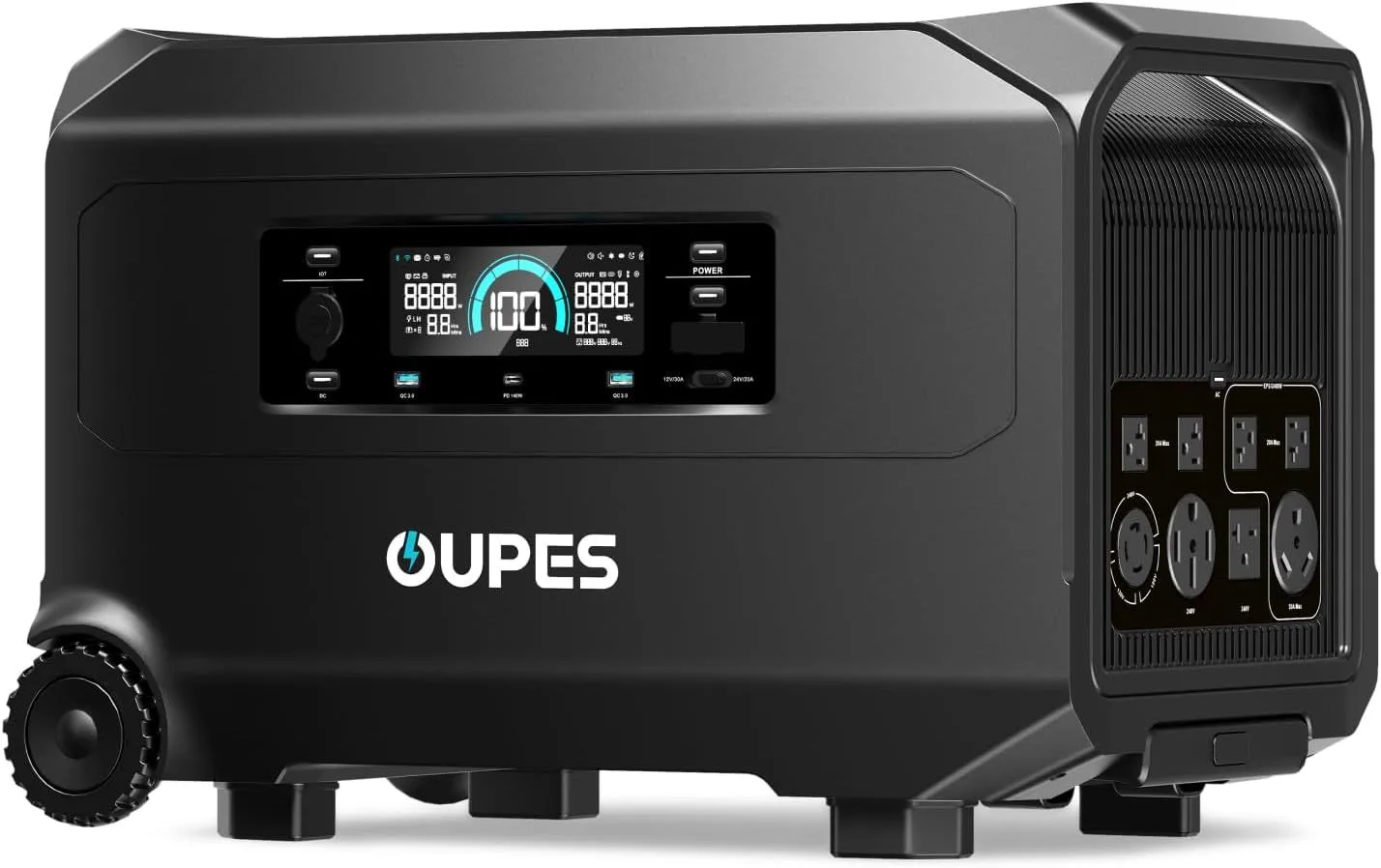
The OUPES Guardian 6000 delivers flagship-level specs at a mid-range price. The inability to charge while outputting 240V is a serious limitation for extended outages, but for overnight backup or solar-paired weekend resilience, it punches way above its price class.
This review is built on analysis of 89+ Amazon ratings (as of 2026-02-08), expert evaluations including Solar Generator Guide and independent YouTube testers, plus comparison with 5 competing whole-home backup systems. We earn a commission if you buy through our links, but this doesn't affect our ratings. Read our full methodology →
This review is based on analysis of 89+ Amazon ratings, expert reviews, and comparison with products in the Whole-Home Backup Systems category. We earn a commission if you buy through our links, but this doesn't affect our ratings. Read our full methodology →
Flagship Specs at Half the Flagship Price
The OUPES Guardian 6000 is the price disruptor of the whole-home backup category. At below average for its category, it delivers 4,608Wh of LiFePO4 capacity and 6,000W of true 240V split-phase output from a single unit — without requiring a second box or a separate voltage hub. The EcoFlow DELTA Pro 3, Anker SOLIX F3800, and Jackery HomePower 3000 all cost substantially more for comparable or lesser specs.
The math is aggressive. The Guardian 6000 offers more stored energy than the EcoFlow DELTA Pro 3 (4,096Wh) and the Anker SOLIX F3800 (3,840Wh). Its 6,000W output matches the F3800 and exceeds the DELTA Pro 3's 4,000W continuous. And its expandability to 41.4kWh with eight G5 batteries outscales everything except the Anker F3800 system (53.8kWh). All for roughly half the cost of entry.
So what is the catch? There are several, and they are not trivial. A 75W idle draw that drains the battery even when nothing is running. An inability to charge while outputting 240V. A low solar input voltage limit that restricts panel configuration options. And customer service concerns that surface repeatedly in owner reviews. The Guardian 6000 delivers flagship numbers, but the details behind those numbers reveal weaknesses that flagship competitors have already solved.
Who Actually Needs 6,000 Watts?
The 6,000W output is not overkill for its intended use case. A typical home runs on two 120V legs that combine to form 240V for heavy appliances — electric dryers, well pumps, HVAC systems, electric stoves. A power station that only outputs 120V cannot run these devices. True 240V split-phase output from a single unit — which the Guardian 6000 provides — eliminates the need for a second unit or a voltage-doubling hub.
The Anker SOLIX F3000, by comparison, requires two units plus a $200 Double Voltage Hub to produce 240V. That doubles or triples the cost. The EcoFlow DELTA Pro 3 outputs 240V natively but costs far more. The Guardian 6000 is the most affordable path to single-unit 240V whole-home backup.
The 75W Idle Drain: A Silent Capacity Killer
This is the Guardian 6000's most impactful weakness, and it is one that does not appear on any spec sheet. At 75W idle consumption — measured by multiple independent testers — the unit drains roughly 1,800Wh every 24 hours with zero connected loads. That is 39% of the base 4,608Wh capacity consumed by the system itself.
For a single-night outage (8-12 hours), the idle draw costs you 600-900Wh — roughly the equivalent of running a small refrigerator. Annoying but manageable. For a multi-day outage (72+ hours), the math turns brutal: 5,400Wh consumed by idle drain alone, more than the entire base battery capacity. Without expansion batteries or solar recharging, the Guardian 6000 will power itself to zero in roughly 2.5 days even if nothing is plugged in.
The mitigation strategy is straightforward but inconvenient: turn the unit off between use sessions. Charge it to full, power it off, and only turn it on when you need 240V output. This preserves stored energy but eliminates always-on UPS capability. For buyers who want the Guardian 6000 to sit powered on as a passive backup that kicks in automatically during outages, the 75W drain makes that impractical without solar input continuously topping off the battery.
What buyers keep asking: Does solar offset the idle drain?
Partially. At 75W idle draw, you need 75W of continuous solar input just to break even. A 200W panel producing 100-150W under real conditions covers the idle draw and adds some net charge. But on cloudy days or short winter daylight, the panel may not keep pace. For reliable idle-offset, budget for at least 400W of panel capacity to maintain a positive energy balance under variable conditions.
Guardian 6000 Strengths
- ✓ Best price-to-capacity ratio in the category — 4,608Wh and 6,000W output at nearly half the price of competitors
- ✓ True single-unit 240V split-phase output without requiring a second unit or hub
- ✓ Massive expandability up to 41.4kWh with 8 G5 expansion batteries
- ✓ Fast 240V AC charging hits 0-100% in roughly 84 minutes
Guardian 6000 Weaknesses
- ✗ High idle power consumption (75W measured) eats into stored capacity during multi-day outages
- ✗ Cannot charge via AC while outputting 240V split-phase — must disconnect all loads to recharge
- ✗ Low solar input voltage limit (140V max, 15A) restricts panel stringing options
- ✗ Customer service and firmware update concerns reported on review platforms
The Charge-While-Output Problem
Here is the limitation that separates the Guardian 6000 from its more expensive competitors: you cannot charge the unit while it is outputting 240V split-phase power. When the two 120V legs combine to produce 240V, the charging circuit shuts down. To recharge, you must disconnect all 240V loads, switch off the split-phase mode, charge the battery, then reconnect your loads and re-enable 240V.
In a 4-hour overnight outage, this is a minor inconvenience. Charge it beforehand, run on battery through the outage, recharge when power returns. But in a multi-day outage — a hurricane, an ice storm, a wildfire-related grid shutdown — the inability to charge while powering your home creates a rotation cycle. Run the house for 8-12 hours. Disconnect everything. Recharge for 84 minutes from 240V AC (or 3+ hours from 120V). Reconnect. Repeat.
The EcoFlow DELTA Pro 3 charges and outputs simultaneously. The Anker F3800 does the same. Both handle pass-through power so the unit charges from the grid (or solar) while continuing to power connected loads — true UPS behavior. The Guardian 6000 cannot do this at 240V. This is the single biggest functional gap between the Guardian 6000 and the competition, and no firmware update can fix it because the limitation is in the hardware architecture.
Expansion Architecture: Road to 41.4kWh
The expansion story is where the Guardian 6000 recovers from its operational limitations. Each G5 battery adds 4,608Wh of additional capacity, and the system supports up to eight batteries for a maximum of 41.4kWh. That is enough stored energy to power a typical American household for 3-5 days without any recharging — comfortably covering the duration of most grid outages.
The expansion math at this price point is notable. A fully expanded Guardian 6000 system with eight G5 batteries delivers 41.4kWh of LiFePO4 capacity. A comparable capacity from EcoFlow (DELTA Pro 3 system) or Anker (F3800 system) costs substantially more. The Guardian 6000's value proposition gets stronger, not weaker, as you add expansion batteries — the base unit's low entry price means the total system cost stays competitive even at maximum expansion.
For a practical example: a household running a refrigerator (150W average), LED lights (50W), a WiFi router (15W), and intermittent phone charging (10W) draws roughly 225W continuously. At that load, the base 4,608Wh unit lasts about 20 hours — factoring in the 75W idle draw. Add two G5 batteries and total capacity jumps to 13,824Wh, stretching runtime to roughly 2.5 days at the same load. That kind of incremental scaling lets you match your investment to your actual outage risk rather than over-buying on day one.
Solar Input: Adequate but Constrained
The 2,400W maximum solar input is competitive with the category — matching the Anker F3000 and Anker F3800, and close to the EcoFlow DELTA Pro 3's 2,600W. In theory, you can charge the 4,608Wh battery from solar in roughly 2-3 hours with a full 2,400W array.
The practical constraint is the 140V maximum input voltage at 15A per MPPT channel. Most standard residential solar panels (60-cell or 72-cell) produce 30-45V open circuit. String two in series, and you are at 60-90V — well within limits. String three, and you may exceed 140V depending on the panel model and temperature conditions. This voltage ceiling limits panel stringing options and requires more parallel wiring (multiple shorter strings), which increases cable complexity and DC combiner requirements.
The Anker F3800 has an even lower 60V per-port limit, which is more restrictive. The EcoFlow DELTA Pro 3 supports up to 150V, giving it slightly more stringing flexibility. For buyers planning a permanent solar installation, check your panel specs against the Guardian 6000's voltage limits before purchasing panels.
Build Quality and Real-World Observations
At 111 lbs, the Guardian 6000 is heavy. Period. This is not a portable power station — it is a semi-permanent installation that happens to have handles. Moving it requires two people and clear pathways. Stairs are a serious challenge. Once you place it, it is staying there unless you have a compelling reason (and a helper) to relocate it.
The build feels industrial. The enclosure is sturdy metal with rubber feet. The display is large and readable. The port layout covers every connection type you need for whole-home integration: NEMA 14-50R for dryer circuits and RV connections, TT-30R for standard RV hookups, L14-30E for generator transfer switches, plus standard 120V outlets, USB-C PD at 140W, USB-A QC3.0, and DC outputs.
Customer service is a documented weak point. Multiple review platforms report slow response times, inconsistent firmware update communication, and difficulty getting warranty claims processed. OUPES offers a 5-year warranty (6 with registration), which is competitive — but the warranty is only as good as the support team behind it. Anker and EcoFlow both have established US-based support infrastructure. OUPES is building theirs but has not reached parity.
The Budget Fortress: Flagship Power With Known Compromises
The OUPES Guardian 6000 delivers flagship-level specs at a mid-range price. The inability to charge while outputting 240V is a serious limitation for extended outages, but for overnight backup or solar-paired weekend resilience, it punches way above its price class.
Buy It If:
- • Budget is your primary constraint — best capacity-per-dollar in the whole-home class
- • You need true 240V split-phase from a single unit without buying a second box
- • Expandability to 41.4kWh aligns with long-term energy independence goals
- • You plan to pair it with solar panels for weekend resilience or off-grid use
Skip It If:
- • You need to charge and output 240V simultaneously for true UPS behavior
- • Low idle draw matters for multi-day outages without solar backup
- • Proven customer support and warranty responsiveness are non-negotiable
- • You need flexible solar panel stringing with higher voltage limits
Across the Whole-Home Field
The whole-home backup market splits into two tiers: the Guardian 6000 anchors the value tier, while the EcoFlow DELTA Pro 3, Anker SOLIX F3800, and Anker SOLIX F3000 occupy the premium tier.
Against the DELTA Pro 3: the Guardian delivers more capacity (4,608 vs 4,096Wh) for dramatically less money. Our OUPES Guardian 6000 vs Anker F3000 comparison breaks down the full spec-for-spec differences. The DELTA Pro 3 counters with 93% efficiency, 30dB operation, faster charging, IP65 water resistance, and the best app ecosystem in portable power. Against the Anker F3800: the Guardian matches 6,000W output at a fraction of the cost. The F3800 counters with 53.8kWh maximum expansion, the most ports in the category, and Anker's proven support infrastructure.
The Guardian 6000 is the right choice for home backup buyers who understand its limitations and plan around them. Pair it with adequate solar panels to offset idle draw. Accept the charge-while-240V limitation by planning recharge windows. Use its extraordinary capacity-per-dollar to build a large-scale expandable system at a cost that keeps the budget grounded.
Guardian 6000: What You Need to Know
Can the OUPES Guardian 6000 power a whole house during an outage?
It can power essential circuits — refrigerator, lights, router, phone charging, and a sump pump — for 12-24 hours depending on total load. The 6,000W output at 240V handles most household needs. For true whole-home backup including HVAC, water heater, and dryer, you will need expansion batteries to extend runtime beyond a few hours.
Why can the Guardian 6000 not charge and output 240V simultaneously?
This is a hardware limitation in the split-phase inverter design. When the Guardian 6000 produces 240V by combining its two 120V legs, the charging circuit cannot operate simultaneously. You must disconnect all 240V loads, recharge the unit, then reconnect loads. This makes it unsuitable for always-on UPS-style backup where charging and output happen in parallel.
How does the 75W idle draw affect practical battery life?
At 75W idle consumption, the Guardian 6000 drains roughly 1,800Wh over 24 hours of standby with no connected loads — nearly 40% of its 4,608Wh capacity. During a multi-day outage, idle draw eats into your stored reserves even when you are not running appliances. The EcoFlow DELTA Pro 3 idles at roughly 30-40W; the Anker F3000 at just 20.5W. This is the Guardian 6000's biggest operational weakness.
What happens when you expand the Guardian 6000 with G5 batteries?
Each G5 expansion battery adds another 4,608Wh of LiFePO4 capacity. The system supports up to 8 G5 batteries for a maximum of 41.4kWh — enough to run a typical household for 3-5 days during an outage. The batteries connect in parallel via cables and charge simultaneously with the main unit via its 2,400W solar input.
Is the OUPES Guardian 6000 a good value compared to the EcoFlow DELTA Pro 3?
On a cost-per-watt-hour basis, the Guardian 6000 is substantially cheaper. It delivers 4,608Wh at roughly half the price of the DELTA Pro 3 (4,096Wh). The DELTA Pro 3 counters with better efficiency (93% vs. the Guardian not publishing this figure), lower idle draw, a far superior app ecosystem, and IP65 water resistance. The Guardian 6000 wins on raw capacity-per-dollar; the DELTA Pro 3 wins on refinement and usability.
Can I connect the Guardian 6000 to my home breaker panel?
Yes, with a transfer switch. The Guardian 6000 has a NEMA 14-50R and L14-30E outlet that connect to manual or automatic transfer switches for whole-home integration. A licensed electrician should install the transfer switch and verify the neutral-ground bonding is configured correctly for your panel. Budget for the transfer switch and installation on top of the unit cost.