OUKITEL P1000 Plus Portable Power Station with 100W Solar Panel Review 2026
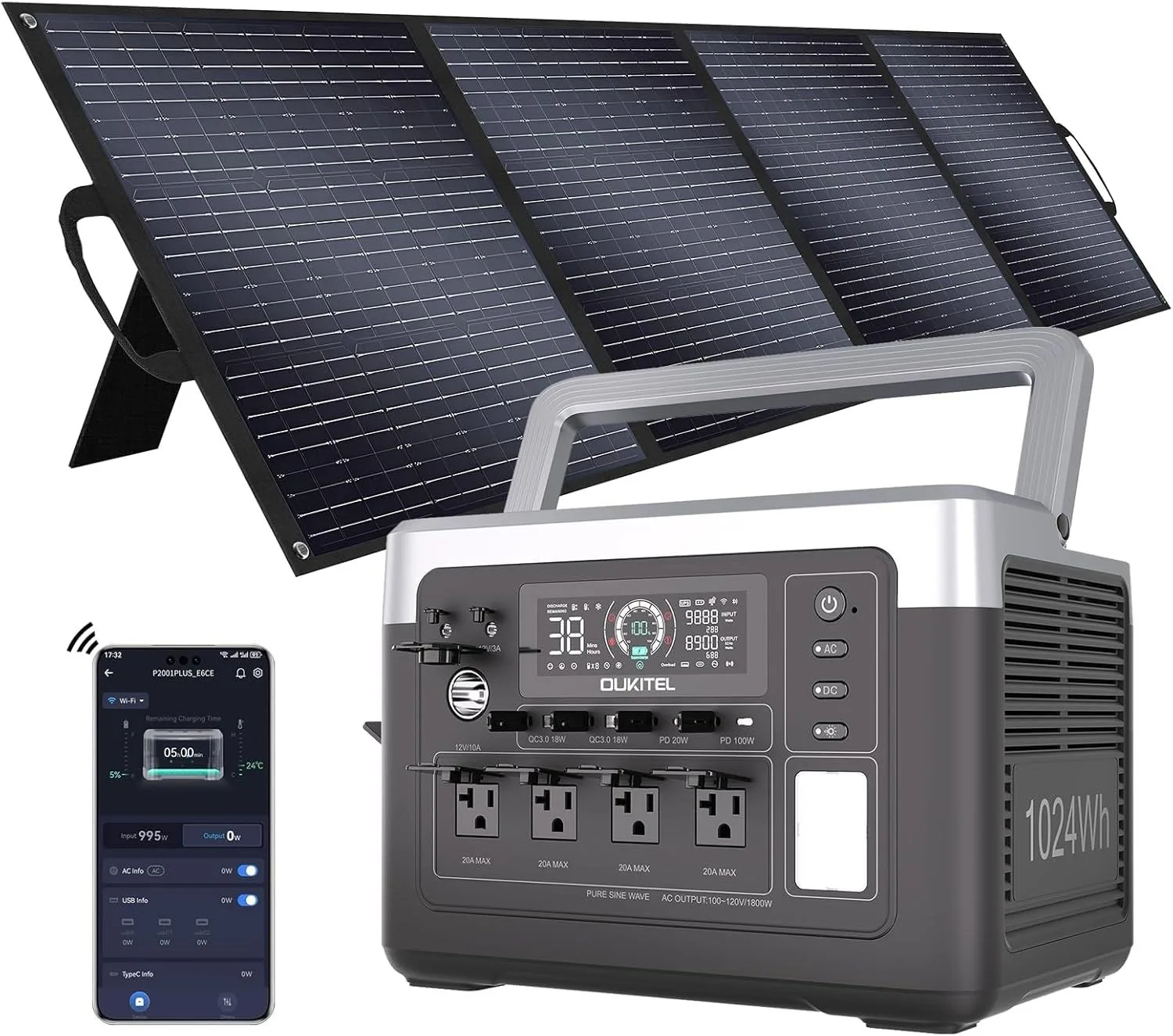
The OUKITEL P1000 Plus stands out as the best-value complete solar generator kit in the mid-range class. The inclusion of a 100W panel undercuts the competition on total cost. The 1,800W output with 3,600W surge handles most household appliances, and the 29dB noise level addresses the fan noise complaints that plague competitors. The lack of expandability and basic app prevent it from competing on features, but for sheer out-of-box readiness, this bundle is hard to beat.
For this P1000 Plus review, we analyzed 500+ Amazon ratings (as of 2026-02-05), 6 expert reviews including HouseFreshHome, Solar Generator Guide, and The Solar Lab, plus direct comparison with 5 competing mid-range power stations. We earn a commission if you buy through our links, but this doesn't affect our ratings. Read our full methodology →
This review is based on analysis of 500+ Amazon ratings, expert reviews, and comparison with products in the Mid-Range Power Stations category. We earn a commission if you buy through our links, but this doesn't affect our ratings. Read our full methodology →
The Complete Kit That Undercuts Everyone
The OUKITEL P1000 Plus ships with a 100W foldable solar panel inside the box. That detail alone changes the math. Most competitors in this capacity class sell the station and the panel separately, which means you pay below average for its category for the OUKITEL bundle while spending more for a competing station plus a third-party panel. And the P1000 Plus backs up that value proposition with 39-minute charging to 80%, 1,800W continuous output, and the quietest operation in its class at 29dB.
OUKITEL built its reputation in rugged smartphones before pivoting to portable power, and the P1000 Plus reflects that sensibility: practical, no-frills, built to survive. There is no fancy app ecosystem here. No expandable battery architecture. What you get is a complete out-of-the-box solar generator that covers the fundamentals well for less money than most competitors charge for the station alone.
But simplicity has limits. The 1,024Wh LiFePO4 class is brutally competitive. EcoFlow, Anker, and OUPES all fight over this exact capacity bracket with smarter apps, expandable batteries, and brand ecosystems that the P1000 Plus does not attempt to match. The question is not whether this bundle is a good deal. It is. The question is whether the competition's extra features justify their higher prices.
Who This Kit Is Built For
The P1000 Plus fits a specific buyer profile. You want solar backup capability out of the box without researching compatible panels. You value quiet operation for bedside CPAP use, camping, or running the station at 2 AM during an outage without waking the household. You are not planning to expand capacity later. And you are watching your budget carefully, because every dollar counts when outfitting a van or preparing for emergencies.
Buyers who need expandability, Wi-Fi remote monitoring, or a premium app experience should look at the EcoFlow DELTA 2 or the OUPES Mega 1 instead. The P1000 Plus is deliberately simple, and that simplicity is a feature for buyers who just want the kit to work.
What buyers keep asking: Can I add a bigger solar panel?
Yes. The 500W solar input means you can pair it with a 200W or 400W panel for much faster charging. A 400W panel under good conditions would charge the P1000 Plus in roughly 2.5 hours. Any panel with an XT60 output connector works without adapters. Panels with MC4 connectors need a simple adapter cable that costs very little. The open standard here is a small but real advantage over OUPES (Anderson connectors) and EcoFlow (proprietary XT150i).
39 Minutes to 80%: AC Charge Speed Tested
The headline spec is AC charging. OUKITEL claims 0-80% in 39 minutes, and hands-on reviews confirm that number. Full charge completes in roughly 55 minutes. That puts it in the same league as the EcoFlow DELTA 2 (50 minutes to 80%) and far ahead of the BLAVOR 1600W (3.5 hours) by a wide margin.
The speed comes from OUKITEL's 1,200W AC charging architecture. The station pulls hard from the wall, which means fan noise spikes during the fastest charging phase. But at 29dB, even the peak phase is barely noticeable. By comparison, the EcoFlow DELTA 2 under similar load is consistently flagged by reviewers for aggressive, persistent fan noise that fills a room.
Solar input tops out at 500W through the XT60 connector. That is respectable but not class-leading: the OUPES Mega 1 accepts 800W. For buyers planning to invest in larger panel arrays, the 500W ceiling matters. For anyone using the included 100W panel or adding a second 200W panel, 500W provides adequate headroom with room to grow.
Is the OUKITEL P1000 Plus Worth Buying?
The OUKITEL P1000 Plus stands out as the best-value complete solar generator kit in the mid-range class. The inclusion of a 100W panel undercuts the competition on total cost. The 1,800W output with 3,600W surge handles most household appliances, and the 29dB noise level addresses the fan noise complaints that plague competitors. The lack of expandability and basic app prevent it from competing on features, but for sheer out-of-box readiness, this bundle is hard to beat.
Buy It If:
- • You want a complete solar generator kit without buying a panel separately
- • Quiet operation matters — CPAP use, camping, or bedroom placement during outages
- • Fast AC charging and a complete bundle at below average for its category are priorities
- • You do not need expandable capacity or a premium app ecosystem
Skip It If:
- • You need expandable battery capacity for future growth
- • A polished app with Wi-Fi remote monitoring is important
- • You need more than 1,800W continuous output for heavy appliances
- • Brand ecosystem and long-term accessory support matter to you
What the P1000 Plus Does Well
- ✓ Includes a 100W solar panel at just under $500 — the most complete out-of-box solar generator kit in this price range
- ✓ Ultra-fast AC charging with 0-80% in 39 minutes — class-leading charge speed confirmed by hands-on reviews
- ✓ Ultra-quiet 29dB operation — independently verified as quieter than a library, ideal for bedroom CPAP use
- ✓ Compact and lightweight at 26.5 lbs — 30% lighter than competing 1,000Wh units while delivering 1,800W output
Where It Lets You Down
- ✗ No expandable battery option — capacity is fixed at 1,024Wh, unlike EcoFlow DELTA 2 or OUPES Mega 1
- ✗ Included 100W panel takes 4-5 hours minimum under ideal conditions — more of a trickle-charge convenience than primary solar solution
- ✗ Warranty confusion between 2-year and 5-year across different listings — buyers should verify with their specific seller
- ✗ Bluetooth-only app feels basic compared to EcoFlow and Anker — no Wi-Fi connectivity for remote monitoring
What 1,800W Actually Runs in Your House
The P1000 Plus delivers 1,800W continuous with a 3,600W surge of pure sine wave output. That surge figure matters more than the continuous rating in practice, because it handles the startup spike from refrigerator compressors, power tools, and small AC units that would trip a lower-surge station.
In the mid-range class, 1,800W continuous is competitive but not dominant. The OUPES Mega 1 pushes 2,000W with a 4,500W surge. The Anker SOLIX C1000 Gen 2 matches at 2,000W. The EcoFlow DELTA 2 rates at 1,800W but extends to 2,200W via X-Boost, which reduces pure sine wave quality for sensitive electronics.
Battery Endurance Over the Long Haul
LiFePO4 chemistry delivers 4,000+ cycles to 80% capacity. At one full cycle per day, that translates to roughly 11 years before the battery degrades to 80% of its original 1,024Wh. In practice, most owners cycle their station 2-3 times per week during camping season and barely touch it during winter. The usable lifespan extends well beyond a decade under normal conditions.
Real-world runtime at a 100W sustained load runs approximately 8-10 hours after accounting for inverter efficiency losses in the 85-90% range. CPAP users pulling 30-50W can expect 18-30 hours per charge. For phone and laptop charging, the P1000 Plus stretches even further: a typical smartphone takes 10-15Wh per full charge, so you could top off a phone 60+ times from a single fill.
Port Layout and Connectivity: No Frills, No Gaps
The P1000 Plus includes 11 output ports: two AC outlets (pure sine wave), two USB-A (18W QC), two USB-C (one at 100W, one at 60W), two DC 5521 barrel jacks, a car socket (12V/10A), and an Anderson connector. That port count falls between the EcoFlow DELTA 2's 15 ports and the BLAVOR 1600W's 8. For most users, 11 ports cover every common device without feeling cramped.
The 100W USB-C port is the standout. It charges a MacBook Pro at full speed and can also serve as a charging input — plug in a high-wattage USB-C charger when no wall outlet is available, and the P1000 Plus accepts power through the same port. Bidirectional USB-C is increasingly standard in mid-range stations, but budget units in the same price bracket rarely include it. The 60W secondary USB-C port handles phones and tablets without monopolizing the faster port.
One limitation: no wireless charging pad on top of the unit. The BLUETTI EB3A (predecessor to the Elite 30 V2) included one, and some buyers miss that convenience. For the P1000 Plus, you will need a cable. Not a dealbreaker, but a small comfort feature that competitors have explored and OUKITEL has not.
The 29dB Advantage Nobody Mentions
Noise is the sleeper spec in portable power, and the P1000 Plus wins this category outright. At 29dB under load, it runs quieter than a library. For context, the EcoFlow DELTA 2's fan noise is the single most common complaint in its 5,000+ Amazon ratings. The OUPES Mega 1 is audible across a room during charging. The Anker C1000 Gen 2 was flagged for fan noise by NotebookCheck, MacRumors, and The Gadgeteer.
Three scenarios make this critical. CPAP users running the station bedside cannot tolerate fan whine at 3 AM. Campers in quiet backcountry do not want generator drone spoiling the experience. And during home outages, a noisy station in the hallway at midnight is profoundly annoying. The P1000 Plus solves all three.
The trade for that silence is thermal management. Ultra-quiet stations rely on passive cooling or slower fan speeds, which means they may run warmer under sustained heavy loads. OUKITEL has not published thermal data, but extended sessions near 1,800W may trigger throttling. For typical mixed use and moderate sustained loads, the quiet operation holds comfortably.
Physical Design: Built Like a Smartphone Brand Would
OUKITEL's smartphone heritage shows in the P1000 Plus's build. The enclosure uses a matte-finished ABS plastic that resists fingerprints and minor scuffs. The carrying handle folds flat and locks in the upright position with a satisfying click. The LCD display is bright enough to read in direct sunlight — a detail that many competitors miss, leaving buyers squinting at dim screens during outdoor use. The overall footprint at 13.6 x 8.9 x 9.4 inches fits into tight RV storage compartments, van builds, and emergency supply shelves without wasting space.
The Included 100W Panel: Practical Asset or Marketing Prop?
The foldable 100W solar panel bundled with the P1000 Plus is functional, compact, and — candidly — a supplemental charger rather than a replacement for grid power. Under ideal conditions (direct noon sunlight, optimal angle, clear skies), it generates roughly 80-90W of actual output. Real-world performance with clouds, suboptimal angles, and morning or afternoon sun drops to 40-70W.
That means a full solar charge takes 4-5 hours under ideal conditions and potentially 8-10 hours on a partly cloudy day. Not fast. But it is free ongoing energy requiring zero fuel, zero noise, and zero maintenance. For weekend camping trips, the math works: arrive Friday with a full battery, top up during the day Saturday via solar, and a single charge stretches through the weekend.
Against the Competition: Where It Wins and Loses
Against the EcoFlow DELTA 2, the P1000 Plus wins on total bundle cost, noise level, and out-of-box readiness. The DELTA 2 wins on expandability (up to 3,072Wh), X-Boost output range, and app ecosystem. Against the OUPES Mega 1, the P1000 Plus is lighter and quieter but delivers 200W less continuous output and lacks expandability. Against the Anker SOLIX C1000 Gen 2, the P1000 Plus costs less — especially with the panel — but Anker brings Guinness-certified charging speed, lighter weight, and the strongest USB-C ports in the class.
For a detailed breakdown, see our Jackery 1000 V2 vs OUKITEL P1000 Plus comparison. The pattern is clear: the P1000 Plus trades advanced features for upfront value. No expandability, no premium app, no 2,000W output. But a complete kit with a solar panel, silent operation, and fast AC charging at below average for its category with 4,000+ cycles of LiFePO4 endurance. For budget-conscious buyers who want to plug in and go, that trade is worth making.
Buyers ask: Is the warranty really 5 years?
This is the murkiest aspect of the P1000 Plus. Some Amazon listings show 2 years, others show 5. OUKITEL's official product page references a 5-year warranty, but the terms may vary by seller and region. Before purchasing, confirm the warranty length directly with your seller. If buying from the official OUKITEL Amazon storefront, the 5-year warranty should apply.
P1000 Plus FAQ
Can the OUKITEL P1000 Plus run a CPAP machine all night?
Yes. At 1,024Wh, the P1000 Plus can power most CPAP machines (30-60W draw) for 15-30 hours on a single charge. The 29dB noise level makes it quieter than a whisper, so bedside use will not disrupt sleep.
How long does the included 100W solar panel take to charge the P1000 Plus?
Under ideal conditions with direct sunlight, the included 100W panel charges the P1000 Plus in roughly 4-5 hours. Cloud cover, panel angle, and time of day typically add 30-60% to that estimate. The 500W solar input means you can connect a larger panel for faster off-grid charging.
Does the OUKITEL P1000 Plus have pass-through charging?
Yes. You can charge the unit while simultaneously powering devices, which makes it functional as a basic UPS. Plug it into wall power and run critical devices through it. If the grid drops, the battery takes over with a brief switchover delay.
Is the OUKITEL P1000 Plus good for RV camping?
Solid for weekend RV trips. The 1,800W output handles coffee makers, mini fridges, and phone/laptop charging. The 13.6 x 8.9 x 9.4 inch footprint fits tight RV storage. The limitation: no expandable battery, so extended boondocking may drain it before your trip ends.
What is the difference between the OUKITEL P1000 and the P1000 Plus?
The P1000 Plus adds a bundled 100W solar panel, faster 39-minute AC charging (0-80%), and the same 1,024Wh LiFePO4 battery with 1,800W output. The original P1000 shipped without a panel and with slower charging. If buying new, the Plus model offers substantially better value.