Jackery HomePower 3000 with 2x200W Solar Panels Review 2026
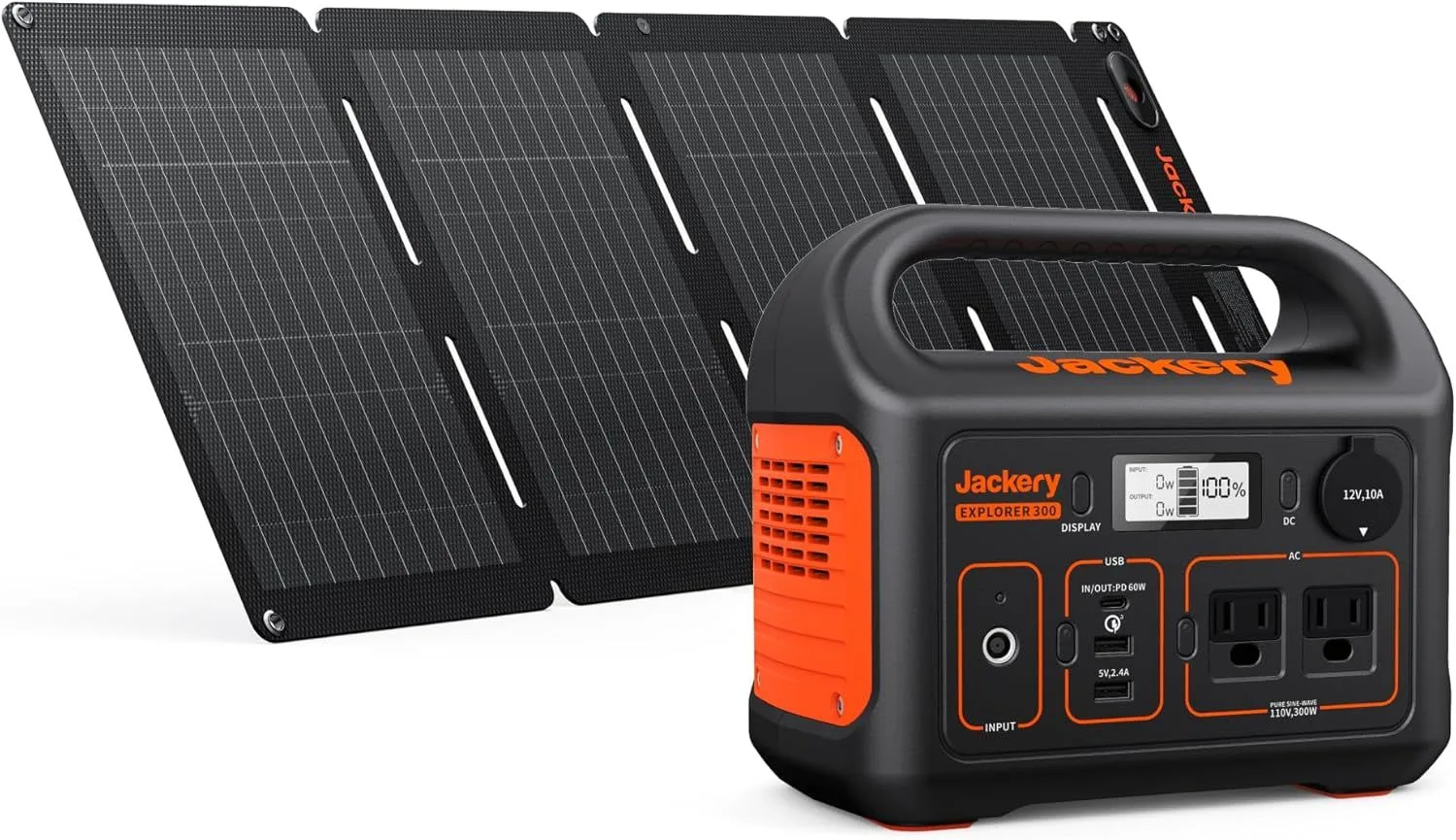
The Jackery HomePower 3000 wins decisively on portability — 59.5 lbs and 8W idle draw make it the best set-and-forget emergency backup. But zero expandability, 1,000W solar input, and the highest price per Wh mean you pay a steep premium for that compact form factor.
We evaluated 74+ Amazon ratings (as of 2026-02-11), 3 expert reviews including The Solar Lab and PowerElectricHub, and comparison with 5 products in the Whole-Home Backup Systems category. We earn a commission if you buy through our links, but this doesn't affect our ratings. Read our full methodology →
This review is based on analysis of 74+ Amazon ratings, expert reviews, and comparison with products in the Whole-Home Backup Systems category. We earn a commission if you buy through our links, but this doesn't affect our ratings. Read our full methodology →
59.5 Pounds Changes Everything
Every other 3kWh power station in this price range weighs between 88 and 137 lbs. The Jackery HomePower 3000 weighs 59.5 lbs. That is not a marginal difference. It is the gap between a two-person lifting operation and a one-person carry. Between dedicated floor space and a closet shelf. Between "permanently installed" and "actually portable."
Jackery achieved this with a cell-to-body (CTB) design that eliminates the conventional metal housing around individual LiFePO4 cells, integrating them directly into the structural chassis. The result is a unit that measures 16.4 x 12.8 x 12 inches — 47% smaller than typical 3kWh stations — while maintaining 3,072Wh of usable capacity and 3,600W continuous output with 7,200W surge capability.
But Jackery traded expansion potential for that compact form factor. The HomePower 3000 has zero expansion ports. No compatible external batteries exist. If 3,072Wh is not enough — and for many households during a multi-day outage, it will not be — your only option is buying an entire second unit. Every competitor in this class offers at least some expansion path. Our solar generator sizing guide covers how to calculate whether 3kWh is enough for your household. This is the trade-off that defines the entire product.
Built for Standby, Not Daily Cycling
The HomePower 3000 excels at the scenario most home backup buyers actually need: charge it, put it somewhere accessible, and forget about it until the power goes out. The 8W idle draw — measured by The Solar Lab as the lowest they have ever recorded from any large power station — means the battery barely drains during weeks of standby. Jackery's ZeroDrain technology retains approximately 95% charge after 12 full months of storage. No competitor publishes comparable retention numbers.
The 3,600W continuous output with 7,200W surge handles the loads that actually matter during a home outage: a full-size refrigerator (150W), a sump pump cycling at 800-1,200W, LED lighting across multiple rooms (50-100W), and a router plus modem (20W) all running simultaneously without approaching the output ceiling. The LiFePO4 battery chemistry rated at 4,000 cycles to 80% capacity translates to roughly 10 years of weekly cycling — and since most standby backup units only see 5-15 full cycles per year during actual outages, the cells will outlast the electronics around them.
How long does the Jackery HomePower 3000 last on a single charge?
Runtime depends entirely on your load. Running essential household circuits — refrigerator (150W), LED lights (50W), router (15W), and phone chargers (20W) — totals roughly 235W, giving you about 13 hours. Add a space heater (1,500W) and runtime drops to approximately 1.7 hours. The 8W idle draw means the battery barely drains when no loads are connected — in standby, the HomePower 3000 can sit ready for weeks without noticeable capacity loss.
What We Like
- Lightest 3kWh power station at 59.5 lbs — less than half the weight of most competitors
- Record-low 8W idle consumption keeps the unit ready for weeks on standby without meaningful drain
- ZeroDrain technology retains ~95% charge after 12 months of storage
- True 30A TT-30R output with 3,600W continuous for RV-ready power delivery
What We Don't
- Zero expandability — no expansion ports, no compatible external batteries
- Underwhelming 1,000W max solar input is the lowest in the category by a wide margin
- No 240V output capability in any configuration — 120V only
- Highest price per Wh in the comparison — more than double the cost per watt-hour of the Guardian 6000
- Bluetooth/WiFi connectivity disables after timeout, requiring manual button press to re-enable
8W Idle: The Number That Matters Most
Most power station reviews focus on maximum output. For a standby backup device, idle consumption is the specification that actually determines real-world usefulness. A station with an 80W idle draw loses half its battery in 24 hours of doing nothing. A station with an 8W idle draw loses roughly 6% over the same period.
The Solar Lab's measurements put this into practical terms. The HomePower 3000 at 8W idle can maintain its inverter in ready state for approximately 16 days on a single charge before the battery is depleted. The Anker F3000 at 20.5W lasts about 6 days. The EcoFlow DELTA Pro 3 at roughly 50W manages 2.5 days. And the Anker F3800 at 80W drains to empty in under 2 days of pure standby. For emergency preparedness — where the unit may sit for weeks between uses — the HomePower 3000's idle efficiency is not a marginal advantage. It is category-defining.
Real-World Scenario: Apartment Emergency Backup
The HomePower 3000 makes the most sense for a demographic that most emergency prep power stations ignore: apartment and condo residents. A 3kWh station that weighs 132 lbs is worthless to someone who lives on the third floor of a walk-up. The HomePower 3000 at 59.5 lbs can be carried up a flight of stairs by one person — uncomfortably, but without requiring a dolly or a second pair of hands.
An apartment outage scenario typically involves a refrigerator (100-150W), a Wi-Fi router (10-15W), phones and laptops (20-30W combined), and lighting (20-40W with LEDs). Total draw: 150-235W. At 235W continuous, the 3,072Wh battery lasts roughly 13 hours. Drop the refrigerator to preserve critical perishables only — running it for 8 hours and then unplugging — and the remaining capacity stretches phone, internet, and lighting past 24 hours. No other 3kWh-class station fits in a coat closet. The HomePower 3000 measures 16.4 x 12.8 x 12 inches — smaller than a medium suitcase standing upright.
The 3,600W output with 7,200W surge also handles high-draw appliances that apartment dwellers might not expect to need: a portable induction cooktop (1,200-1,800W), a space heater during a winter outage (1,500W), or even a portable AC unit (1,000-1,500W) during a summer brownout. Running a space heater at 1,500W drains the battery in roughly 2 hours — short, but enough to take the edge off a cold night in a building with no central heat. The surge capacity matters here more than you might expect: induction cooktops and portable AC compressors both create momentary startup spikes that smaller stations simply cannot handle, and the HomePower 3000 absorbs them without tripping the overload protection.
1,000W Solar: The Slowest Recharge in Its Class
The HomePower 3000 accepts a maximum of 1,000W solar input. In a category where the Anker F3800 Plus takes 3,200W, the EcoFlow DELTA Pro 3 accepts 2,600W, and the OUPES Guardian 6000 handles 2,400W, one thousand watts is conspicuously low. A full solar recharge from empty takes approximately 4 hours under ideal conditions — roughly double the time of its nearest competitor.
In a prolonged outage where solar is your only recharging option, this limitation compounds daily. You get one full recharge per day of good sun — enough for essential circuits overnight but not enough to run heavier loads around the clock. Competitors with 2,400W+ solar input can recharge by midday and still have an afternoon of surplus solar for active loads. The HomePower 3000 spends most of the daylight hours just refilling the tank.
Balcony solar setups — a growing trend among apartment dwellers — face additional constraints. A single 200W panel propped on a south-facing balcony produces 120-160W during peak hours with partial shading from railings and neighboring buildings. At 140W average, a full recharge from empty takes roughly 22 hours of equivalent sun — nearly three full days of balcony solar. Two panels improve the equation to roughly 10-11 hours. For apartment use, the HomePower 3000 is realistically a charge-from-the-wall-and-keep-ready device, with solar as a supplementary trickle during extended outages.
Solar panels not included at the base price. The bundled package includes two 200W Jackery SolarSaga panels, but the base-unit-only option exists for less. Verify which configuration you are purchasing. Two 200W panels only deliver 400W of the 1,000W maximum — filling the remaining 600W of solar capacity requires additional panel purchases.
No 240V, No Expansion: The Portability Tax
The HomePower 3000 outputs 120V only. No 240V in any configuration, no hub option, no workaround. Central AC compressors, well pumps, electric dryers, and most EV chargers require 240V. If any of these are on your critical-load list, the HomePower 3000 cannot serve you — period.
The zero-expansion design is equally absolute. Other manufacturers provide expansion ports that accept additional battery packs, growing total capacity from 3kWh to 10kWh, 20kWh, or beyond. The Anker F3800 expands to 53.8kWh. The OUPES Guardian 6000 reaches 24kWh. The HomePower 3000 will be 3,072Wh on the day you buy it and 3,072Wh on the day you sell it. If your power needs grow — new home, new appliances, kids, a home office — you buy a second unit or switch platforms.
Is the Jackery HomePower 3000 expandable?
No. The HomePower 3000 is a completely closed system with zero expansion ports and zero compatible external batteries. If 3,072Wh is not enough for your needs, your only option is purchasing a second complete unit. Every other whole-home competitor in this price range — including the Anker F3000, F3800, and EcoFlow DELTA Pro 3 — offers some expansion path. This is the most significant long-term limitation of the HomePower 3000.
The WiFi Timeout Problem
A real-world usability issue that does not appear on any spec sheet: the HomePower 3000's Bluetooth and WiFi connectivity disables itself after a period of inactivity. Re-enabling requires physically pressing two buttons simultaneously on the unit. For a power station sitting on a desk or counter, this is a minor inconvenience. For a unit stored in a basement utility closet, a garage cabinet, or an RV storage bay — exactly the locations where a compact backup unit is likely to live — reconnecting the app means physically accessing the unit every time you want to check battery status remotely.
A PopUpPortal reviewer using the HomePower 3000 in an RV confirmed the timeout occurs reliably after every period of disuse. There is no app setting to keep the radio active, and Jackery has not addressed this with a firmware update despite it being one of the most frequently mentioned user complaints in forums. For set-and-forget emergency backup where you want to periodically confirm battery level from your phone without physically walking to the unit, this design choice is a genuine friction point that undermines the otherwise excellent standby experience.
The TT-30R RV Outlet: A Genuine Differentiator
The HomePower 3000 includes a true 30A TT-30R outlet — the standard connector for RV shore power. This is not a 120V household outlet with an adapter. It is the same receptacle found at every RV campground pedestal in North America. Plug your RV shore power cord directly into the HomePower 3000, and the onboard converter distributes power to the RV's AC circuits, battery charger, and appliances.
For RV owners who boondock (camp without hookups), this eliminates the need for a noisy gas generator during overnight stays. The 3,072Wh battery runs a typical RV — LED lighting, a 12V compressor refrigerator, phone charging, and a ceiling fan — for 10-14 hours overnight. The residential AC (rooftop air conditioning) draws 1,200-1,500W running and 2,000-3,000W on startup. The HomePower 3000's 7,200W surge handles the startup spike, and the 3,600W continuous output keeps the AC running. But at 1,300W draw, the battery sustains roughly 2.3 hours of AC — enough to cool down a hot rig before bed, not enough for all-night climate control.
The Right Station for the Right Buyer
The Jackery HomePower 3000 wins one category in the whole-home class so decisively that no competitor is close: portability in a 3kWh-class station. At 59.5 lbs, one person can carry it. At 16.4 inches wide, it fits spaces that reject every rival. At 8W idle, it stays charged and ready for weeks without a trickle charger. At 95% charge retention after 12 months, it is the best set-and-forget backup in the category. For apartment dwellers, RV owners who need a bay-friendly unit, and emergency preparedness buyers who want something they can charge once and trust for months — this is the product.
For everyone else, the math is harder to justify. Zero expandability means the capacity you buy is the capacity you keep. No 240V means no central AC, no well pumps, no EV charging. The 1,000W solar input is the weakest in the class by a wide margin. And the price per watt-hour is the highest among its peers. The OUPES Guardian 6000 delivers 50% more capacity at roughly 40% less cost. The Anker SOLIX F3000 offers expansion potential at a lower price point.
The HomePower 3000 is not the best value in its class. It is the most portable. If that single attribute is your top priority, nothing else comes close.
The Jackery HomePower 3000 wins decisively on portability — 59.5 lbs and 8W idle draw make it the best set-and-forget emergency backup. But zero expandability, 1,000W solar input, and the highest price per Wh mean you pay a steep premium for that compact form factor.
Best for: Portability-first users who prioritize compact size, light weight, and long-term standby readiness
Common Questions About the HomePower 3000
Can the Jackery HomePower 3000 power a house?
It can power essential 120V circuits — refrigerator, lights, router, fans, phone chargers, and small appliances — for roughly a full day on a single charge. It cannot power 240V loads (central AC, well pumps, electric dryers) in any configuration because it only outputs 120V. For a two-person household running essentials only, the 3,072Wh is adequate for a 24-hour outage. For a family of four or any scenario requiring 240V, look at the Anker F3800 or EcoFlow DELTA Pro 3 instead.
Is the Jackery HomePower 3000 worth the price?
At nearly three grand for 3,072Wh, the HomePower 3000 is the most expensive per watt-hour in its class. The OUPES Guardian 6000 delivers 50% more capacity at roughly 40% less cost. You are paying a steep premium for two things: the 59.5 lb weight (half or less than competitors) and the 8W idle draw (10x more efficient at standby than the Anker F3800). If portability and set-and-forget standby readiness are your top priorities, the premium has tangible value. If raw capacity per dollar matters more, competitors offer considerably better economics.
What is the difference between the Jackery HomePower 3000 and Explorer 3000 Pro?
The HomePower 3000 upgrades from NMC chemistry to LiFePO4 (4,000 cycles vs 2,000), adds the true 30A TT-30R outlet for RV use, introduces ZeroDrain charge retention technology, drops idle consumption from roughly 20W to 8W, and arrives at 59.5 lbs vs the Explorer 3000 Pro's similar weight but larger footprint. The battery type change alone extends the product's useful lifespan from roughly 3-5 years to 8-10 years of regular cycling.
Does the HomePower 3000 have UPS functionality?
Yes — the HomePower 3000 provides UPS with approximately 20ms switchover, which is fast enough for most electronics (computers, routers, medical devices) to continue operating without restart. The 20ms speed is slightly slower than the Anker F3800's 10ms but still within the tolerance of most equipment. Be aware that sensitive laboratory instruments or legacy systems requiring sub-10ms switchover may need a dedicated inline UPS.