Jackery Explorer 300 Portable Power Station Review 2026
The Jackery Explorer 300 was a strong buy in 2022. In 2026, its 500-cycle NMC battery, slow charging, and proprietary connector feel outdated. The BLUETTI Elite 30 V2 delivers LiFePO4 chemistry, 600W output, faster charging, and a 5-year warranty for $30 less. Jackery still wins on brand trust and simplicity, but the specs gap is real.
This review is based on analysis of 18500+ Amazon ratings, expert reviews, and comparison with products in the Compact Portable Generators category. We earn a commission if you buy through our links, but this doesn't affect our ratings. Read our full methodology →
The Baseline Everyone Knows
The Jackery Explorer 300 occupies a unique position in portable power. It is the unit your friend already owns. The one you see stacked at Costco. The one that pops up first when you search "portable power station" on Amazon. With 18500+ reviews and a 4.4-star rating, it has become the default recommendation for first-time buyers — the station against which everything else in this category is measured.
And that is precisely why this review matters. Being the best-known option and being the best option are not the same thing. The Explorer 300 earned its reputation in 2021 when the compact power station market was thin. Four years later, LiFePO4 chemistry has become standard, charging speeds have tripled, output wattages have doubled, and prices for superior technology have dropped below what Jackery still charges for the Explorer 300.
So the question is not whether the Jackery Explorer 300 works. It does. The question is whether it still deserves your money when the category has moved on without it.
What Jackery Gets Right: Build Quality and Simplicity
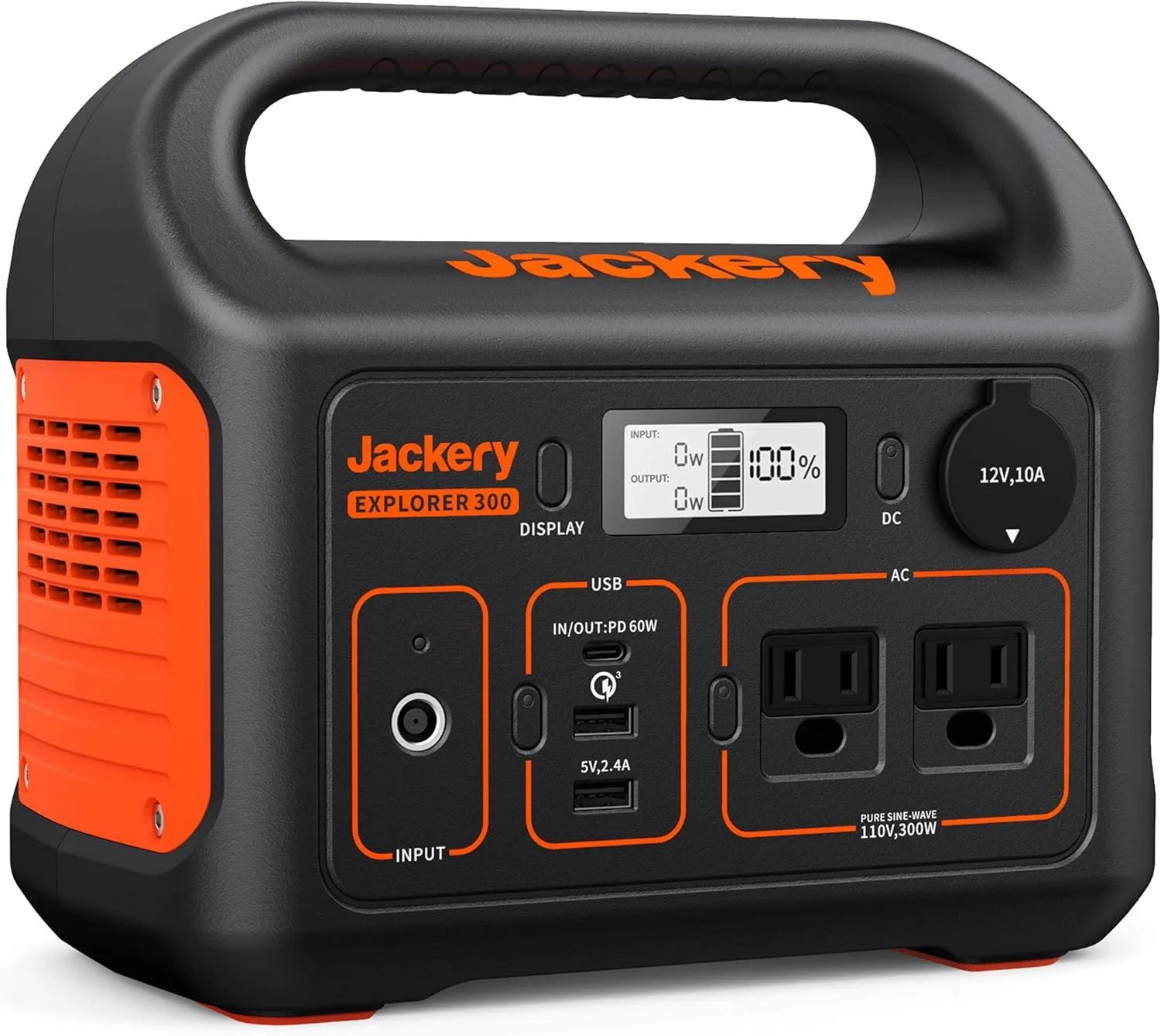
Pick up the Explorer 300 and you understand the appeal immediately. At 7.1 lbs, it is the second lightest unit in the compact class — only the Zerokor 300W undercuts it. The rubberized carry handle sits flush against the top panel when folded, and the bright orange accents against the matte black body give it a rugged-but-approachable aesthetic that photographs well and looks at home on a campsite picnic table.
The control layout is dead simple. One button powers the AC outlets. One button powers the DC and USB ports. A clear LCD screen shows remaining percentage, input/output wattage, and estimated time to empty or full. There is no app. No Bluetooth. No WiFi. For a certain buyer — someone who wants to plug in and forget about it — this simplicity is a genuine feature, not a missing one.
Jackery also benefits from ecosystem breadth. SolarSaga panels from 40W to 200W are widely available at retailers like Costco, Best Buy, and Amazon. Replacement cables and accessories are stocked. If something breaks, you can walk into a store and find a replacement part. That retail presence matters when you are 200 miles from the nearest outdoor shop and need a cable.
The 18,500-Review Advantage
Numbers create their own kind of trust. With 18500+ Amazon reviews, the Explorer 300 has been scrutinized more thoroughly by real buyers than any other compact power station. The aggregate data tells a consistent story: it charges phones reliably, it powers laptops for a few hours, and it rarely breaks. There are almost no reports of battery swelling, charging failures, or sudden shutdowns — the kinds of catastrophic failures that can plague lesser-known brands with thinner review histories.
That track record matters to first-time buyers. When you spend $100–$250 on a battery you are trusting near your sleeping bag, having 18,500 data points confirming that it does not catch fire is worth something. And for the record — that is a fair reason to choose the Explorer 300 over a brand with 150 reviews.
Explorer 300 Strengths
- Excellent portability at 7.1 lbs — second lightest in the compact class after Zerokor, lighter than both Anker and BLUETTI alternatives
- Jackery brand recognition and ecosystem — one of the most recognized names in portable power with widespread retail availability
- Bidirectional USB-C PD 60W port charges the station and powers devices — dual charging (wall + USB-C) reaches full in 2.5 hours
- Proven reliability with 18,500+ Amazon reviews — the most customer-verified unit in our entire catalog by a wide margin
Explorer 300 Weaknesses
- Li-ion NMC battery with only 500 cycles — the worst cycle life among all compact portables, meaning 2-3 years of regular use before capacity degrades
- Proprietary solar connector makes third-party panels difficult to use — DIY Solar Forum users flagged this as a significant frustration
- No built-in LED light — a basic feature the cheaper Zerokor and both VTOMAN units include for camping and emergencies
- Slow 4-hour wall charge time — 4x slower than Anker C300 and 2x slower than BLUETTI Elite 30 V2 at similar capacity
Watch: Watch Jackery Explorer 300 Review
What does 500 cycles actually mean?
This is the number that should stop you. Every other compact portable in our catalog uses LiFePO4 batteries rated for 3,000 to 3,500 cycles. The Jackery Explorer 300 uses NMC lithium-ion rated for just 500 cycles to 80% capacity. If you charge it twice a week — a normal pace for weekend camping — the battery degrades to 80% capacity in under five years. At three cycles per week, you are looking at three years before the unit starts losing real capacity.
For comparison, the DaranEner NEO at half the price offers 3,500 LiFePO4 cycles. The BLUETTI Elite 30 V2 offers 3,000 cycles. Both will outlast the Jackery Explorer 300 by a factor of six to seven.
Charging Speed: The Widening Gap
The Explorer 300 charges from a wall outlet in approximately 4 hours. That was acceptable in 2021. In 2026, the Anker SOLIX C300 hits 80% in 50 minutes. The BLUETTI Elite 30 V2 hits 80% in 45 minutes. The VTOMAN FlashSpeed 600 — which has nearly double the capacity — charges fully in 70 minutes. Jackery's 4-hour charging time is not just slow by modern standards. It is the slowest in the entire compact portable category.
Solar charging tells a similar story. The Explorer 300 accepts a maximum of 90W solar input through its proprietary connector. The VTOMAN FlashSpeed 600 accepts 200W through standard Anderson and DC5521 ports. The BLUETTI Elite 30 V2 accepts 200W through standard solar connectors. Jackery's lower solar ceiling means longer charge times in the field and fewer compatible third-party panels.
Real-World Usage Scenarios
The 293Wh capacity and 300W output define what the Explorer 300 can and cannot do. A smartphone charges roughly 20-25 times. A 60Wh laptop gets 3-4 charges with inverter losses factored in. A CPAP machine at 50W runs for about 5-6 hours — one night, but not two.
What it cannot do: run a mini fridge (most draw 40-60W continuously, draining the battery in 5-7 hours), power a small space heater (exceeds the 300W limit), or sustain a drone charging station for more than 3-4 flights. The 300W ceiling also means that any device drawing more than 300W — a blender, a hair dryer, a power tool — will trigger overload protection and shut down the output.
For a weekend camping trip where you are charging phones, running a Bluetooth speaker, and powering a small LED string, the Explorer 300 handles the job. The issue is that the BLUETTI Elite 30 V2 handles that same job AND runs 600W appliances AND charges in half the time AND lasts 6x longer — for less money.
The Proprietary Connector Problem
Jackery uses a DC8020 proprietary solar connector. Every SolarSaga panel ships with this connector. Third-party panels — which use standard Anderson, XT60, or DC5521 connectors — require adapter cables that Jackery does not officially sell. DIY Solar Forum members have documented workaround adapters, but Jackery's warranty terms are ambiguous about whether using non-SolarSaga panels voids coverage.
This matters because solar panel technology has improved faster than Jackery's connector ecosystem. A 200W bifacial panel from a brand like BougeRV or Renogy costs under $200 and delivers double the output of Jackery's comparable SolarSaga panel. But connecting it to the Explorer 300 requires an adapter, is limited to 90W input anyway, and may void your warranty.
Every other compact portable in our catalog uses standard connectors. The VTOMAN FlashSpeed 600 accepts both Anderson and DC5521. The BLUETTI Elite 30 V2 uses standard MC4 compatible inputs. The Anker SOLIX C300 uses XT60. Jackery's proprietary approach locks you into their ecosystem with no upgrade path. Our solar generator buying guide covers connector compatibility in more detail.
Does the Jackery Name Still Justify the Price?
At above average for its category, the Explorer 300 is not the most expensive compact portable. But it is arguably the worst value. A side-by-side comparison with three direct competitors makes the gap painfully clear:
The DaranEner NEO costs less than half the price and delivers LiFePO4 chemistry with 3,500 cycles, 300W output, and faster 2-hour charging. It gives up some capacity (192Wh vs 293Wh) and brand recognition, but the per-cycle cost is a fraction of the Jackery's.
The BLUETTI Elite 30 V2 costs less than the Explorer 300 and delivers LiFePO4 with 3,000 cycles, 600W continuous output (double the Jackery), 45-minute fast charging to 80%, app control, and UPS capability. The Elite 30 V2 is superior in every measurable category except weight — it is 2.4 lbs heavier.
The Anker SOLIX C300 costs the same and includes a 60W solar panel, whisper-quiet 25dB operation, 50-minute fast charging to 80%, and the Anker brand trust that rivals Jackery's. It matches the 300W output but adds faster charging and a solar panel in the box.
What does Jackery offer that these three do not? Brand familiarity, slightly lighter weight, and a 4.4-star rating across 18,500+ reviews. Whether that justifies paying the same or more for inferior specs depends entirely on how much you value the known quantity over the better one.
There is one scenario where the Jackery ecosystem still makes sense: if you already own two or three SolarSaga panels and plan to keep using them. Selling used solar panels is a hassle, and the DC8020 connector means those panels work best with Jackery products. In that case, the Explorer 300 is a low-friction addition to a setup you have already invested in. But for first-time buyers starting from scratch with no existing gear, the numbers above speak for themselves — the Explorer 300 is the worst value in its class on every metric except brand recognition.
Should You Buy the Jackery Explorer 300?
Rating: 4.4/5
The Jackery Explorer 300 was a strong buy in 2022. In 2026, its 500-cycle NMC battery, slow charging, and proprietary connector feel outdated. The BLUETTI Elite 30 V2 delivers LiFePO4 chemistry, 600W output, faster charging, and a 5-year warranty for $30 less. Jackery still wins on brand trust and simplicity, but the specs gap is real.
Buy the Jackery Explorer 300 if:
- You already own multiple Jackery SolarSaga panels with DC8020 connectors and want to stay in the Jackery ecosystem
- You prioritize established brand trust and widespread retail availability above all other factors
- Absolute minimum weight matters more to you than charging speed or battery cycle life
- You are buying for someone who wants the simplest possible operation with no companion apps, no settings menus, and no configuration
Skip the Jackery Explorer 300 if:
- You plan to use the station regularly for more than 2-3 years (the 500-cycle NMC battery is a dealbreaker)
- You want to power anything beyond phones, laptops, and small USB devices
- Charging speed matters — the Explorer 300 takes 4-8x longer than modern competitors
- You want solar flexibility with standard connectors and higher input wattage
Common Questions About the Jackery Explorer 300
Is the Jackery Explorer 300 still worth buying in 2026?
For buyers who prioritize brand trust and simplicity above all else, yes. But on pure specs, the BLUETTI Elite 30 V2 delivers LiFePO4 chemistry, double the output wattage, faster charging, and a longer warranty for less money. The Jackery Explorer 300 is the safe choice, not the smart one.
How many times can the Jackery Explorer 300 charge a phone?
With 293Wh of capacity, the Explorer 300 can charge a typical smartphone (3,000-5,000mAh battery) approximately 20-25 times. A laptop with a 60Wh battery gets about 3-4 full charges, accounting for inverter losses.
Can the Jackery Explorer 300 run a CPAP machine?
Yes, but only for about one night. Most CPAP machines draw 30-60W, which means the 293Wh battery lasts roughly 5-8 hours depending on your pressure settings and whether the humidifier is active. Multi-night camping trips require a larger unit or a solar panel for daytime recharging.
Why does the Jackery Explorer 300 use lithium-ion instead of LiFePO4?
The Explorer 300 was designed before LiFePO4 became the standard in portable power stations. Its NMC (nickel manganese cobalt) lithium-ion battery was the norm in 2021-2022. Jackery has since moved to LiFePO4 in their newer models, but the Explorer 300 has not been updated with the new chemistry.
Can I use third-party solar panels with the Jackery Explorer 300?
This is where things get frustrating. Jackery uses a proprietary DC8020 solar connector. Most third-party panels use Anderson, XT60, or DC5521 connectors. You can buy an adapter cable, but Jackery warns that non-SolarSaga panels may void the warranty. The 90W maximum solar input also limits what panels are practical.
The Bottom Line for 2026
The Jackery Explorer 300 is the Toyota Camry of portable power stations — reliable, well-known, available everywhere, and thoroughly average on every metric that matters in 2026. It will charge your phone. It will run your laptop for a few hours. It will not surprise you or disappoint you in any dramatic way.
But the market moved on. LiFePO4 batteries that last 6-7x longer cost less. Fast charging that fills a station in under an hour is now standard. Double the output wattage is available at the same price point. The 293Wh capacity that felt generous in 2021 now trails modern competitors like the Anker SOLIX C300 (288Wh with LiFePO4 and 50-minute fast charging) and the BLUETTI AC2A (204Wh but with 300W output, LiFePO4, and half the recharge time). The Explorer 300 earned its 18,500 reviews over years of being the safe choice. In 2026, the safe choice and the good choice have diverged, and the Jackery sits firmly on the wrong side of that split.
For first-time buyers who value simplicity and established brand trust above raw specs and long-term value, the Explorer 300 remains a serviceable option. For everyone else — especially anyone who plans to use their power station regularly for more than a couple of years — the BLUETTI Elite 30 V2 or Anker SOLIX C300 deliver more capability for the same money or less.