Jackery Solar Generator 1000 v2 with 200W Solar Panel Review 2026
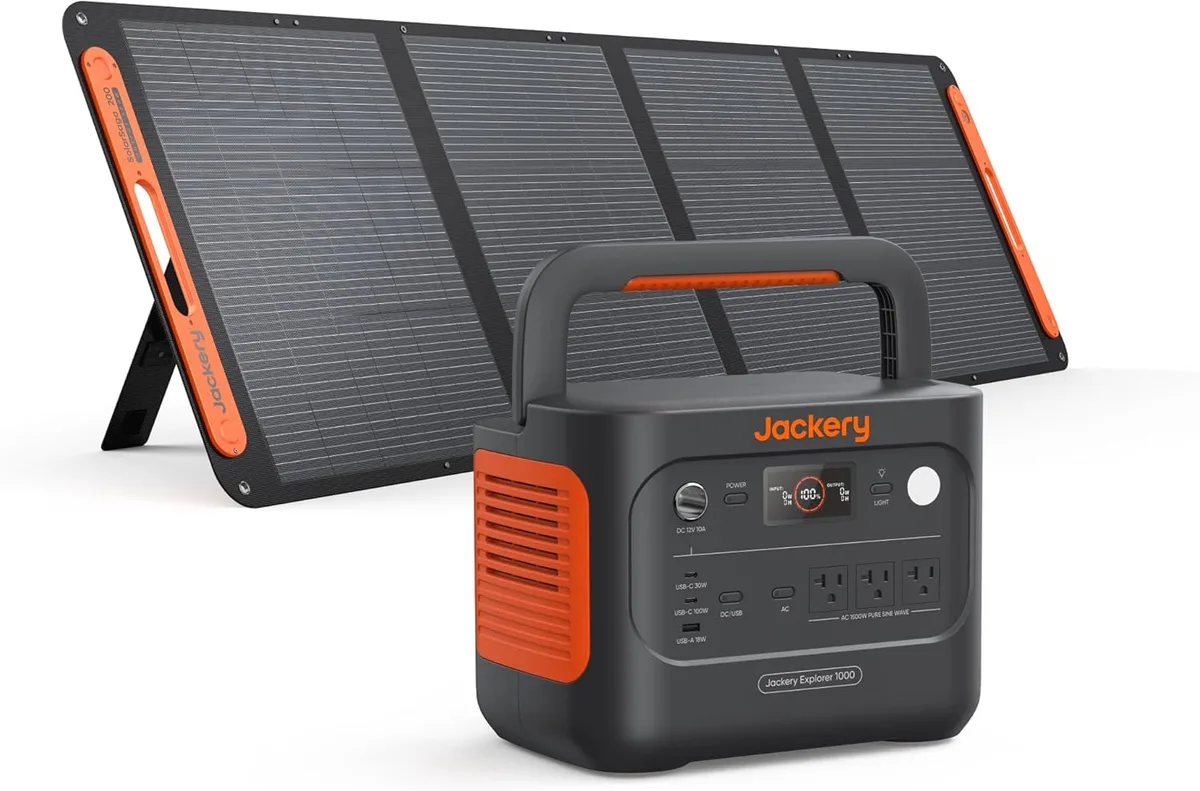
The Jackery Explorer 1000 v2 is the safe, premium choice — lightest weight, quietest fans, best bundled solar panel, and the most trusted brand name in portable power. The 200W bifacial panel alone is worth the price premium over bare-unit competitors. But the 1,500W output ceiling and limited port count mean power users should look at the Anker C1000 Gen 2 or EcoFlow DELTA 2 for heavier workloads.
This review is based on analysis of 2947+ Amazon ratings, expert reviews, and comparison with products in the Mid-Range Power Stations category. We earn a commission if you buy through our links, but this doesn't affect our ratings. Read our full methodology →
The Brand Everyone Trusts — Does It Deliver?
Jackery is the name most people think of when they hear "portable power station." The Explorer 1000 v2 is their mid-range flagship: 1,070Wh of LiFePO4 battery, 1,500W continuous output, and at 24.5 lbs, the lightest unit in its class. It is Amazon's #1 Best Seller in Outdoor Generators for a reason — brand trust, retail availability at Best Buy and Costco, and a design that just works.
But this bundle is not about the power station alone. The included SolarSaga 200W bifacial panel is the real differentiator. At 26.7% conversion efficiency with IP68 waterproofing, it outperforms every other bundled panel in the market. If you're buying a solar generator for actual solar use — camping, RV living, off-grid weekends — this panel earns its keep.
Seven output ports cover the essentials: three pure sine wave AC outlets, two USB-C at 100W PD, one USB-A, and a 12V car port. It is the fewest ports in the mid-range lineup, and power users who charge six devices simultaneously will feel the pinch. For most camping and backup scenarios, seven is enough. The two 100W USB-C ports charge MacBook Pros and iPads at full speed — a detail that matters for remote workers who depend on laptop power during extended outages or off-grid stays.
The LiFePO4 chemistry is a welcome upgrade over the original Explorer 1000's lithium NMC cells. LiFePO4 runs cooler, tolerates partial charge states better during storage, and offers a longer cycle life — 4,000 cycles to 70% capacity. That translates to roughly 11 years of daily cycling. The chemistry also eliminates the thermal runaway risk that plagued early NMC portable stations, which matters when you're keeping this inside a tent or van.
Build quality matches what you would expect from Jackery at this price. The textured gray enclosure resists fingerprints and minor scuffs. The retractable handle folds flat — no protruding grip to catch on gear bags or vehicle cargo areas. Android Police noted the handle mechanism feels more durable than previous Jackery models, with a stiffer pivot that avoids the loose wobble some competitors exhibit after a few months of use. At 14.76 x 10.47 x 10.91 inches, the 1000 v2 is compact enough to fit in a standard 65L cooler-sized space, which makes packing for car camping trips much simpler than dealing with the bulkier OUPES Mega 1 or EcoFlow DELTA 2.
Explorer 1000 V2: Pros and Cons
✓ Strengths
- ✓ Best solar panel in any bundle — 200W bifacial SolarSaga with 26.7% efficiency and IP68 waterproof rating
- ✓ Lightest power station in the mid-range lineup at 24.5 lbs delivering 1,500W — the best portability-to-power ratio
- ✓ Whisper-quiet 30dB operation with a dedicated quiet overnight charging mode in the app
- ✓ Most recognized brand in portable power — Amazon #1 Best Seller with retail availability at Best Buy, Home Depot, and Costco
✗ Weaknesses
- ✗ Lowest continuous output in the mid-range tier at 1,500W — space heaters and high-draw appliances may trip the unit
- ✗ Fewest ports at 7 total (3 AC, 2 USB-C, 1 USB-A, 1 car) — less versatile for multi-device charging
- ✗ Cycle life rated at 4,000 cycles to 70% capacity — not the 80% benchmark used by most competitors
- ✗ 400W solar input ceiling limits fast off-grid charging compared to competitors accepting 500-800W
Solar Performance: Where the 200W Panel Shines
The bundled SolarSaga 200W panel is not a throwaway accessory — it is a legitimate solar panel that competes with standalone offerings. The IBC bifacial cells collect light from both the front and rear surfaces, which means reflected light from a tent's rain fly, a light-colored table, or even sand adds 10-25% more energy harvest than a standard single-sided panel would capture.
Outdoor Tech Lab tested the panel during a northern Michigan autumn camping trip. Despite low sun angles and partial cloud cover, the bifacial panel kept the unit topped up through 3 days of powering a 12V cooler, phone chargers, and camp lights. The IP68 rating meant leaving it out during an unexpected rain shower was a non-event.
The 400W solar input ceiling on the station itself is the bottleneck, not the panel. With a single 200W SolarSaga, you will pull 140-180W in direct sunlight (real-world conditions are always below the panel's rated maximum). Adding a second 200W panel through a Y-connector pushes you toward that 400W cap and cuts full recharge time from roughly 6 hours to about 3.5 hours. But most buyers using the included bundle without extras should expect a full solar recharge in 5-7 hours depending on season, latitude, and cloud cover.
One detail competitors miss: the SolarSaga 200W folds into a compact carrying case with a magnetic latch. The case protects the cells during transport and doubles as a kickstand. Unfolded, the panel measures 93.9 x 21.7 inches — large enough that propping it on the ground at the right angle requires a flat clearing. It will not balance on a picnic table. Plan for ground-level deployment with a reflective tarp underneath for maximum bifacial benefit.
AC Charging and Daily Use
The Jackery app's emergency mode pushes a full charge in about an hour — useful when you need to top up fast before a storm. Standard mode takes 1.7 hours, which is gentler on the battery and recommended for regular use. Both are competitive, though the Anker C1000 Gen 2 at 49 minutes and the VTOMAN FlashSpeed 600 at sub-hour make the Jackery's charging speed merely average for the tier.
That 30dB operating noise is a real advantage. Android Police specifically noted you can charge it overnight in a bedroom without disturbance. The quiet mode in the app reduces fan speed even further during sleep hours — a feature that no other unit in this lineup matches. For van lifers sleeping next to their power station, this matters more than any spec sheet number.
The Jackery app itself is polished — more refined than VTOMAN's and comparable to Anker's. Real-time power input and output monitoring, scheduled charge and discharge windows, battery health status, and firmware updates all work over both Bluetooth and WiFi. One feature that campers will appreciate: the app shows estimated remaining runtime based on current draw, updated live. If you are running a 65W laptop and a 45W mini-fridge, the app calculates how many hours of combined use remain — a calculation you would otherwise do manually with pen and paper.
One area where Jackery trails: no expandable battery ecosystem. Anker's C1000 connects to a B1000 expansion battery, doubling capacity to over 2,000Wh without buying a second station. EcoFlow's DELTA 2 connects to extra batteries as well. The Jackery 1000 v2 is a closed system — what you buy is what you get. If your power needs grow over time, you cannot add capacity. You would need to sell and upgrade to a larger unit, or run two stations side by side. For buyers who foresee expanding their setup later, that is a real limitation worth weighing against the solar bundle advantage.
Camping, Van Life, and Backup Scenarios
The Explorer 1000 v2 is best suited for 2-3 day camping trips where you are running lights, charging phones and laptops, and perhaps powering a small 12V fridge. At 1,070Wh, a nightly load of 150W (LED lights, phone charging, fan) depletes about 30-35% of the battery. With the solar panel collecting 600-800Wh during a full day of sun, you can operate indefinitely in summer conditions. Autumn and winter cut solar harvest by 40-60%, so pack accordingly.
Van lifers have a different calculus. The 24.5 lb weight and compact footprint mean the 1000 v2 fits under a bench seat or in a cabinet without eating into living space. The 30dB fan noise is quiet enough to sleep beside — a claim that the Anker C1000 and EcoFlow DELTA 2 cannot make. One van lifer on the Jackery subreddit ran a CPAP machine (30-60W), phone charger, and LED strip for 3 nights between solar recharges. The unit reached 12% on morning three before the panel brought it back above 70% by afternoon.
For home backup, the 1,070Wh capacity keeps a router, a few LED bulbs, and phone chargers running for 15-20 hours. A refrigerator (cycling at 80-150W average) drains the battery in about 6-8 hours, which covers a typical daytime outage. Overnight outages require rationing — either run the fridge on a timer or prioritize other loads. If whole-home backup is the primary use case, the Anker SOLIX C2000 Gen 2 or pecron F3000LFP offer 2-3x the capacity at a higher total cost.
The 1,500W Output Ceiling
This is where the Jackery falls short. At 1,500W continuous, it is the lowest output in the mid-range lineup. The Anker C1000 Gen 2 pushes 2,000W. The BLAVOR 1600W pushes 1,600W. The EcoFlow DELTA 2 hits 1,800W with X-Boost taking it to 2,700W. If you need to run a full-size space heater (1,500W), a hair dryer (1,500-1,875W), or a power tool, the Jackery is at its limit or beyond it.
The 3,000W surge helps with motor startups — refrigerator compressors, fans, small power tools — but sustained high-draw loads above 1,500W will trip the protection. This is a deliberate design trade-off: Jackery prioritized light weight and quiet operation over raw output. For most camping and light backup needs (laptops, lights, mini-fridges, CPAP machines, phone charging), 1,500W is plenty. For heavier demands, look elsewhere.
To put the 1,500W limit in perspective: a Ninja blender peaks at 1,100W, a Keurig coffee maker pulls about 1,300W during heating, and a 10-quart Instant Pot draws around 1,000W. All of those run without issues. The loads that trip the protection — full-size space heaters, hair dryers on high, and large power tools — are not typical camping appliances. Most buyers will never hit the ceiling unless they are running the unit as a home backup for high-draw kitchen circuits.
Should You Buy the Jackery 1000 v2 Bundle?
Our Verdict: 8.2/10
The Jackery Explorer 1000 v2 is the safe, premium choice — lightest weight, quietest fans, best bundled solar panel, and the most trusted brand name in portable power. The 200W bifacial panel alone is worth the price premium over bare-unit competitors. But the 1,500W output ceiling and limited port count mean power users should look at the Anker C1000 Gen 2 or EcoFlow DELTA 2 for heavier workloads.
The value equation depends entirely on whether you plan to use solar. As a bare power station, the 1000 v2's 1,070Wh at 1,500W continuous output is adequate but not exceptional — several competitors deliver more watts and more watt-hours for less money. But as a complete solar generator system, the bundle pricing changes the math. The SolarSaga 200W panel would cost a premium amount if purchased separately, and no other manufacturer includes a bifacial panel with IP68 waterproofing in a bundle at this price tier.
Buy it if: You want the most trusted brand with the best solar panel bundle on the market. The 200W bifacial SolarSaga panel, 24.5 lb weight, and 30dB quiet operation make this the premier choice for camping, van life, and solar-first use. Jackery's retail presence and customer support provide peace of mind that smaller brands cannot match. First-time buyers who want zero guesswork — unbox, unfold the panel, plug in, done — will appreciate how friction-free this system is compared to assembling a station and panel from different manufacturers.
Skip it if: You need more than 1,500W continuous output or more than 7 ports. The Anker C1000 Gen 2 delivers 2,000W at the same price (without panel), and the OUPES Mega 1 bundles a panel with higher continuous output for less money. See how the Jackery stacks up in our Jackery 1000 V2 vs OUKITEL P1000 Plus comparison. The Jackery is a premium solar bundle — not a raw power champion. If you never plan to charge from solar and only want wall-outlet backup power, you are paying for a panel you will not use.
Questions Buyers Ask
Is the Jackery Explorer 1000 v2 worth the premium over cheaper alternatives?
The value proposition hinges on the bundled 200W bifacial solar panel. As a bare unit, the 1000 v2 competes with stations that deliver more output for less. But the SolarSaga 200W panel alone would cost $300+ separately — factoring that in, the $599 bundle is competitive. If you plan to use solar, the bundle is strong. If you only charge from wall outlets, the OUPES Mega 1 or EcoFlow DELTA 2 offer more power per dollar.
How quiet is the Jackery Explorer 1000 v2 compared to other power stations?
At 30dB, it is the quietest unit in our mid-range lineup — tied with the OUKITEL P1000 Plus. For reference, 30dB is roughly the sound level of a whisper from 3 feet away. The Jackery app also includes a quiet overnight charging mode that reduces fan speed further during designated sleep hours. Anker and EcoFlow units are noticeably louder under similar loads.
What makes the bundled solar panel special?
The included SolarSaga 200W uses IBC bifacial technology — it collects light from both sides of the panel, boosting efficiency to 26.7% compared to the typical 22-23% from competitor bundles. The IP68 waterproof rating means real rain protection (not just splash resistance). And the bifacial design picks up reflected light from surfaces below the panel, which adds roughly 10-25% more energy harvest depending on the surface.
Can the Jackery 1000 v2 power a space heater?
Most space heaters draw 1,500W — right at the unit's continuous limit. A 1,500W heater may work briefly but risks tripping the overload protection under sustained use. Lower-wattage space heaters (750-1,200W) run reliably. If powering a full-size space heater is a priority, consider the Anker C1000 Gen 2 (2,000W continuous) or the BLAVOR 1600W.
What does the 4,000 cycles to 70% rating actually mean?
After 4,000 full charge-discharge cycles, the battery retains 70% of its original capacity — meaning your 1,070Wh battery drops to about 749Wh. Most competitors rate their cycles at 80% retention. At the 80% benchmark, the Jackery's effective cycle count is lower than advertised. Daily cycling would reach the 70% mark in roughly 11 years, but you'll notice reduced runtime before that point.
Can the Jackery Explorer 1000 v2 run a CPAP machine overnight?
Yes — CPAP machines typically draw 30-60W depending on the model and humidifier setting. At 50W average draw, the 1,070Wh battery powers a CPAP for roughly 17-18 hours (accounting for inverter efficiency losses). That covers two full nights for most users. The 30dB quiet operation means the power station will not add noise to your sleep environment, which is not true of louder competitors like the Anker C1000 or EcoFlow DELTA 2.
Does the Jackery app work without WiFi or cell service?
Yes. The Jackery app connects over Bluetooth when WiFi is unavailable, which covers most camping and off-grid scenarios. Bluetooth range is approximately 30 feet line-of-sight. You can monitor battery level, input/output wattage, set quiet mode hours, and view estimated remaining runtime — all without internet access. Firmware updates do require WiFi, so update before heading into the field.
The Premium Solar Bundle Pick
The Jackery Explorer 1000 v2 with 200W SolarSaga panel is the best complete solar generator package for buyers who plan to use solar charging. The panel alone justifies the price premium, the unit is the lightest and quietest in its class, and Jackery's brand trust is unmatched. Accept the 1,500W output limitation and fewer ports, and you get a refined, reliable system that earns its #1 Best Seller ranking.