GROWATT HELIOS 3600 Portable Power Station Review 2026
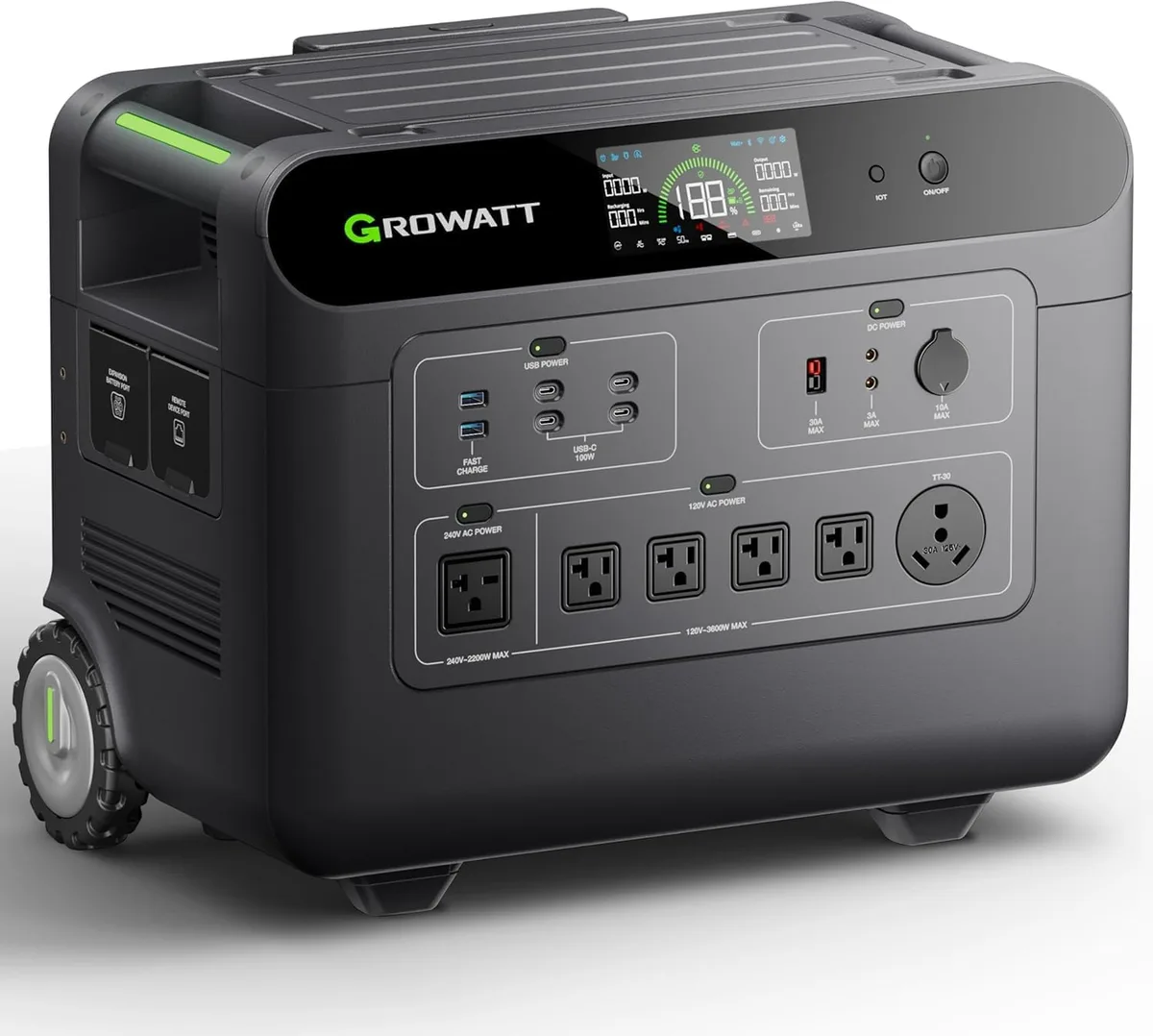
The GROWATT HELIOS 3600 blurs the line between portable power station and home battery system. Its 3,686Wh capacity, 3,600W/240V output, and expansion to 36kWh make it the most capable unit for whole-home backup. But at 99 lbs with underrated cables and app issues, this is a unit you place and leave — not one you throw in the truck. For serious off-grid or backup power systems, the HELIOS 3600 delivers capability that smaller units cannot match.
This review is based on analysis of 150+ Amazon ratings, expert reviews, and comparison with products in the Whole-Home Backup Systems category. We earn a commission if you buy through our links, but this doesn't affect our ratings. Read our full methodology →
Not a Portable Power Station — A Home Battery That Happens to Be Portable
Calling the GROWATT HELIOS 3600 a "portable power station" is technically accurate but misleading. At 99 lbs, this is a piece of equipment you install. You position it, plug in your home's critical circuits, and leave it. The comparison is not against camping power stations — it is against Tesla Powerwalls and Enphase IQ batteries. And at that scale, the HELIOS 3600 offers a compelling cost-per-kilowatt-hour ratio that dedicated home batteries cannot touch.
The 3,686Wh LiFePO4 battery holds nearly 80% more energy than the 2,048Wh units from Anker and EcoFlow. A cabin owner running a fridge, Starlink, router, and TV continuously reported 24-30 hours of runtime on a single charge. With a 400W solar panel providing daytime recharging, that cabin effectively disconnected from the grid entirely. The LiFePO4 chemistry is rated for 3,000+ charge cycles to 80% capacity — at one full cycle per day, that is over 8 years of daily use before the battery degrades to 80% of its original capacity.
But the capacity number is not even the headline feature. The HELIOS 3600 outputs both 120V and 240V natively — including a NEMA TT-30 outlet that runs RV air conditioners, 240V welders, and heavy workshop tools. Connect two units in parallel and you have 7,200W at 240V. With expansion batteries, the system scales to 36kWh. That is not a camping gadget — that is a residential power installation.
The unit arrives partially assembled with the wheels and pull handle pre-attached. Unboxing weighs on you — the carton is over 110 lbs with packaging — and you will need a second person or a dolly to get it from the porch to its final resting spot. Growatt ships an AC charging cable, a car charging cable, MC4 solar input cables, and a user manual. No solar panels are included, which is standard for this capacity tier. The display panel sits on top, angled slightly forward for readability when the unit is positioned on the floor. Sixteen ports are organized across the front face, with the 240V NEMA TT-30 and Anderson connector on the side.
Where the HELIOS 3600 Excels and Falls Short
✓ Strengths
- ✓ Highest capacity in the high-capacity class at 3,686Wh — nearly 80% more than competing 2,048Wh units
- ✓ 120V/240V dual voltage with NEMA TT-30 outlet — two units in parallel deliver 7,200W/240V for genuine whole-home backup
- ✓ 2,000W solar input is the highest in class — full charge in 2.5 hours with a matching solar array
- ✓ Cold startup certified at -22°F (-30°C) — operates in extreme cold where other stations refuse to start
✗ Weaknesses
- ✗ Brutally heavy at 99 lbs — requires two-person lift and is effectively a semi-permanent installation
- ✗ Included AC charging cable is underrated 14AWG — users report frying extension cords during charging
- ✗ Cannot charge from grid while running two units in 240V parallel mode — solar only in that configuration
- ✗ MyGro app connectivity is unreliable — slow to connect and frequently fails to retrieve status updates
3,600W Continuous Output and the 240V Advantage
The 3,600W continuous inverter at 120V handles every standard household appliance short of a central HVAC system. See our pecron F3000LFP vs GROWATT HELIOS 3600 comparison for a detailed spec breakdown. A contractor used the HELIOS 3600 on a remote job site with no grid access — the unit powered circular saws (1,800W draw) without hesitation, and the 4,500W Watt+ surge accommodated an air compressor startup. The 240V NEMA TT-30 outlet ran a 240V welder at half capacity. No 2kWh portable station can attempt that.
The pure sine wave output measures clean across most loads, which matters for sensitive electronics. Medical equipment, variable-speed tools, and audio gear all run without interference. A woodworker reported running a 1,500W table saw and a dust collector (780W) simultaneously for a full afternoon of shop work — the HELIOS 3600 sat at roughly 63% inverter load with stable voltage output. The 4,500W Watt+ surge mode absorbs the inrush current from motors and compressors without tripping the protection circuit, though Growatt recommends keeping sustained loads below 3,600W to avoid thermal throttling during extended operation.
Sixteen output ports cover nearly every scenario: four USB-C at 100W each, USB-A fast charge ports, multiple 120V AC outlets, the 240V NEMA TT-30, a car lighter port, two DC5521 barrels, and an Anderson connector. The port count matches the FOSSiBOT F2400 and exceeds everything from Anker and EcoFlow in this class. The Anderson connector is a standout — it delivers 12V/25A for direct DC wiring to RV systems, ham radio equipment, or custom off-grid installations without inverter conversion losses. DC loads like LED strips and 12V fridges run about 10-15% more efficiently through the Anderson connector than through AC outlets.
Solar Charging: 2,000W Input Changes the Math
Most high-capacity stations cap solar input at 500-1,000W. The HELIOS 3600 accepts 2,000W — enough to charge its 3,686Wh battery from empty in roughly 2.5 hours under full sun. For off-grid installations, this transforms the unit from an emergency backup into a daily-cycling solar battery. A 2,000W panel array is affordable at current pricing, keeping the total system cost well within the mid-range bracket for 3,686Wh of solar-powered storage.
AC charging is equally capable: 1.5 hours via 240V at 3,600W input, or 2.7 hours via standard 120V at 1,800W. Both are competitive for a battery this large. The EcoFlow DELTA Pro 3 charges faster in absolute terms (0-80% in 50 minutes), but it also holds 400Wh less capacity and costs more than double.
Dual charging — AC and solar simultaneously — is also supported. During a cloudy winter week in Michigan, a homeowner ran 1,200W of rooftop solar into the unit while also trickle-charging from the grid at 500W. The combined input kept the battery topped off while running a chest freezer, LED lights, and a home office setup around the clock. This dual-input capability is useful for hybrid solar/grid installations where solar provides daytime power and grid charging backfills overnight. The HELIOS 3600's input flexibility makes it one of the most adaptable charging platforms in the whole-home category.
The 99-Pound Reality and the Parallel Limitation
Two issues define the ownership experience. First, the weight. At 99 lbs, the HELIOS 3600 has wheels and a handle, and it rolls across flat surfaces. But stairs, gravel driveways, and vehicle loading require two people or a hand truck. This is a placement appliance. Once you decide where it lives, it stays there.
Second, the parallel charging limitation. When two HELIOS 3600 units run in 240V parallel mode (7,200W output), AC grid charging is disabled entirely. Only solar charging works in that configuration. For homeowners planning 240V backup, this means either: run 240V from solar only, or disconnect 240V mode and switch to single-unit 120V to recharge from the grid. It is a frustrating design choice that limits the unit's whole-home backup usefulness during extended outages without solar panels.
The MyGro app adds another friction point. Smart features like customizable power strategies and weather-based alerts sound useful on paper — but the app connects slowly and frequently fails to retrieve status updates. Growatt's commercial inverter app is mature and reliable; the portable station app is not there yet. Multiple Amazon reviewers describe a pattern: the app connects over Bluetooth after 10-15 seconds of searching, displays status data, then loses the connection within a minute or two. WiFi connectivity fares slightly better at home, but drops out periodically. For a unit positioned as a semi-permanent home backup, the app experience falls short of what Anker and EcoFlow deliver.
The display on the unit itself partially compensates. The top-mounted LCD shows real-time input/output wattage, battery percentage, estimated time to full/empty, and individual circuit status. It is readable from several feet away and updates in real-time. For daily monitoring of a stationary installation, the built-in display may be all you need — reducing reliance on the finicky app. Growatt also promises firmware updates to improve the MyGro experience, though the timeline remains unspecified.
Who the HELIOS 3600 Is Actually Built For
Three buyer profiles make sense for this unit. The first is the cabin or off-grid homeowner who wants a battery backup that charges from solar and powers essentials for 24+ hours. The 3,686Wh capacity, 2,000W solar input, and expansion to 36kWh make the HELIOS 3600 the foundation of a serious off-grid electrical system. A family running a cabin in northern Minnesota reported using the HELIOS 3600 with a 1,600W rooftop panel array, keeping a chest freezer, LED lighting, well pump, and Starlink running year-round. Cold startup to -22°F means the unit fires up in January without pre-heating — a feature missing from most competitors.
The second profile is the emergency preparedness buyer in hurricane, tornado, or ice storm territory. A single HELIOS 3600 keeps a refrigerator (120W average), router (15W), phone chargers (20W), and LED lights (30W) running for roughly 20 hours on a full charge. With any solar input during daylight, that runtime extends indefinitely for these low-draw essentials. Two units in parallel provide 240V for window AC units during summer outages — the difference between discomfort and danger in southern states.
The third profile is the mobile professional — contractors, event production crews, food truck operators — who need high-wattage 120V or 240V power where there is no grid connection. The HELIOS 3600 runs power tools, commercial blenders, sound systems, and lighting rigs. It does not replace a gas generator for 8-hour construction sites, but it runs quieter, produces zero emissions, and costs nothing per hour of fuel. For events, film sets, and pop-up locations where generator noise is unacceptable, the HELIOS 3600 fills the gap.
Is the GROWATT HELIOS 3600 the Right Investment?
Our Verdict: 7.8/10
The GROWATT HELIOS 3600 blurs the line between portable power station and home battery system. Its 3,686Wh capacity, 3,600W/240V output, and expansion to 36kWh make it the most capable unit for whole-home backup. But at 99 lbs with underrated cables and app issues, this is a unit you place and leave — not one you throw in the truck. For serious off-grid or backup power systems, the HELIOS 3600 delivers capability that smaller units cannot match.
Buy it if: You need maximum battery capacity with 240V output for whole-home or cabin backup, and you have solar panels (or plan to install them). The 3,686Wh battery, 2,000W solar input, and expansion to 36kWh make this the capacity king. It undercuts every competitor in the 3,000Wh+ class on price. Cold startup to -22°F seals it for northern climates.
Skip it if: You need portability, polished app control, or the ability to charge from the grid while running 240V output. The Anker SOLIX F3000 is nearly silent with a best-in-class app at roughly double the cost. The EcoFlow DELTA Pro 3 charges faster and weighs half as much at more than double the price. Both cost more, but both are more refined daily-use products.
HELIOS 3600 Questions Answered
How much does the GROWATT HELIOS 3600 actually weigh and can one person move it?
At 99 lbs, the HELIOS 3600 requires two people to lift safely. Growatt includes enlarged wheels and an ergonomic pull handle for rolling across flat surfaces, but stairs, uneven ground, or loading into a vehicle is a two-person job. Most owners treat it as a semi-permanent installation — place it once and leave it. A hand truck or furniture dolly makes repositioning manageable for one person on flat ground.
Can the GROWATT HELIOS 3600 actually power a whole house?
A single unit delivers 3,600W continuous at 120V and has a 240V NEMA TT-30 outlet for heavy appliances. That handles a fridge, lights, router, CPAP, and a few other essentials simultaneously. For true whole-house backup including HVAC, connect two units in parallel for 7,200W/240V output. With expansion batteries, the system scales to 36kWh — enough to run most homes for 24-48 hours depending on load. The catch: grid charging is disabled in parallel mode, so you need solar panels to recharge while in 240V configuration.
What solar panels work best with the GROWATT HELIOS 3600?
The unit accepts up to 2,000W of solar input — the highest in its class. For maximum charging speed, pair it with four 400W or five 400W rigid panels. Growatt sells compatible panels, but any panel array within the voltage and amperage input range works. A 2,000W array charges the 3,686Wh battery from empty in roughly 2.5 hours under good sun conditions. Even a single 400W panel provides solid daytime top-up for overnight loads.
How does the HELIOS 3600 compare to the EcoFlow DELTA Pro 3?
The HELIOS 3600 offers 80% more capacity (3,686Wh vs 4,096Wh for the DELTA Pro 3) at less than half the price. But the EcoFlow charges faster (0-80% in 50 min vs 1.5-2.7 hours), is far lighter (55.1 lbs vs 99 lbs), has a better app ecosystem, and delivers higher continuous output (4,000W vs 3,600W). The HELIOS 3600 wins on raw capacity and solar input ceiling; the DELTA Pro 3 wins on refinement, portability, and charging speed. Budget vs polish.
Is Growatt a reliable brand for power stations?
Growatt is one of the world's largest inverter manufacturers with over 10 years in the solar industry and installations in 180+ countries. Their commercial and residential inverters have a strong track record. The portable power station line is newer, and early user reviews are mixed — hardware quality is solid, but the MyGro app has connectivity issues and the included charging cables are underrated for the unit's capacity. The 5-year warranty provides decent coverage. Growatt is not a fly-by-night brand, but their portable product line is still maturing.
How loud is the GROWATT HELIOS 3600 during operation?
The HELIOS 3600 runs its cooling fans at a moderate volume under load — noticeably louder than the near-silent Anker SOLIX C2000 Gen 2, but quieter than a window-mounted air conditioner. At low loads (under 500W), the fans cycle intermittently. At sustained loads above 1,500W, expect consistent fan noise comparable to a box fan on low speed. For bedroom use during outages, position the unit in an adjacent room or hallway. For garage or outdoor installations, the fan noise is a non-issue.
Does the HELIOS 3600 support UPS mode for automatic switchover?
Yes — the HELIOS 3600 includes a UPS function with a switchover time of approximately 10-20ms. This is fast enough to keep networking equipment, LED lighting, and most consumer electronics running through a brief grid interruption without visible disruption. It is not fast enough for enterprise servers or medical ventilators that require sub-10ms switchover. For home backup use, connect the HELIOS 3600 to your critical load panel and leave it plugged into the wall — when grid power drops, the battery takes over automatically.
The Capacity King for Serious Backup
The GROWATT HELIOS 3600 is not for everyone. It is heavy, the app needs work, the included cable is underrated, and the parallel charging limitation is a real design flaw. But no other portable power station delivers 3,686Wh of LiFePO4 storage with 240V output and 2,000W solar input at this price point. For buyers building a cabin power system, a whole-home backup solution, or an off-grid solar installation, the HELIOS 3600 is the foundation unit — the one you expand around as your needs grow.
The long-term economics also favor the HELIOS 3600. With 3,000+ cycle LiFePO4 cells, one cycle per day yields over 8 years of service. A daily-cycling off-grid cabin putting 3kWh through the unit per day racks up over 8,700kWh of total energy delivery over the battery's rated life. Divide the purchase price by that energy output and the per-kilowatt-hour cost undercuts grid electricity in many rural markets — especially when solar panels eliminate fuel costs entirely. The HELIOS 3600 is an investment that amortizes faster than most home battery alternatives.