FOSSiBOT F2400 Portable Power Station Review 2026
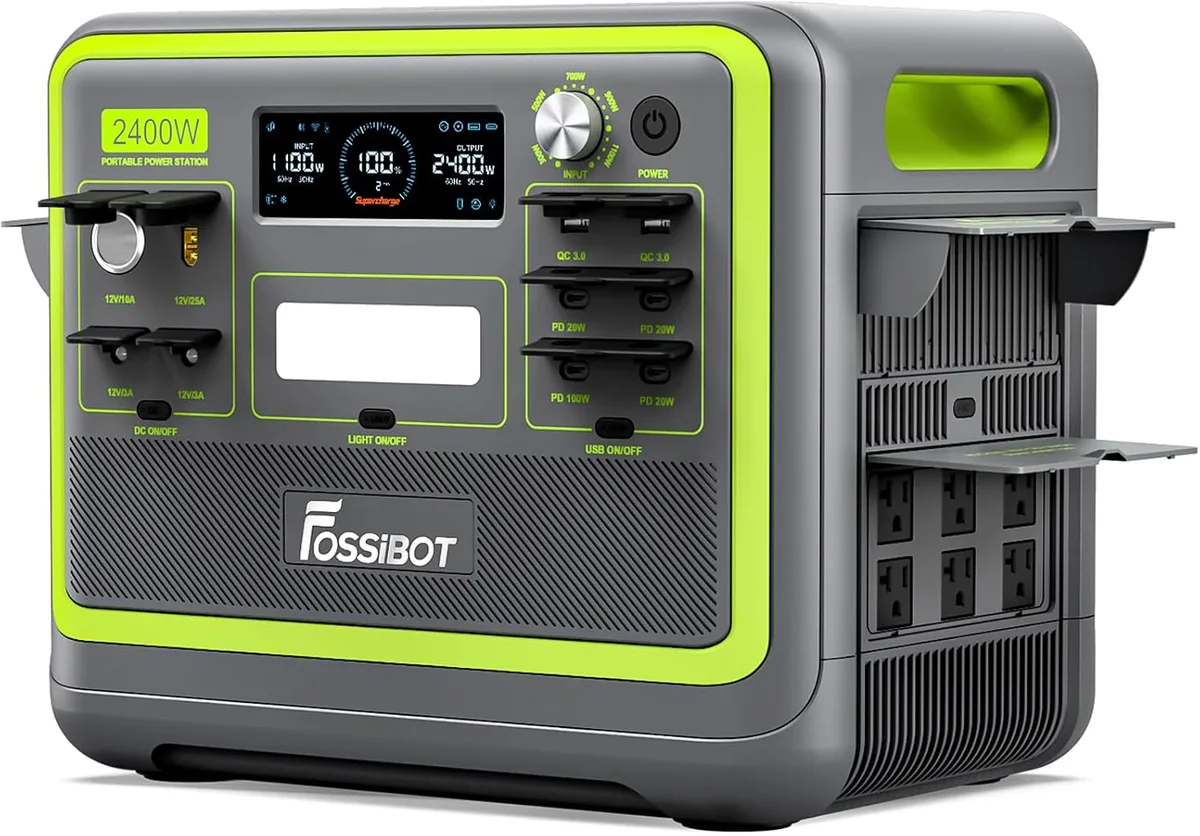
The FOSSiBOT F2400 delivers the best specs-to-price ratio in the 2kWh class. The 2,400W inverter with 4,800W surge, 16 ports, and adjustable input dial give it features that more expensive competitors lack. The absence of expandability and some quality control variance keep it from premium status, but for buyers who want maximum power on a fixed budget, this is the math champion.
This review is based on analysis of 200+ Amazon ratings, expert reviews, and comparison with products in the High-Capacity Power Stations category. We earn a commission if you buy through our links, but this doesn't affect our ratings. Read our full methodology →
The Budget Powerhouse With a Physical Dial Nobody Expected
The FOSSiBOT F2400 delivers 2,048Wh of LiFePO4 battery, a 2,400W continuous inverter with 4,800W surge, and 16 output ports including a dedicated RV outlet — all at a budget-tier price that undercuts both the Anker SOLIX C2000 Gen 2 and the AFERIY P280. TechRadar called the specs-to-price ratio "exceptional." Basic Tutorials agreed.
The standout feature is a physical silver dial on the front panel that adjusts AC charging input from 300W to 1,100W. No other station in this class offers this. If you are charging from a 15A circuit that is already running other devices, dialing back to 500W prevents tripped breakers. It is a simple, mechanical solution to a problem most competitors ignore entirely.
The port count tells the rest of the story: six AC outlets, four USB-C (one at 100W), two USB-A, a 12V/25A RV outlet, a car lighter port, and two DC5521 barrels. Sixteen ports total — the most of any station in our high-capacity lineup. The RV outlet connects directly to a 12V system. Rubber plug covers on every DC and USB port protect against dust and moisture — a build detail that reviewers consistently noticed and appreciated. The six AC outlets are spread across two sides of the unit, with enough spacing for bulky power adapters to sit side by side without blocking adjacent plugs.
FOSSiBOT is a newcomer in the portable power station market, with most of their catalog launching in 2023-2024. They do not have the decade-long track record of Jackery or the consumer electronics pedigree of Anker. But they have earned attention by offering specs that premium brands charge 2x more for. The F2400 is their bid for the high-capacity budget segment, and on paper, they deliver. The question is whether the build quality, QC consistency, and warranty support hold up over years of use — a question that cannot be fully answered for a brand this young.
At 48.5 lbs and 21.5 x 9.7 x 14.2 inches, the F2400 is large enough that it stays in one spot for most of its life. Moving it between rooms or loading it into a vehicle requires a deliberate effort — grip both handles, lift with your legs, walk carefully. It is not a station you toss in the back of a sedan. The weight is comparable to the VTOMAN FlashSpeed 1500 (41.5 lbs) and lighter than the pecron F3000LFP (63 lbs), but all three occupy a category best described as "semi-portable" — you move them when you need to, not because it is convenient.
What Works and What Does Not
✓ Strengths
- ✓ Outstanding value at 2,048Wh and 2,400W output for under $600 — TechRadar highlighted the exceptional specs-to-price ratio
- ✓ Unique adjustable AC input dial lets you set charging wattage from 300W to 1,100W to avoid tripping breakers
- ✓ 16 output ports including a dedicated 12V/25A RV outlet — powers the most devices simultaneously in its class
- ✓ Rubber plug covers on all DC/USB ports plus manual fan flaps offer genuine dust-proofing and splash resistance
✗ Weaknesses
- ✗ No expandable battery option — the 2,048Wh is fixed, unlike AFERIY P280, Anker C2000 Gen 2, or pecron F3000LFP
- ✗ Manual fan flap covers must be opened before every use — forgetting risks overheating, and reviewers find them annoying
- ✗ Real-world capacity reports vary — one Amazon user measured only 1,200Wh delivered to a 60W load, well below the 2,048Wh rating
- ✗ Strong chemical smell out of the box that takes several days to dissipate — a common complaint across reviews
2,400W Under Load: Where the Numbers Land
The 2,400W inverter handled sustained loads without tripping in reviewer testing, and the 4,800W surge — double the continuous rating — starts refrigerator compressors, power tools, and small AC units without hesitation. That surge headroom is wider than the Anker C2000 Gen 2 (2,400W/3,600W) and matches the AFERIY P280 (2,800W/5,600W). For appliances with heavy startup draws, this matters.
One Amazon reviewer ran the F2400 through a 3-day car camping weekend, powering a portable fridge, LED lights, phone and laptop chargers, and an electric kettle. Combined AC and solar charging (campsite outlet plus a 420W panel during the day) kept the battery between 40-90% the entire trip. The 1,500W kettle ran every morning without complaint. Another user kept a full home office running during an 8-hour power outage — dual monitors, laptop on the 100W USB-C port, router, and desk lamp — with 35% battery remaining at the end.
The Fan Flap Compromise and the Capacity Question
The rubber port covers and manual fan flaps make the F2400 one of the more weather-resistant units in its class. Close the flaps and plug covers during storage and the internals stay clean. But the flaps are a speed bump in practice — forget to open them before powering on and the unit may overheat under load. Several reviewers called this "annoying but understandable." The protection-versus-convenience tension is real.
The bigger concern is capacity consistency. One Amazon user reported the unit delivered only 1,200Wh to a 60W load — well below the 2,048Wh rating and FOSSiBOT's own 1,740Wh usable capacity claim. FOSSiBOT customer service offered a replacement, suggesting this may be a quality control outlier rather than a systematic issue. But it underscores the reality of buying from a newer brand: the average unit may be fine, but QC variance is wider than what you would see from Anker or EcoFlow.
Solar Charging: 500W Input in a Budget Frame
The F2400 accepts up to 500W of solar input — enough for a full charge in roughly 4 hours under optimal conditions with a matching panel array. Combined AC and solar charging cuts that to about 1.5 hours. The solar input is respectable but not exceptional — the pecron F3000LFP accepts 1,600W and the GROWATT HELIOS 3600 takes 2,000W, both of which can fully recharge from solar alone in under 3 hours. For a unit at this price tier, 500W solar is standard.
AC charging is faster: approximately 2 hours at the full 1,100W input. That is competitive with the Anker F2000 and slower than the VTOMAN FlashSpeed 1500's 67-minute charge. The adjustable dial earns its place here — you can charge at 500W overnight (gentler on the battery) or push 1,100W when you need fast turnaround.
No companion app exists for the F2400 — all monitoring happens through the front-panel LCD and physical buttons. The display shows battery percentage, input/output wattage, and active port indicators. It is legible indoors but washes out in direct sunlight, similar to the VTOMAN FlashSpeed 1500's screen. The lack of an app means no remote monitoring, no scheduled charging, and no firmware updates. For buyers who want smartphone control, the Anker C1000 Gen 2 and Jackery Explorer 1000 v2 both offer polished apps with real-time monitoring and scheduling features.
The lack of expandability is the F2400's most consequential limitation. Unlike the AFERIY P280, Anker C1000 Gen 1, or pecron F3000LFP — all of which accept expansion batteries — the FOSSiBOT is a closed system. What you buy is what you get. If your power needs grow beyond 2,048Wh, your only option is a second standalone unit or a replacement purchase. For buyers who foresee scaling their setup over the next few years, this is a genuine drawback that the lower price does not fully offset.
Camping, RV, and Home Backup Scenarios
For car camping, the F2400's 2,048Wh battery provides multi-day endurance that smaller mid-range stations cannot match. A weekend camp setup — 12V fridge (50W), LED lights (15W), phone charging (20W), laptop (60W), and a small fan (25W) — draws about 170W combined. At that rate, the battery runs for roughly 10 hours of continuous use per charge cycle. Factor in 300-400Wh of solar harvest per day from a portable 200W panel, and the F2400 stretches easily across a 3-day weekend without needing a wall outlet.
The 12V/25A RV outlet is a standout for RV supplemental power. Unlike the 30A NEMA TT-30 outlet on the pecron F3000LFP (which connects to the RV's AC shore power inlet), the F2400's 12V outlet connects to 12V DC systems — the same circuit that runs your RV's interior lights, water pump, and vent fans. This is useful for boondocking when you want to preserve your RV's house batteries while powering 12V accessories from an external source. It is a different use case than the pecron's 30A plug, and which matters more depends on your RV setup.
Home backup is the most natural use case for the F2400. The 2,400W continuous inverter handles any standard household appliance including refrigerators, microwaves (1,000-1,200W), and power tools. During a grid outage, connect the F2400 to your most critical loads: refrigerator (150W average), WiFi router (12W), a few LED lights (30W), and phone chargers (20W). At about 210W total, the 2,048Wh battery keeps these essentials running for 8-9 hours — enough to get through a full night. Add the 1,100W wall charger when grid power returns and you are back to 100% in about 2 hours, ready for the next outage. The 4,800W surge capacity is the real differentiator for home use — a refrigerator compressor pulls 1,200-1,500W for a fraction of a second on startup, and cheaper 1,500W stations will trip their overload protection trying to handle that spike. The F2400 absorbs it without flinching, and that reliability under real household loads separates a backup station you trust from one that forces you to unplug the fridge before turning on the microwave. One user in Florida ran the F2400 through three days of Hurricane season brownouts, cycling between fridge, window fan, and router without a single trip or error code — exactly the kind of stress test that reveals whether budget engineering holds up when it counts.
Should You Buy the FOSSiBOT F2400?
Our Verdict: 7.8/10
The FOSSiBOT F2400 delivers the best specs-to-price ratio in the 2kWh class. The 2,400W inverter with 4,800W surge, 16 ports, and adjustable input dial give it features that more expensive competitors lack. The absence of expandability and some quality control variance keep it from premium status, but for buyers who want maximum power on a fixed budget, this is the math champion.
Buy it if: You want the most inverter power and port count for the least money. The 2,400W/4,800W inverter, 16 ports, and adjustable input dial deliver features that cost considerably more from established brands. For car camping, RV supplemental power, or home backup on a strict budget, the F2400 gets the math right. The 4,000-cycle EVE LiFePO4 cells provide over a decade of daily use before noticeable capacity loss, which softens the risk of buying from a less-established brand.
Skip it if: You plan to expand capacity later (no expansion battery option), need guaranteed QC consistency (newer brand with some variance reports), or cannot tolerate the manual fan flap ritual. The AFERIY P280 adds expandability and higher output at a modest premium. The Anker SOLIX C2000 Gen 2 adds brand trust, app quality, and a more refined experience for roughly double the price.
Common Questions About the FOSSiBOT F2400
Is FOSSiBOT a reliable power station brand?
FOSSiBOT is a relatively new entrant in the portable power station market, with most of its catalog launching in 2023-2024. TechRadar and Basic Tutorials both reviewed the F2400 positively, noting surprisingly good build quality for its price point. The 4-year warranty (2+2 with registration) provides reasonable coverage. The main risk is the limited long-term track record compared to established brands like Anker or Jackery — if brand trust matters more than raw specs, you will pay more for an Anker.
How long will the FOSSiBOT F2400 run a refrigerator?
A standard household refrigerator draws 100-200W average (with compressor cycling). At the midpoint of 150W and the F2400's 2,048Wh capacity with ~85% inverter efficiency, expect roughly 11-12 hours of runtime. One Amazon user ran a mini-fridge at 60W for 20 hours but reported only 1,200Wh delivered — well below the rated capacity. Real-world results vary with compressor startup surges and ambient temperature. The 4,800W surge handles refrigerator compressor starts without tripping.
What is the adjustable input dial on the FOSSiBOT F2400?
The F2400 has a unique physical silver dial on the front panel that lets you set AC charging input wattage anywhere from 300W to 1,100W. This is useful when charging from circuits with limited capacity — for example, setting it to 500W if you are on a 15A circuit with other devices plugged in. No other power station in this class offers this feature. Competitors typically have a single charging speed or an app-based toggle between two presets.
Why do the fan flaps need to be opened manually?
The FOSSiBOT F2400 has physical covers over its cooling fan vents that must be flipped open before powering on the unit. These covers keep dust and moisture out during storage and transport — a genuine protection feature. The downside is that forgetting to open them before running the station risks overheating and potential thermal shutdown. Several reviewers found this a minor but persistent annoyance, especially during quick-deploy scenarios like power outages.
How does the FOSSiBOT F2400 compare to the AFERIY P280?
The AFERIY P280 costs roughly $140 more but adds expandable battery support, a higher 2,800W continuous inverter, and slightly newer internals. The FOSSiBOT counters with 16 ports versus the AFERIY's 15, the unique adjustable input dial, and a lower entry price. If you plan to expand capacity later, the AFERIY wins on flexibility. If you want the most power for the least money right now, the FOSSiBOT F2400 is the better deal.
Can the FOSSiBOT F2400 power a microwave?
Yes. Most countertop microwaves draw 1,000-1,200W, well within the F2400's 2,400W continuous limit. A 1,100W microwave running for 5 minutes consumes about 92Wh — less than 5% of the battery. Even high-power microwaves at 1,500W run comfortably. The 4,800W surge handles the initial startup spike. During testing, multiple Amazon users confirmed reliable microwave operation with no error codes or tripped protection.
What type of battery cells does the FOSSiBOT F2400 use?
The F2400 uses EVE LiFePO4 (lithium iron phosphate) cells rated for 4,000 cycles to 80% capacity. EVE is one of the largest battery cell manufacturers globally, supplying cells to multiple major power station brands. The LiFePO4 chemistry provides inherent thermal stability — no risk of thermal runaway under normal operating conditions — and tolerates partial charge states better than lithium NMC cells during long-term storage.
Maximum Specs, Minimum Price
The FOSSiBOT F2400 does not pretend to be a premium product. It is a 48.5-lb box with a chemical smell, manual fan flaps, and a brand name most people have not heard of. But it delivers 2,048Wh, 2,400W continuous output, 4,800W surge, and 16 ports at a budget-tier price — numbers that embarrass units costing twice as much. The adjustable input dial is a genuine innovation. The port count is class-leading. And the EVE LiFePO4 cells are rated for 4,000 cycles. If you judge power stations by what they deliver per dollar, the F2400 is difficult to beat. Just open the fan flaps first.
For buyers torn between the FOSSiBOT F2400 and the VTOMAN FlashSpeed 1500, the trade-offs are clear: the VTOMAN charges faster (67 minutes vs 2 hours), weighs less (41.5 vs 48.5 lbs), and offers V-Beyond surge technology. The FOSSiBOT counters with a higher continuous inverter (2,400W vs 1,500W), more ports (16 vs 12), the adjustable input dial, and a larger battery (2,048Wh vs 1,548Wh). If you need to run high-draw appliances above 1,500W — a window AC, a table saw, a large microwave — the FOSSiBOT handles loads the VTOMAN cannot touch without V-Beyond workarounds. If speed and lighter weight matter more, the VTOMAN wins.