EcoFlow DELTA Pro 3 Portable Power Station Review 2026
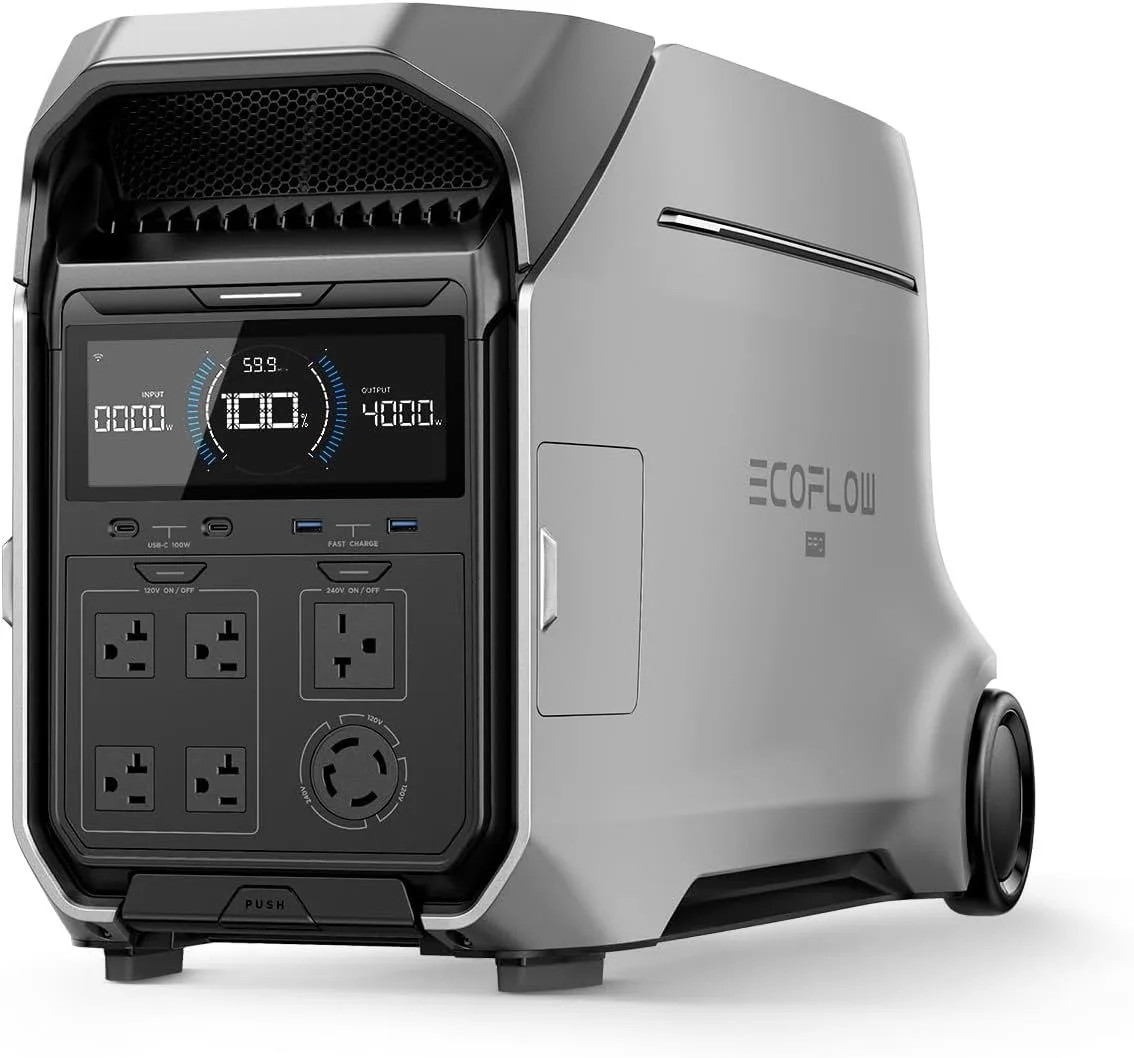
The EcoFlow DELTA Pro 3 is the most polished power station in this class — it charges faster, runs quieter, and integrates into a home energy ecosystem better than any competitor. But the pass-through limitation undermines its always-on UPS value, and 113.5 lbs makes portability theoretical.
This review is based on analysis of 312+ Amazon ratings, expert reviews, and comparison with products in the Whole-Home Backup Systems category. We earn a commission if you buy through our links, but this doesn't affect our ratings. Read our full methodology →
The Smart Home Integration King
EcoFlow built the DELTA Pro 3 to be the center of a home energy ecosystem, not just a backup battery. Where competing stations focus on raw output numbers or expansion capacity, the DELTA Pro 3 invests its engineering budget in the connective tissue — app control, Smart Home Panel 2 integration, backward compatibility with original DELTA Pro batteries, and what remains the fastest AC charging speed in any portable power station on the market.
The result is a station that does more out of the box than anything else at its price point. Native 240V output from a single unit. 0-80% charge in roughly 50 minutes from a standard wall outlet. 93% discharge efficiency that delivers 3,790Wh of usable power from the 4,096Wh rated capacity. IP65 dust and water resistance on the battery pack. And an app ecosystem that lets you monitor, schedule, and control every aspect of power delivery from your phone.
But the DELTA Pro 3 also carries baggage that its polished exterior does not advertise. At 113.5 lbs, it requires two people and a hand truck for any relocation beyond rolling it across a garage floor. A documented pass-through power limitation undermines its UPS functionality in certain scenarios. And one publicly documented fire incident, while isolated, introduces a conversation that EcoFlow would prefer to avoid.
Why 93% Efficiency Changes the Math
Most portable power stations lose 15-20% of their stored energy during the DC-to-AC inversion process. The DELTA Pro 3 loses just 7%. On paper, that looks like a small difference. In practice, it reshapes every runtime calculation.
From the 4,096Wh LiFePO4 battery pack, the DELTA Pro 3 delivers approximately 3,790Wh of usable AC power. Compare that to the Anker SOLIX F3000 at 84% efficiency — its 3,072Wh battery yields roughly 2,580Wh usable. The DELTA Pro 3 does not just have a larger battery; it extracts proportionally more usable power from every watt-hour stored.
For extended outage scenarios, this efficiency advantage compounds. A refrigerator drawing 150W runs for roughly 25 hours on the DELTA Pro 3 versus about 17 hours on the F3000 — an 8-hour difference that could mean the difference between food spoilage and keeping everything cold through a day-long grid failure. Add a couple of lights and a phone charger, and the DELTA Pro 3 still has usable reserves when competing stations are approaching empty.
How fast does the DELTA Pro 3 charge from solar panels?
The DELTA Pro 3 accepts up to 2,600W of <a href="/guides/how-solar-panels-work/">solar input</a> through dual MPPT controllers, the highest solar ceiling in its immediate competitive set. With a matched 2,600W panel array in direct sunlight, a full charge takes approximately 2-3 hours. Real-world conditions — partial shade, suboptimal panel angles, temperature — typically extend that to 3-5 hours for a full cycle. Even a modest 800W panel setup delivers a full charge in roughly 6-7 hours of good sun.
X-Stream Charging: 0 to 80% in Under an Hour
For home backup buyers who need speed above all, the DELTA Pro 3's fastest headline feature is its X-Stream charging technology, which pulls the battery from 0 to 80% in approximately 50 minutes from a standard AC outlet. No special outlet, no electrician visit, no dedicated 240V circuit — just a regular wall plug. The remaining 20% trickles in more slowly to protect cell longevity, bringing total 0-100% time to roughly 90 minutes.
For emergency preparedness, this changes the calculus. A station that can go from depleted to 80% in under an hour before a forecasted storm provides a safety margin that slower-charging competitors cannot match. The Anker SOLIX F3800 takes 2-3 hours for a full charge. The Jackery HomePower 3000 takes about 2.2 hours. The DELTA Pro 3's charging speed is not incrementally faster — it is a different category.
The trade-off is heat generation during fast charging. X-Stream charging pushes the maximum power the battery cells can safely absorb, and the unit's fans run at higher speeds to dissipate the resulting thermal load. In a temperature-controlled garage, this is a non-issue. In a hot RV on a summer afternoon, the internal thermal management may throttle charging speed to protect the cells. EcoFlow's firmware manages this automatically, but it means the 50-minute headline figure assumes reasonable ambient temperatures.
The Ecosystem Advantage: Smart Home Panel 2
The Smart Home Panel 2 is where the DELTA Pro 3 separates itself from every competitor in ways that spec sheets cannot capture. This is a subpanel that installs alongside your main electrical panel, connecting up to 6 circuits to the DELTA Pro 3 for automatic backup. When the grid goes down, the transfer happens in less than 20 milliseconds — fast enough that most electronics never notice the switch.
Through the EcoFlow app, you prioritize which circuits get power and in what order. Refrigerator stays on always. Home office gets power during work hours. Bedroom outlets activate at night for CPAP and phone charging. This granular control means a single DELTA Pro 3 can stretch its 4,096Wh across a full day of selective backup rather than trying to power everything simultaneously and running out in hours.
Anker offers a similar Home Power Panel for the F3800 lineup, but the EcoFlow ecosystem is more mature, with more firmware updates, broader third-party integration (including Tesla Powerwall compatibility), and a larger installed user base providing feedback and bug reports. The DELTA Pro 3 is also backward compatible with original DELTA Pro Extra Batteries, which means first-generation EcoFlow owners can carry their battery investment into the new platform.
Does the EcoFlow DELTA Pro 3 work with existing DELTA Pro batteries?
Yes — and this is one of its strongest differentiators. The DELTA Pro 3 is backward compatible with original DELTA Pro Extra Batteries, which means existing EcoFlow owners can carry their battery investment forward into the new platform. Each Extra Battery adds 3,600Wh. New DELTA Pro 3 batteries add 4,096Wh. You can mix both types in a single system up to 48kWh total.
Where the Delta Pro 3 Excels
- ✓ Fastest charging in the category — 0-80% in approximately 50 minutes from a standard AC outlet
- ✓ Best-in-class 93% discharge efficiency (3,790Wh usable from 4,096Wh rated) and 30dB quiet operation
- ✓ Strongest ecosystem with backward compatibility for original DELTA Pro batteries
- ✓ IP65 dust and water resistance on the battery pack — viable for garage or semi-outdoor installation
Where It Disappoints
- ✗ Heaviest unit at 113.5 lbs — requires two people and wheels for any relocation
- ✗ Pass-through power limitation causes shutdowns when AC compressor surge exceeds ~2,000W while grid-connected
- ✗ No 12V car socket — requires adapters for car-type accessories
- ✗ Documented fire incident and neutral-ground bonding safety concerns with transfer switches
The Pass-Through Problem Nobody Talks About
The DELTA Pro 3's most discussed flaw among owners is the pass-through power limitation. When the unit is connected to the grid and acting as an always-on UPS — the exact scenario EcoFlow markets most aggressively — it passes grid electricity through to connected devices. If a high-surge appliance like an air conditioning compressor draws more than approximately 2,000W through this pass-through path while the grid is active, the unit may shut down to protect its circuitry.
This does not affect off-grid operation. When running purely on battery, the DELTA Pro 3 handles its full 4,000W continuous rating (and up to 6,000W with X-Boost for resistive loads). The limitation specifically affects the simultaneous charging-while-powering scenario that defines UPS operation. For a station marketed as an always-on home backup solution, this is a meaningful caveat that Amazon product listings do not adequately communicate.
The practical workaround is circuit selection. When using the Smart Home Panel 2, keep high-surge circuits (HVAC, large appliances) on the direct grid connection and route only moderate loads through the DELTA Pro 3's pass-through path. This requires some electrical planning during installation, which adds complexity — but it avoids the shutdown issue in most residential scenarios.
Weight, Portability, and the Permanent Installation Reality
At 113.5 lbs, the DELTA Pro 3 is portable only in the most technical sense. It has wheels. It has a handle. And two reasonably fit adults can roll it across a flat surface without incident. But moving it between floors, loading it into a vehicle, or repositioning it in a tight garage space requires deliberate effort and planning. This is not a station you grab on the way to a tailgate.
The weight reflects the 4,096Wh LiFePO4 battery pack, the heavy-duty inverter capable of 4,000W continuous output, and the IP65-rated enclosure that provides genuine dust and water resistance. The IP65 rating is not marketing — it means the battery pack can sit in a garage, a covered patio, or a semi-outdoor utility area without concern about rain splashes or dust infiltration. That is a genuine advantage for homeowners who do not want a 113-lb battery sitting in their living space.
Most DELTA Pro 3 owners treat it as a semi-permanent installation. Roll it into position once, connect it to the Smart Home Panel, plug in the solar array, and leave it. The wheels become relevant during seasonal relocation or the occasional deep-cleaning of the utility space. For RV use, the DELTA Pro 3 is feasible if the vehicle has a dedicated space — but the Anker SOLIX F3000 at 91.5 lbs or the Jackery HomePower 3000 at 59.5 lbs are more practical for mobile applications.
How loud is the EcoFlow DELTA Pro 3?
EcoFlow rates it at 30dB during normal operation, which is quieter than a whisper at conversational distance. In practice, the fans do spin up under heavy loads and during fast charging, producing a noticeable hum. At moderate loads (under 2,000W), the unit is quiet enough for indoor use without complaint. It is not silent the way the Anker SOLIX F3000 approaches silence, but it is among the quietest in the 4kWh class.
Addressing the Safety Record
One fire incident involving the DELTA Pro 3 has been publicly documented and discussed across consumer forums and review channels. EcoFlow has not issued a recall or a formal safety bulletin in response. Separate from the fire incident, some owners have raised concerns about neutral-ground bonding behavior when the DELTA Pro 3 is connected to certain transfer switches — a technical grounding issue that can create shock hazards if not properly addressed during installation.
Context matters here. LiFePO4 battery chemistry is inherently more stable than NMC (nickel-manganese-cobalt) lithium-ion cells. LiFePO4 does not experience the same thermal runaway cascade that makes NMC batteries dangerous when damaged or overheated. A single incident across hundreds of units in the field does not constitute a pattern — but it is the kind of data point that a responsible review must surface rather than ignore.
The neutral-ground bonding concern is more technical but potentially more widespread. If you are installing the DELTA Pro 3 with a manual or automatic transfer switch, ensure your electrician understands the unit's grounding configuration. EcoFlow's documentation covers this, but it requires an electrician who is specifically experienced with portable power station installations — not just standard generator hookups.
Is there a fire risk with the EcoFlow DELTA Pro 3?
One fire incident involving the DELTA Pro 3 has been documented publicly. EcoFlow has not issued a recall. The unit uses LiFePO4 cells, which are inherently more stable than NMC lithium-ion and do not experience thermal runaway under the same conditions. As with any high-capacity battery system, follow manufacturer guidelines for ventilation, avoid charging in extreme heat, and do not modify or damage the battery casing. The documented incident is a single data point, not a pattern — but buyers should be aware of it.
Value Positioning: Where the DELTA Pro 3 Sits
The DELTA Pro 3 is top-tier investment for the whole-home backup category. At $500+, it is not the most affordable entry — the OUPES Guardian 6000 offers more raw capacity for less money. But it delivers the best combination of charging speed, efficiency, ecosystem integration, and firmware maturity in its class.
The true cost calculation extends beyond the unit itself, just as it does for every station in this category. The Smart Home Panel 2, professional installation, and optional additional batteries push total system cost well beyond the initial purchase. The backward compatibility with original DELTA Pro batteries partially mitigates this for existing EcoFlow owners — upgrading from a DELTA Pro to a DELTA Pro 3 does not strand your previous battery investment.
Against the Anker SOLIX F3800, the DELTA Pro 3 trades maximum single-unit output (4,000W vs. 6,000W) for faster charging and better efficiency. Against the Jackery HomePower 3000, it trades portability for expandability and 240V output. Against the F3800 Plus, it trades solar input capacity (2,600W vs. 3,200W) for lower weight and a more mature software ecosystem. Every comparison involves concessions, and the right choice depends on which specifications align with your actual installation scenario. Our sizing guide walks through how to match capacity and output to your household loads.
Can the DELTA Pro 3 power a whole house during an outage?
A single DELTA Pro 3 delivers 4,000W continuous (6,000W with X-Boost) at both 120V and 240V, which covers most essential household circuits — refrigerator, lights, router, phone chargers, and a few small appliances. It will not run central HVAC and a clothes dryer simultaneously. For full whole-home coverage, pair it with additional batteries or a second unit connected via the Smart Home Panel 2.
The Bottom Line on the DELTA Pro 3
EcoFlow DELTA Pro 3
Tech-forward homeowners who want the fastest-charging, quietest, most ecosystem-integrated power station
Watch: Watch EcoFlow Delta Pro 3 Review

The EcoFlow DELTA Pro 3 is the most polished power station in this class — it charges faster, runs quieter, and integrates into a home energy ecosystem better than any competitor. But the pass-through limitation undermines its always-on UPS value, and 113.5 lbs makes portability theoretical.
Check Current PriceThe DELTA Pro 3 earns its position as the most polished power station in the whole-home class. The 93% efficiency, sub-hour AC charging, and mature Smart Home Panel ecosystem set it apart from competitors that match or exceed individual specifications but cannot deliver the same integrated experience. For tech-forward homeowners who want their power backup to operate as a managed system rather than a dumb battery, this is the benchmark.
But polish has limits. The 113.5-lb weight restricts it to semi-permanent installations. The pass-through limitation complicates its UPS pitch. And the documented safety concern — while isolated — is a data point that warrants awareness. If portability, maximum output, or the lowest possible cost per watt-hour are your priorities, better options exist within this very comparison set.
What is the pass-through power limitation?
When the DELTA Pro 3 is connected to the grid and acting as a UPS, it passes grid power through to connected devices. If a high-surge appliance (like an AC compressor) pulls more than roughly 2,000W through the pass-through circuit while the grid is active, the unit may shut down to protect itself. This does not affect off-grid operation — the limitation only applies when the unit is simultaneously charging from and delivering power to the grid.
Compare directly in our F3800 vs DELTA Pro 3 head-to-head or see all options in the Best Whole-Home Backup Systems roundup.