EcoFlow DELTA 3 MAX with 220W Solar Panel Review 2026
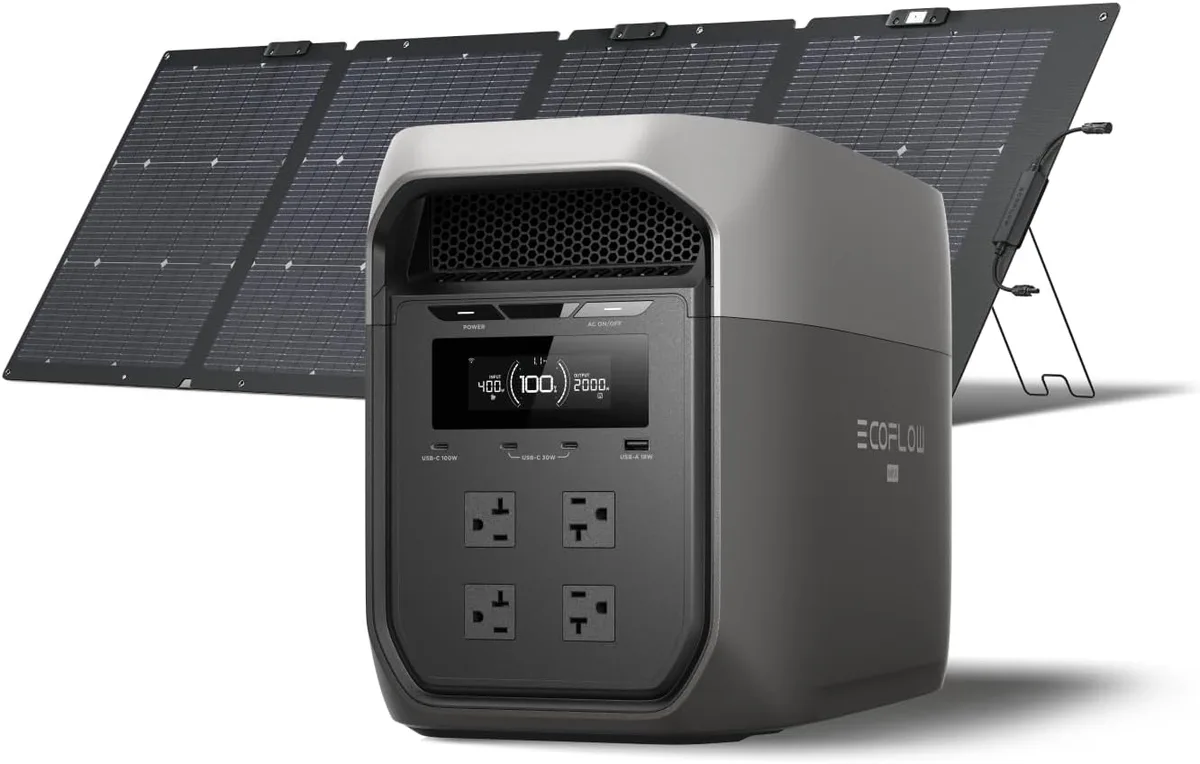
The EcoFlow DELTA 3 MAX is the premium, polished option in the high-capacity class — and the only unit that ships with a solar panel included. Whisper-quiet operation, 68-minute AC charging, and EcoFlow's refined app make it a pleasure to use. But the high price, no expandability, and fewer ports mean you are paying for brand polish and the bundled panel, not raw capability. If solar convenience and silence matter more than specs-per-dollar, this is the one.
This review is based on analysis of 100+ Amazon ratings, expert reviews, and comparison with products in the High-Capacity Power Stations category. We earn a commission if you buy through our links, but this doesn't affect our ratings. Read our full methodology →
The Premium Bundle That Ships Ready to Charge
The EcoFlow DELTA 3 MAX is the only high-capacity power station in its class that ships with a solar panel included. The 220W bifacial panel uses TOPCon cells at 25% conversion efficiency — front and rear surfaces both generate power, pulling up to 28% more energy from reflected light than single-sided panels. Pair that with a 2,048Wh LiFePO4 battery, 2,400W output, and 68-minute AC charging, and you have a complete solar generator that works out of the box.
That convenience comes at a cost. The DELTA 3 MAX bundle runs nearly double what competitors charge for the same 2,048Wh capacity without a panel. The FOSSiBOT F2400 delivers the same capacity and higher output for less than half the price. The AFERIY P280 adds expandable storage at a fraction of the DELTA 3 MAX's cost. EcoFlow is asking you to pay for the panel, the whisper-quiet operation, and the brand — and whether that math works depends entirely on how much you value those things.
The build quality justifies some of that ask. Pick up the DELTA 3 MAX and the first thing you notice is the density — 46.3 lbs packed into a surprisingly compact enclosure. The housing feels rigid with no flex or creak when gripped from the side handles. The front display is bright, responsive, and shows real-time input/output wattage, estimated time remaining, and battery percentage without pressing any buttons. EcoFlow placed all nine ports on the front face — no reaching around the back — and organized them into clearly labeled clusters. The overall impression is a product that was designed by people who actually carry these things around.
Nine output ports handle the essentials: four AC outlets at 2,400W total, one USB-C at 100W, two USB-C at 30W, a car port, and one DC barrel. That is the lowest port count in the high-capacity class — the FOSSiBOT F2400 has 16 and the AFERIY P280 has 15. There are no USB-A ports at all. If you charge devices that still use USB-A cables, you will need adapters. EcoFlow prioritized USB-C, which is forward-looking but creates a real inconvenience for anyone still using older cables, headlamps, or battery banks with USB-A inputs.
The LiFePO4 battery chemistry is rated for 4,000 cycles to 80% capacity — among the longest in the category. At one cycle per day, that translates to roughly 11 years of use before the battery drops to 80% of its original 2,048Wh. Most buyers cycle the unit 2-3 times per week at most, which stretches the practical lifespan to two decades or more. The chemistry also eliminates thermal runaway risk, a safety concern with the older lithium NMC cells that still appear in some budget stations. For buyers who plan to keep the unit for 5-10 years, the LiFePO4 advantage is not just longevity — it is peace of mind.
Delta 3 Max: Worth the Investment?
✓ Strengths
- ✓ Included 220W bifacial solar panel with TOPCon cells at 25% efficiency — the only bundle in its class that ships with a panel
- ✓ Whisper-quiet sub-25dB operation at loads up to 600W — inaudible next to a bedside fan during overnight outages
- ✓ Full 0-100% AC charge in 68 minutes via X-Stream technology — confirmed by The Solar Lab testing
- ✓ Front-facing port design eliminates cables-out-both-ends and improved surge tolerance over previous EcoFlow generations
✗ Weaknesses
- ✗ Most expensive option in its class at nearly double the price of competitors with the same 2,048Wh capacity
- ✗ Not expandable — no expansion battery support, unlike Anker C2000 Gen 2, AFERIY P280, or pecron F3000LFP
- ✗ Only 9 output ports with no USB-A — fewer than FOSSiBOT F2400 (16 ports) or AFERIY P280 (15 ports)
- ✗ 500W solar input cap is the lowest in its class — even with the included panel, solar recharging takes 5-6 hours
Near-Silent at 25dB: The Quiet Advantage
The DELTA 3 MAX operates below 25dB at loads up to 600W. To put that in context: a library is typically 40dB, a refrigerator hum is 45dB, and most competing power stations run at 40-55dB under similar loads. During an overnight outage, one user ran a CPAP machine (65W), phone charger, and a small fan from the unit on their nightstand. The station was completely inaudible over the fan — a stark contrast to their previous power station that woke them with fan noise every 20 minutes.
The 2,400W inverter handles household loads cleanly, and the 4,800W surge starts compressors and motor-driven appliances. X-Boost 3.0 pushes the effective output to 3,200W for resistive loads, though The Solar Lab notes that X-Boost degrades waveform quality — pure sine wave devices (medical equipment, sensitive electronics) should run without it. The front-facing port design is a welcome change from older EcoFlow models that routed cables out both ends.
The 220W Bifacial Panel: Convenience vs Raw Speed
The included 220W bifacial panel is the headline feature and the primary justification for the price premium. TOPCon cells on both sides capture direct sunlight on the front (up to 220W) and reflected light on the rear (up to 175W in ideal conditions). In real-world camping use in Colorado, one user averaged 190W combined — 150W front plus 40W rear from ground reflection. Over a 6-hour sun window, the panel recovered roughly 1,100Wh, enough to offset a portable fridge, phone charging, and evening laptop use.
The limitation is the 500W solar input cap. With just the included 220W panel, a full recharge takes 5-6 hours in ideal conditions. Adding a second panel helps, but the 500W ceiling means diminishing returns quickly. Competitors accepting 1,000-2,000W solar input can fully recharge 2-4 times faster with larger arrays. The pecron F3000LFP accepts 1,600W and recharges from solar in 2.5 hours. The GROWATT HELIOS 3600 takes 2,000W. For a user who owns or plans to buy a large panel array, the DELTA 3 MAX's 500W cap becomes a bottleneck.
For the single-panel user, the included 220W panel changes the calculation. The panel folds to the size of a large briefcase and weighs 19.8 lbs — manageable for car camping, tailgating, or balcony setups. It sets up in under 30 seconds with the integrated kickstand angle guide. No separate poles, no guy lines, no hunting for the right angle. During a weekend camping trip in the Blue Ridge Mountains, one user set the panel on the picnic table each morning, connected the included cable, and recovered 1,000-1,200Wh over 6 hours of direct sun — enough to offset a portable fridge, phone chargers, and evening laptop use without touching the wall charger.
68-Minute AC Charging and the Expandability Gap
X-Stream AC charging fills the battery from 0-100% in 68 minutes — The Solar Lab confirmed the spec. That is competitive with the fastest in its class. The VTOMAN FlashSpeed 1500 matches it at 67 minutes. For hurricane prep or pre-trip charging, an hour from empty to full is fast enough to be practical. The charging curve ramps aggressively through the first 80%, then tapers for the final 20% to protect cell longevity — expect roughly 50 minutes to 80% and another 18 minutes for the last stretch.
The expandability gap is the biggest strategic weakness. The Anker SOLIX C2000 Gen 2, AFERIY P280, and pecron F3000LFP all accept expansion batteries, letting users scale from 2,000Wh to 4,000-9,000Wh over time. The DELTA 3 MAX is locked at 2,048Wh. If you outgrow the capacity — and multi-day outages or extended off-grid trips can expose the limit — your only option is a second standalone unit. That is an expensive path compared to adding an expansion battery.
The EcoFlow App: Best in Class for a Reason
EcoFlow's app connects over both WiFi and Bluetooth, with a polished interface that puts real-time monitoring front and center. You see input/output wattage, battery percentage, estimated time to full or empty, and individual AC/DC circuit status — all updating in near real-time without the lag that plagues competitors' apps. Remote monitoring over WiFi works when you are away from the unit, letting you check battery status from another room or another state.
The app also supports firmware updates over the air, which EcoFlow pushes periodically to improve charging algorithms, fix bugs, and occasionally add features. One update in late 2025 improved the X-Boost waveform quality for certain resistive loads. Another adjusted the fan curve to reduce noise at low loads. This kind of post-purchase improvement is rare in the power station space — most competitors ship firmware once and never update it. The FOSSiBOT app crashes frequently. The AFERIY app drops Bluetooth connections. The pecron app barely functions. EcoFlow's software is a genuine differentiator, not a marketing checkbox.
Should You Buy the EcoFlow DELTA 3 MAX?
Our Verdict: 7.6/10
The EcoFlow DELTA 3 MAX is the premium, polished option in the high-capacity class — and the only unit that ships with a solar panel included. Whisper-quiet operation, 68-minute AC charging, and EcoFlow's refined app make it a pleasure to use. But the high price, no expandability, and fewer ports mean you are paying for brand polish and the bundled panel, not raw capability. If solar convenience and silence matter more than specs-per-dollar, this is the one.
Buy it if: You want a complete, out-of-box solar generator that works in silence. The included 220W bifacial panel, sub-25dB operation, fast AC charging, and EcoFlow's app ecosystem make this the most refined experience in the high-capacity class. For bedroom backup, CPAP use, quiet camping, or buyers who do not want to research and buy a separate solar panel, the bundle justifies its premium. Apartment and condo dwellers who cannot install permanent solar also benefit — the portable panel sets up on a balcony in 30 seconds and folds flat for storage.
Skip it if: You prioritize value, expandability, or port count. The FOSSiBOT F2400 delivers the same capacity with more ports at about half the price. The AFERIY P280 adds a bigger inverter and expandable storage for much less. The pecron F3000LFP gives you 50% more capacity with a true 30A plug at a lower cost. If you are willing to buy a panel separately, nearly every competitor offers more capability per dollar. The lack of USB-A ports and the 500W solar input ceiling are also limiting for users with existing panel setups or older USB devices.
On the fence? Consider how often you will actually move the unit. If it sits in the garage as a home backup system, the EcoFlow's premium lands on features you may rarely notice — the quiet fan, the polished app, the included panel gathering dust inside. For that use case, the Anker SOLIX C2000 Gen 2's 9W idle draw and Storm Guard mode are better optimized. But if you carry the station to a campsite, a tailgate, or a balcony twice a month, the DELTA 3 MAX's out-of-box solar bundle and near-silent fan curve earn their premium through repeated use.
Questions Buyers Ask About the DELTA 3 MAX
Is the EcoFlow DELTA 3 MAX worth the price premium over competitors?
The DELTA 3 MAX costs nearly double what competitors charge for the same 2,048Wh capacity. The included 220W bifacial solar panel (~$300 value separately) closes some of that gap, and the whisper-quiet operation plus 68-minute AC charging are genuine advantages. If you value EcoFlow's app ecosystem, near-silent operation, and the convenience of a bundled panel, the premium may be justified. If raw specs-per-dollar drive your decision, the FOSSiBOT F2400 or AFERIY P280 deliver more capability for less money.
How quiet is the EcoFlow DELTA 3 MAX compared to other power stations?
At loads up to 600W, the DELTA 3 MAX operates below 25dB — roughly the volume of a whisper from across a room. This is noticeably quieter than competing stations that run at 40-55dB under similar loads. During an overnight outage, one user ran a CPAP, phone charger, and small fan from the unit on their nightstand and reported the station was completely inaudible over the fan. For bedroom use or quiet camping, this is a standout advantage.
How does the included 220W bifacial solar panel perform?
The included EcoFlow 220W panel uses TOPCon bifacial cells at 25% conversion efficiency. The front captures up to 220W while the rear picks up 40-80W from ambient and reflected light — up to 28% more total energy than single-sided panels. In real-world camping use, one user averaged 190W combined (150W front + 40W rear) on partly cloudy days in Colorado. IP68 waterproofing means rain is a non-issue. Setup takes under 30 seconds thanks to the integrated angle guide.
Can the EcoFlow DELTA 3 MAX be expanded with extra batteries?
No. Unlike the Anker SOLIX C2000 Gen 2, AFERIY P280, and pecron F3000LFP, the DELTA 3 MAX does not support expansion batteries. The 2,048Wh internal battery is the maximum capacity. If you anticipate needing more capacity in the future, this is a significant limitation — you would need to buy a second standalone unit rather than adding an expansion pack.
EcoFlow DELTA 3 MAX vs Anker SOLIX C2000 Gen 2 — which is better?
Both deliver 2,048Wh with LiFePO4 batteries, but the differences are real. The EcoFlow includes a 220W solar panel and runs quieter (sub-25dB vs the Anker at moderate fan noise). The Anker offers expandable storage, 2,400W continuous output, more ports (11 vs 9), and costs less without a panel. If silence and solar convenience are priorities, EcoFlow wins. If expandability, port count, and value matter more, the Anker is the better choice.
How long will the EcoFlow DELTA 3 MAX battery last before replacement?
The LiFePO4 battery is rated for 4,000 cycles to 80% capacity. At one full cycle per day — which is heavy use — that is over 10 years before the battery degrades to 80% of its original 2,048Wh. Most users cycle the battery 2-3 times per week, which extends the practical lifespan to 25+ years. EcoFlow backs it with a 5-year warranty. The LiFePO4 chemistry also eliminates the thermal runaway risk associated with lithium-ion NMC batteries.
Can the DELTA 3 MAX power a full-size refrigerator during an outage?
Yes. A standard household refrigerator draws 100-200W when the compressor is running and cycles on/off throughout the day, averaging roughly 50-80W per hour. The 2,048Wh battery runs a typical fridge for 20-30 hours on a single charge. With the included 220W solar panel supplementing during daylight, you can extend that to multi-day operation in most weather conditions. The 4,800W surge capacity absorbs compressor startup spikes without issue.
Premium Polish at a Premium Price
The EcoFlow DELTA 3 MAX is the refined choice in a class dominated by value plays. It is quieter than everything else, charges faster from AC than most, and ships with a solar panel that works from the moment you open the box. EcoFlow's app, build quality, and 5-year warranty round out an experience that feels premium because it is. The cost is real — you pay nearly double for the same raw capacity competitors offer. But for buyers who value silence, solar convenience, and brand polish over maximum specs-per-dollar, the DELTA 3 MAX delivers exactly what it promises.
The 5-year warranty from EcoFlow carries real weight. Their support infrastructure includes US-based phone and email support, and the brand has a documented track record of handling warranty claims efficiently based on user reports across Amazon and Reddit. For a product you may depend on during an emergency, knowing the manufacturer stands behind it for half a decade matters more than saving money on a unit from a brand with 6 months of market history. The DELTA 3 MAX is not just a power station — it is an insurance policy for your critical devices, backed by a company with the resources to honor that commitment.