EcoFlow DELTA 2 Portable Power Station Review 2026
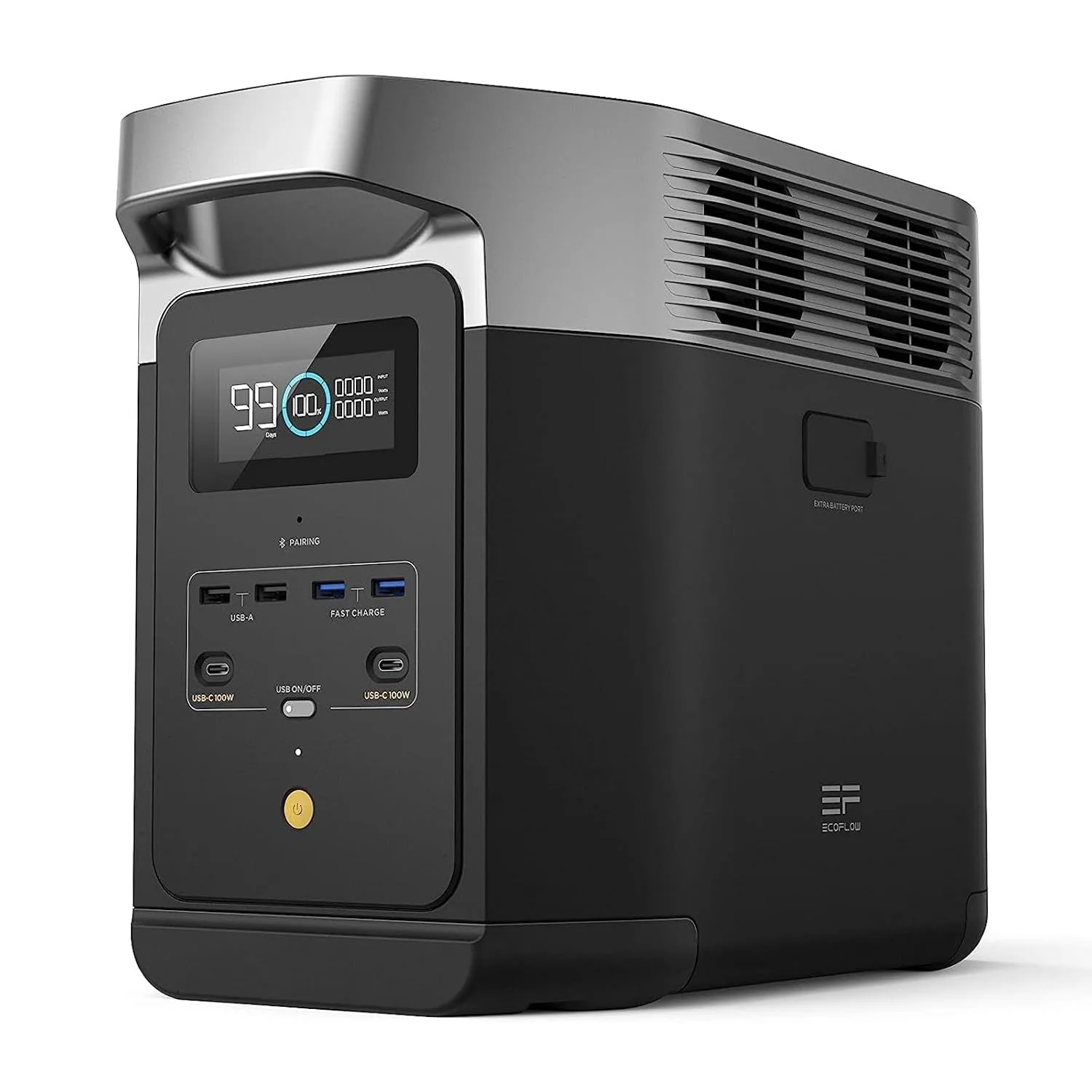
The EcoFlow DELTA 2 remains one of the most capable mid-range power stations thanks to blazing-fast 50-minute AC charging, X-Boost extending output to 2,200W, and expandability to 3,072Wh. The app ecosystem is unmatched. But the loud fan noise is a real and consistent drawback. At its price, it represents strong value for buyers who prioritize charging speed and smart features over quiet operation.
This review is based on analysis of 5000+ Amazon ratings, expert reviews, and comparison with products in the Mid-Range Power Stations category. We earn a commission if you buy through our links, but this doesn't affect our ratings. Read our full methodology →
The Feature-Rich Power Station That Sets the Standard
EcoFlow built its reputation on speed and smart features. The DELTA 2 is the centerpiece of that strategy — a below average for its category LiFePO4 power station that charges faster, connects smarter, and expands further than almost anything in its class. With 5,000+ Amazon ratings averaging 4.5 stars, the market has spoken: this is the benchmark that other mid-range stations measure themselves against.
But "benchmark" is not the same as "best value." The DELTA 2 launched when LiFePO4 chemistry was still a differentiator. Two years later, every serious competitor uses LiFePO4. The 1,024Wh capacity that once led the mid-range now sits below the UPOPOWER S1200's 1,190Wh and the OUPES Mega 1's 1,008Wh (expandable to 5,120Wh). What the DELTA 2 still owns — definitively — is the total package: the fastest wall charging in the category, an app ecosystem that no competitor matches, and X-Boost wattage extension that turns 1,800W into 2,200W effective output.
The question in 2026 is not whether the DELTA 2 is good. It is. The question is whether its specific strengths — speed, software, expandability — are worth paying more per watt-hour than newer alternatives that deliver raw capacity cheaper.
Is the EcoFlow DELTA 2 worth the price over cheaper alternatives?
That depends on what you value. The DELTA 2 costs more than the UPOPOWER S1200 (which offers more raw capacity per dollar) and the VTOMAN FlashSpeed 600 (which covers light use cases for less). What you get for the premium: X-Stream fast charging (50 minutes vs 90+ minutes for competitors), the best app ecosystem in the category, X-Boost extending usable wattage to 2,200W, and expandability to 3,072Wh. If charging speed, smart features, and future expandability matter to you, the premium is justified. If you just need reliable stored power, cheaper units deliver more Wh per dollar.
X-Stream Charging: 50 Minutes Changes Everything
The DELTA 2's single most consequential feature is its AC charging speed. EcoFlow's X-Stream technology pushes 1,200W of input power through the built-in charger, filling the battery from 0 to 80% in 50 minutes and to full in approximately 80 minutes. StorageReview independently verified these numbers and confirmed them as accurate under controlled conditions.
Fifty minutes. Think about what that means practically. You get a severe weather alert at 6 PM for overnight storms. Most power stations need 2-3 hours to reach full charge. The DELTA 2 is ready before dinner. You realize your camping gear is dead the morning of your trip. Plug in while you pack — it is done before you load the car. A 90-minute flight layover at an airport with AC outlets? The DELTA 2 goes from empty to full.
The speed comes with a cost. During X-Stream charging, the cooling fans run at full speed, and the unit is loud. PCWorld titled their review "Flexible, advanced, and LOUD" — the fan noise during fast charging was their single biggest complaint. Multiple Amazon reviewers echo this. If you are charging overnight in a small apartment, you will hear it. This is not a background hum; it is a persistent, noticeable whir that carries through open doors.
For context: the OUKITEL P1000 Plus achieves 0-80% in 39 minutes while maintaining 29dB operation — quieter than a library. The DELTA 2 cannot match that combination. EcoFlow chose raw speed over acoustic comfort, and that design choice is baked into the hardware.
How loud is the EcoFlow DELTA 2 during charging?
The fan noise is the DELTA 2's most consistent criticism. PCWorld titled their review "Flexible, advanced, and LOUD." During X-Stream fast charging (0-80% in 50 minutes), the fans run at maximum and are clearly audible from across a room. Under normal discharge, the fans cycle on and off depending on load — light loads under 200W are quieter, but anything above 400W triggers noticeable fan activity. This is not a unit you want next to your bed at night.
Why Buyers Love the Delta 2
- Industry-leading fast AC charging — 0-80% in 50 minutes via X-Stream technology, independently verified by PCWorld and StorageReview
- X-Boost technology extends effective output to 2,200W — intelligently manages voltage to power microwaves, coffee makers, and hair dryers
- Best-in-class Wi-Fi + Bluetooth app ecosystem — real-time monitoring, remote port toggling, charging schedules, and firmware updates
- Expandable to 3,072Wh with EcoFlow extra batteries — future-proof investment that grows with your needs
Common Complaints
- Fan noise is significant — the most common complaint across all reviewers, with PCWorld calling it "Flexible, advanced, and LOUD"
- Larger footprint at 19.5 x 9.5 x 12 inches — notably wider and taller than OUKITEL (13.6 x 8.9 x 9.4 in) and Anker Gen 2 (15.1 x 8.2 x 9.6 in)
- 83.3% discharge efficiency under load — StorageReview measured only 0.85kWh usable from 1,024Wh at 270W draw
- 3,000 cycle life falls short of the 4,000+ cycles offered by UPOPOWER, OUKITEL, Anker Gen 2, and Jackery
Watch: Watch EcoFlow Delta 2 Overview
X-Boost: 2,200 Watts from an 1,800W Unit
EcoFlow's X-Boost is a voltage management system that extends the DELTA 2's effective output from its rated 1,800W continuous to 2,200W for resistive loads. In plain terms: it intelligently reduces voltage to heating-element appliances — microwaves, coffee makers, hair dryers, space heaters — so they draw less wattage from the inverter while still functioning. Your microwave might take 15 seconds longer to heat soup. Your hair dryer might blow slightly less hot air. But they run, and they do not trip the overload protection.
This matters more than it sounds. The 1,800W continuous rating already handles most household electronics and small appliances. X-Boost extends the reach to devices in the 1,800-2,200W range that would otherwise require a larger, more expensive unit. During the Texas ice storm in 2023, multiple Amazon reviewers reported running space heaters on the DELTA 2 using X-Boost — something that a strict 1,800W limit would not allow.
X-Boost does not work on motor-driven loads. Air conditioners, large power tools, and commercial compressors need full voltage and current — reducing voltage can damage motors or cause them to stall. The DELTA 2's 2,700W surge rating handles motor startup spikes, but sustained loads above 1,800W on non-resistive equipment will trigger the overload protection regardless of X-Boost settings.
What appliances can the DELTA 2 run with X-Boost?
X-Boost extends the effective output from 1,800W to 2,200W by intelligently managing voltage to resistive heating appliances. It handles most microwaves (1,000-1,200W rated), standard coffee makers, hair dryers on medium settings, and space heaters on low. It will not run high-draw motor loads like air conditioners, large table saws, or commercial-grade tools. X-Boost works best with heating elements — it reduces voltage slightly, which means appliances may take marginally longer to heat, but they run without tripping the overload protection.
The App That Actually Matters
Most power station apps are afterthoughts — a battery percentage readout with a couple of toggle switches. The EcoFlow app is a genuine control center, and it is the single biggest differentiator the DELTA 2 holds over every competitor in the mid-range category.
Real-time power monitoring shows input and output wattage for every port, updated continuously over WiFi or Bluetooth. You can toggle individual AC outlets and USB ports on and off remotely. Charging schedules let you set the unit to charge only during off-peak electricity hours — a feature that saves real money if you use the DELTA 2 as a daily driver for time-of-use electricity arbitrage. Firmware updates arrive over WiFi, and EcoFlow has a track record of pushing real improvements post-purchase (they added the charging limit feature via a firmware update months after launch).
The app also integrates with EcoFlow's smart home ecosystem. If you add the Smart Home Panel, the DELTA 2 can serve as a whole-home backup that automatically switches circuits during an outage. For a portable power station, this is territory that overlaps with installed home battery systems like the Tesla Powerwall — at a fraction of the cost and complexity.
No other mid-range power station comes close. The Anker SOLIX C1000 Gen 2 has a basic app. The VTOMAN FlashSpeed 600 has no app at all. The OUPES Mega 1 has a rudimentary one. If software and smart features influence your buying decision, the DELTA 2 wins this category outright — and it is not close.
Expandability: Future-Proofing That Costs Extra
The DELTA 2's 1,024Wh capacity is adequate for phone and laptop charging, small appliance runs, and light home backup. It is not enough for multi-day off-grid living or running a refrigerator through a 24-hour outage. EcoFlow's answer: buy more capacity later.
The expansion system connects additional battery modules to the DELTA 2 via a proprietary port on the back panel. Add one DELTA 2 Extra Battery (1,024Wh) for 2,048Wh total, or one DELTA Max Extra Battery (2,048Wh) for 3,072Wh total. The app manages the combined system as a single unit — you see aggregate capacity, and load balancing happens automatically.
Three kilowatt-hours of LiFePO4 storage from a system that started as a 27-pound portable unit. That is a serious expansion ceiling. It means you can buy the DELTA 2 now for weekend camping and light home backup, then add an extra battery later when you build out a more permanent solar setup or need whole-home emergency coverage.
The catch: EcoFlow's expansion batteries are not cheap. The DELTA 2 Extra Battery typically costs as much as the main unit. At that point, the total system price exceeds units that ship with more capacity out of the box. The UPOPOWER S1200 ships with 1,190Wh for below average for its category pricing — no expansion needed to exceed the DELTA 2's base capacity. The OUPES Mega 1 expands to 5,120Wh for buyers who need maximum scalability. Expandability is a genuine advantage, but only if you actually expand — and the expansion cost matters.
How does expandability work with the EcoFlow DELTA 2?
The DELTA 2 connects to EcoFlow's Extra Battery modules via a proprietary port on the back of the unit. You can add one DELTA 2 Extra Battery (1,024Wh) for a total of 2,048Wh, or one DELTA Max Extra Battery (2,048Wh) for a total of 3,072Wh. The expansion batteries are not cheap — they typically cost as much as the main unit — but they let you triple your capacity without replacing the system. The app manages both units as a single system. No other power station in this price class offers this level of modular expansion.
The 83% Efficiency Question
StorageReview's lab testing surfaced a number that deserves attention: 0.85kWh usable output from 1,024Wh rated capacity at a sustained 270W draw. That is approximately 83% discharge efficiency — below the 85-90% range typical of LiFePO4 units in this class.
Where does the missing 17% go? Primarily into the inverter and the cooling system. The DELTA 2's active cooling fans are always-on during discharge above moderate loads, and those fans consume power from the same battery they are cooling. The pure sine wave inverter, while delivering excellent power quality, operates at slightly lower efficiency than some competitors' inverters. At lighter loads — a laptop and phone charging, LED lights, a small fan — efficiency climbs closer to 88%. At heavier loads near the 1,800W ceiling, it drops further.
In practical terms: plan for approximately 850Wh of usable power at moderate loads, not the rated 1,024Wh. This means a 50Wh laptop gets roughly 15-16 full charges instead of the theoretical 20. A CPAP machine drawing 30-60W runs for 14-20 hours instead of 17-34. These are still strong numbers — but if you are sizing a system for a specific runtime, use the 850Wh figure for conservative planning.
What is the actual usable capacity of the EcoFlow DELTA 2?
StorageReview measured 0.85kWh usable output from the 1,024Wh rated capacity at a 270W continuous draw — that is approximately 83% discharge efficiency. This is slightly below the 85-90% efficiency typical of LiFePO4 units in this class. The gap is partly due to the DELTA 2's active cooling system drawing power during discharge. At lighter loads (under 150W), efficiency improves closer to 88%. Plan for roughly 850Wh of usable power at moderate loads.
Solar Charging: 500W Input Ceiling
The DELTA 2 accepts up to 500W of solar input via its MPPT controller — the highest solar ceiling in the mid-range class alongside the Jackery Explorer 1000 v2. With 400W of panels connected in optimal conditions, expect a full charge in approximately 3 hours. Pair it with EcoFlow's own 400W rigid or portable panels for plug-and-play compatibility, or use any third-party panel with an MC4 connector (11-60V input range).
The 500W solar ceiling is generous for a 1,024Wh battery. Most owners will never need more than 200-400W of panels to keep the DELTA 2 topped off during daylight hours. The wide voltage range (11-60V) means you can wire panels in series for higher voltage without exceeding the controller's limits — useful for cloudy-day performance where higher voltage helps maintain charging current.
One limitation: the DELTA 2 does not support pass-through charging from solar while simultaneously delivering full output. Under heavy load, solar input supplements the battery but does not fully offset high-draw usage. This is standard for the category — true solar pass-through at full rated output requires larger units — but worth noting if you plan to run appliances directly from solar during the day.
Can the EcoFlow DELTA 2 charge from solar and AC simultaneously?
Yes. The DELTA 2 supports dual charging — combine AC and solar input for a maximum combined input of up to 1,700W. In practice, this means you can plug into a wall outlet while also connected to solar panels, and the unit intelligently manages both inputs. This is useful for topping off quickly before a planned outage or departure. Not all portable power stations support simultaneous input from multiple sources.
Build Quality and Port Layout
EcoFlow's industrial design is a step above most competitors. The DELTA 2 feels like a piece of professional equipment. The chassis is solid, the handles are comfortable for the 27-pound weight, and the input/output panel layout is logical. Six AC outlets line the front panel with clear status LEDs. USB-C PD 100W ports handle laptop charging at full speed. The DC outputs and Anderson connector on the back serve RV and van-life installations.
The 19.5 x 9.5 x 12 inch footprint is the DELTA 2's physical weakness. It is wider and taller than the OUKITEL P1000 Plus (13.6 x 8.9 x 9.4 inches) and the Anker SOLIX C1000 Gen 2 (15.1 x 8.2 x 9.6 inches), both of which offer comparable capacity in a more compact package. If portability is your top priority, our solar generator buying guide breaks down the size-versus-capacity trade-offs. If trunk space, closet storage, or countertop footprint matters, the DELTA 2 demands more room than its capacity alone would justify. The 27-pound weight is in line with the class — not light, but manageable for one-person carries with the dual handles.
The display panel on the front provides real-time input/output wattage, estimated run time, and battery percentage. It is bright, readable, and auto-dims after a set period. Every piece of information you need at a glance is on the display — no need to pull out your phone and open the app for basic status checks.
Cycle Life: 3,000 Is Solid But Not Best-in-Class
The DELTA 2 is rated for 3,000+ cycles to 80% capacity — standard for LiFePO4 chemistry and enough for 8+ years of daily use. At one cycle per day, that is 3,000 days before the battery degrades to 80% of its original capacity. Even at 80%, you still have 820Wh of usable power — enough for most use cases.
But 3,000 cycles is no longer the ceiling. The UPOPOWER S1200 rates at 4,000+ cycles. The OUKITEL P1000 Plus rates at 4,000+. The Anker SOLIX C1000 Gen 2 rates at 3,000+. The Jackery Explorer 1000 v2 rates at 4,000+ cycles. EcoFlow's 3,000-cycle rating puts it at the bottom of a field that has been pushing cycle counts higher with each new product generation.
In practical terms, the difference between 3,000 and 4,000 cycles is approximately 2.5 extra years of daily use before hitting 80% capacity. For most buyers — using the unit 2-3 times per week for camping, occasional home backup, and weekend projects — 3,000 cycles translates to over a decade of useful life. The shorter cycle life only matters if you plan heavy daily use (daily cycling for solar energy arbitrage or continuous off-grid living), where the extra 1,000 cycles represent real added value.
Should You Buy the EcoFlow DELTA 2 in 2026?
The EcoFlow DELTA 2 is the most complete mid-range power station you can buy. Not the cheapest. Not the most capacity per dollar. Not the quietest. But the most complete — the unit that does the most things well while doing nothing poorly.
The 50-minute AC charging is not matched by any competitor outside of OUKITEL's 39-minute claim. The app ecosystem is years ahead of the field. X-Boost extending usable output to 2,200W solves real-world problems that strict wattage limits create. Expandability to 3,072Wh means this is a system, not just a product — it grows with your needs instead of forcing a replacement when your power demands increase.
The fan noise is a genuine drawback that EcoFlow has not addressed across two years of firmware updates. It is the one flaw that 5,000+ Amazon reviewers consistently call out, and it is not something that improves with a software fix. The 83% discharge efficiency means you get roughly 850Wh of usable power, not 1,024Wh. And the 3,000-cycle rating, while adequate, now trails newer competitors offering 4,000+ cycles at lower prices.
Buy the DELTA 2 if you want the fastest wall charging, the best app, and the option to expand later. Skip it if fan noise is a dealbreaker, if you need maximum Wh per dollar, or if you plan to cycle the battery daily for over a decade. The UPOPOWER S1200 offers more capacity for less money. The OUKITEL P1000 Plus charges faster and runs quieter with a solar panel included. But neither matches the DELTA 2's total feature set — and for buyers who value the complete package, that still matters.
Compare: Anker C1000 Gen 2 vs EcoFlow DELTA 2 → | See all mid-range power stations →