Anker SOLIX F3800 Plus Portable Power Station Review 2026
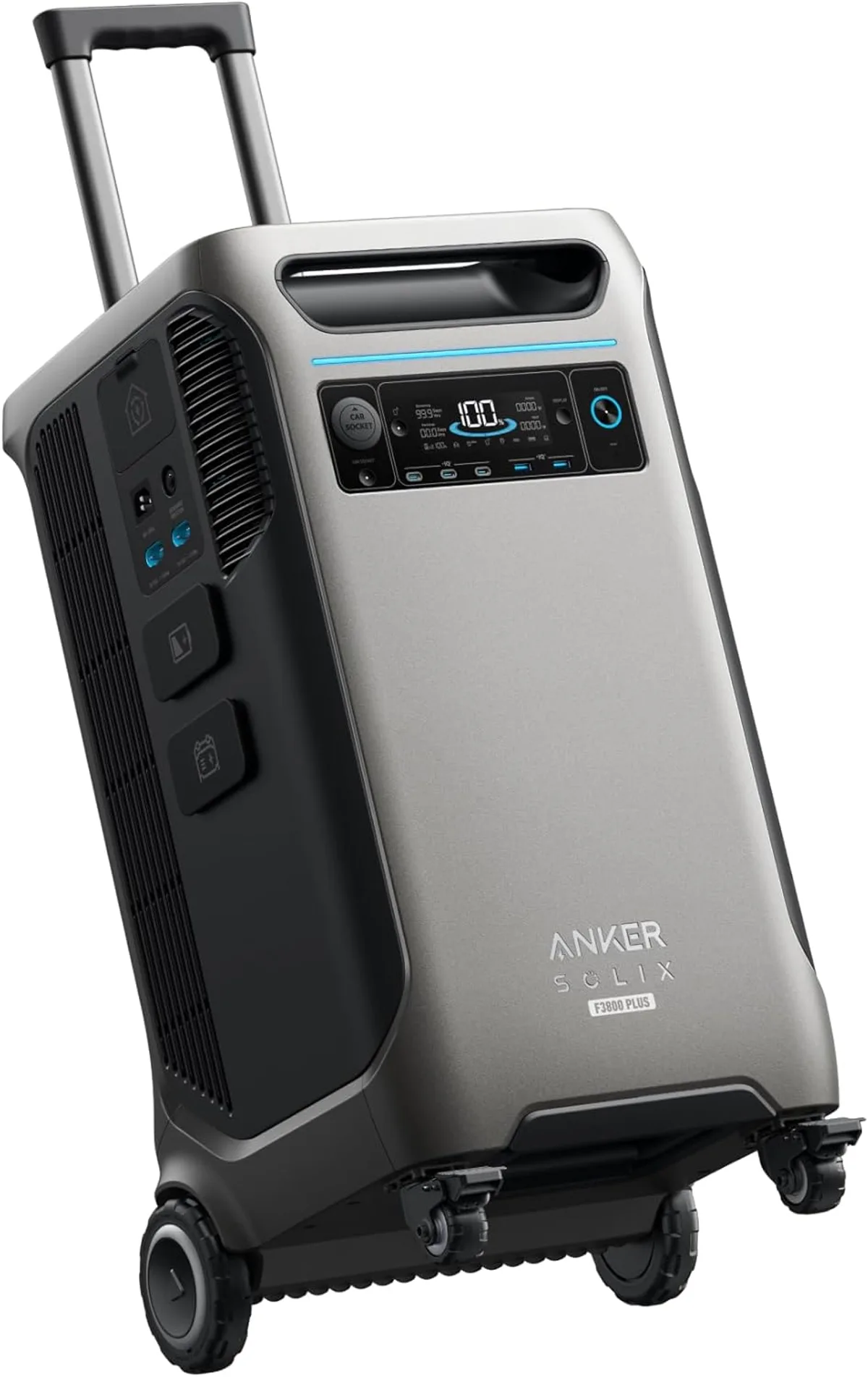
The Anker SOLIX F3800 Plus surgically fixes the original's biggest flaw — 3,200W MC4-compatible solar input transforms the experience. But the reduced standalone output and extreme weight mean this is an investment in a system, not a standalone product.
This assessment reflects 67+ Amazon ratings (as of 2026-02-11), 4 expert reviews including Apple Insider and The Solar Lab, and comparison with 5 products in the Whole-Home Backup Systems category. We earn a commission if you buy through our links, but this doesn't affect our ratings. Read our full methodology →
This review is based on analysis of 67+ Amazon ratings, expert reviews, and comparison with products in the Whole-Home Backup Systems category. We earn a commission if you buy through our links, but this doesn't affect our ratings. Read our full methodology →
The Original's Biggest Flaw, Surgically Fixed
The Anker SOLIX F3800 was a beast with a blind spot. Six thousand watts from a single unit, 53.8kWh expansion ceiling, every connector standard in North American residential wiring — and a 60V solar input limit that made it borderline incompatible with standard solar panels. Buyers who spent over three grand on whole-home backup discovered they couldn't plug in the solar arrays they already owned.
The F3800 Plus exists to fix that one critical failure. Solar input jumps to 3,200W at 165V per MPPT port with standard MC4 connectors — the highest solar throughput in the whole-home category. Plug in your existing residential panels. Wire them in series. No voltage gymnastics, no proprietary adapters, no frustrating compatibility charts. The Solar Lab confirmed it directly: connecting standard 400W MC4 panels worked immediately without the configuration headaches the original demanded.
But fixing the solar flaw came with a trade-off that caught early buyers off guard. Single-unit output dropped from 6,000W to 3,300W. The F3800 Plus cannot match its predecessor's standalone power without purchasing at least one BP3800 expansion battery — an additional investment that pushes the total system cost past the initial sticker price. This is a product designed around ecosystem commitment, not standalone capability.
A Foundation for Solar-First Home Energy
The port selection mirrors the original F3800 exactly: three UPS-enabled 120V outlets, three standard AC outlets, NEMA 14-50 for EV charging, L14-30R for generator transfer switches, triple USB-C (including 140W PD), dual USB-A, and DC output. Add the Home Power Panel for circuit-level management and the Smart Meter for energy monitoring, and the F3800 Plus becomes the core of a complete solar home system that Anker updates through firmware and app improvements.
What is the difference between the Anker F3800 and F3800 Plus?
Three key upgrades: solar input jumps from 2,400W at 60V to 3,200W at 165V with standard MC4 connectors, 240V generator charging is added for ~1.5-hour full recharges, and weather-alert auto-charging prepares the battery before storms. The cost is reduced single-unit output — 3,300W vs the original's 6,000W. You need at least one BP3800 expansion battery to unlock 6,000W on the Plus. The original F3800 remains the better standalone powerhouse; the Plus is the better foundation for a solar-integrated ecosystem.
Strengths
- Best solar input in the category — 3,200W at 165V MPPT compatible with standard MC4 panels
- 240V generator and wall outlet charging for 0-100% in approximately 1.5 hours
- Automatic storm preparation via weather alert integration with the Home Power Panel
- Full Anker ecosystem integration with batteries, solar arrays, generators, and circuit-level management
Limitations
- Heaviest unit in the entire comparison at 136.7 lbs — practically a permanent installation
- Reduced single-unit output (3,300W vs. original F3800's 6,000W) — requires expansion battery for full power
- Same UPS limitation as original F3800 — only three 120V ports at 1,440W max in UPS mode
- Highest absolute price at $3,099 for 3,840Wh — competitors offer more capacity for less
- BP3800 expansion battery buzzing/rattling issues persist from the original F3800 platform
3,200W Solar Input: From Worst to First
The original F3800's solar story was painful. Its 60V-per-port limit rejected most residential panel configurations, and the proprietary connectors required adapters that added cost and failure points. Buyers with existing solar installations learned the hard way that "2,400W solar input" came with an asterisk the size of their roof.
The F3800 Plus changes everything. Dual 165V MPPT controllers accept standard MC4 connections — the same connectors used by virtually every residential panel manufacturer. Wire up to three or four standard 400W panels in series per port without exceeding the voltage ceiling. Total solar throughput reaches 3,200W — 33% more than the EcoFlow DELTA Pro 3's 2,600W and the highest in the whole-home category. On a clear day with properly oriented panels, the F3800 Plus can fully recharge from empty in under two hours from solar alone.
Can the Anker F3800 Plus work with any solar panels?
The F3800 Plus accepts standard MC4 panel connections at up to 165V per MPPT port — a massive improvement over the original's restrictive 60V limit and proprietary connectors. Most standard residential panels (30-50V open circuit each) work in both series and parallel configurations. You can series-connect up to 3-4 typical 400W panels per port without exceeding the voltage ceiling. Verify your panel specs: as long as the string voltage stays below 165V open circuit and total input stays below 3,200W, you are within safe operating parameters.
The 3,300W Standalone Compromise
Here is the specification that makes potential buyers pause. The original F3800 delivers 6,000W from a single unit — enough to run central AC compressors, EV chargers, and workshop power tools without question. The F3800 Plus delivers 3,300W alone. That gap is not subtle.
At 3,300W, the F3800 Plus handles refrigerators, lights, routers, fans, phone charging, and most kitchen appliances simultaneously. It cannot start a central AC compressor (typical surge draw: 4,000-5,000W). It cannot run a table saw (typical draw: 1,800W) alongside other loads without careful power budgeting. For buyers accustomed to the original's "plug in anything" confidence, the reduced standalone output feels like a downgrade.
Anker's answer: buy a BP3800 expansion battery. With one battery connected, output jumps to 6,000W at 240V — matching the original and unlocking the NEMA 14-50 and L14-30R for heavy loads. But that battery adds weight, floor space, and cost to an already expensive system. The total investment for "Plus performance" equals the F3800 Plus base unit plus roughly nine hundred dollars for the expansion battery. Budget accordingly.
Single-unit output matters for emergency readiness. If the power goes out and your expansion battery is disconnected, stored elsewhere, or malfunctioning, you have 3,300W — not 6,000W. The original F3800 never has this problem because its full output is self-contained. If standalone emergency capability is your primary use case, weigh this dependency carefully.
240V Generator Charging and Storm Prep
Two features separate the F3800 Plus from the original beyond solar. The 240V bypass charging accepts input from a 240V wall outlet or a gas generator — filling the battery from empty to full in approximately 1.5 hours. During an extended outage, this means you can run a gas generator for under two hours, fully charge the F3800 Plus, and then run silently on battery for the rest of the day. The original F3800 lacked 240V input entirely, making generator-assisted recharging slower and less efficient.
The weather-alert auto-preparation feature works through the Home Power Panel and the Anker app. When the National Weather Service issues a severe weather alert for your area, the F3800 Plus begins charging automatically from grid power — topping off the battery before a potential outage. No manual intervention, no watching weather forecasts, no midnight trips to the garage to plug in the charger. Apple Insider described this as "set it and forget it" preparedness.
Is the Anker F3800 Plus worth the upgrade over the original?
If solar charging matters to you — yes, absolutely. The original's 60V solar limit was its most damaging flaw. The Plus fixes it so thoroughly (3,200W at 165V, standard MC4) that solar goes from the F3800's weakest feature to its strongest. Add 240V generator charging and weather-alert auto-prep, and the Plus is a more complete product. But if you need maximum single-unit output and never plan to use solar, the original F3800's 6,000W standalone power at a lower price may be the better call.
The Full Ecosystem Price Tag
The F3800 Plus is priced in the premium tier for its base unit alone. But the base unit is not the whole story. At 3,300W standalone output, most buyers will need at least one BP3800 expansion battery to unlock the full 6,000W at 240V — adding roughly the cost of a mid-range power station on top of the base price. A set of solar panels to feed the 3,200W input adds another substantial investment. The Home Power Panel for automatic circuit management is a separate accessory. The Smart Meter for energy monitoring is yet another.
Fully built out, the F3800 Plus ecosystem (base unit + one expansion battery + 1,600W of solar panels + Home Power Panel) costs more than a professionally installed Tesla Powerwall 3 with comparable capacity. The difference: the Powerwall requires a home, a licensed electrician, permits, and a permanent installation. The F3800 Plus is technically portable (the wheels work on flat surfaces), requires zero permits, and can move with you if you relocate. For renters, homeowners in HOA-restricted communities, or anyone who wants a modular system they control, the premium has practical justification. For homeowners with no restrictions who plan to stay put, a permanent battery wall may offer better long-term value per kilowatt-hour.
136.7 Pounds: Permanent Placement Required
The F3800 Plus weighs 136.7 lbs — nearly 5 lbs more than the original F3800 and the heaviest unit among its whole-home competitors. The Jackery HomePower 3000, which delivers comparable capacity, weighs 59.5 lbs. The EcoFlow DELTA Pro 3 at 4,096Wh checks in around 88 lbs. The OUPES Guardian 6000, offering far more capacity at 4,608Wh, weighs approximately 114 lbs.
Apple Insider's reviewer found the pop-up suitcase handle adequate for dragging across flat garage floors and driveways, but noted that small bumps — driveway cracks, garage thresholds, the lip where a deck meets concrete — can bring the rolling to an abrupt halt. Getting the F3800 Plus up or down even a single step required a second person. After initial placement, the reviewer never moved it again. That tracks with every other review we analyzed: once the F3800 Plus is in position, it stays there.
Plan your placement before unboxing. Near a window or wall penetration for solar cables. Within reach of your electrical panel if using the Home Power Panel. On a level surface that won't flex under 137 lbs of sustained load. With enough clearance for ventilation around the air intakes. Moving it later means enlisting help, and the suitcase handle is not designed for lifting — only rolling.
App and Firmware: Ongoing Improvements With Growing Pains
The Anker SOLIX app manages the F3800 Plus through Wi-Fi and Bluetooth, providing real-time monitoring of input/output wattage, battery state-of-charge, individual port status, and firmware version. The interface is cleaner and more responsive than the OUPES app but falls short of EcoFlow's polish — Anker lacks the historical energy consumption graphs, scheduled charging windows, and automated load-shedding that EcoFlow users take for granted.
Firmware updates arrive over Wi-Fi and have historically improved the F3800 platform — fixing UPS switchover timing, refining MPPT tracking efficiency, and adding the weather-alert auto-prep feature post-launch. But early firmware versions also introduced bugs that bricked units until manual recovery. Multiple Amazon reviewers reported the F3800 Plus becoming unresponsive after a firmware update, requiring a full power cycle (disconnect all cables, hold the power button for 15 seconds) to restore function. Anker's support response time for these incidents averaged 2-3 business days according to affected buyers. The app rates 3.4 stars on the iOS App Store — decent but not best-in-class. Check for pending firmware updates before relying on the F3800 Plus for critical backup, and avoid updating the firmware during an active outage.
Should You Buy the F3800 Plus?
The Anker SOLIX F3800 Plus makes perfect sense for one specific buyer: someone who plans to build a comprehensive solar home energy system around the Anker ecosystem. The 3,200W MC4-compatible solar input is the highest of any unit in this entire roundup. The 240V generator charging and weather-alert auto-prep add practical value you won't find elsewhere. The 53.8kWh expansion ceiling and Home Power Panel integration create a growth path that spans years.
But "solar-first ecosystem" is not every buyer's need. If you want maximum standalone output without buying expansion batteries, the original F3800 delivers 6,000W from a single unit at a lower price. If you want more capacity per dollar, the EcoFlow DELTA Pro 3 packs 4,096Wh at a noticeably lower cost. And if weight matters at all — for RV use, storm evacuation portability, or any scenario where you might move the unit more than once — the Jackery HomePower 3000 at 59.5 lbs is less than half the burden.
The F3800 Plus is an investment in a system, not a standalone purchase. The base unit is the down payment. The expansion battery unlocks full output. The solar panels unlock the best-in-class charging. The Home Power Panel unlocks whole-home management. Each component makes the others more valuable, and the total system cost exceeds the sticker price of any single competitor. Buy it knowing what you're committing to — and the F3800 Plus rewards that commitment with the best solar-integrated home backup platform available.
The Anker SOLIX F3800 Plus surgically fixes the original's biggest flaw — 3,200W MC4-compatible solar input transforms the experience. But the reduced standalone output and extreme weight mean this is an investment in a system, not a standalone product.
Best for: Solar-first users who want to maximize renewable charging and build a comprehensive Anker home energy system
F3800 Plus FAQ
How much does the Anker F3800 Plus weigh?
The F3800 Plus weighs 136.7 lbs — the heaviest unit among its whole-home competitors and nearly 5 lbs more than the already-massive original F3800. The pop-up suitcase handle works on flat surfaces, but any terrain change (thresholds, cracks, single steps) requires a second person. Most buyers position it once and treat it as a permanent fixture. Wheels are included but function best on smooth, level flooring.
Can the Anker F3800 Plus power a whole house?
A single F3800 Plus at 3,300W can run essential circuits — refrigerator, lights, router, phone chargers, and a few small appliances. With one BP3800 expansion battery, output reaches 6,000W at 240V, enough for larger loads including well pumps, HVAC blower motors, and EV charging via the NEMA 14-50 port. The full ecosystem (two F3800 Plus units plus six BP3800 batteries at 53.8kWh) can sustain a typical American household for 3-5 days during a moderate outage. Pair with solar panels for indefinite runtime on essentials.
Does the F3800 Plus have UPS functionality?
Yes, but only on three 120V outlets at a combined 1,440W maximum with approximately 10ms switchover. The 240V outlets, NEMA 14-50, and L14-30R do not have UPS capability — this is the same limitation as the original F3800. For desktop computers, networking equipment, and medical devices, the UPS ports work well. For 240V loads that cannot tolerate any interruption, plan for a dedicated UPS alongside the F3800 Plus.
What happens to BP3800 buzzing issues on the Plus model?
The F3800 Plus uses the same BP3800 expansion batteries as the original F3800. Forum reports of buzzing and rattling under heavy AC loads (above 3,000W) carry over to the Plus platform since the battery hardware is identical. The noise appears related to transformer vibration during high-power delivery and does not indicate a safety issue. Anker has not addressed this with a hardware revision as of early 2026.