Anker SOLIX F3800 Portable Power Station Review 2026
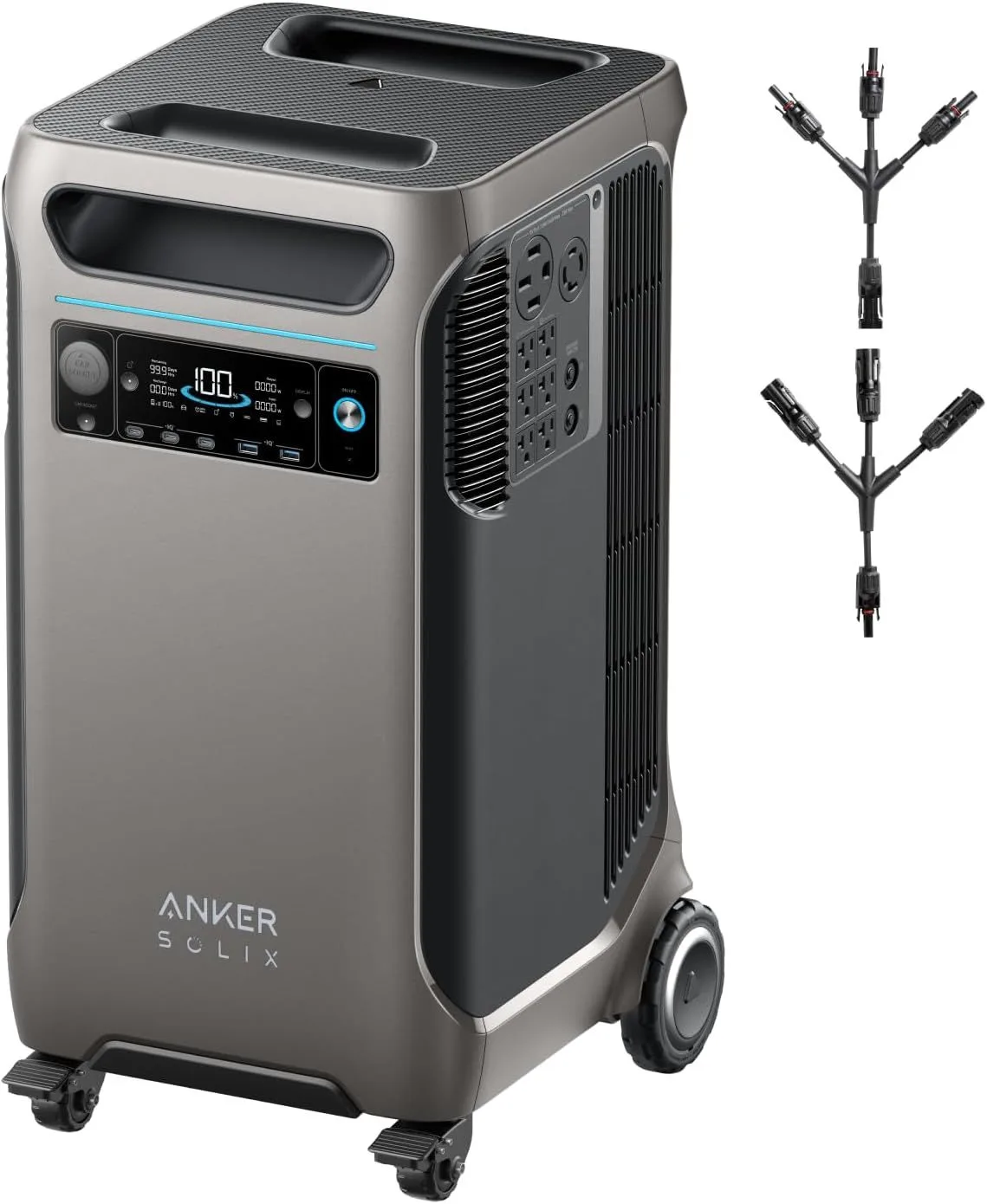
The Anker SOLIX F3800 is the brute-force option — 6,000W of 240V output from a single unit with a 53.8kWh expansion ceiling is unmatched. But 132 lbs, 80W idle draw, and restrictive 60V solar input make it a unit that works best as a permanent installation.
This review was built from 203+ Amazon ratings (as of 2026-02-10), 5 expert reviews, and comparison with 5 products in the Whole-Home Backup Systems category. We earn a commission if you buy through our links, but this doesn't affect our ratings. Read our full methodology →
This review is based on analysis of 203+ Amazon ratings, expert reviews, and comparison with products in the Whole-Home Backup Systems category. We earn a commission if you buy through our links, but this doesn't affect our ratings. Read our full methodology →
6,000 Watts From a Single Box
The Anker SOLIX F3800 does not try to be elegant. It tries to be powerful. And at 6,000W continuous at 240V from a single unit, it succeeds. No other portable power station delivers this much output without requiring a second unit, a hub, or a workaround. Plug in your EV charger. Run your central AC compressor. Power your workshop table saw. The F3800 handles loads that every other station in this class refuses.
That raw power comes with raw weight. At 132 lbs, the F3800 is not a device you move casually. The wheels help on flat surfaces, but loading it into a vehicle or carrying it down stairs is a two-person job that requires planning and grip strength. This is a permanent installation disguised as a portable device — Anker ships it with wheels, but most buyers will position it once and leave it there for years.
The 3,840Wh LiFePO4 battery and 53.8kWh expansion ceiling give the F3800 enormous potential. But two specs undermine the experience: an 80W idle draw that devours stored energy during standby, and a 60V-per-port solar input limitation that makes it incompatible with most residential solar panels. These are not minor quibbles. They fundamentally shape who should and should not buy this product.
A Station Built for Permanent Installation
The F3800 ships with 14+ ports covering every connector standard in North American residential electrical. The NEMA 14-50 handles EV charging, RV hookups, and large appliance connections. The L14-30R serves generator transfer switches and high-power tools. Three UPS-enabled 120V outlets provide instant backup for sensitive electronics. The USB ports — including 140W USB-C Power Delivery — handle device charging as an afterthought. This port selection is designed for a home electrical closet, not a campsite.
Can the Anker SOLIX F3800 charge an electric vehicle?
Yes — the built-in NEMA 14-50 port delivers 240V at up to 25 amps, the same connector used by most Level 2 EV chargers. A typical EV adds 20-25 miles of range per hour of charging from this port. The 3,840Wh battery can add roughly 30-40 miles of range before depleting — enough for emergency commuting, not enough for a full charge. For EV owners in outage-prone areas, having even partial charge capability without a gas generator is a meaningful safety net.
Why the F3800 Stands Out
- Highest single-unit output in the category — 6,000W continuous at 240V from one box
- Direct EV and RV charging via built-in NEMA 14-50 and L14-30 ports without adapters
- Most extensive port selection with 14+ ports covering every use case
- Largest expansion ceiling at 53.8kWh (two units + 12 BP3800 batteries)
Where It Stumbles
- Heaviest unit at 132 lbs — requires two people for any relocation between floors
- High idle draw (80W measured) consumes ~1,920Wh over 24 hours of standby
- Restrictive 60V-per-port solar input limit incompatible with most standard residential panels
- UPS mode limited to three 120V ports at 1,440W max — no 240V UPS capability
- Reported buzzing/rattling from BP3800 expansion batteries under heavy AC loads
Why does the F3800 have an 80W idle draw?
The 80W standby consumption is the F3800 largest weakness in real-world use. It stems from the always-on monitoring of the 240V output system, the UPS circuitry on three ports, and the high-power inverter maintaining readiness. Over 24 hours of standby, 80W drains approximately 1,920Wh — half the total battery. Anker has not released a firmware fix. If your primary use case is long-term standby (waiting for outages), the F3000 at 20.5W idle is a far better choice despite lower output.
Worth It If You Need Maximum Output — Skip It If You Need Efficiency
The Anker SOLIX F3800 is the right choice for exactly one buyer profile: someone who needs the highest possible output from a single unit, plans a permanent installation with professional wiring, and intends to build a large-scale expandable system over time. For that specific buyer, nothing else competes. The 6,000W at 240V from one box is unmatched. The 53.8kWh expansion ceiling provides a growth path that spans years of incremental investment.
For everyone else, the F3800 is harder to recommend. The 80W idle draw is disqualifying for emergency standby use — the Anker F3000 wastes one-quarter the standby energy. The 60V solar input limit is disqualifying for anyone with standard residential panels — the F3800 Plus fixes this for a few hundred dollars more. And 132 lbs eliminates any pretense of portability.
The F3800 occupies an awkward middle ground in Anker's own lineup. The F3000 below it is more efficient and portable. The F3800 Plus above it solves the solar compatibility problem. Unless the 6,000W single-unit output is a hard requirement that overrides everything else, one of those siblings is likely the better buy.
The Anker SOLIX F3800 is the brute-force option — 6,000W of 240V output from a single unit with a 53.8kWh expansion ceiling is unmatched. But 132 lbs, 80W idle draw, and restrictive 60V solar input make it a unit that works best as a permanent installation.
Best for: Power users who need maximum single-unit output (6,000W/240V) and plan to build a large-scale expandable system
The 80W Idle Drain: A Spec Sheet Doesn't Show
Every power station wastes some energy while sitting idle. The inverter, display, BMS monitoring circuit, and WiFi radio all draw power even when no appliances are connected. Most stations lose 10-30W in this state. The F3800 loses 80W.
At 80W idle, the F3800 drains approximately 1,920Wh every 24 hours — half its total 3,840Wh capacity in a single day of doing nothing. Leave it charged and waiting for a power outage, and it will be at 50% within 24 hours. In 48 hours, it is effectively empty. For a product marketed as home backup, this standby drain makes the "keep it charged and ready" promise impractical without a continuous trickle charge from wall power or solar.
The Anker F3000 manages 20.5W idle. The Jackery HomePower 3000 achieves just 8W. The EcoFlow DELTA Pro 3 sits between those at roughly 25-30W. The F3800's 80W is an outlier — four times higher than the next-worst competitor. Anker has not indicated whether a firmware update can reduce this, and the hardware architecture (always-on 240V monitoring) suggests the high idle draw may be structural rather than software-fixable.
The Solar Input Limitation That Caught Buyers Off Guard
The F3800's dual MPPT controllers accept 2,400W of solar input — a strong number on paper. The catch is the 60V maximum per input port. Standard residential solar panels typically produce 30-50V open circuit voltage individually, which fits within the limit. But the moment you wire two panels in series — the standard configuration for most residential rooftop systems — the combined voltage exceeds 60V and the F3800 rejects the input.
This means the F3800 requires all solar panels wired in parallel, not series. Parallel wiring increases amperage while keeping voltage low, but it requires different gauge wiring, MC4 branch connectors, and a fundamentally different panel layout than most residential installations use. The parallel configuration also increases resistive losses over longer cable runs, reducing actual solar harvest by 5-10% compared to a series-wired setup of equivalent wattage. Buyers who purchased the F3800 expecting to connect it to their existing rooftop solar discovered an expensive incompatibility.
Anker addressed this directly with the F3800 Plus, which raises the voltage limit to 165V and adds standard MC4 connectors. If solar charging is central to your plans, the F3800 Plus review covers why that upgrade matters.
Solar panel buyer beware: Anker's own SOLIX PS400 (400W) panels exceed the 60V port limit when wired in series. Connecting two PS400 panels in series to the F3800 can damage the MPPT controller. Always wire panels to the F3800 in parallel configuration, and verify that individual panel open-circuit voltage stays below 60V.
Home Workshop Power: Where 6,000W Earns Its Keep
The F3800's 6,000W output becomes a genuine advantage in a scenario most competitors cannot handle: powering a home workshop during an outage, or in a detached garage with no dedicated electrical service. A 10-inch table saw draws 1,800W running with a 4,500W startup surge. A dust collector adds 1,200W. Overhead LED lighting and a battery charger contribute another 100W. The combined running load of 3,100W with periodic surge spikes sits comfortably within the F3800's envelope.
No other single portable unit can run this load profile. The EcoFlow DELTA Pro 3 tops out at 3,600W — enough for the saw alone but not with the dust collector running simultaneously. The Jackery HomePower 3000 matches at 3,600W continuous but lacks 240V output for larger tools like 240V welders or air compressors. The Anker F3000 maxes at 6,000W only with two units connected through a hub. The F3800 does it from one box.
For contractors who need temporary job site power, this matters. A single F3800 replaces a gas generator for a day of interior finishing work — trim carpentry, painting, drywall sanding — where generator exhaust would be hazardous or prohibited. The 3,840Wh battery sustains a typical finishing workload (1,500-2,000W average) for roughly 2-3 hours. Pair with two BP3800 expansion batteries and that window extends to 6-8 hours, covering a full work day. The silence alone justifies the switch for indoor renovation work — no ear protection needed, no exhaust ventilation required, and no fuel spills on the client's subfloor. Electricians doing panel upgrades and HVAC technicians installing mini-splits have started keeping F3800 units on their trucks specifically for this use case.
Expansion to 53.8kWh: The Long-Term Investment Case
The F3800's expansion ceiling is its strongest strategic argument. Two F3800 units plus six BP3800 expansion batteries reach 53.8kWh — enough to power a typical American home for 3-5 days during a moderate home backup outage without any solar input. That capacity level competes with permanent whole-home battery walls like the Tesla Powerwall system, at a comparable total cost but with the flexibility of a portable form factor.
The expansion path is incremental. Start with one F3800. Add a BP3800 battery when budget allows (each adds 3,840Wh). Add a second F3800 when you need 240V or more output. The system grows with your needs and your budget. This is the argument Anker makes for choosing the F3800 over a one-and-done solution like the Jackery HomePower 3000, which has zero expansion capability.
The counterargument: BP3800 batteries carry a premium price per watt-hour, and they are compatible only with the F3800 platform. If Anker releases a new architecture in 2-3 years, your BP3800 investment is tied to aging hardware. Cross-compatibility within the Anker ecosystem is limited — BP3000 batteries for the F3000 do not work with the F3800, and vice versa. This platform lock-in is the hidden cost of expansion: you are betting that Anker continues supporting the F3800 connector standard and communication protocol for the useful life of the batteries, which LiFePO4 chemistry suggests could be 8-10 years at one cycle per day.
The real-world expansion math: a single F3800 at 3,840Wh runs a household's essentials (refrigerator, lights, router, chargers) at roughly 250W total draw for about 15 hours. Add one BP3800 (7,680Wh total) and runtime doubles to 30 hours. Add two BP3800 batteries (11,520Wh total) and you reach nearly two full days of essential-circuit coverage. For most suburban households facing a typical 12-36 hour outage, one or two expansion batteries is the practical sweet spot — the full six-battery 53.8kWh configuration is reserved for off-grid homes or multi-day disaster preparation.
How does the Anker SOLIX F3800 compare to the F3800 Plus?
The F3800 Plus is a direct upgrade in three areas: solar input (3,200W at 165V vs 2,400W at 60V), MC4 panel compatibility (standard connectors vs proprietary), and weather alert preparation (automatic charging before storms). The original F3800 counters with higher single-unit output (6,000W vs 3,300W) and a lower price point. The F3800 is the better standalone powerhouse; the F3800 Plus is the better foundation for a solar-integrated system.
UPS Mode Limitations at 240V
The F3800 offers UPS functionality — but only on three 120V ports at a combined maximum of 1,440W. The 240V outlets, the NEMA 14-50, and the L14-30R do NOT have UPS capability. If grid power drops, devices on the UPS ports switch over in 20 milliseconds. Devices on the non-UPS ports lose power until the station's manual or automatic transfer engages.
For desktop computers, networking equipment, and medical devices, the 120V UPS ports work well. For 240V loads that cannot tolerate any interruption, the F3800's UPS limitation is a real gap. The EcoFlow DELTA Pro 3 offers faster 10ms switchover across its full output range. A dedicated UPS for critical 240V loads may be needed alongside the F3800. This is particularly relevant for home servers, aquarium systems with sensitive pumps, and CPAP machines that need unbroken power throughout the night — the 20ms switchover on the 120V ports handles these fine, but buyers running 240V workshop equipment during outages need to understand this gap before committing.
Do the BP3800 expansion batteries make noise under load?
Multiple Amazon reviewers and forum users report buzzing or rattling sounds from BP3800 batteries under heavy AC loads (above 3,000W). The noise appears to be related to transformer vibration during high-power delivery. It does not indicate a safety issue — the batteries continue to function correctly — but it is an audible nuisance in indoor installations. Anker has not addressed this with a hardware revision or firmware update as of early 2026.
What solar panels are compatible with the Anker SOLIX F3800?
The F3800 accepts up to 2,400W of solar input through dual MPPT controllers — but with a critical restriction. Each MPPT port is limited to 60V maximum. Most standard residential solar panels operate at 30-50V open circuit, which falls within spec. But series-connected panel strings (common in residential rooftop installations) can exceed 60V easily. This means the F3800 is effectively incompatible with standard residential solar installations without rewiring panels into parallel configurations. The F3800 Plus fixes this with a 165V limit.
What Buyers Ask About the F3800
Does the F3800 require professional installation?
For portable use (plugging devices directly into the station), no installation is needed. For permanent home backup with a transfer switch connected to your electrical panel, a licensed electrician is required. The Home Power Panel accessory manages the connection between the F3800 and your breaker panel. Local building codes may require permits for permanent installation. Budget several hundred to over a thousand dollars for professional installation depending on your panel complexity.
Can I use the F3800 for an RV without the expansion batteries?
Yes — the built-in L14-30R and NEMA 14-50 ports handle RV shore power connections natively. The standalone 3,840Wh battery runs a typical RV (air conditioning, refrigerator, lights) for 3-5 hours on AC and 8-12 hours on lights and essentials only. For extended RV trips, adding even one BP3800 battery doubles your runtime. The 132 lb weight makes it impractical for frequent vehicle loading, so it works best in RVs where it can be permanently mounted.
Watch: Watch Anker SOLIX F3800 Review
