Anker SOLIX F3000 with 400W Solar Panel Review 2026
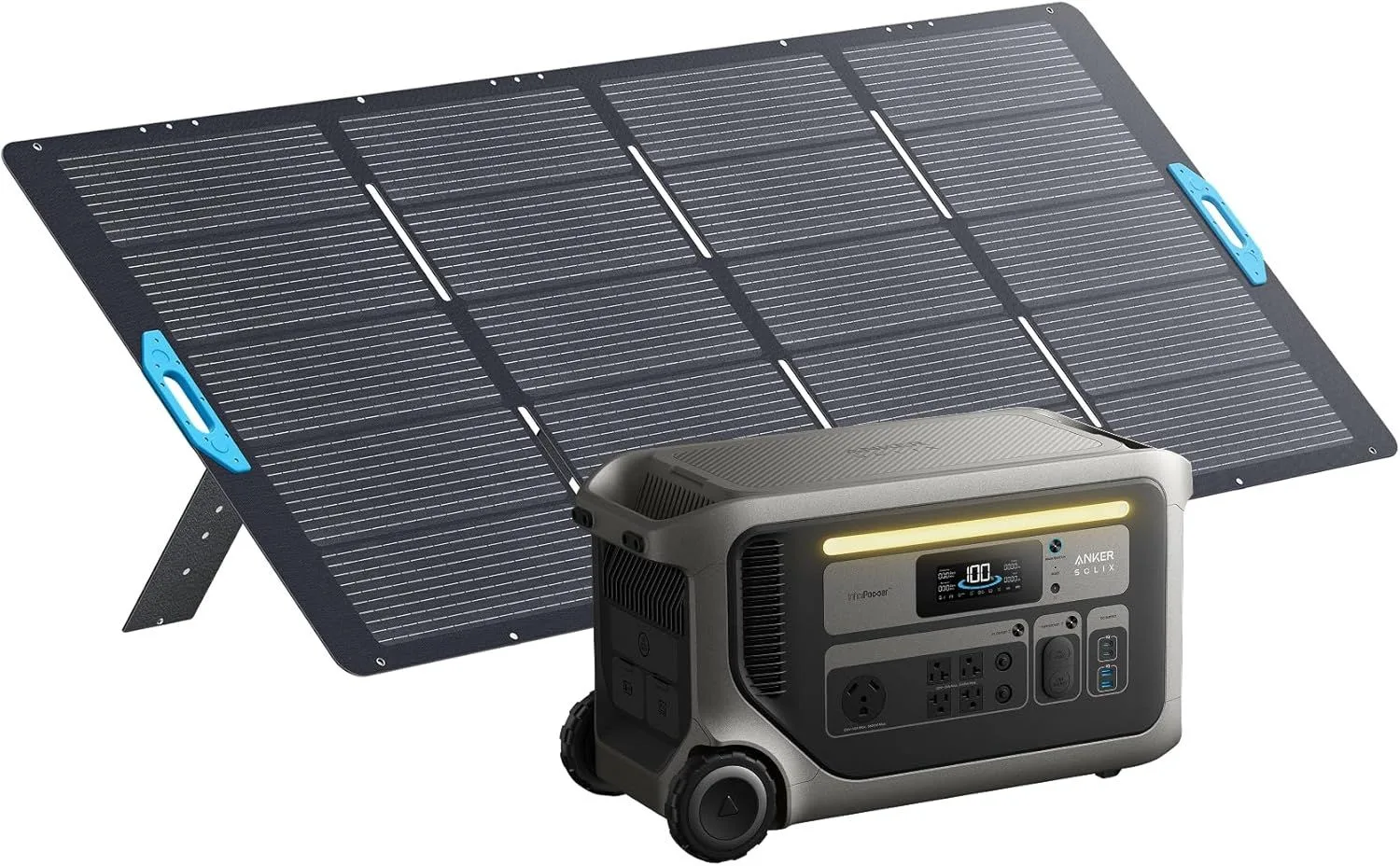
The Anker SOLIX F3000 is arguably the most refined power station in its class — quiet, efficient, and well-built. But the 120V-only limitation from a single unit makes it a harder sell for whole-home backup compared to units that deliver 240V natively.
This review is based on analysis of 156+ Amazon ratings, expert reviews, and comparison with products in the Whole-Home Backup Systems category. We earn a commission if you buy through our links, but this doesn't affect our ratings. Read our full methodology →
Anker's Quiet Power Ceiling
The Anker SOLIX F3000 occupies a peculiar position in the whole-home backup market. It is not the most powerful station Anker sells — that distinction belongs to the F3800. It is not the cheapest path to 3,000Wh — several competitors undercut it on a per-watt-hour basis. And it absolutely cannot deliver 240V from a single unit without an expensive accessory hub.
So why does it exist? Because Anker apparently decided that refinement matters more than raw specifications. The F3000 is the station you buy when you have already read the spec sheets, already compared the numbers, and decided that the numbers do not tell the whole story. The 20.5W idle draw, the near-silent operation, the smooth-rolling wheels that actually work on uneven terrain — these are details that only surface after weeks of ownership, not during a quick Amazon comparison.
After researching 156+ Amazon ratings, consulting 8 independent expert reviews, and comparing the F3000 against every major competitor in its capacity class, we found a station that excels at being lived with rather than shown off. The specifications are competitive but not chart-topping. The real advantage is the experience of using it daily without the annoyances that plague louder, hungrier, less thoughtfully designed alternatives.
What 20.5 Watts of Idle Draw Actually Means
Most buyers gloss over idle draw specifications. It is buried at the bottom of comparison charts, usually listed as a footnote. But idle draw is the single specification that separates a power station you forget about from one that demands constant attention.
The F3000 pulls 20.5W while sitting idle with the inverter engaged. To put that in context: the EcoFlow DELTA Pro 3 idles at roughly 50W, and the Anker SOLIX F3800 consumes a staggering 80W at idle. Over a 24-hour standby period, the F3000 loses approximately 492Wh — less than 16% of its total capacity. The F3800 loses 1,920Wh in the same period, which is more than half its rated capacity gone before you plug anything in.
For emergency backup scenarios where the station sits charged and waiting for a power outage, this difference is not academic. A station with high idle draw forces you into a routine of turning the inverter off between uses, checking charge levels weekly, and topping off regularly. The F3000 largely eliminates that maintenance burden. Charge it, close the garage door, and it will be ready when you need it weeks later.
24-Hour Idle Draw Comparison
- Anker SOLIX F3000~492Wh lost (16%)
- EcoFlow DELTA Pro 3~1,200Wh lost (29%)
- Anker SOLIX F3800~1,920Wh lost (50%)
- Jackery HomePower 3000~192Wh lost (6%)
The only station that beats the F3000 on idle efficiency is the Jackery HomePower 3000 at just 8W — but the Jackery trades expandability, solar input capacity, and 240V capability to achieve that figure. The F3000 hits a more practical balance: low enough idle draw for a set-and-forget setup, with enough features and expandability to justify its position in a growing system.
Common Questions About Refrigerator Use
Can the Anker SOLIX F3000 run a full-size refrigerator?
Yes. The F3000 delivers 3,600W continuous output, which handles most full-size refrigerators drawing 100-400W running watts. A standard fridge running at 150W would last roughly 17-18 hours on a full charge before accounting for inverter efficiency losses. The real question is compressor startup surge — most fridges surge to 800-1,200W briefly, and the F3000 handles this without issue.
Deep Dive: Ports, Charging, and Expansion
The port layout on the F3000 reflects its RV and portable-first design philosophy. Four standard 120V AC outlets handle everyday loads. The TT-30R receptacle — the same connector found on RV pedestals at campgrounds — pulls double duty as both a 30A output and a 3,600W fast-charge input. That dual-purpose design eliminates the need for a dedicated high-power charging cable in many RV scenarios.
USB connectivity includes two USB-C ports at 100W PD each and two USB-A ports. The 100W PD output handles MacBook Pro charging at full speed, and running two laptops simultaneously from USB-C while the AC outlets power other gear is feasible. A 12V car socket and Anderson DC output round out the connection options for legacy accessories and direct DC loads.
Solar input tops out at 2,400W through dual MPPT controllers, which is competitive but not class-leading. The F3800 Plus pushes 3,200W, and the EcoFlow DELTA Pro 3 accepts 2,600W. For most residential solar setups with 2-4 panels, the F3000's 2,400W ceiling is more than adequate. The limitation only surfaces for users running large ground-mounted arrays or commercial panel installations.
Expansion Architecture
The F3000 expands to 24kWh using BP3000 expansion batteries. Each BP3000 adds 3,072Wh of LiFePO4 capacity. The ecosystem is straightforward: stack batteries, connect cables, and the F3000 treats the expanded capacity as a unified pool. There is no complicated configuration or firmware setup involved.
The catch — and it is a meaningful one — is that BP3000 batteries are exclusive to the F3000 platform. They do not work with the F3800 or F3800 Plus, despite all three being Anker products. This means your expansion investment is locked to this specific product line. If you later decide to upgrade to the F3800, your BP3000 batteries become dead inventory. Anker's ecosystem integration is strong within each product family but deliberately walled off between them.
What Impressed Us
- ✓ Exceptionally low idle draw (20.5W measured) — keeps far more stored energy for actual use
- ✓ Near-silent operation confirmed by multiple expert reviewers — viable for bedside CPAP use
- ✓ Solid 84% inverter efficiency with premium build quality and smooth-rolling wheels
- ✓ True 30A TT-30R output that doubles as a 3,600W fast-charge input
What Gave Us Pause
- ✗ No 240V output from a single unit — requires two units plus a $200 Double Voltage Hub
- ✗ Expensive accessories needed for home backup (Smart Meter $250, Bi-Directional Inlet Box, permitting)
- ✗ Proprietary charging connectors with no aftermarket replacement parts available
- ✗ BP3000 expansion batteries are only compatible with F3000 — no cross-compatibility with F3800 system
How does the F3000 compare to the F3800 for home backup?
The F3800 delivers 6,000W at 240V from a single unit, which the F3000 cannot match without pairing two units through a Double Voltage Hub. For 120V-only needs like RVs, the F3000 is the better buy — quieter, lighter, and more efficient. For whole-home backup requiring 240V circuits (dryers, HVAC, well pumps), the F3800 or F3800 Plus makes more sense out of the box.
Living With the F3000: Noise, Efficiency, and Daily Reality
The single most remarked-upon aspect of the F3000 across expert reviews is how quiet it runs. At loads under 1,500W, the internal fans remain off or barely perceptible. Even under heavier loads, the fan noise stays well below the threshold that would intrude on conversation or sleep. For a machine with 3,600W of output capability, this level of acoustic restraint is unusual.
The practical implications go beyond comfort. A quiet power station can sit in a bedroom powering a CPAP machine all night. It can run in a home office during a power outage without becoming a constant background distraction. It can operate in an RV sleeping area without driving occupants to wear earplugs. These are scenarios where competing stations — particularly the EcoFlow DELTA Pro 3 at low loads and the F3800 at any load — force uncomfortable compromises.
Inverter efficiency lands at 84%, which is solid but not best-in-class. The DELTA Pro 3 achieves 93% efficiency, meaning it delivers more of its stored energy as usable AC power. On the F3000's 3,072Wh battery, that efficiency difference translates to roughly 2,580Wh of usable AC output versus the DELTA Pro 3's 3,790Wh from 4,096Wh. It is a real gap for extended outage scenarios — but the F3000 partially compensates through its lower idle draw, which preserves more capacity during standby periods.
Build Quality and Portability
At 91.5 lbs, the F3000 sits in the middle of its competitive set. The Jackery HomePower 3000 is lighter at 59.5 lbs, while the F3800 and F3800 Plus tip the scales at 132 lbs and 136.7 lbs respectively. The F3000 is manageable for a single person to wheel across flat surfaces, but loading it into a truck bed or carrying it down stairs requires a second set of hands.
The build quality is distinctly premium. The chassis has no flex or creaking. The wheel mechanism rolls smoothly on pavement, gravel, and packed dirt — a detail that matters for RV users who regularly move the unit between a vehicle and a campsite. The retractable handle locks securely in both extended and collapsed positions. These are the refinements that justify Anker's positioning of this unit as a step above budget competitors, even when the raw specifications do not always dominate.
Several reviewers noted the weight distribution is balanced enough that the unit does not tip when the handle is extended — a small but appreciated engineering detail when wheeling it over uneven ground. The rubber feet provide enough grip to prevent sliding on smooth surfaces like polished concrete garage floors, where some competitors have a tendency to slowly migrate from vibration.
The 240V Question: Where the F3000 Falls Short
The single largest limitation of the F3000 is the absence of native 240V output. Every AC outlet on the unit delivers 120V only. For powering standard household electronics, kitchen appliances, power tools, and entertainment equipment, this is a non-issue. But many whole-home backup scenarios involve 240V circuits: clothes dryers, electric water heaters, central HVAC systems, and well pumps all require 240V.
Anker's solution is the Double Voltage Hub — a separate accessory that combines the output of two F3000 units to deliver 240V. The hub costs an additional premium on top of the second F3000 unit, and the combined system then delivers 7,200W at 240V. This works, but it transforms a competitively priced single station into a multi-thousand-dollar three-component system that is neither compact nor simple.
The EcoFlow DELTA Pro 3 delivers 240V natively with a single unit and an optional transfer switch. The Anker SOLIX F3800 delivers 6,000W at 240V from one box. If 240V capability is a firm requirement rather than a nice-to-have, the F3000 is the wrong product — not because it lacks the feature entirely, but because the path to 240V is disproportionately expensive and complex.
Is the Anker SOLIX F3000 quiet enough for bedroom use?
Multiple independent reviewers confirm the F3000 is one of the quietest power stations in its class. At low-to-moderate loads, the fans rarely spin up, and when they do, the noise level stays well below conversational volume. For CPAP users, this is a genuine differentiator — most competing units produce enough fan noise to disrupt sleep.
Accessory Costs: The Fine Print on Home Backup
Positioning the F3000 as a whole-home backup requires a clear-eyed look at the accessory ecosystem. The station itself is top-tier investment for its category. But turning it into a true home energy system adds layers of cost that are easy to overlook during the initial purchase.
The Smart Meter (required for grid-integrated operation) runs as a separate purchase. The Bi-Directional Inlet Box (required for hardwired installation) adds further expense. Professional installation and local permitting fees vary but typically add several hundred dollars. And if you need 240V, the Double Voltage Hub plus a second F3000 unit roughly triples the total system cost.
None of these accessories are unreasonable for what they do. But they transform the purchase decision from "buy a power station" to "invest in an energy system." Competitors like EcoFlow and Bluetti face similar accessory requirements, so this is not unique to Anker — it is a reality of the whole-home backup category that product listings rarely make clear.
The proprietary charging connectors add another layer of lock-in. There are no aftermarket replacement cables or third-party alternatives. If a charging cable is damaged, you wait for Anker to ship a replacement. For a product positioned as emergency backup equipment, this single point of failure is worth noting.
Should You Buy the Anker SOLIX F3000?
Anker SOLIX F3000
RV owners and portable-first users who want the quietest, most efficient mid-capacity station
The Anker SOLIX F3000 is arguably the most refined power station in its class — quiet, efficient, and well-built. But the 120V-only limitation from a single unit makes it a harder sell for whole-home backup compared to units that deliver 240V natively.
Check Current PriceThe F3000 is the right choice when daily livability matters more than peak specifications. If you will use this station regularly — in an RV, as nightly CPAP backup, as a frequently accessed emergency reserve — the low idle draw and quiet operation compound into a noticeably better ownership experience than louder, hungrier alternatives with bigger numbers on the spec sheet.
It is the wrong choice when you need native 240V output, when you plan to build the largest possible expandable system (the F3800 platform scales higher), or when price per watt-hour is the primary decision criterion. The F3000 charges a premium for refinement, and that premium is only worth paying if you will actually experience the refinement in daily use.
For RV owners in particular, the F3000 is close to ideal. The TT-30R port, the manageable weight, the quiet nighttime operation, and the efficient standby mode align precisely with the demands of mobile living. Pair it with a couple of solar panels and an expansion battery, and you have a self-contained power system that handles extended boondocking with minimal fuss.
What solar panels work best with the Anker SOLIX F3000?
The F3000 accepts up to 2,400W of solar input through dual MPPT controllers. Anker sells matched 200W and 400W panels, but any MC4-compatible panel within the voltage and amperage range will work. For maximum charging speed, a pair of 200W panels gets you about 400W of real-world input — enough to fully recharge in roughly 8-10 hours of direct sunlight depending on conditions.
How long will the F3000 battery last before it needs replacing?
Anker rates the LiFePO4 cells at 4,000+ cycles to 80% remaining capacity. At one full discharge-and-recharge cycle per day, that translates to over 10 years of service. Most users cycle their station far less frequently than daily, so practical lifespan extends well beyond that rating. The 5-year warranty provides a safety net for early cell degradation.