Anker SOLIX F2000 (PowerHouse 767) Portable Power Station Review 2026
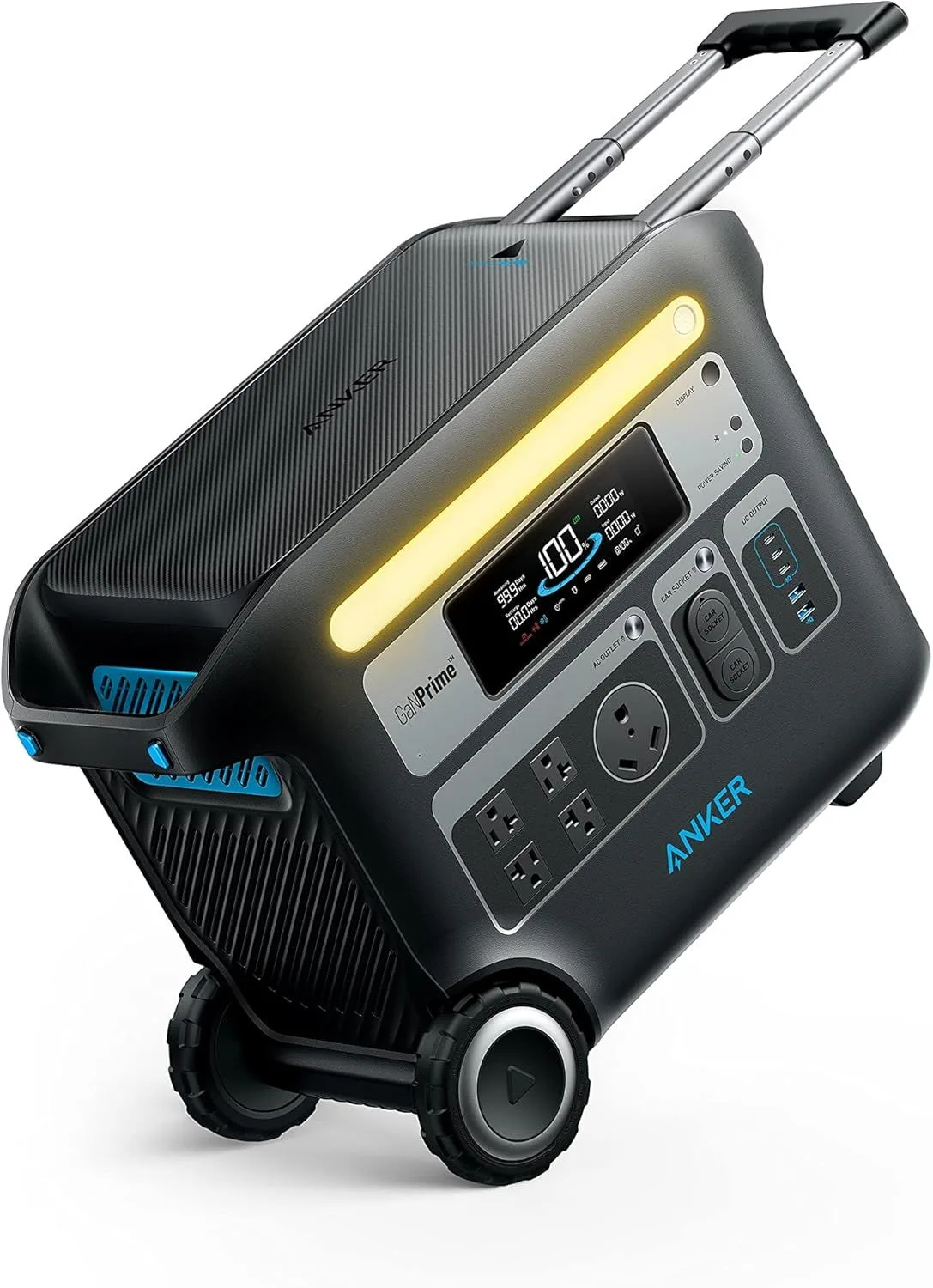
The Anker SOLIX F2000 is the old guard of the 2kWh market — solid and reliable but surpassed in specs by newer competitors including Anker's own C2000 Gen 2. The wheels and build quality remain excellent, but at 67 lbs with limited surge capacity, it is hard to recommend at its current price when lighter, more capable alternatives exist.
For this review, we examined 1500+ Amazon ratings (as of 2026-01-28), expert assessments from StorageReview, GearJunkie, and Trusted Reviews, plus comparison with 5 competing high-capacity power stations. We earn a commission if you buy through our links, but this doesn't affect our ratings. Read our full methodology →
This review is based on analysis of 1500+ Amazon ratings, expert reviews, and comparison with products in the High-Capacity Power Stations category. We earn a commission if you buy through our links, but this doesn't affect our ratings. Read our full methodology →
The Original 2kWh Workhorse — Still Relevant?
The Anker SOLIX F2000 was a top pick when it launched. A 2,048Wh LiFePO4 battery, 2,400W pure sine wave output, 12 ports, wheels, a retractable handle, and the Anker name behind it. GearJunkie said it "could effectively replace the electrical system in a van." StorageReview called it "a comprehensive solution for off-grid power needs."
But the portable power market moves fast, and the F2000 has been lapped. Anker's own C2000 Gen 2 delivers the same 2,048Wh capacity at 41.7 lbs instead of 67.2 lbs, with 4,000W surge instead of 2,400W, and charges fully in 58 minutes instead of roughly 90. The F2000 is not a bad product — it is an older product in a market that has gotten dramatically better. The question is whether the current street price reflects that reality.
The Wheels and Handle Still Matter
At 67.2 lbs, the F2000 is not something you carry. It is something you roll. The 4.72-inch wheels and telescoping handle turn what would be an immovable brick into something you can tow across a campsite, through a garage, or down a hallway. No other power station in this capacity class offers built-in wheels. If you need to reposition your power source regularly — between a workshop and a truck bed, for example — the F2000's mobility system earns its weight penalty.
The build quality reinforces Anker's hardware reputation. Impact-resistant, flame-retardant, anti-UV casing. The unit feels overbuilt in a way that inspires confidence during rough handling. Stacking gear on top during transport, tossing it in a truck bed, leaving it in direct sun — the F2000 handles abuse that would worry you with a lighter, more plasticky competitor.
GaN Technology: Marketing Buzzword or Real Advantage?
Anker claims the F2000's gallium nitride (GaN) power electronics deliver 25% lower fan noise, 30°C lower operating temperatures, improved charging efficiency, and 60% reduced energy loss compared to conventional silicon MOSFETs. Smart temperature monitoring checks internal temps 100 times per second.
The practical difference: the F2000 runs quieter and cooler than its specs suggest it should. During extended 1,500W loads, fan noise stays manageable — not silent like the OUKITEL P1000 Plus at 29dB, but notably less aggressive than the EcoFlow DELTA 2 under similar stress. The thermal management also contributes to the 3,000-cycle battery life, since heat is the primary enemy of LiFePO4 longevity.
Where GaN does not help
The F2000's surge rating is capped at 2,400W — identical to its continuous rating. Most competing 2kWh stations offer 2x surge (4,000-4,800W peak). High-inrush appliances like well pumps, table saws, and large AC compressors that spike above 2,400W on startup will trip the F2000's overload protection. This is the single most limiting spec on the unit, and GaN technology does not fix it. The inverter was simply designed for a lower surge ceiling.
Strengths Worth Noting
- ✓ Premium build with wheels and retractable handle makes the 67-lb unit manageable for repositioning
- ✓ GaN technology delivers 25% lower fan noise and 30°C lower temperatures than conventional designs
- ✓ WiFi and Bluetooth app control with smart power management and automatic device disconnect
- ✓ Strong 5-year warranty from one of the most recognized names in portable power
Weaknesses to Consider
- ✗ Extremely heavy at 67.2 lbs — the heaviest unit relative to its 2,048Wh capacity in this tier
- ✗ Surge watts capped at 2,400W (same as continuous) — high-inrush devices like compressors may fail to start
- ✗ Solar XT-60 parallel adapter leaves exposed live pins — requires insulating tape to fix safely
- ✗ Cannot charge from AC and DC simultaneously, eliminating speed benefit of combined AC+solar charging
Real-World Runtime: What 2,048Wh Actually Powers
A 2,048Wh battery sounds impressive on paper, but inverter efficiency eats 10-15% of that capacity. Expect roughly 1,740-1,840Wh of usable energy at the AC outlets. At a sustained 500W load (small space heater, power tools, or a mini fridge plus laptop plus phone charging), runtime lands around 3.5-4 hours. At 100W sustained (a few lights, phone charging, and a router), you are looking at 17-18 hours.
The 2,400W continuous output handles dual-appliance scenarios that trip smaller stations. Running a refrigerator (150W average) and a microwave (1,000-1,200W) simultaneously stays well within the ceiling — a combination that matters during outages when you need to reheat food without unplugging the fridge. The 100W USB-C port on the front panel also charges modern laptops at full speed, including 16-inch MacBook Pros and Dell XPS models that draw 90-100W. Most competing stations cap their USB-C at 60W, forcing laptops into slow-charge mode. During a 36-hour hurricane outage, one owner ran a full-size refrigerator, internet router, and several phone chargers from the F2000. The fridge ran for approximately 24 hours before the battery hit critical levels. When grid power briefly returned, the 2,200W AC input brought the battery from 12% to 80% in just 1.4 hours — fast enough to bank capacity before the next outage cycle.
The charging speed gap
AC charging hits 0-80% in about 1.4 hours, which was fast for its generation. But the market has moved: the Anker C2000 Gen 2 reaches full charge in 58 minutes. The EcoFlow DELTA 3 MAX does 0-80% in 43 minutes. The F2000's charging is adequate, not leading-edge. And the inability to combine AC and solar charging simultaneously means you cannot speed things up by plugging in both — AC always takes priority and solar sits idle.
Tailgating and outdoor events
One use case where the F2000 outperforms lighter stations is outdoor events. An owner who runs a weekend farmers market booth reported rolling the F2000 from their truck across a gravel lot to their tent — something they could not do with a 40 lb station that requires carrying. The booth ran a chest freezer displaying samples, two LED light strips, a tablet POS system, and a phone charger from roughly 7am to 2pm without issue. At 2,048Wh, the battery had approximately 30% remaining at breakdown. A portable PA system drawing 100-200W could run alongside that setup if the freezer were swapped for a cooler.
Tailgating follows the same logic. The F2000 rolls directly from the trunk to the tailgate area. A blender (600-900W bursts), a portable TV (50-80W), phone chargers, and a speaker system run for 4-6 hours before the battery dips below 20%. Add a portable electric griddle for pregame cooking and you are pulling 1,200-1,500W during bursts — well within the 2,400W continuous limit but burning through capacity faster. Budget roughly 300-400Wh for two hours of active cooking and the remaining 1,600Wh for entertainment loads the rest of the afternoon. The LED light bar across the front panel doubles as ambient lighting after sunset — bright enough to illuminate a 10x10 canopy area.
The Exposed Pin Problem
Trusted Reviews flagged this and they were right. The XT-60 parallel adapter used for chaining multiple solar panels together leaves exposed live pins on unused ports. If you are only using one panel, the second port has bare metal contacts that could short against metal surfaces or shock curious fingers. Anker has not addressed this in subsequent firmware or accessory updates.
The fix is simple: a 50-cent roll of electrical tape. But on a unit that retails near the premium price tier, requiring a DIY safety fix is a disappointing oversight. Every competitor uses either covered connectors, magnetic caps, or recessed ports that eliminate this hazard entirely.
The Van Life Companion That Rolls Where You Point It
A digital nomad documented a 3-week van conversion road trip with the F2000 as primary power. The retractable handle and wheels made daily repositioning practical — rolling it from inside the van to the campsite table for daytime solar charging, then back inside at night. The 2,048Wh battery powered a mini fridge, laptop, phone charging, and LED lighting for roughly 14 hours before needing a recharge.
The LED light bar across the front panel served as the primary reading light in the van each evening — a thoughtful inclusion that no spec sheet captures. The SOS mode on that same light strip adds emergency visibility. These details reveal Anker's user research: they clearly talked to people who actually live out of vehicles.
Against the Field: Where It Stands Now
Against its own successor, the Anker C2000 Gen 2, the F2000 loses on weight (67.2 vs 41.7 lbs), surge capacity (2,400W vs 4,000W), cycle life (3,000 vs 4,000), and charge speed. It wins on rolling mobility and raw physical toughness. Against the EcoFlow DELTA 3 MAX, the F2000 offers a higher solar input ceiling (1,000W vs 800W) and Anker brand trust, but falls behind on expandability and charge speed. Against budget options like the FOSSiBOT F2400, the F2000 costs more for similar specs — you are paying for the Anker name and build quality.
The honest assessment: the F2000 is a well-built, reliable product that no longer leads its class on any measurable spec. At full price, buy the C2000 Gen 2 instead — see our F2000 vs AFERIY P280 comparison for another perspective. On deep sale, the F2000 remains a solid high-capacity station with best-in-class rolling mobility and Anker's 5-year warranty behind it. Where the F2000 still holds its ground is ecosystem integration. If you already own Anker SOLIX solar panels, expansion batteries, or the Smart Home Power Kit, the F2000 slots into that ecosystem without adapters or compatibility questions. Starting fresh with no existing gear tips the calculus toward the C2000 Gen 2, but existing Anker owners with accessories and expansion batteries should factor in the cost of replacing that ecosystem when evaluating whether the upgrade is worth the premium. The F2000's XT-60 solar connector and expansion port are shared across three generations of Anker SOLIX products — a degree of backward compatibility that competitors like EcoFlow and Jackery have not consistently maintained across their own product lines.
Long-Term Cost of Ownership
The F2000 uses LiFePO4 chemistry rated at 3,000 cycles to 80% capacity. At one full cycle per day — aggressive use that most owners never sustain — that is over 8 years before the battery degrades to 80%. At a more realistic 2-3 cycles per week (weekend camping, occasional outage use), the math stretches past 15 years. The 5-year warranty covers defects during the period when LiFePO4 cells are most likely to reveal manufacturing issues. After warranty, the cells should still hold 90%+ capacity if thermal management has been maintained.
Replacement parts are another consideration. The F2000 uses standard XT-60 connectors for solar input, which are available from any electronics supplier. The AC charging brick is proprietary but available through Anker's parts program. There are no consumable filters, no user-replaceable fuses on the exterior, and no maintenance schedule beyond keeping the vents clear and storing between 30-80% charge during extended periods of inactivity. Compared to a gas generator with oil changes, fuel stabilizer, spark plug replacements, and carburetor maintenance, the F2000's total cost of ownership is lower over a 5-year horizon — even if you factor in the higher upfront price.
Should You Buy the Anker SOLIX F2000 in 2026?
The Anker SOLIX F2000 is the old guard of the 2kWh market — solid and reliable but surpassed in specs by newer competitors including Anker's own C2000 Gen 2. The wheels and build quality remain excellent, but at 67 lbs with limited surge capacity, it is hard to recommend at its current price when lighter, more capable alternatives exist.
Buy It If:
- • You find it at a steep discount — 40%+ off makes the value proposition compelling
- • Built-in wheels and a retractable handle matter for your use case
- • Anker brand trust and a 5-year warranty are priorities
- • You need 1,000W solar input capacity for large panel arrays
Skip It If:
- • Weight matters — at 67.2 lbs, it is nearly impossible to lift alone
- • You need high surge capacity for compressors, pumps, or power tools
- • Simultaneous AC and solar charging is important for outage recovery
- • The Anker C2000 Gen 2 is available at any price — it is better in almost every way
Common Questions About the F2000
Is the Anker SOLIX F2000 worth it in 2026?
Only at a steep discount. The F2000 launched as a flagship, but the Anker SOLIX C2000 Gen 2 surpasses it in every measurable spec while weighing 25 lbs less. At full retail the F2000 is overpriced for what it delivers. If you find it heavily discounted below the mid-range price tier, the premium build quality and wheels still make it a solid workhorse.
How long will the Anker F2000 power a refrigerator?
A standard household refrigerator drawing 100-150W runs for roughly 12-18 hours on the 2,048Wh battery, depending on compressor cycling frequency and ambient temperature. Energy Star models that average 50-80W continuous draw can stretch past 24 hours. The 2,400W output handles the compressor startup surge without issue.
Can the Anker F2000 charge from AC and solar simultaneously?
No. This is one of the F2000's most frustrating limitations. AC input takes priority — when both AC and DC sources are connected, the unit ignores solar until AC is disconnected. Most competitors in this price range support dual-input charging that combines both sources for faster refill times.
What is the difference between the Anker F2000 and the C2000 Gen 2?
The C2000 Gen 2 is the successor in almost every way: 25 lbs lighter (41.7 vs 67.2 lbs), 4,000W surge vs 2,400W, faster 58-minute full charge, 4,000 cycle life vs 3,000, and supports dual-input charging. The F2000 has wheels and a retractable handle, which the C2000 Gen 2 lacks. If mobility on wheels matters more than raw specs, the F2000 still has an edge.
Is the Anker SOLIX F2000 safe for sensitive electronics?
Yes. It outputs pure sine wave AC power, which is safe for laptops, CPAP machines, medical devices, and other sensitive electronics. The GaN technology also provides tighter voltage regulation and lower electromagnetic interference than conventional inverters.
How long does the Anker F2000 battery last before needing replacement?
The LiFePO4 battery is rated for 3,000 full charge-discharge cycles to 80% original capacity. At one cycle per day, that translates to over 8 years. At a more typical 2-3 cycles per week, expect 15+ years before the battery degrades noticeably. LiFePO4 chemistry degrades gracefully — at 80% capacity you still have approximately 1,638Wh of usable energy, which is more than many smaller stations offer brand-new.
See all high-capacity options in our Best High-Capacity Power Stations 2026 roundup.