Anker SOLIX C300 Portable Power Station with 60W Solar Panel Review 2026
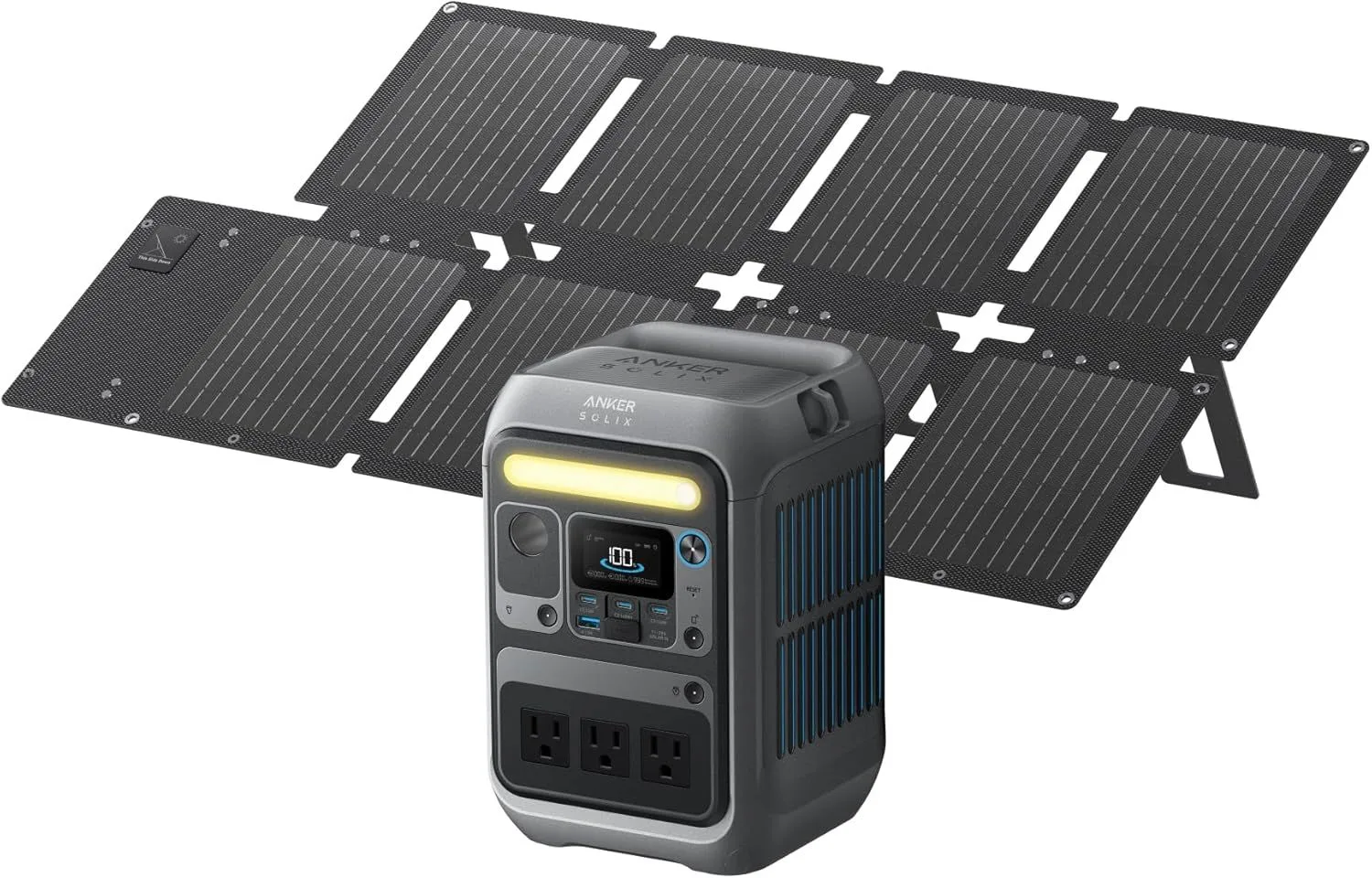
The Anker SOLIX C300 wins on charging speed, silence, and brand trust. Refilling to 80% in under an hour from a wall outlet is a real advantage for between-stop road trips. But the 300W output ceiling makes it firmly a gadget-charging station, not a campsite power hub — and the BLUETTI Elite 30 V2 delivers double the output at the same capacity for less money.
Our review incorporates 2150+ Amazon ratings (as of 2026-01-31), 6 expert reviews including CNN Underscored, Bob Vila, and Battery Essence, plus comparison with 5 products in the Compact Portable Generators category. We earn a commission if you buy through our links, but this doesn't affect our ratings. Read our full methodology →
This review is based on analysis of 2150+ Amazon ratings, expert reviews, and comparison with products in the Compact Portable Generators category. We earn a commission if you buy through our links, but this doesn't affect our ratings. Read our full methodology →
The Brand Name That Starts on Your Desk
Before Anker made power stations, they made the USB-C charger in your bag, the Bluetooth speaker on your shelf, and the power bank in your pocket. Over 100 million charging products sold worldwide. When Anker enters a product category, they bring distribution channels, customer service infrastructure, and a warranty system that most portable power brands cannot match. The SOLIX C300 is Anker's compact portable entry — and it carries all of that institutional weight.
The specs position it at the top of the compact class: 288Wh LiFePO4 battery, 300W continuous output with 600W SurgePad, 80% charge in 50 minutes from a wall outlet, 25dB whisper-quiet operation, a bundled 60W solar panel, 140W two-way USB-C, and a 5-year warranty. Our sizing guide explains how to match watt-hours to your actual power needs. At premium, the C300 commands the highest price in the compact category — and Anker's argument is that brand trust, build quality, and the included panel justify that premium.
But the 2150+ Amazon reviews tell a more nuanced story. The C300 excels in specific use cases — CPAP users, quiet environments, road trips — while falling short in others. The 300W output ceiling, the restrictive solar panel compatibility, and the weight-to-power ratio all create trade-offs that prospective buyers need to understand before committing to the Anker premium.
25 Decibels: The Silence That Changes Everything
Twenty-five decibels. That is quieter than a whisper. Quieter than the ambient hum of a library. Quieter than the sound of breathing in a still room. Battery Essence tested the SOLIX C300 at various loads and confirmed it operates at "whisper-quiet" levels — the fan engages so gently at low-to-moderate loads that you need to put your ear against the unit to detect it.
For most portable power station use cases — outdoor camping, tailgating, garage workbenches — noise is irrelevant. Ambient sound masks any fan noise. But for two specific use cases, the C300's silence is a genuine differentiator that no competitor matches.
CPAP Users: The Bedside Power Station
CPAP machines draw 30-60W and run for 6-8 hours per night. The patient needs the power station within arm's reach, operating all night, in a bedroom. Every other compact portable has a fan that cycles audibly under load — a click-whir pattern every few minutes that disrupts sleep. The SOLIX C300 at 25dB is quieter than the CPAP machine itself. It sits on the nightstand and does its job without announcing its presence.
At 288Wh, the C300 provides 5-7 hours of CPAP runtime through the DC port (bypassing the inverter for better efficiency). That covers one full night for most CPAP configurations. The 60W solar panel can recharge during the day at a campsite, enabling multi-night camping trips without wall outlets. For CPAP users, this is the most complete solution in the compact class.
Is the Anker SOLIX C300 good for CPAP machines?
The SOLIX C300 is one of the best compact portables for CPAP use. The 25dB operating noise is quieter than most CPAP machines themselves. Battery Essence confirmed it runs "genuinely whisper-quiet" during nighttime use. At 288Wh, expect 5-7 hours of CPAP runtime using a DC adapter (bypassing the inverter saves roughly 15% energy). A 40W CPAP gets about 6 hours; a 60W unit with humidifier gets about 4 hours. The 60W solar panel can recharge during the day for multi-night camping trips.
Remote Workers: The Silent Office Companion
Shared workspaces, video calls, quiet home offices. Any environment where a cycling fan would be picked up by a microphone or noticed by a colleague. The C300 charges laptops through its 140W USB-C port while maintaining silence that a high-end office UPS cannot match. Bob Vila confirmed that the C300 powered a laptop and phone for a full work week on a single charge with 32% remaining — a testament to the efficiency of the 140W USB-C connection.
How quiet is 25dB in real terms?
For reference: a quiet whisper is about 30dB. A library is about 40dB. Normal conversation is 60dB. The Anker SOLIX C300 at 25dB is quieter than a whisper — you would need to put your ear against the unit to hear any noise at light loads. This makes it the only compact portable we tested that produces no perceptible noise during bedside CPAP use, tent charging, or quiet office environments.
What the C300 Gets Right
- Fastest AC charging in class — 80% in 50 minutes verified by CNN Underscored and Bob Vila, 5x faster than Jackery 300
- Whisper-quiet at 25dB — Battery Essence confirmed it is "genuinely whisper-quiet," ideal for bedside CPAP and quiet tent use
- 140W two-way USB-C eliminates laptop chargers — Bob Vila ran a laptop and phone for a full week on one charge with 32% left
- 60W solar panel included with 5-year warranty from Anker — the most trusted brand name in portable power under $250
What Holds It Back
- 300W output limits appliance compatibility — the BLUETTI Elite 30 V2 delivers 600W continuous from the same 288Wh for $30 less
- Solar panel compatibility is restrictive — Anker warns panels over 100W cause device malfunction, and their own PS200/PS400 panels are incompatible
- At 9 lbs with only 300W output, weight-to-power ratio is poor compared to the 600W BLUETTI Elite 30 V2 at 9.48 lbs
- The 60W included panel provides slow solar charging — 4-5 hours for a full charge vs. competitors accepting 200W input
Road Trips and Weekend Getaways: The Portable Use Case
The SOLIX C300 weighs approximately 9 lbs and measures 9.8 x 7.9 x 8.4 inches. That is small enough to slide behind a car seat, sit in an overhead airplane bin (TSA permits lithium batteries under 300Wh for carry-on), or fit inside a standard cooler bag with room to spare. For weekend road trips, the C300 occupies less trunk space than a small backpack and provides enough power for two days of phone, tablet, and camera charging without touching the car's electrical system.
The 12V car charging input adds flexibility for long drives. Plug the C300 into the car's 12V socket and it trickles back to full over 4-5 hours of driving. That means a road trip pattern of "use the station at the campsite, recharge while driving to the next stop" keeps the C300 perpetually topped off without needing a wall outlet. For multi-day road trips through areas without reliable power — BLM land, national forest dispersed camping, remote trailheads — the combination of car charging during transit and the bundled 60W solar panel during the day creates a self-sustaining power loop.
Build quality reflects Anker's hardware roots. The shell is a dense ABS plastic with rubberized corner bumpers. The handle is integrated into the top, not a flimsy afterthought. The display is a clear LCD showing input/output wattage, battery percentage, and estimated runtime. The buttons have a firm click with no wobble. In a class where most competitors feel like injection-molded boxes with ports, the C300 feels like a product that went through multiple engineering revisions before shipping.
The 50-Minute AC Recharge: Fast, But Not the Fastest
CNN Underscored and Bob Vila both verified the SOLIX C300's wall charging claim: 80% in approximately 50 minutes. From dead flat to full takes about 70 minutes total. That is fast — roughly 5x faster than the Jackery Explorer 300's 4-hour wall charge time, and competitive with the class-leading BLUETTI Elite 30 V2's 45-minute turbo to 80%.
The practical difference between 45 minutes and 50 minutes to 80% is negligible. Both are fast enough to replenish during a lunch stop, a hotel check-in, or a laundromat visit. The Anker's charging curve follows a similar pattern to the BLUETTI: aggressive input for the first 50 minutes, then tapered current to protect cell longevity during the final stretch. The BMS manages thermal throttling automatically — the unit gets warm but stays within safe operating parameters.
For road trippers who refuel between stops, the 50-minute charge window eliminates charging as a planning constraint. Stop for food, plug in, drive away full. The wall charging speed is one of the SOLIX C300's strongest specs, and it pairs well with the brand's reputation for charger quality — Anker knows power delivery better than almost anyone in the market.
The 300W Ceiling: Where the Anker Hits Its Limit
Here is where the SOLIX C300 stumbles. At 288Wh capacity and 300W continuous output, the C300 matches budget units costing $100 less on output power. The BLUETTI Elite 30 V2 — at the same 288Wh capacity and a lower price — delivers 600W continuous. That is double the output from the same energy storage.
The 300W ceiling means the SOLIX C300 cannot run small appliances that the BLUETTI handles without issue. Electric kettles, personal blenders, rice cookers, small heaters — anything in the 400-600W range is off-limits. The 600W SurgePad handles brief startup spikes, but sustained draws above 300W trip the overload protection.
For gadget charging — phones, tablets, laptops, cameras, drones, LED lights, CPAP machines — 300W is more than sufficient. None of these devices approach 300W. But the moment you want to do more than charge gadgets, the 300W limit forces a choice: stay within the line, or look at the BLUETTI that delivers twice the power for less money.
The weight-to-power ratio problem: The SOLIX C300 weighs approximately 9 lbs and delivers 300W continuous. The BLUETTI Elite 30 V2 weighs 9.48 lbs and delivers 600W continuous. That is 33W per pound for the Anker versus 63W per pound for the BLUETTI. On a pure efficiency basis, the BLUETTI extracts double the output from nearly identical weight. The Anker's advantage is silence and the included panel — not raw power efficiency.
Is the 300W output a problem for the Anker SOLIX C300?
For phone, tablet, and laptop charging — no. For CPAP, LED lights, and USB devices — no. Our <a href="/guides/solar-generator-sizing-guide/">sizing guide</a> explains how to match output to your gear. The 300W limit becomes a problem if you want to run small appliances: mini fridges with high compressor start-up, electric kettles, personal heaters, or 500W+ power tools. The BLUETTI Elite 30 V2 handles all of these at 600W continuous. If your use case stays within the gadget-charging tier, 300W is not a limitation. If you want appliance flexibility, it is.
Solar Panel Compatibility: An Unexpected Limitation
The bundled 60W panel is a welcome inclusion — most competitors in the $100–$250 range either include no panel (BLUETTI Elite 30 V2) or include a smaller 40W panel (EBL 300W). The 60W panel provides adequate solar charging for the 288Wh battery: roughly 4-5 hours from empty in good sun.
The problem emerges when you try to upgrade. The SOLIX C300 accepts a maximum of 100W solar input via its XT60 connector. Anker explicitly warns that panels exceeding 100W can cause "device malfunction." Their own larger panels — the PS200 (200W) and PS400 (400W) — are listed as incompatible with the C300. This means your solar upgrade path maxes out at 100W, limiting charge speed to about 2.5-3 hours for a full battery.
Compare this to the BLUETTI Elite 30 V2, which accepts up to 200W of solar input. A 200W panel charges the BLUETTI in about 2.2 hours — nearly twice as fast as the Anker's maximum solar input allows. For buyers planning to invest in a higher-wattage solar panel for future use, the Anker's 100W ceiling restricts that investment.
Can I use third-party solar panels with the Anker SOLIX C300?
With restrictions. The C300 accepts up to 100W of solar input via its XT60 connector (11-28V range). Panels between 60-100W with compatible connectors work fine. Anker explicitly warns that panels over 100W can cause device malfunction. Their own larger panels (PS200, PS400) are listed as incompatible. This limits your solar upgrade path — you cannot simply add a 200W panel later as you can with the BLUETTI Elite 30 V2.
The Anker vs BLUETTI Question
Every buyer in the 288Wh compact class faces the same fork: Anker SOLIX C300 or BLUETTI Elite 30 V2. Same capacity. Same LiFePO4 chemistry. Same 3,000+ cycle life. Same 5-year warranty. The Anker costs about $30 more and includes a 60W panel. The BLUETTI costs $30 less with no panel but delivers double the output.
Choose the Anker if: you need whisper-quiet operation for CPAP or bedroom use, you want a bundled solar panel in the box, you value Anker's customer service infrastructure, and your loads stay under 300W. The Anker is the better choice for CPAP users, remote workers in quiet spaces, and buyers who want a complete kit without add-on purchases. See our full Anker C300 vs BLUETTI Elite 30 V2 comparison for the detailed breakdown.
Choose the BLUETTI if: you need to run small appliances beyond basic charging, you want app control and UPS switchover, you will buy a 200W solar panel separately, and you prioritize raw output per dollar. The BLUETTI is the better choice for apartment dwellers, campsite power hubs, and tech-forward buyers who want maximum capability from a compact unit.
How does the Anker SOLIX C300 compare to the BLUETTI Elite 30 V2?
Both have 288Wh LiFePO4, 3,000+ cycles, and 5-year warranties. The BLUETTI wins on output (600W vs 300W), turbo charging (80% in 45 min vs 50 min), and app control. The Anker wins on silence (25dB vs louder under load), included solar panel (60W vs none), and brand trust. The Anker costs about $30 more but includes the panel. If output power matters, get the BLUETTI. If quiet operation and solar capability matter more, get the Anker.
Is the Anker Brand Premium Worth It?
The Anker SOLIX C300 is the most expensive compact portable in our catalog, and it does not deliver the most power. The BLUETTI Elite 30 V2 outputs twice the wattage at a lower price. Budget kits from EBL and Apowking cost half as much. On raw specs-per-dollar, the Anker loses to multiple competitors.
But specs-per-dollar ignores what the Anker actually delivers. The 25dB operating noise is unmatched — no other compact portable comes close to this level of silence. The included 60W panel eliminates a $60-80 add-on purchase. The 5-year warranty and Anker's support network mean that a problem at month 36 gets resolved, not ignored. The 80% charge in 50 minutes means wall charging is never a constraint. And the 2150+ Amazon reviews represent the largest customer-verified sample in the compact class.
The Anker SOLIX C300 is the right compact portable for buyers who prioritize silence, brand support, and a complete out-of-box solution — and whose power needs stay within the 300W gadget-charging tier. It is the wrong choice for buyers who need appliance-level output, maximum solar input, or the lowest price per watt-hour. Know which buyer you are, and the decision makes itself.
The Anker SOLIX C300 wins on charging speed, silence, and brand trust. Refilling to 80% in under an hour from a wall outlet is a real advantage for between-stop road trips. But the 300W output ceiling makes it firmly a gadget-charging station, not a campsite power hub — and the BLUETTI Elite 30 V2 delivers double the output at the same capacity for less money.
Best for: CPAP users, road trippers, and remote workers who value ultra-fast AC recharging, whisper-quiet operation, and a trusted brand
Anker SOLIX C300 — Buyer Questions
Does the Anker SOLIX C300 have a warranty and customer support?
Anker provides a 5-year warranty — the longest in the compact portable class, tied with BLUETTI. Anker customer support is available through phone, email, and live chat with US-based representatives. Their service infrastructure is among the best in the portable power industry, built on the back of their massive charging accessories business. Replacement parts and repair service are available through their website.