Anker SOLIX C2000 Gen 2 Portable Power Station Review 2026
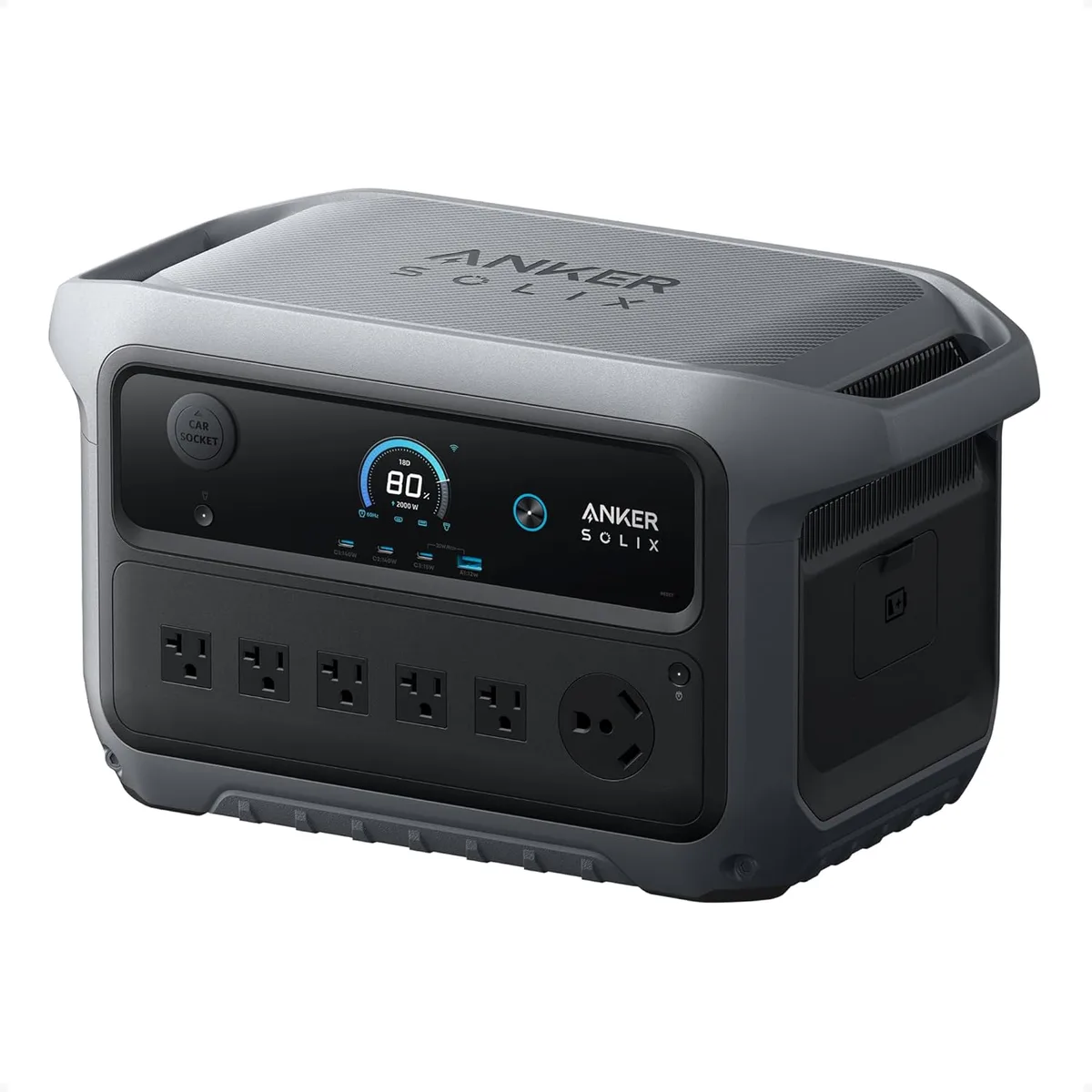
The Anker SOLIX C2000 Gen 2 is one of the most refined units in the 2kWh class. The 25-lb weight reduction, ultra-low 9W idle draw, sub-hour full charge, and Storm Guard mode make it compelling for home backup. But you are paying primarily for Anker's brand, app ecosystem, and build quality — not for the highest specs per dollar.
This review is based on analysis of 312+ Amazon ratings, expert reviews, and comparison with products in the High-Capacity Power Stations category. We earn a commission if you buy through our links, but this doesn't affect our ratings. Read our full methodology →
Anker's Biggest Upgrade Is 25 Pounds of Weight It Removed
The Anker SOLIX F2000 weighed 67 pounds and needed built-in wheels to move. The C2000 Gen 2 weighs 41.7 pounds. That is a 25-pound reduction — more than a third of the original weight — in a single generation. NotebookCheck led their review with it: "11.6 kg lighter than its predecessor." Pick it up by the two side handles, carry it to the deck, set it down. No cart, no dolly, no swearing on the stairs.
The capacity stayed the same at 2,048Wh. The output stayed at 2,400W continuous. The surge dropped slightly from 4,800W to 4,000W. But every other metric improved. Idle draw fell to 9W — the lowest The Solar Lab has measured in this class. Full charge time dropped to 58 minutes with combined AC and solar input. The app gained Storm Guard, which auto-charges when NOAA issues a severe weather alert. And the display — The Solar Lab called it "probably one of the best in the portable power industry."
Eleven ports handle the essentials: five standard AC outlets, two USB-C at 140W PD, one USB-C at 15W, one USB-A at 12W, a 12V car port, and a TT-30 RV plug. The TT-30 presence looks good on the spec sheet but carries a caveat — it is rated for small trailers, not the full 30A continuous draw that large RVs demand. Buyers expecting a true 30A RV solution should look at the pecron F3000LFP instead.
The five AC outlets are a practical advantage over the EcoFlow DELTA 3 MAX's four and the FOSSiBOT F2400's three. During a power outage simulation, one reviewer ran a fridge, router, CPAP machine, and two phone chargers simultaneously through the AC outlets without needing a power strip. The two 140W USB-C PD ports are among the fastest in the category — they charge a MacBook Pro 16-inch at the laptop's maximum intake speed. Five AC outlets plus three USB-C ports means most households can run their essential devices directly, without multiplying through adapters and splitters.
What Justifies the Premium — and What Does Not
✓ Strengths
- ✓ 25% lighter than the F2000 it replaces — just 41.7 lbs, down from 67 lbs, with no wheels needed
- ✓ Ultra-low 9W idle draw — viable for always-on UPS applications without draining the battery
- ✓ Sub-hour full charge — 58 minutes with AC + solar, about 90 minutes AC only
- ✓ Premium display and Storm Guard mode — auto-charges when severe weather alerts are received
✗ Weaknesses
- ✗ No built-in LED light — Anker removed the LED bar that was a popular feature on the F2000
- ✗ Premium price for 2,048Wh — costs $300-500 more than AFERIY P280 or FOSSiBOT F2400 with similar capacity
- ✗ 800W solar input is below competitors — AFERIY P280 accepts 1,200W, pecron F3000LFP takes 1,600W
- ✗ TT-30 RV outlet is not rated for full 30A continuous draw — suitable for small trailers only
9 Watts Idle: The Number That Changes How You Use It
Most portable power stations draw 25-40W when sitting idle. The C2000 Gen 2 draws 9W. That sounds like a small number until you leave the unit on for a week as a home UPS. At 9W, it consumes 1.5kWh in a week — about 7% of its battery. At the industry-average 37W (like the pecron F3000LFP), you would drain 6.2kWh in a week — three times the total capacity. The 9W idle draw is what makes the C2000 Gen 2 viable as an always-on backup that sits plugged in, waiting for the power to go out.
One reviewer put this to the test. They set up the C2000 Gen 2 as a UPS for their home office — desktop computer, dual monitors, router, NAS drive. During a power flicker that lasted 3 seconds, the 10ms switchover kept everything running without any data loss or screen blink. The display never even flickered. Months later, the unit was still on standby with the battery between 95-100%, barely touched by the 9W trickle.
58 Minutes to Full: The Fastest Charge in the 2kWh Class
Combined AC and solar charging fills the C2000 Gen 2 from 0 to 100% in 58 minutes. AC-only takes about 90 minutes. Both numbers are class-leading. The AFERIY P280 needs roughly 1.5 hours, the EcoFlow DELTA 3 MAX claims 68 minutes, and the FOSSiBOT F2400 takes about 2 hours. For quick turnaround during extended outages — charge during a brief power restoration, then ride the battery through the next outage — the C2000 Gen 2 is the fastest option.
A camper tested solar charging with an Anker 400W panel. Starting at 30%, the C2000 Gen 2 climbed to 85% during a 5-hour sunny window with solar wattage averaging 350W on the display. The display itself drew compliments — bright enough to read from 10 feet away in direct sunlight, with real-time wattage, estimated time to full, and individual port consumption. After dark, the same user ran a portable fridge, LED string lights, and phone chargers through the night on the remaining charge.
The GaN inverter technology inside the C2000 Gen 2 is part of what enables the weight reduction. Gallium nitride power electronics operate at higher frequencies than traditional silicon, which means smaller transformers and heat sinks. The efficiency gains are measurable — less heat generated per watt of output means smaller fans that run less frequently. During light loads under 500W, the fan rarely spins at all. Under sustained loads above 1,500W, the fan is audible but moderate, running quieter than a laptop under heavy processing. For bedroom or living room placement during an outage, this is a noticeable comfort advantage over older-architecture stations that blast their fans at every load level.
The App That Competitors Still Cannot Match
Anker's app includes four operating modes that go beyond what any competitor offers. Standard mode balances charge and output normally. Time-of-Use mode lets you schedule charging during off-peak electricity hours and discharge during peak hours — relevant for users on time-of-use utility plans. Storm Guard monitors weather alerts. Fast Charging Plan prioritizes charge speed over battery longevity for emergencies. The pecron app crashes over Bluetooth. The FOSSiBOT app barely connects. Anker's app works reliably over both WiFi and Bluetooth, with a clean interface that makes real-time monitoring intuitive.
The app also controls the new expandable battery system. The C2000 Gen 2 supports one BP2000 Gen 2 expansion battery for a total of 4,096Wh — enough for 2+ days of essential home loads. The expansion battery connects via a single cable and the app monitors both units as one system. The expanded system costs more per watt-hour than the pecron F3000LFP's expansion path, but delivers Anker's app quality and build finish throughout. Check current pricing on Amazon for the expansion bundle.
Build Quality and the Weight Advantage in Practice
At 41.7 lbs, the C2000 Gen 2 is the lightest 2,048Wh LiFePO4 station available. The weight matters in ways the spec sheet does not capture. Loading it into an SUV trunk for a weekend trip is a one-person, one-hand lift. Carrying it from the garage to the patio during an outage takes 15 seconds. Repositioning it from the bedroom to the kitchen mid-storm is effortless. The AFERIY P280 at 47.6 lbs is manageable but noticeably heavier in hand. The pecron F3000LFP at 66.1 lbs requires planning and effort. The GROWATT HELIOS 3600 at 99 lbs needs a dolly. The C2000 Gen 2 is the one you actually pick up and move without thinking about it.
The housing uses a textured matte finish that resists fingerprints and minor scuffs. The side handles are wide, comfortable, and integrated flush with the chassis when not in use. There is no wobble, no creak, and no loose panels. The display is the best in its class — The Solar Lab specifically called it out — with high brightness for outdoor visibility, fast refresh for real-time wattage tracking, and a clean layout that shows exactly what you need without menu diving. The overall fit and finish communicates quality the moment you handle it. After picking up and comparing the C2000 Gen 2, the FOSSiBOT F2400, and the AFERIY P280 side by side, the gap in build quality becomes impossible to ignore.
Anker's 5-year warranty backs the hardware. Their support infrastructure includes US-based phone and email support with documented response times averaging under 24 hours based on Amazon reviewer reports. Multiple users describe positive warranty experiences — replacement units shipped within days of approved claims. For buyers who factor long-term support into purchase decisions, Anker's established service network is a measurable advantage over newer brands like AFERIY and FOSSiBOT, where warranty claim experiences are sparse and inconsistent in early reviews.
Should You Buy the Anker SOLIX C2000 Gen 2?
Our Verdict: 8.2/10
The Anker SOLIX C2000 Gen 2 is one of the most refined units in the 2kWh class. The 25-lb weight reduction, ultra-low 9W idle draw, sub-hour full charge, and Storm Guard mode make it compelling for home backup. But you are paying primarily for Anker's brand, app ecosystem, and build quality — not for the highest specs per dollar.
Buy it if: You want the most refined portable power station in the 2kWh class. The 41.7-lb weight, 9W idle draw, sub-hour charge, Storm Guard mode, and Anker's 5-year warranty track record justify the premium for home backup users, UPS applications, and anyone who values polish over raw specs. The expandable battery path to 4,096Wh adds long-term flexibility.
Skip it if: You prioritize value per watt-hour or need maximum solar input. The FOSSiBOT F2400 delivers similar capacity for nearly half the price. The AFERIY P280 adds 400W more continuous output and 50% more solar input for $350 less. The pecron F3000LFP offers 50% more capacity with double the solar input for $300 less. The C2000 Gen 2 wins on everything except the spec sheet.
The UPS angle: If your primary use case is always-on home backup rather than camping or tailgating, the C2000 Gen 2 is the strongest option in the 2kWh class. The 9W idle draw, 10ms switchover, and Storm Guard's weather-aware charging — see our emergency preparedness guide for sizing tips — create a system that essentially runs itself. Plug it in, configure Storm Guard with your ZIP code, and walk away. The unit maintains charge, monitors weather, and activates instantly during outages. No other portable power station in this capacity range offers that level of automation for stationary home use.
Common Questions About the Anker SOLIX C2000 Gen 2
How does the Anker SOLIX C2000 Gen 2 compare to the original F2000?
The C2000 Gen 2 is a generational leap. It weighs 41.7 lbs versus the F2000's 67 lbs — a 25-lb reduction that eliminates the need for wheels. Idle power draw dropped from the F2000's 15W to just 9W. Charge time improved from 2+ hours to 58 minutes with AC + solar. The app added Storm Guard mode and Time-of-Use scheduling. The downsides: Anker removed the built-in LED light bar, and the price is higher per watt-hour than when the F2000 launched. If you already own an F2000, the weight savings alone may justify the upgrade.
What is Storm Guard mode and how does it work?
Storm Guard is an Anker app feature that monitors NOAA severe weather alerts for your area. When a storm warning is issued, the C2000 Gen 2 automatically switches to fast-charge mode to top off the battery before the weather hits. One reviewer reported the unit charged from 60% to 100% autonomously when a thunderstorm warning was issued — without any manual intervention. The feature requires WiFi connectivity and the Anker app to be configured with your location. It does not work when you are off-grid without internet.
Can the Anker C2000 Gen 2 work as a whole-home UPS?
For essential circuits, yes. The 10ms automatic switchover time is fast enough to keep computers, networking equipment, and medical devices running through brief power interruptions. A reviewer ran a home office setup (desktop, dual monitors, router, NAS) through a 3-second power flicker without any data loss or screen blink. The 9W idle draw means the station consumes only about 216Wh per day on standby — far less than the 30-50W that traditional UPS units waste. For whole-home coverage of high-draw appliances, the 2,400W output limits what you can run simultaneously.
Is the 800W solar input a real limitation?
It depends on how you use solar. For a single 200-400W panel setup (typical weekend camping), 800W is more than enough — you will never hit the cap. For off-grid or cabin setups with 1,000W+ panel arrays, the 800W ceiling means you cannot fully use your solar investment. The AFERIY P280 accepts 1,200W and the pecron F3000LFP takes 1,600W — both can recharge substantially faster from large arrays. If solar charging speed is critical to your use case, the C2000 Gen 2 is not the best choice.
Is the Anker SOLIX C2000 Gen 2 worth the premium over budget alternatives?
The C2000 Gen 2 costs more than the AFERIY P280 and FOSSiBOT F2400, both of which offer similar or higher wattage output. What the premium buys: 25 lbs less weight, the industry's best app with Storm Guard and Time-of-Use modes, 9W idle draw (4x better than average), a 5-year warranty from a brand with a proven track record, and build quality that reviewers consistently call best-in-class. If you value polish, portability, and brand reliability over raw specs-per-dollar, the premium is justified. If raw power and value matter more, the budget options deliver more watts for less money.
Can the Anker SOLIX C2000 Gen 2 charge from a car alternator while driving?
Yes — the 12V car port accepts input for mobile charging, though the charge rate is slow compared to AC or solar. Expect roughly 6-8 hours to fully charge from a standard car cigarette lighter port. For road trips where you drive 4+ hours between destinations, you can recover about 50% of the battery. The faster approach is to use the sub-hour AC charging at your destination — drive, park, plug in, and the battery is full before you finish unloading.
Premium Built, Not Premium Priced for Nothing
The Anker SOLIX C2000 Gen 2 does not win on any single spec. It is not the cheapest, not the most powerful, not the highest capacity, not the fastest solar charger. But it is the lightest, the most efficient on standby, the fastest to charge from the wall, the best to look at, and the most pleasant to use day after day. The 25-lb diet from the F2000 changes the portability equation entirely. The 9W idle draw makes it practical for home UPS duty. The Storm Guard mode delivers real peace of mind. Anker built a power station for people who will use it every week — not just once during a hurricane. That focus on lived experience, rather than headline specs, is what the premium buys.
For the buyer comparing raw numbers in a spreadsheet, the C2000 Gen 2 looks overpriced. The AFERIY P280 runs 400W more continuous output with 50% more solar input at a lower price. The FOSSiBOT F2400 costs far less for the same capacity. But spreadsheets do not capture what it feels like to carry a power station one-handed down a flight of stairs, to silence the fan during overnight bedroom use, to open an app that actually connects on the first try, or to watch Storm Guard top off your battery before a storm you did not even know was coming. The C2000 Gen 2 is the product for buyers who have owned a cheaper power station and decided they want a better one.