Anker SOLIX C1000 Portable Power Station Review 2026
The Anker SOLIX C1000 Gen 1 is the expandable option in the Anker C-series — the B1000 expansion battery doubles capacity to 2,112Wh, a feature the Gen 2 sacrificed for its lighter, faster design. If future growth matters, the Gen 1 is the smarter buy. But buyers who prioritize charging speed and weight should consider the newer Gen 2, which outperforms it on those metrics at a lower price.
This review is based on analysis of 2800+ Amazon ratings, expert reviews, and comparison with products in the Mid-Range Power Stations category. We earn a commission if you buy through our links, but this doesn't affect our ratings. Read our full methodology →
The Expandable Anker: C1000 Gen 1 Overview
The Anker SOLIX C1000 is the original mid-range workhorse from one of the most trusted names in portable power. At 1,056Wh with LiFePO4 chemistry and 1,800W continuous output (2,400W through the SurgePad outlet), it covers everything from camping to home backup with room to grow.
And that "room to grow" is the Gen 1's defining feature. The B1000 expansion battery doubles total capacity to 2,112Wh — the only Anker C-series model that supports this. For buyers who want to start modest and scale up as their power needs increase, the Gen 1 is uniquely positioned. Anker's newer Gen 2 is faster and lighter, but it gave up expandability entirely.
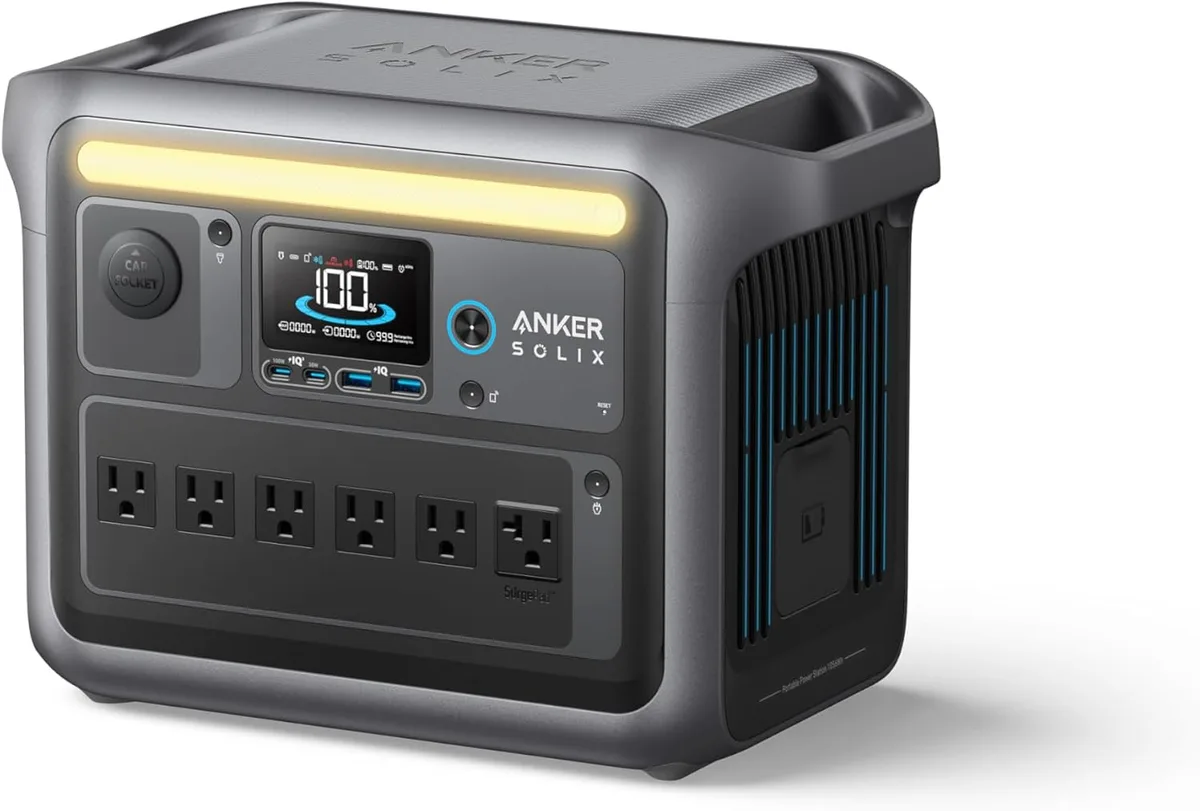
Six AC outlets with generous spacing — a practical detail that matters when you're plugging in bulky adapters. The SurgePad outlet handles demanding appliances that would trip the 1,800W limit, using voltage management to push up to 2,400W. A 58-minute UltraFast charge from wall power keeps downtime short.
The physical build is classic Anker — dense, well-assembled, with no panel flex when gripping the handles. At 25.5 lbs and 14.8 x 8.07 x 11.02 inches, it is slightly heavier and larger than the Gen 2 (24.9 lbs), but the difference is hard to notice unless you carry both side by side. The front-panel LCD shows battery percentage, input/output wattage, and estimated time to full charge or empty. The display is bright enough to read outdoors in daylight, which is more than can be said for the VTOMAN FlashSpeed 1500's dim screen or the FOSSiBOT F2400's basic readout.
Anker ships the C1000 with a 240W AC adapter, a car charging cable, and an XT-60 solar adapter. No solar panel is included — this is a bare station. If you want a bundled panel, the Jackery Explorer 1000 v2 or OUPES Mega 1 include panels in their box. Buying a separate 200W panel adds to the Gen 1's already-high price, which is the primary argument for competitors that bundle panels at lower total cost.
Strengths and Weaknesses
✓ Strengths
- ✓ Expandable to 2,112Wh with the B1000 battery pack — the only Anker C-series model that supports expansion
- ✓ SurgePad outlet handles up to 2,400W for demanding appliances like hair dryers and portable heaters via voltage management
- ✓ Six AC outlets with generous spacing eliminate the crowding issues common on competing mid-range stations
- ✓ Sub-60-minute full charge via UltraFast technology at 1,300W input — faster than most competitors in the tier
✗ Weaknesses
- ✗ At $649 MSRP, it costs $50 more than the Gen 2 which delivers faster charging, lighter weight, and higher continuous output
- ✗ 3,000 cycle life is the lowest tier in this lineup — OUPES, OUKITEL, and the Gen 2 all offer 4,000+ cycles
- ✗ Audible fan noise during charging and high loads — flagged by Outdoor Gear Lab, TechRadar, and The Drive
- ✗ Heavier at 25.5 lbs compared to the Gen 2 at 24.9 lbs, with a larger footprint at 14.8 x 8.07 x 11.02 inches
Charging Speed and Power Delivery
UltraFast charging pushes 1,300W from the wall and hits 80% in 43 minutes, with a full charge in 58 minutes. That is faster than the EcoFlow DELTA 2 (80 minutes) and the BLAVOR 1600W (3.5+ hours), though the Gen 2 beats it at 49 minutes flat. The 1,300W input generates noticeable heat — the unit's cooling system is doing real work during fast charging, and you can feel warmth radiating from the side vents. This is normal operation, not a defect, but it explains why the fans spin up aggressively during UltraFast mode.
Solar charging accepts up to 600W input at 60V maximum, matching the Gen 2's solar ceiling. With a 600W panel array, full recharges take around 1.8 hours — fast enough for a full cycle between morning and afternoon sun. The XT-60 connector works with most third-party solar panels, though the parallel adapter's exposed pin issue applies here too.
The 11-port layout covers all the bases: six AC outlets (five standard plus one SurgePad at 2,400W), two USB-A ports, two USB-C ports at 100W each, and one 12V car port. Port spacing on the AC side is generous enough for side-by-side power bricks without blocking adjacent outlets — a detail GearJunkie specifically praised.
One 100W USB-C port deserves attention. Laptop charging from a power station is not a given — many budget units cap USB-C output at 60W, which slow-charges a MacBook Pro and fails entirely for larger gaming laptops. Both of the C1000's USB-C ports deliver 100W, so a MacBook Pro 16-inch charges at full speed and a Dell XPS 15 draws its rated power without throttling. For remote workers running a laptop off-grid, this is a practical distinction that matters daily.
The 12V car port outputs at 10A, which limits accessories to 120W — enough for a 12V compressor fridge but not a 12V kettle or high-draw cooler. If 12V output matters to your setup, the pecron F3000LFP with its NEMA TT-30 RV plug and the VTOMAN FlashSpeed 1500 with Anderson connectors offer more 12V output options.
Real-World Use: Camping, Home Backup, and the Noise Factor
The C1000 Gen 1 handles weekend car camping with room to spare. A typical overnight draw — 12V fridge at 45W, LED strip at 15W, two phones charging at 20W total, and a Bluetooth speaker at 5W — pulls roughly 85W combined. At that rate, the 1,056Wh battery lasts about 10 hours before factoring in inverter losses. With a 200W solar panel topping up 500-700Wh during the day, you can camp indefinitely in summer conditions.
Home backup is where the Gen 1 holds its own. The 1,800W continuous output runs most household essentials — refrigerators (100-200W cycling), routers (10-15W), LED lighting (20-50W), and laptop chargers (60-100W). During a 6-hour outage, an Amazon reviewer ran their full kitchen refrigerator, a table lamp, a WiFi router, and kept two phones charged. The unit dropped to 38% — roughly 4 hours of additional capacity if the outage continued. For longer outages, the B1000 expansion battery doubles that endurance to over 20 hours of essential loads.
The noise, though. Multiple reviewers flagged it, and it is impossible to ignore. Under heavy AC load or during fast charging, the cooling fans spin up to a level that The Drive described as "noticeable from across the room." Outdoor Gear Lab measured similar noise to a running laptop fan at close range. You will not sleep beside this unit while it is charging at full speed — a limitation the Jackery Explorer 1000 v2 avoids entirely with its 30dB quiet mode. If night-time noise matters (van life, bedroom backup, apartment use), the fan volume is a real drawback that specs alone do not communicate.
Gen 1 vs Gen 2: The Expandability Question
The Gen 1 and Gen 2 share the Anker SOLIX name but serve different buyers. Our C1000 vs C1000 Gen 2 comparison covers every detail, but the short version: the Gen 2 charges faster (49 vs 58 minutes), weighs less (24.9 vs 25.5 lbs), pushes more continuous watts (2,000W vs 1,800W), and lasts longer (4,000+ vs 3,000 cycles). It also costs less at $599 versus $649.
But the Gen 2 cannot be expanded. Period. If you want to grow beyond 1,024Wh, you replace the entire unit. The Gen 1 accepts the B1000 battery and doubles to 2,112Wh — crossing into high-capacity territory without buying a second standalone station. For RV users, extended camping trips, or home backup planning, that growth path has real value.
Long-Term Value and Warranty
Anker's 5-year warranty is among the strongest in the mid-range tier. The brand's customer service reputation — responsive, US-based support — adds practical value that spec sheets don't capture. Multiple Amazon reviewers cite Anker's warranty handling as a reason for choosing this over less-known brands. One reviewer described a replacement process that took 4 business days from initial contact to receiving a new unit — the kind of turnaround you do not get from VTOMAN or FOSSiBOT.
The 3,000-cycle LiFePO4 battery translates to about 8.2 years of daily cycling before degrading to 80% capacity. That trails the Gen 2's 4,000+ cycles and the OUPES Mega 1's 4,000 cycles, but the B1000 expansion option partially offsets the shorter individual lifespan — you can add fresh capacity rather than replacing the entire unit.
The Anker app works over WiFi and Bluetooth, providing real-time monitoring, power scheduling, and automatic device disconnect when battery drops below a set threshold. App polish is a step above competitors like OUPES and OUKITEL, though EcoFlow still leads in app ecosystem depth. The scheduling feature is particularly useful for home backup — you can set the station to charge during off-peak electricity hours (typically 11 PM to 7 AM) and discharge during peak afternoon rates, which can reduce electricity bills in time-of-use rate areas.
One longevity concern: the 3,000-cycle rating means your battery loses 20% capacity in roughly 8 years of daily use. For occasional campers who cycle the battery 50-80 times per year, that extends the effective lifespan to 35-60 years — long enough that cycle degradation is irrelevant. The people who need to think about cycle life are daily-use power station owners: work-from-van professionals, full-time RV residents, and off-grid cabin dwellers. For those users, the Gen 2's 4,000+ cycle rating provides a 25-30% longer usable window before degradation becomes noticeable.
Who Should Buy the C1000 Gen 1?
Our Verdict: 7.8/10
The Anker SOLIX C1000 Gen 1 is the expandable option in the Anker C-series — the B1000 expansion battery doubles capacity to 2,112Wh, a feature the Gen 2 sacrificed for its lighter, faster design. If future growth matters, the Gen 1 is the smarter buy. But buyers who prioritize charging speed and weight should consider the newer Gen 2, which outperforms it on those metrics at a lower price.
Buy the Gen 1 if: You want the option to expand to 2,112Wh without replacing your station. The B1000 expansion battery turns the C1000 into a serious extended-use system for RV living, multi-day camping, or growing home backup needs. Anker's 5-year warranty and brand support add confidence.
Skip it if: You don't plan to expand. The Gen 2 is faster, lighter, more powerful, longer-lasting, and cheaper. Unless the B1000 expansion path matters to you, the Gen 2 is the better buy in the Anker C-series. Similarly, if your budget is fixed and you need a panel included, the Jackery Explorer 1000 v2 bundle or the OUPES Mega 1 bundle deliver a complete solar system for comparable or lower total outlay.
One scenario where the Gen 1 makes particular sense: renters and apartment dwellers who anticipate moving to a house with higher power needs. Buy the C1000 now for apartment-scale backup (1,056Wh covers a couple of essentials through a 6-hour outage), then add the B1000 when you move to a house and need to cover a full refrigerator, router, and lighting circuit for 12+ hours. Growing your system incrementally costs less upfront than buying a single high-capacity unit you do not need yet.
Common Questions About the Anker SOLIX C1000
Can the Anker SOLIX C1000 Gen 1 be expanded with extra batteries?
Yes — the Gen 1 supports the Anker B1000 expansion battery, doubling total capacity from 1,056Wh to 2,112Wh. This is one of its key advantages over the Gen 2, which removed expansion support to achieve a lighter, more compact design.
What is the SurgePad outlet and how does it work?
The SurgePad outlet is a dedicated AC outlet that uses voltage management to run appliances drawing up to 2,400W — higher than the standard 1,800W continuous rating. It achieves this by reducing voltage to the appliance. Hair dryers, portable heaters, and other high-draw devices that would trip the standard outlets can operate through SurgePad, though at slightly reduced performance due to the lower voltage.
How does the C1000 Gen 1 compare to the Gen 2 model?
The Gen 1 offers expandability (B1000 battery support) and six AC outlets versus the Gen 2's five. The Gen 2 counters with faster charging (49 vs 58 minutes), lighter weight (24.9 vs 25.5 lbs), higher continuous output (2,000W vs 1,800W), longer cycle life (4,000+ vs 3,000), and a lower price. Choose the Gen 1 if you need future capacity expansion; choose the Gen 2 for daily portability and speed.
How loud is the Anker SOLIX C1000 during operation?
Fan noise is noticeable during AC charging at full 1,300W input and when powering high-draw appliances. Multiple reviewers including Outdoor Gear Lab and TechRadar flagged this as a consideration. The cooling system works well — the unit runs cool — but it is not silent. Not the best choice for a nightstand or quiet bedroom setup.
Is the Anker SOLIX C1000 worth buying over cheaper alternatives?
At $649 MSRP, the Gen 1 is the most expensive mid-range option in our lineup. The OUPES Mega 1 bundle delivers comparable capacity with an included solar panel for about $150 less. The Gen 1's value proposition hinges on expandability and Anker's brand reliability with a 5-year warranty. If neither matters to you, budget alternatives offer more watts per dollar.
Can the Anker C1000 Gen 1 charge from a car cigarette lighter port?
Yes — the included car charging cable pulls about 100W from your vehicle's 12V port. A full charge takes approximately 10.5 hours from the car. This is a trickle charge best suited for topping up during long drives rather than a primary charging method. The solar and AC wall inputs are far faster for daily use.
Does the C1000 have pass-through charging?
Yes. The C1000 Gen 1 supports pass-through charging, meaning you can charge the station and power devices simultaneously. During a power outage, you can plug the station into a wall outlet when power returns and continue running your connected devices uninterrupted. Anker recommends limiting combined input and output to avoid excessive heat buildup, which may trigger the fan to run at higher speeds.
The Expandable Choice in Anker's Lineup
The Anker SOLIX C1000 Gen 1 remains the only expandable option in the Anker C-series — a real advantage for buyers who want to start at 1,056Wh and grow. Solid build quality, Anker's 5-year warranty, and 11 output ports make it a reliable mid-range station. The Gen 1's value lives squarely in the expansion path — the B1000 battery doubles capacity without replacing the entire unit, which no other Anker model offers.
For buyers already committed to the Anker ecosystem, the Gen 1 represents the growth-friendly option. For everyone else, the Gen 2 surpasses it on speed, weight, output, cycle life, and price. Make your decision on one question: do you foresee needing more than 1,056Wh within the next 2-3 years? If yes, the Gen 1 with its expansion capability is the smarter long-term play. If not, save money and buy the newer, faster Gen 2.