AFERIY P280 Portable Power Station Review 2026
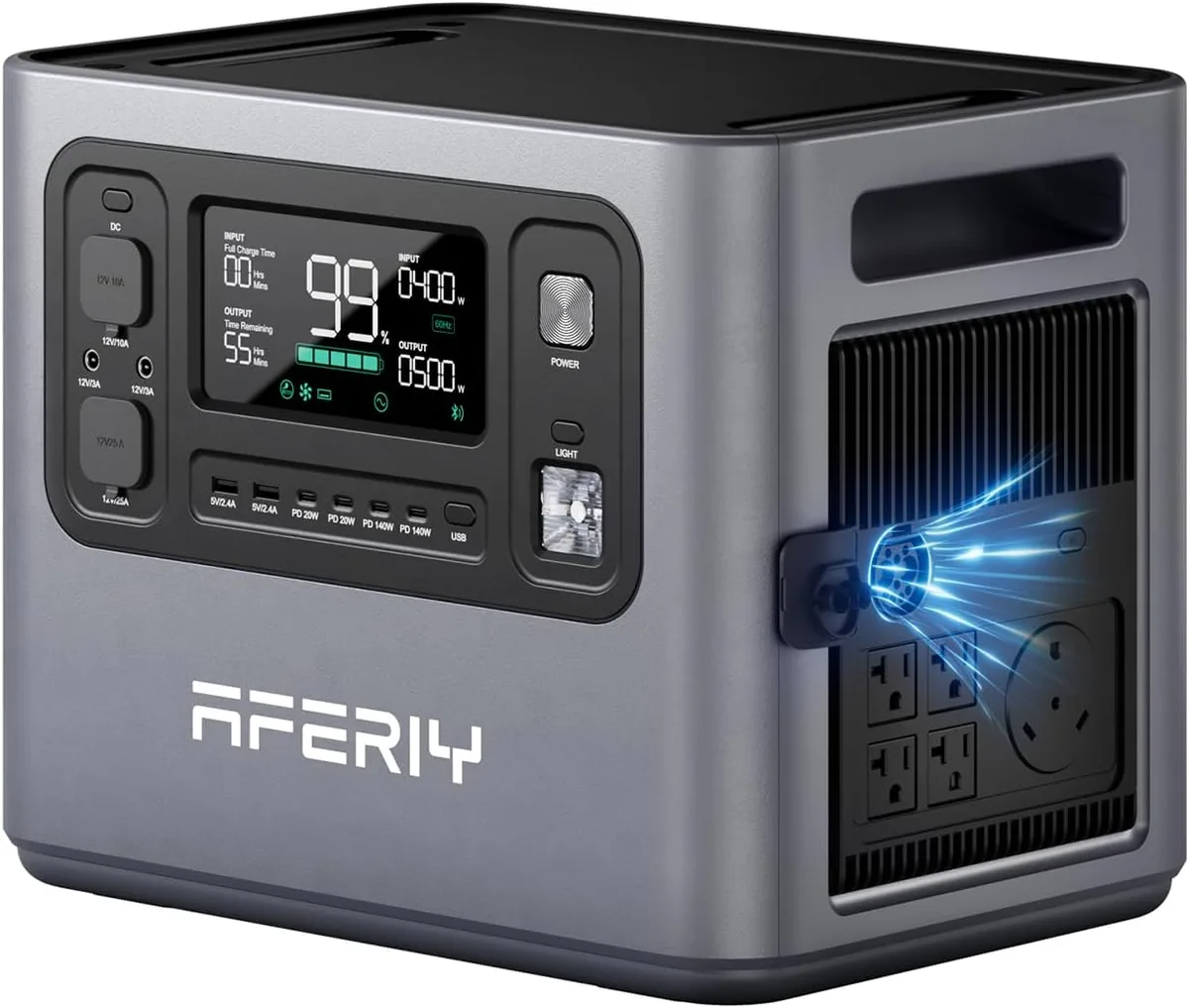
The AFERIY P280 is a serious contender for anyone who needs to run heavy appliances — its 2,800W inverter and 5,600W surge handle loads that would trip most 2kWh competitors. The dual 1,200W solar input and expandability to 10,240Wh make it a genuinely modular system. At under $740, it undercuts the Anker C2000 Gen 2 by over $350 while offering more raw power. The app issues and plastic button quality keep it from feeling truly premium, but the 7-year warranty provides meaningful reassurance.
This review is based on analysis of 156+ Amazon ratings, expert reviews, and comparison with products in the High-Capacity Power Stations category. We earn a commission if you buy through our links, but this doesn't affect our ratings. Read our full methodology →
2,800 Watts for Under $740 — Nobody Else Comes Close
The AFERIY P280 runs a 2,800W continuous inverter with 5,600W surge capacity. At the same 2,048Wh LiFePO4 battery size that Anker, FOSSiBOT, and EcoFlow all share, the P280 pushes 400W more continuous power and 1,600W more surge than the next-closest competitor in the high-capacity class. See how it measures up in our Anker F2000 vs AFERIY P280 head-to-head. That gap is not academic. A window air conditioner compressor that surges to 3,400W will trip a 2,400W station. The P280 absorbs it. A 2,000W space heater that overwhelms a FOSSiBOT F2400 runs without complaint on the P280.
TechRadar reviewed the expandability and called it a shift "from portable power station towards modular home energy backup territory." With up to 4 expansion batteries, total capacity scales to 10,240Wh — enough for 3-4 days of essential home loads. No other unit in this price class offers expansion past 4,096Wh. The P280 is the only sub-$800 station that can realistically serve as a foundation for a multi-day home backup system.
Fifteen ports cover nearly every scenario: three standard AC outlets rated for the full 2,800W, a NEMA TT-30 RV outlet, two USB-C at 140W PD, two USB-C at 20W, two USB-A at 12W, an XT60 DC port at 300W, two DC5521 barrels, and a car port. The dual MPPT solar controllers — two independent solar input ports, each optimizing its array separately — mean partial shade on one panel string does not drag down the other. At 1,200W max solar input, the P280 can recharge from panels alone in about 2 hours under optimal conditions.
The 140W USB-C PD ports are a standout. Most competitors cap USB-C at 100W — enough for laptops but slow for newer high-wattage devices. The P280's 140W ports charge a MacBook Pro 16-inch at maximum speed and support the latest USB PD 3.1 specification. For remote workers and content creators who depend on fast laptop charging in the field, this is a measurable advantage. The XT60 DC port at 300W also opens up direct-DC applications — drone battery charging stations, amateur radio setups, and 12V/24V equipment all benefit from bypassing the inverter entirely, saving 10-15% in conversion losses.
Raw Power Versus Rough Edges
✓ Strengths
- ✓ Highest inverter output in the 2kWh class — 2,800W continuous / 5,600W surge handles appliances that trip 2,400W competitors
- ✓ Expandable to 10,240Wh with up to 4 expansion batteries — scales from portable station to modular home energy backup
- ✓ Ultra-fast AC charging at 1,800W — reaches 80% in 38 minutes, full in about 55 minutes
- ✓ Industry-leading 7-year warranty — significantly longer than the 2-5 year warranties from competitors
✗ Weaknesses
- ✗ Bulky and heavy at 47.6 lbs — better suited to planned setups than spontaneous portable use
- ✗ iOS app has significant problems — NotebookCheck reported connection failures and unreliable monitoring
- ✗ Build quality concerns on controls — the power button uses faux-chrome plastic that does not feel durable
- ✗ Slow 12V car socket recharging — car charging is impractical for road trips without a separate high-wattage alternator charger
5,600W Surge: Running Appliances That Trip Everything Else
The surge capacity is not just a spec sheet number. During a 3-day off-grid RV trip, a user ran their RV air conditioner — startup surge around 3,400W — through the TT-30 outlet without the P280 flinching. Their previous 2,400W station could not handle the compressor kick. The 5,600W surge provides enough headroom for any single household appliance, and the 2,800W continuous output sustains high-draw loads (space heaters, power tools, hair dryers) that fall outside the comfort zone of 2,400W competitors.
A ham radio operator ran a full amateur radio station setup during a field day event — HF transceiver, amplifier drawing intermittent 800W peaks, laptop, and lighting. The dual solar input pulled 950W from two 600W panels on a partly cloudy day, keeping the battery above 60% through daytime operations. The dual MPPT controllers made the difference: when clouds partially shaded one panel array, the second MPPT controller kept its array operating at full output independently.
The App Problem and the Build Question
NotebookCheck documented "massive problems" with the iOS app, including connection failures and unreliable monitoring data. The app is not developed by AFERIY — it is a third-party product called Bright EMS. Android users report a functional but basic experience: real-time monitoring works, but no advanced features like scheduled charging, Time-of-Use optimization, or weather-triggered charge modes. If app quality matters to you — and it should for a home backup system — the Anker SOLIX C2000 Gen 2 has the best app in the business. The P280's app is its weakest link.
Build quality is a mixed story. The overall construction is solid — metal chassis, sturdy side handles, well-organized port layout. But TechRadar noted the power button uses faux-chrome plastic that "does not feel as durable as competitors' IP-rated buttons." The controls feel like they belong on a $300 unit, not a $740 one. This is a cosmetic concern more than a functional one — the station works — but it undermines confidence when everything you touch feels slightly cheaper than what Anker or EcoFlow deliver.
The idle power draw is another area where the P280 falls behind polished competitors. With the inverter active and no load attached, the P280 draws roughly 25W — enough to drain the entire 2,048Wh battery in about 3.5 days if you forget to turn it off. The Anker SOLIX C2000 Gen 2 idles at just 9W, lasting nearly three times as long on standby. For buyers who want to leave the unit plugged in as a home UPS, the P280's higher idle consumption matters. The workaround is simple — turn the inverter off when not in active use — but it adds a manual step that the Anker handles automatically with its more efficient power management.
Expansion to 10kWh: The Long-Term Play
Four expansion batteries bring the P280 system to 10,240Wh. For context, that is enough to run a refrigerator, router, lights, and phone chargers for 3-4 days without any solar input. With 1,200W of solar panels supplementing during daylight, the expanded system can sustain essential loads indefinitely in most climates. The expansion batteries connect with a single cable each and the system manages charge balancing automatically.
A fully expanded 10,240Wh system delivers a cost per watt-hour that is competitive with dedicated whole-home battery systems offering similar capacity. The pecron F3000LFP expands to 9,216Wh at a similar per-watt-hour cost, but starts with 50% more base capacity (3,072Wh). The Anker C2000 Gen 2 caps at 4,096Wh. Our sizing guide explains how to calculate your expansion needs — and for buyers building toward a multi-day backup system over time, the P280 has the best expansion ceiling in the market.
The expansion path also changes how you think about the initial purchase. Buying the P280 base unit is not a fixed commitment to 2,048Wh — it is entry into a modular system. Start with the base unit for weekend camping and road trips. Add one expansion battery when hurricane season approaches. Add a second when you move off-grid. The incremental cost is spread over months or years, making the total system price more digestible than buying a 6,000Wh+ unit upfront. Each expansion battery roughly doubles the prior capacity step, and the P280 handles charge distribution across all connected batteries without manual balancing.
Real-World Use Cases: Where the P280 Fits
RV boondocking is the P280's strongest use case. The TT-30 outlet connects directly to the RV's shore power inlet, delivering the same 30A/120V that a campground pedestal provides. An RV owner in Arizona ran their roof AC through the P280 during a summer boondocking trip — the 5,600W surge absorbed the compressor kick and the 2,800W continuous output sustained the AC at full blast. With two 400W panels on the roof feeding the dual MPPT inputs, the battery recovered enough during morning sun to repeat the cycle each afternoon. No generator noise. No fuel cost. No campground fees.
Home emergency backup is the second major use case. During a 36-hour ice storm outage in Tennessee, a family ran their refrigerator, a space heater on low (750W), LED lights throughout the house, and a WiFi router from the P280 base unit. The 2,048Wh battery lasted approximately 14 hours before needing a recharge. With a single expansion battery, that runtime would have stretched to 28+ hours — enough to outlast most weather-related outages without solar input. The 7-year warranty adds confidence for buyers who plan to keep the unit stored and ready for emergencies rather than cycling it daily.
Field work and mobile professional use is the third fit. Contractors, photographers, and event planners need sustained high-wattage power without the noise and fumes of gas generators. The P280 runs a 1,500W space heater in a construction trailer, powers professional lighting rigs for on-location shoots, and charges dozens of devices at events through its 15 ports simultaneously. The dual 140W USB-C PD ports handle laptop charging for two crew members at full speed — something single-USB-C units cannot do.
Should You Buy the AFERIY P280?
Our Verdict: 7.9/10
The AFERIY P280 is a serious contender for anyone who needs to run heavy appliances — its 2,800W inverter and 5,600W surge handle loads that would trip most 2kWh competitors. The dual 1,200W solar input and expandability to 10,240Wh make it a genuinely modular system. At under $740, it undercuts the Anker C2000 Gen 2 by over $350 while offering more raw power. The app issues and plastic button quality keep it from feeling truly premium, but the 7-year warranty provides meaningful reassurance.
Buy it if: You need the most inverter power in the 2kWh class and want expansion potential that goes far beyond what competitors offer. The 2,800W/5,600W output handles heavy appliances that trip 2,400W stations. The dual 1,200W MPPT solar input is best-in-class. The 7-year warranty is the longest available. And the expansion path to 10,240Wh makes this a genuine foundation for whole-home backup — not just a camping gadget.
Skip it if: App quality and build refinement matter to you. The iOS app has documented issues, the Android app is basic, and the power button feels cheap. The Anker SOLIX C2000 Gen 2 delivers a more polished experience — better app, lower idle draw, lighter weight — for $360 more. The pecron F3000LFP offers 50% more base capacity and a true 30A RV outlet for $60 more. If you do not need the 2,800W inverter or the 10kWh expansion ceiling, better options exist at every price point.
The long-term angle: AFERIY is betting you will buy the base unit now and expand later. Each expansion battery adds another 2,048Wh — and if your power needs grow over the next 3-5 years, you scale without replacing the entire system. No other station under $800 offers this growth path. For buyers who think in terms of 5-year energy plans rather than single-purchase decisions, the P280's expansion ceiling is its most compelling feature. The 7-year warranty signals AFERIY expects you to still be using this unit in 2033.
Questions About the AFERIY P280
Is AFERIY a reliable power station brand?
AFERIY is a newer entrant in the portable power market with products launching primarily in 2024-2025. TechRadar and NotebookCheck both reviewed the P280 with generally positive conclusions — TechRadar called the expandability "genuinely modular home energy backup territory." The 7-year warranty (2+5 with registration) is the longest in the category, which suggests confidence in the product. The main risk is app quality — the iOS app has documented issues — and the thinner customer support infrastructure compared to Anker or EcoFlow. For buyers who weigh raw specs and value over brand polish, AFERIY delivers.
Can the AFERIY P280 run a window air conditioner?
Yes — and this is where the 2,800W inverter and 5,600W surge matter. A standard 5,000 BTU window AC draws 450-600W continuous but surges to 2,000-3,500W when the compressor kicks on. The P280's 5,600W surge absorbs this without tripping. One reviewer ran their RV air conditioner (startup surge around 3,400W) successfully through the TT-30 outlet — something their previous 2,400W station could not handle. Most competing 2,400W stations will trip on the compressor surge of a large AC unit. The P280 handles it.
How does the dual MPPT solar input work?
The P280 has two separate solar input ports, each with its own MPPT (Maximum Power Point Tracking) controller. This means you can connect two independent solar arrays — for example, two 600W panel strings — and each MPPT controller optimizes its array independently. If one array is partially shaded, the other still operates at full efficiency. A ham radio operator reported pulling 950W from two 600W panels on a partly cloudy day. Single-MPPT competitors force all panels through one controller, where shading on one panel degrades the entire string.
How far can the AFERIY P280 expand?
The P280 supports up to 4 expansion batteries for a total of 10,240Wh — roughly 5x the base capacity. That is enough to run a home's essential circuits (refrigerator, lights, router, chargers) for 3-4 days. A fully expanded system delivers exceptional cost-per-watt-hour value for 10,240Wh of storage. TechRadar noted this expansion range "shifts the unit from portable power station towards modular home energy backup territory." No other unit in this price range offers the same expansion ceiling.
How does the AFERIY P280 compare to the Anker SOLIX C2000 Gen 2?
The P280 offers more raw power for less money: 2,800W vs 2,400W output, 5,600W vs 4,000W surge, 1,200W vs 800W solar input, and expandability to 10,240Wh vs 4,096Wh — all at a lower price. The Anker counters with 6 fewer pounds (41.7 vs 47.6 lbs), 9W idle draw (vs roughly 25W on the P280), a polished app with Storm Guard, and Anker's established brand reputation. If raw capability and expansion potential drive your decision, the P280 wins. If portability, app quality, and brand trust matter more, the Anker justifies its premium.
How loud is the AFERIY P280 during operation?
Fan noise is moderate — comparable to a laptop running under load. At low draws under 500W, the fans cycle on and off intermittently. At sustained loads above 1,500W, expect constant fan noise at roughly 45-50dB, which is audible indoors but not disruptive in a garage or outdoor setting. The EcoFlow DELTA 3 MAX at sub-25dB is noticeably quieter. For bedroom or quiet camping use, the P280 is not the best choice. For RV, workshop, or outdoor use, the fan noise blends into the background.
Maximum Power, Maximum Expansion, Minimum Polish
The AFERIY P280 is the power user's power station. It runs heavier loads than anything else in its class, charges faster from solar, expands further, and costs less than the premium brands — all backed by a 7-year warranty that suggests AFERIY knows what it built. You feel the missing polish every time you press the faux-chrome power button, every time the iOS app drops its connection, every time you lift 47.6 pounds out of the truck. But you also feel the raw capability every time a compressor kicks on without tripping the protection circuit, every time the dual MPPT controllers pull 950W from partially shaded panels, every time you check the expansion battery port and know you can scale to 10,240Wh when the need arises.
The 7-year warranty deserves specific attention. AFERIY offers 2 years standard plus 5 additional years with product registration — the longest warranty in the portable power station market. Anker and EcoFlow both offer 5 years. Most budget brands offer 2 years. The extended warranty signals either genuine confidence in the LiFePO4 battery durability or an aggressive market entry strategy — either way, the buyer benefits. For a unit positioned as a long-term home backup foundation that expands over time, the 7-year coverage reduces the risk of committing to AFERIY's ecosystem before the brand has a multi-year track record.