pecron F3000LFP vs GROWATT HELIOS 3600 (2026)
Bottom Line
The pecron F3000LFP is the smarter buy for most people — 3,072Wh and 3,600W output at a price roughly 33% lower than the Growatt. The GROWATT HELIOS 3600 earns its premium with more capacity (3,686Wh), 240V output, 2,000W solar input, and expansion to 36kWh. If you need 240V or plan to scale into a whole-home system, the Growatt is the only option here. For everything else, the pecron delivers more watts per dollar.
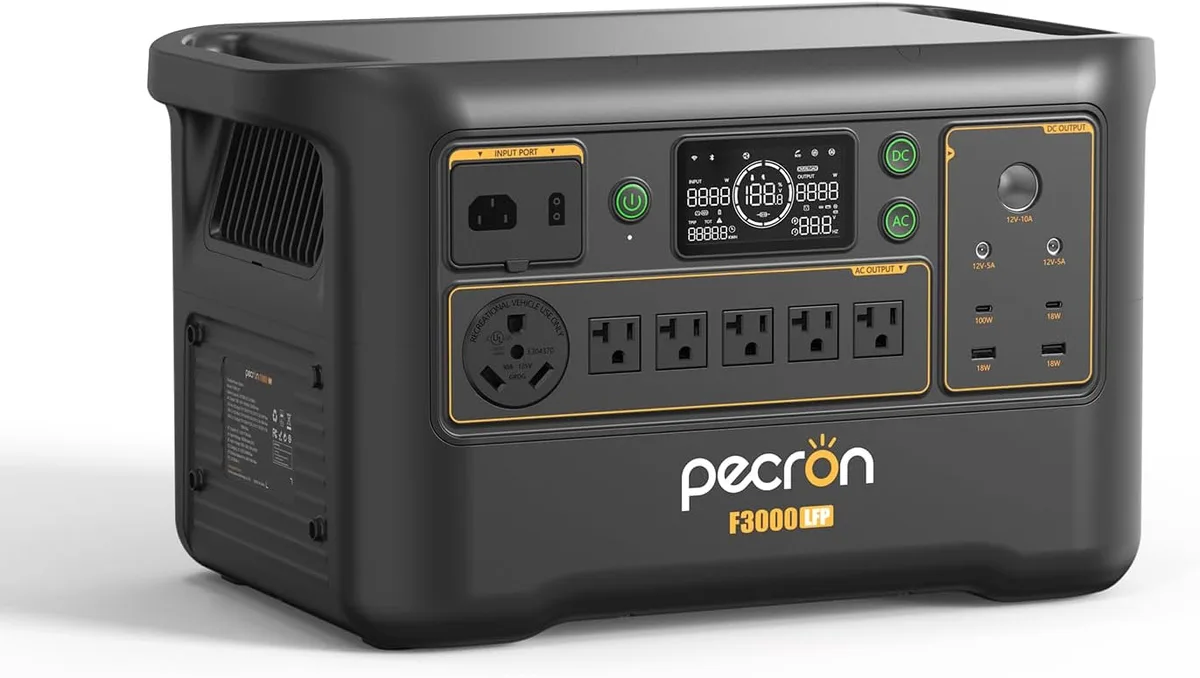
pecron F3000LFP
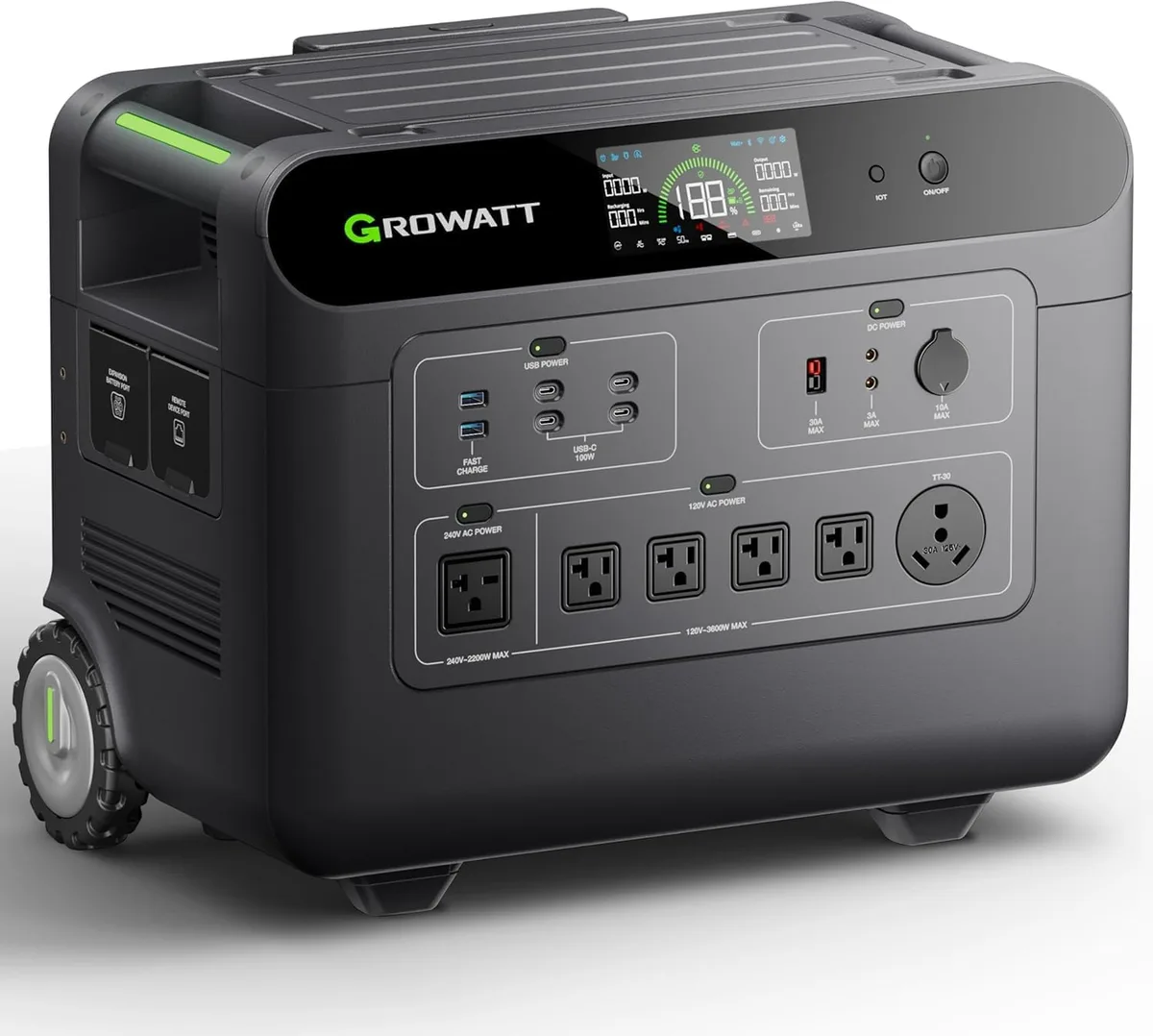
GROWATT HELIOS 3600
3kWh Budget King vs 3.7kWh Whole-Home Contender
These are the two heaviest hitters in our review lineup — and the two heaviest units, period. The pecron F3000LFP sits at top-tier investment with 3,072Wh of LiFePO4 power. The GROWATT HELIOS 3600 runs top-tier investment with 3,686Wh and dual-voltage output. Both deliver 3,600W continuous, both have true 30A plugs, and both weigh enough to discourage casual relocation.
The Growatt adds 20% more capacity, 240V output, 2,000W solar input, and expansion to 36kWh. The pecron counters with a 33% lower price, a more reasonable 63-lb weight, and efficiency numbers that hold up under sustained load. If you need 240V whole-home backup, the Growatt is the only option here. If portability and price-per-watt matter more, the pecron wins that contest decisively.
| Feature | pecron F3000LFP Portable Power Station | GROWATT HELIOS 3600 Portable Power Station |
|---|---|---|
| Price Range | $500+ | $500+ |
| Battery Capacity | 3,072Wh | 3,686Wh |
| Battery Type | LiFePO4 (51.2V 60Ah) | LiFePO4 (EV-grade) |
| Output Power | 3,600W continuous | 3,600W (120V/240V dual voltage) |
| Surge Power | 4,500W peak | 4,500W (Watt+) |
| Weight | 63.3 lbs | 99 lbs |
| Solar Input | 1,600W max (XT60 to MC4, 25-120V) | 2,000W max |
| Check Price | Check Price |
Capacity and Runtime: 3,072Wh vs 3,686Wh
The Growatt packs 614Wh more capacity — roughly 20% more than the pecron. In practical terms, running a 150W refrigerator continuously, the pecron lasts about 17 hours while the Growatt stretches to roughly 20 hours. That 3-hour gap matters during an extended outage but is invisible during a standard 8-hour power failure.
A cabin owner running a fridge, Starlink, router, and TV on the HELIOS 3600 reported 24-30 hours of runtime on a single charge. The pecron owner running a similar load would get roughly 20-25 hours. Both outlast a typical 8-12 hour outage easily — the Growatt just provides more margin for multi-day events where solar recharging may be limited by weather.
Where the capacity gap becomes meaningful: sustained high-draw appliances. Running a 1,500W space heater, the pecron delivers roughly 1.7 hours of heat before dying. The Growatt gives you about 2.1 hours. Neither is designed to replace your furnace for an entire night, but the Growatt's extra 614Wh buys roughly 25 more minutes of warmth — enough to keep a bedroom above freezing during a winter storm while waiting for morning light to start solar recharging.
GROWATT Wins 240V Output and the Whole-Home Question
The GROWATT HELIOS 3600 outputs both 120V and 240V. That single capability separates the two products more than any other spec. Well pumps, electric dryers, certain HVAC systems, and 240V welders all require 240V — the pecron simply cannot run them.
Growatt takes this further with parallel capability: two HELIOS 3600 units together deliver 7,200W at 240V. With expansion batteries, the system scales to 36kWh — genuine whole-home backup territory that competes with Tesla Powerwall installations at a fraction of the cost. The pecron expands to 9,216Wh with two EP3000-48V batteries, which is respectable but stays firmly in the "large portable" category.
For rural homeowners on well water, the 240V question is not optional. A typical submersible well pump draws 240V at 10-15A during operation, with startup surges reaching 30-40A for a fraction of a second. The Growatt's 240V NEMA TT-30 outlet handles this without any adapter or transfer switch required. The pecron cannot power a well pump under any configuration — no firmware update or adapter changes that limitation.
GROWATT Wins Solar Input: 2,000W vs 1,600W
The Growatt accepts 2,000W of solar input — the highest we have reviewed. The pecron takes 1,600W, which The Solar Lab confirmed at full capacity with a matching panel array. Both numbers are impressive. The question is whether that extra 400W makes a practical difference.
For a typical 2-4 panel setup (400-800W), both stations are equally fast since neither bottleneck kicks in. The Growatt's advantage appears only with large 5+ panel arrays producing over 1,600W — realistic for a permanent cabin installation with roof-mounted panels, but overkill for portable setups. If your solar array is under 1,600W, this spec difference is irrelevant.
The math gets interesting at scale. With a 2,000W rooftop array feeding the Growatt on a clear summer day (roughly 5 peak sun hours), you could harvest up to 10kWh — enough to fully charge the 3,686Wh battery almost three times. The pecron caps at 8kWh from the same day with its 1,600W limit. For off-grid cabins designed around solar as the primary power source, that 2kWh daily difference compounds into real capability over a cloudy week.
Both stations use MPPT charge controllers, and both accept up to 150V open-circuit voltage from solar panels. The Growatt's higher current acceptance (up to 30A vs the pecron's 25A) allows larger panel strings in parallel without exceeding the controller's limits. If you are planning a permanent solar installation, the Growatt provides more headroom for future panel additions without hitting the input ceiling.
pecron Wins Weight and Practical Portability
The pecron weighs 63 lbs. The Growatt weighs 99 lbs. That 36-lb gap is the difference between "heavy but one person can manage it" and "requires two people every time."
A contractor using the HELIOS 3600 at a remote job site noted the enlarged wheels and ergonomic handle help on flat ground. But getting it into a truck bed, up porch steps, or through a doorway is a two-person job regardless of the handles. The pecron at 63 lbs is still no featherweight, but one strong adult can lift it from the ground to a truck bed with effort. For any use case involving regular repositioning, the pecron's weight advantage is more relevant than the Growatt's extra 614Wh.
The dimensional footprint reinforces the portability gap. The pecron measures 21.1 x 11.1 x 13.2 inches — wide and boxy, but compact enough to sit behind the rear seat of a standard pickup truck cab. The Growatt is even bulkier. Its telescoping handle and integrated wheels suggest VTOMAN designed it to be rolled, not carried — but wheels only work on smooth, flat surfaces. Rolling a 99-lb station across a gravel driveway, up a flight of stairs, or across wet grass is an exercise in frustration. Several Amazon reviewers describe the wheels as "decorative" on anything other than pavement.
For RV owners, the weight difference translates directly into cargo capacity. A Class B van with 500 lbs of cargo capacity loses 20% of that budget to the Growatt versus 13% to the pecron. That 7% difference is a sleeping bag, a cooler, or a full water jug — gear you actually use on the trip. In a smaller travel trailer where every pound counts against tongue weight limits, the 36-lb gap matters even more.
AC Charging Speed and Input Infrastructure
The Growatt charges faster from AC — roughly 1.5 hours to full versus the pecron's 2.5 hours. That speed advantage comes from the Growatt's 3,600W AC input, which pulls more current than most household circuits are designed to deliver continuously. Multiple owners report tripping 20A breakers during full-speed charging, particularly when other appliances share the same circuit.
The pecron's AC charging is slower but gentler on your home wiring. Its lower draw charges to 80% in about 2 hours without stressing a standard 15A or 20A outlet. For homeowners without dedicated circuits for power station charging, the pecron's charge profile creates fewer problems. The Growatt may need a dedicated 30A circuit for reliable full-speed charging — an installation that adds cost and planning for renters or apartment dwellers who cannot modify their electrical setup.
Both stations support simultaneous AC and solar charging, but the practical limits differ. The pecron accepts 1,600W solar plus AC input simultaneously — in ideal conditions, reaching full from empty in under 90 minutes with panels and a wall outlet working together. The Growatt combines its 2,000W solar ceiling with 3,600W AC for a theoretical 5,600W combined input, though reaching that number requires an industrial-grade solar array and a dedicated high-amperage circuit running at the same time. For most real-world setups, combined charging on either station cuts recharge time by 30-40% compared to AC alone.
pecron Wins Price-to-Performance Value
The pecron F3000LFP delivers the lowest cost per watt-hour in the 3kWh class. The Solar Lab called it "a unit that beats power stations from more established and premium brands like Jackery and Anker." The Growatt costs roughly 25% more per watt-hour of stored energy — you are paying for 240V capability, higher solar input, and greater expandability.
Put differently: the pecron's price premium over a budget 2kWh station like the FOSSiBOT F2400 buys you an additional 1,024Wh of capacity and 1,200W of extra output power. The Growatt's premium over the pecron buys you 614Wh of extra capacity, 240V output, and 400W more solar input. The pecron's price-to-capability ratio is steeper at every comparison point.
Long-term cost of ownership tilts further toward the pecron. Both units use LiFePO4 batteries rated for 3,500+ cycles, so battery longevity is a wash. But the pecron's lower purchase price means a lower cost per cycle over the unit's lifetime. If you charge and discharge either station once per week for 10 years (520 cycles), the pecron's per-cycle cost sits well below the Growatt's. Only the Growatt's expansion capability offsets this — adding batteries later is cheaper than buying a second standalone unit.
Reliability Concerns and Idle Draw
The pecron F3000LFP draws 37W at idle — higher than modern competitors pulling single-digit watts. Over a 3-day weekend with no load, that drains roughly 2.6kWh passively — about 8% of the total battery. Not catastrophic, but noticeable for long-term standby applications where the unit sits charged and waiting for an outage.
The Growatt has its own concern: the included AC charging cable is only 14AWG. One user reported frying an extension cord and external outlet while charging at full wattage. Growatt should include heavier-gauge cables with a unit that draws up to 3,600W from the wall. If you buy the HELIOS 3600, budget for a 10AWG or 12AWG replacement cord before your first full charge.
Fan noise is another area where both units lag behind premium competitors. The pecron's cooling fans run at a noticeable volume under moderate-to-heavy load — not loud enough to wake a sleeper in the next room, but audible in a quiet living space. The Growatt is louder still, particularly during AC charging when the internal fans run at full speed to manage heat from the 3,600W charger. Neither unit is appropriate for a bedroom nightstand. If quiet operation matters, stations like the EcoFlow DELTA 3 MAX (sub-25dB) are in a different class entirely.
On build quality, the pecron feels solid for its price class. The chassis is metal with no flex, and the ports are well-spaced. The Growatt's build quality matches its higher price point — heavier-gauge housing, larger wheels for rolling on flat surfaces, and a telescoping handle. But the wheels are useless on stairs, gravel, or uneven ground. At 99 lbs, you carry the Growatt or you do not move it. The pecron has no wheels at all, which is actually more honest — at 63 lbs, you are going to pick it up and carry it regardless.
Who Should Get Which?
Get the pecron F3000LFP if you:
- Move your station regularly. At 63 lbs, one person can lift the pecron into a truck bed or carry it from a garage to a patio. The Growatt at 99 lbs requires help every time.
- Want maximum 120V power for the money. The pecron delivers 3,072Wh and 3,600W at a price that undercuts competing 2kWh stations from premium brands. No other 3kWh+ unit matches this cost-per-watt ratio.
- Run an RV or travel trailer. The true 30A NEMA TT-30 plug handles your RV air conditioner. At 63 lbs, the pecron can sit in a basement storage compartment. The Growatt would need its own dedicated spot and eat into your cargo weight limit.
- Use it as a construction jobsite backup. Contractors who work a different site each day need something one person can deploy. The pecron runs circular saws, compressors, and battery chargers all day, and fits in a standard truck bed alongside other gear.
Get the GROWATT HELIOS 3600 if you:
- Need 240V output. This is the dividing line. Well pumps, electric dryers, certain HVAC equipment, and high-power workshop tools all require 240V. The pecron cannot provide it under any configuration.
- Plan to build a whole-home backup system. The Growatt accepts up to 4 expansion batteries (18kWh per unit) and supports parallel operation (36kWh, 7,200W at 240V). If your goal is to replace a generator for multi-day outages, only the Growatt has the expansion runway.
- Have a permanent solar installation. The 2,000W solar input feeds from a 6-8 panel roof array without bottlenecking. The pecron's 1,600W limit means 2 fewer panels can contribute during peak production.
- Keep it in one location. At 99 lbs, the Growatt is essentially a semi-permanent appliance. If it lives in your garage, basement, or utility room and only needs to power your home during outages, the weight is irrelevant.
pecron F3000LFP vs GROWATT HELIOS 3600: Your Questions
Can the pecron F3000LFP run my RV air conditioner?
Yes. The F3000LFP's 3,600W continuous output and true 30A NEMA TT-30 plug handle RV air conditioners without adapters. The Solar Lab confirmed it ran a full 3,600W continuous load without tripping, and the 4,500W surge accommodates compressor startups. The GROWATT HELIOS 3600 handles the same load with identical 3,600W output and 4,500W surge — but weighs 36 lbs more doing it.
Which accepts more solar power?
The GROWATT HELIOS 3600 takes 2,000W of solar input — the highest of any station we have reviewed. The pecron F3000LFP accepts 1,600W, which is still impressive and was the class leader before the Growatt. For most practical setups with 2-4 panels, 1,600W is plenty. You need a 2kW+ panel array to take full advantage of the Growatt's ceiling.
Can I use 240V appliances with the pecron?
No. The pecron F3000LFP outputs 120V only. The GROWATT HELIOS 3600 outputs both 120V and 240V via its NEMA TT-30 outlet, and two units in parallel deliver 7,200W at 240V. If you need 240V for a well pump, dryer, or certain HVAC equipment, only the Growatt works.
How heavy is the Growatt compared to the pecron?
The GROWATT HELIOS 3600 weighs 99 lbs — two-person lift territory. The pecron F3000LFP is 63 lbs — still heavy, but manageable for one strong adult. The 36-lb gap makes the Growatt effectively a semi-permanent installation, while the pecron can still be loaded into a truck bed or repositioned by one person with effort.
Which has better expandability?
The Growatt scales much further. It accepts up to 4 expansion batteries, reaching 18kWh — and two units in parallel with full expansion hit 36kWh. The pecron expands to 9,216Wh with 2 EP3000-48V batteries. For a homeowner building a serious backup system over time, the Growatt's expansion ceiling is unmatched.
Is the pecron F3000LFP really the best value in the 3kWh class?
The pecron F3000LFP delivers the lowest cost per watt-hour in the 3kWh class. The Solar Lab called it "a unit that beats power stations from more established and premium brands like Jackery and Anker." The Growatt offers more capacity and features, but costs roughly 50% more — the pecron wins on raw value.
How long does each station take to charge from a wall outlet?
The pecron F3000LFP charges from 0-80% in about 2 hours via AC, reaching full in roughly 2.5 hours. The GROWATT HELIOS 3600 charges faster with its 3,600W AC input — about 1.5 hours to full. But that faster AC charge comes at a cost: the Growatt draws heavy current through a 14AWG cord that multiple owners have flagged as undersized. Plan on replacing it with a 10AWG or 12AWG cable.
Can either station power a home during a full day without solar?
Running a typical emergency load — refrigerator (150W), router (15W), a few lights (40W), and phone charging (20W) — the pecron F3000LFP lasts roughly 13-14 hours at 225W combined draw. The Growatt HELIOS 3600 stretches to about 16-17 hours with its extra 614Wh. Add solar panels and both can run indefinitely during daylight hours with moderate loads.
Which unit works better for construction job sites?
The pecron F3000LFP is better for mobile job sites. At 63 lbs, one person can unload it from a truck. It runs power tools up to 3,600W continuously, and the 4,500W surge handles circular saws and compressors. The Growatt has identical output but at 99 lbs needs two people to move. For a fixed construction trailer or permanent site, the Growatt's 240V output and bigger capacity are advantages. For a contractor who drives to a different site every day, the pecron is more practical.
Which 3kWh+ Station Is Right for You?
The pecron F3000LFP is the right choice if you want maximum 120V power per dollar and do not need 240V output. It is the value champion — 3,072Wh and 3,600W for roughly what competitors charge for 2,048Wh. For RV owners, contractors, and homeowners who want serious backup without breaking the budget, the pecron punches well above its price class.
The GROWATT HELIOS 3600 is the right choice if you need 240V, plan to build a multi-battery whole-home backup system, or want the highest possible capacity and solar input. The 99-lb weight and undersized charging cable are real downsides — but for a homeowner building a permanent backup system that rivals a Tesla Powerwall at a fraction of the installed cost, those are minor annoyances. The Growatt is an investment in a system that grows. The pecron is a standalone powerhouse that delivers right now.