OUPES Mega 1 vs BLAVOR 1600W: Raw Power vs Extra Capacity
Two mid-range LiFePO4 power stations sharing the same 1,024Wh battery capacity but built around completely different philosophies. The OUPES Mega 1 prioritizes brute-force output and expandability, delivering 2,000W continuous with room to grow to 5,120Wh. The BLAVOR 1600W bets on a built-in solar panel and all-in-one convenience. Same energy stored, different strategies for how that energy gets used and replenished. Which approach actually makes more sense for your setup?
Quick Verdict
The OUPES Mega 1 wins this matchup for most buyers. It delivers 25% more continuous output (2,000W vs 1,600W), nearly triple the solar input capacity (800W vs 280W), and genuine expansion capability the BLAVOR cannot match — all while being modestly more expensive in the other direction. The BLAVOR 1600W earns consideration only if you value its unique built-in solar panel for emergency preparedness scenarios where forgetting a panel is a genuine concern.
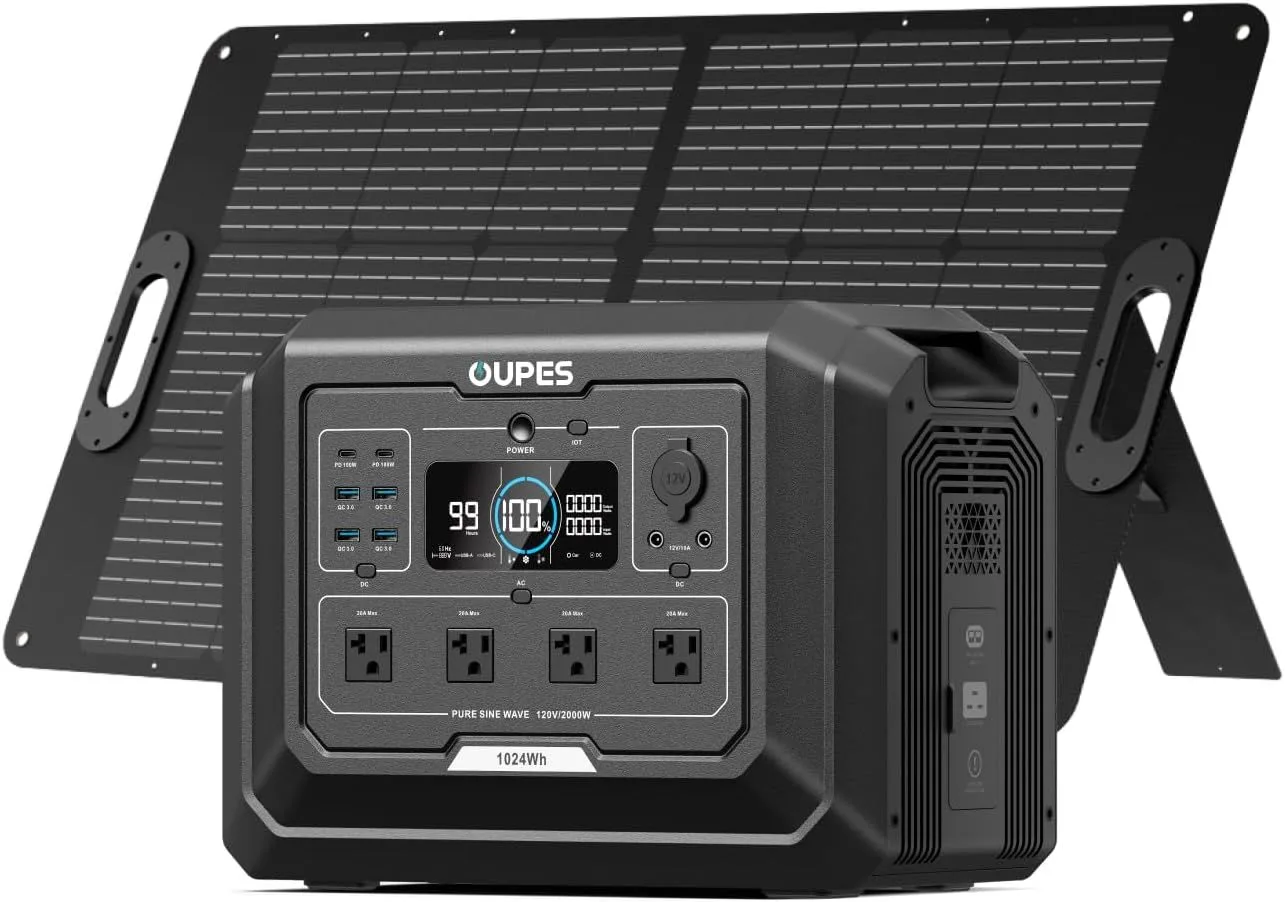
OUPES Mega 1
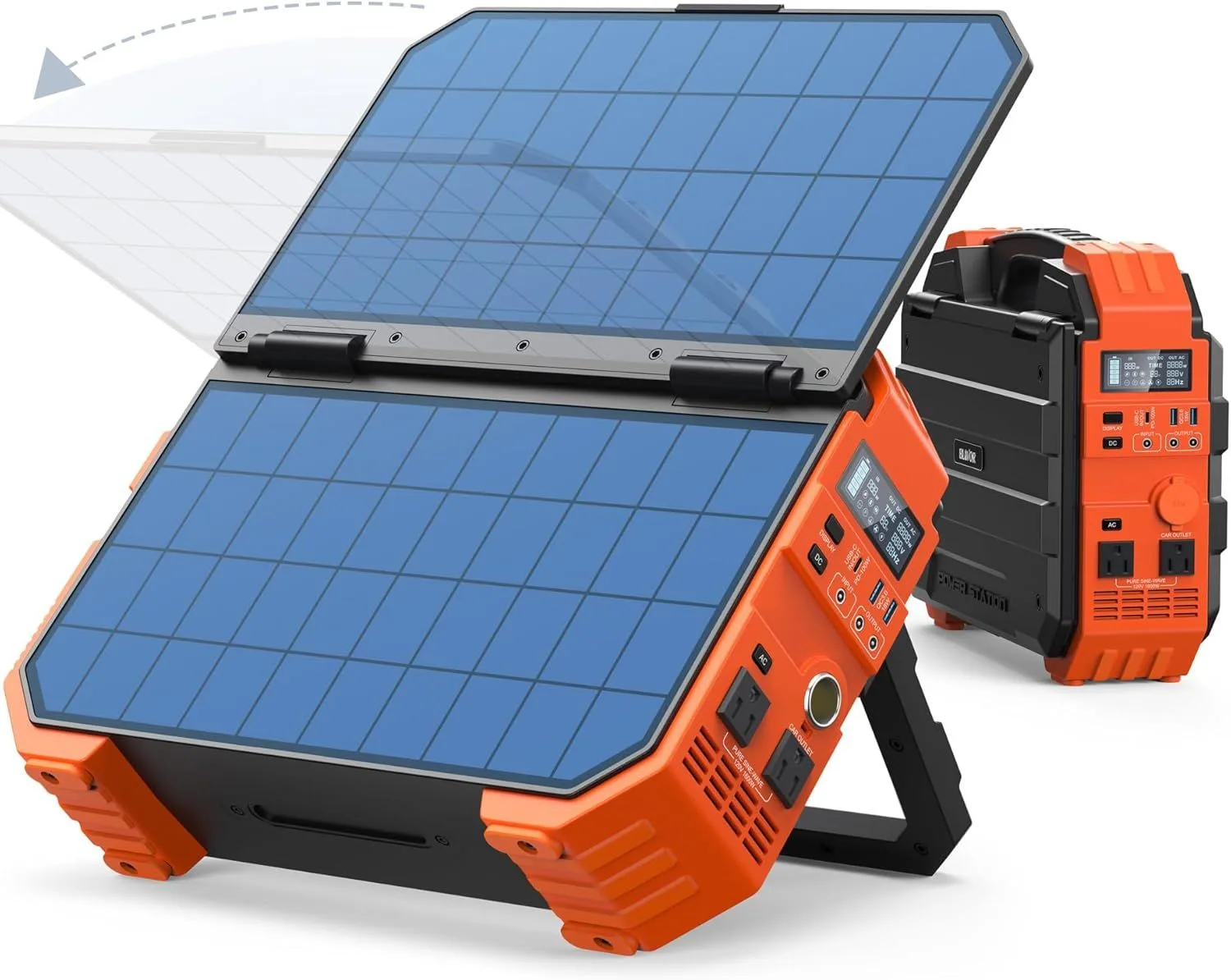
BLAVOR 1600W
Side-by-Side Specifications
Both units share the same 1,024Wh LiFePO4 battery chemistry and 3,500+ cycle lifespan. The divergence shows up in output power, charging speed, port count, and expansion capability. Here is how the raw numbers stack up before we break down what they mean in practice.
| Feature | OUPES Mega 1 Portable Power Station with 100W Solar Panel | BLAVOR 1600W Portable Power Station |
|---|---|---|
| Price Range | $250–$500 | $500+ |
| Battery Capacity | 1,024Wh | 1,024Wh |
| Battery Type | LiFePO4 | LiFePO4 |
| Output Power | 2,000W | 1,600W |
| Surge Power | 4,500W | 3,200W |
| Weight | ~28 lbs | ~28 lbs |
| Solar Input | 800W max | ~280W (40W built-in + 240W external) |
| Check Price | Check Price |
Category-by-Category Breakdown
Output Power and Surge Handling
OUPES Mega 1 WinsThe OUPES Mega 1 delivers 2,000W continuous output — a full 400W more than the BLAVOR's 1,600W ceiling. That 25% power advantage grows even wider under surge conditions. The OUPES absorbs 4,500W startup spikes, while the BLAVOR caps at 3,200W. The Solar Lab and CleanTechnica independently verified the OUPES surge rating, confirming it handles heavy inrush loads without tripping.
What does 400W of extra headroom mean in practice? Running a 1,500W space heater on the OUPES still leaves 500W available for a lamp, phone charger, and Wi-Fi router simultaneously. The same space heater on the BLAVOR leaves 100W of surplus — barely enough for a phone charger, and any additional device cycling on risks triggering overload shutdown. That thin margin becomes a recurring frustration during real outages when you are juggling multiple devices.
For power tool users, the gap is even more pronounced. Circular saws, compressors, and high-draw tools generate aggressive inrush current that exceeds their rated wattage for the first second or two of startup. The OUPES's 4,500W surge handles these transients. The BLAVOR's 3,200W surge means you will hear the overload alarm more often than you want during workshop use.
Solar Charging Speed and Flexibility
OUPES Mega 1 WinsThe OUPES Mega 1 accepts up to 800W of solar input — nearly three times the BLAVOR's combined maximum of 280W (40W built-in panel plus 240W external). With a properly sized panel array, the OUPES reaches a full charge from solar in roughly 1.5 hours. The BLAVOR needs 4-4.5 hours under identical conditions with its maximum external array connected.
That time difference reshapes how you use solar power during a day. With 800W panels and strong sun, the OUPES fully recharges during a lunch break. The BLAVOR consumes most of a sunny afternoon to reach the same result. For off-grid camping, this means the OUPES cycles through a full discharge-and-recharge before dinner. The BLAVOR might not finish recharging before sunset.
The included panels tell the same story at a smaller scale. The OUPES ships with a 100W foldable solar panel — more than double the BLAVOR's built-in 40W panel. And the OUPES panel is removable, replaceable, and upgradeable. You can start with the included 100W panel and add more as your budget allows, up to the 800W ceiling. The BLAVOR's built-in panel is fixed at 40W permanently.
Design and Self-Sufficiency
BLAVOR 1600W WinsThe BLAVOR 1600W is the only power station on the market with a built-in foldable solar panel. It earned an iF Design Award for this approach, and the concept addresses a genuine pain point. You will never arrive at a campsite or reach for your emergency power during a blackout only to realize the solar panel is in a different closet, still in your car, or never purchased in the first place. The panel is physically attached. It is always there.
The BLAVOR also ships with 10 adapter heads covering virtually every device connector standard in use today. Combined with the built-in solar panel, the 100W bidirectional USB-C port, and DC outputs, the unit functions as a completely self-contained emergency power kit out of the box. Nothing else to buy, nothing to forget, nothing to lose between now and the next power outage.
For dedicated emergency preparedness kits that sit in a hallway closet for months at a time, this self-contained design has real value. When the power goes out at 2 AM during a winter storm, you grab one box and everything you need is inside it. No hunting for cables, adapters, or a solar panel you packed away six months ago. That organizational simplicity is the BLAVOR's genuine advantage.
The OUPES Mega 1, by contrast, requires you to manage a separate solar panel, keep the proprietary AC adapter accessible, and potentially track expansion batteries. More capable, but more to manage. The BLAVOR trades peak performance for operational simplicity.
Future-Proofing and Capacity Growth
OUPES Mega 1 WinsThe OUPES Mega 1 connects to up to two B2 expansion batteries, boosting total capacity from 1,024Wh to 5,120Wh. That transforms a mid-range portable unit into a legitimate home backup system capable of running a refrigerator, lights, and Wi-Fi router through a full overnight outage — and potentially well into the next day depending on load management.
The BLAVOR 1600W has no expansion ports and no compatible external batteries. The 1,024Wh you buy today is the 1,024Wh you will have five years from now. For anyone whose power needs grow over time — adding an electric cooler, expanding home backup to more circuits, or transitioning from weekend camping to extended off-grid trips — the BLAVOR hits a permanent wall.
The economics favor the expansion path as well. Adding a B2 battery to the OUPES costs less per watt-hour than buying a second complete power station, and the system manages charge distribution across all connected batteries automatically. The OUPES grows with your needs. The BLAVOR stays fixed.
AC Wall Charging: The Speed Gap
OUPES Mega 1 WinsThe OUPES Mega 1 recharges from a wall outlet in approximately 60 minutes using its 1,400W AC input. The BLAVOR's fastest charging method — combining DC and USB-C inputs simultaneously — takes roughly 3.5 hours. That is a 3.5x speed difference from the same starting point to the same finish line.
During intermittent power outages, this gap matters enormously. If utility power returns for 90 minutes between blackout cycles, the OUPES fully recharges with 30 minutes to spare. The BLAVOR recovers less than half its capacity in that same window. During rolling blackouts or storm-related outages with unpredictable power availability, faster recharging translates directly into more stored energy when the lights go out again.
Even for routine use, faster AC charging reduces the friction of keeping the unit topped off. Plug in the OUPES when you get home from a camping trip, and it reaches full charge before dinner. The BLAVOR needs most of an evening to fully recover.
The BLAVOR's slow charging speed is its most consistent criticism across Amazon reviews. Multiple buyers flagged it as the one specification they wished they had examined more carefully before purchase. The 3.5-hour floor is not a corner case — it is the fastest the unit can charge under any circumstances.
Long-Term Value and Warranty Protection
OUPES Mega 1 WinsThe OUPES Mega 1 is modestly more expensive than the BLAVOR 1600W — and that lower price arrives with more output wattage, faster charging from both wall and solar, triple the solar input ceiling, and genuine expansion capability. The OUPES also includes a 100W foldable panel, which outperforms the BLAVOR's built-in 40W panel by a factor of 2.5x.
Warranty coverage amplifies the value gap. The OUPES carries a 5-year warranty (6 years with product registration) backed by US-based customer support with a documented track record on Amazon. The BLAVOR provides just 1 year of warranty coverage — the shortest in the entire mid-range category. For a product positioned at a mid-range for its category price point, that single year raises legitimate questions about how much the manufacturer trusts its own hardware to hold up.
On a pure cost-per-watt-hour basis, the OUPES delivers more value before you even factor in the included 100W panel, the expansion headroom, or the multi-year warranty advantage. Once you account for all of those, the BLAVOR's pricing becomes difficult to justify on performance grounds alone. Its value proposition rests entirely on the convenience of its integrated design.
Weight, Dimensions, and Field Portability
BLAVOR 1600W WinsThe BLAVOR 1600W weighs 29.8 lbs and bundles its solar panel directly into the chassis — nothing extra to carry, strap down, or forget. The OUPES Mega 1 weighs 23.2 lbs for the station alone, but add the included 100W foldable panel (roughly 6-8 lbs depending on the specific panel model) and total carry weight lands in the same neighborhood. The practical weight difference when you account for the full kit is narrower than the spec sheets suggest.
Where the BLAVOR wins on portability is in packing simplicity. One box. One handle. Grab it and go. The OUPES requires you to manage two separate items — the station and the panel — plus the cables connecting them. For car camping where everything rides in the trunk, this barely matters. For emergency grab-and-go situations where you need power immediately and cannot spend time gathering components, the BLAVOR's integrated design eliminates a failure mode that no competitor addresses.
The OUPES Mega 1 does have an advantage for stationary home backup setups. At 23.2 lbs without the panel, it is lighter to position in a utility room or garage corner. The panel stays folded and stored separately until needed. If your station lives in one spot 95% of the time, the lower base weight and detachable panel make the OUPES easier to install and maintain.
Port Selection and Device Compatibility
The OUPES Mega 1 offers a substantially wider port array: four AC outlets, two USB-C PD 100W ports, four USB-A QC3.0 ports, two DC5521 outputs, and a car socket. That is 13 ports total, covering every charging scenario from modern laptops to legacy 12V devices.
The BLAVOR 1600W provides roughly 8 output ports — AC outlets, USB-C 100W PD, USB-A, and DC outputs. It covers the basics, but the reduced count limits simultaneous device charging. During a family camping trip or a household outage with multiple phones, tablets, and a laptop all needing power, the OUPES has ports to spare. The BLAVOR requires prioritization and rotation.
The OUPES also includes dual USB-C PD ports at 100W each — fast-charging two MacBooks or iPads simultaneously at maximum speed. The BLAVOR's single 100W USB-C port handles one device at full speed. If USB-C fast charging matters to your workflow, that is a two-to-one advantage.
Which One Should You Actually Buy?
Get the OUPES Mega 1 if you...
- ✓Need the highest continuous output for power tools, space heaters, or air conditioning units with heavy startup loads
- ✓Plan to rely on solar panels as a primary or frequent charging method — the 800W input ceiling is unmatched at this price
- ✓Want the option to expand from 1,024Wh to 5,120Wh as your power needs grow over time
- ✓Value fast wall charging — the 60-minute full recharge handles intermittent outages and quick turnarounds between trips
- ✓Prioritize warranty length and customer support — 5 years with US-based service
Get the BLAVOR 1600W if you...
- ✓Want a fully self-contained emergency kit — grab one box and every power capability is built in
- ✓Value design innovation and appreciate the iF Design Award-winning integrated solar panel approach
- ✓Store your power station for months between uses and need the peace of mind that the solar panel is always attached
- ✓Only need 1,600W of continuous output — more than enough for refrigerators, CPAP machines, fans, and standard household electronics
- ✓Prefer a simpler setup with fewer separate components to track, store, and maintain
Three Buyer Scenarios That Clarify the Choice
The weekend camper with a growing setup: You car-camp twice a month, run a 12V cooler overnight, charge two phones and a Bluetooth speaker, and occasionally power a portable projector for movie night. Today 1,024Wh covers your needs — but next summer you want to add an electric air pump and a laptop for remote work from the campsite. The OUPES Mega 1 handles your current load and grows to 5,120Wh with expansion batteries when you are ready. The BLAVOR hits a permanent wall at 1,024Wh.
The emergency preparedness minimalist: Your power station lives in a hallway closet and comes out twice a year — once for a hurricane scare and once to verify it still works. You want zero setup time. When the power drops at 2 AM, you grab one thing, unfold the panel at sunrise, and keep your phone, medications fridge, and a fan running. The BLAVOR's all-in-one design means you will never discover the solar panel is in the garage, the cable is in the junk drawer, or the adapter was lost six months ago. For this buyer, the BLAVOR's integrated simplicity is worth the performance gap.
The solar enthusiast building incrementally: You already own a 200W portable panel and plan to add more over time. You want a station that can absorb every watt your growing panel array produces. The OUPES Mega 1's 800W solar ceiling means your current 200W panel uses only 25% of the station's capacity — you can triple your solar setup without hitting a bottleneck. The BLAVOR caps at 280W total solar input, and its built-in 40W panel occupies part of that ceiling permanently. The OUPES is the only choice here.
Common Questions About This Matchup
Can both the OUPES Mega 1 and BLAVOR 1600W run a full-size refrigerator?
The OUPES Mega 1 handles refrigerators more confidently with 2,000W continuous and 4,500W surge — enough to absorb compressor startup spikes without tripping. The BLAVOR 1600W can run most refrigerators at 1,600W continuous with 3,200W surge, but compressors pulling heavy startup loads may occasionally trigger its overload protection.
Which unit charges faster from solar panels?
The OUPES Mega 1 charges drastically faster from solar — its 800W solar input can fully recharge the 1,024Wh battery in roughly 1.5 hours with adequate panels. The BLAVOR accepts only about 240W external solar input plus its built-in 40W panel, requiring 4-4.5 hours for a full solar charge even in ideal conditions.
Is the BLAVOR built-in solar panel actually useful in a real emergency?
As a primary charging method, no — the 40W built-in panel would need 30-40 hours of ideal sunlight to fully charge the 1,024Wh battery. As a supplemental trickle charger during extended outages or a last-resort emergency option, it adds genuine value that no competitor offers. Think of it as a survival feature, not a practical daily charging solution.
Which has better long-term expansion potential?
Only the OUPES Mega 1 offers expansion — it connects with up to two B2 expansion batteries to reach 5,120Wh total. The BLAVOR 1600W is a sealed unit with no expansion capability. If you anticipate growing power needs, the OUPES is the only option between these two.
How do the warranties compare between these two stations?
The OUPES Mega 1 includes a 5-year warranty (6 years with product registration) backed by US-based customer support. The BLAVOR 1600W comes with just 1 year of coverage — the shortest warranty in the mid-range category. For a purchase at this price level, that four-year gap in coverage is hard to ignore.
Are both of these units loud during operation?
Both units produce noticeable fan noise under load or while charging. The OUPES Mega 1 has been specifically called out by multiple reviewers for being louder than competitors during wall charging and USB-C output. The BLAVOR runs its fans during high-draw situations as well, but has fewer complaints about volume in Amazon reviews. Neither unit is silent.
Can I use third-party solar panels with either unit?
The OUPES Mega 1 accepts third-party panels up to 800W through its MC4 solar input — nearly any portable solar panel on the market will work. The BLAVOR 1600W accepts external panels up to approximately 240W alongside its built-in 40W panel. Both units are compatible with standard MC4 connectors, but the OUPES gives you far more headroom to upgrade your panel array over time without hitting the station's input ceiling.
How long will each unit power a standard mini-fridge during a blackout?
A typical mini-fridge draws 50-80W with compressor cycling averaging around 40-50W over time. The OUPES Mega 1 and BLAVOR 1600W both pack 1,024Wh, so runtime is similar: roughly 18-24 hours of continuous mini-fridge operation depending on ambient temperature and how often you open the door. The OUPES pulls ahead in extended scenarios because you can add B2 expansion batteries to reach 5,120Wh — enough for 4-5 days of uninterrupted mini-fridge operation.
Ready to Decide?
For the majority of buyers comparing these mid-range stations, the OUPES Mega 1 offers the stronger value proposition — more output, faster charging from every source, solar flexibility, room to grow, and a longer warranty at a lower price. The BLAVOR 1600W fills a narrower but real niche for emergency preparedness buyers who want absolute simplicity in a single self-contained unit.
Prices and availability change frequently. Check Amazon for the most current pricing.