Expandable Modular Power vs Integrated Efficiency: Two Paths to Whole-Home Backup
The OUPES Guardian 6000 bets on raw capacity, 240V single-unit output, and the largest expansion path in its price range. The Anker SOLIX F3000 bets on best-in-class efficiency, near-silent operation, and Anker's premium build quality. One costs substantially less. The other runs quieter, sips power, and comes from the more established brand. Picking between them depends on which shortcomings you can live with.
Quick Verdict
The Guardian 6000 wins on specs and value. The F3000 wins on refinement and livability. For budget-conscious buyers who need the most capacity and native 240V output per dollar, the Guardian 6000 is the better investment. For buyers who prioritize quiet operation, low idle draw, and brand reliability — and can live with 120V-only from a single unit — the F3000 delivers a more polished ownership experience.
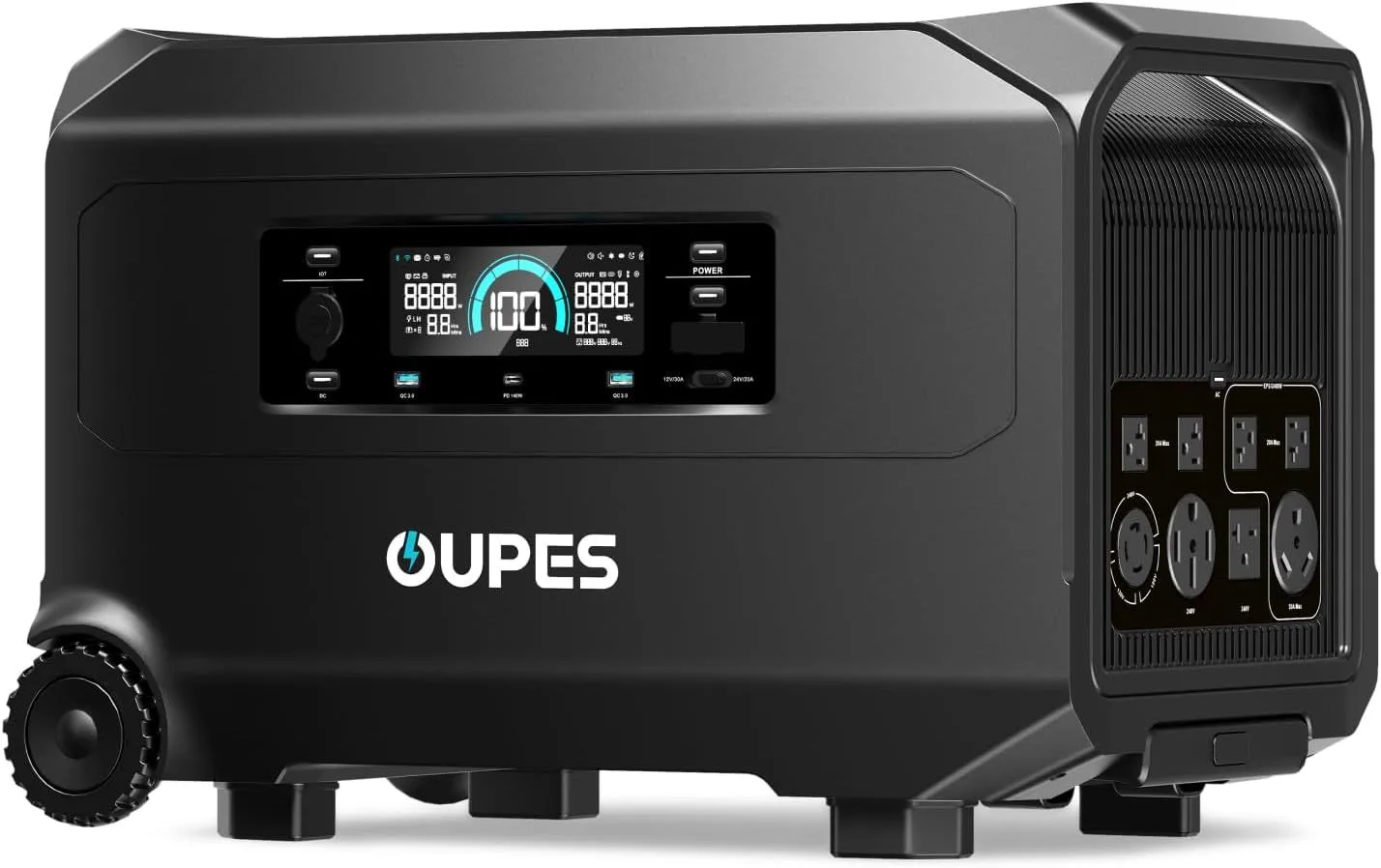
OUPES Guardian 6000
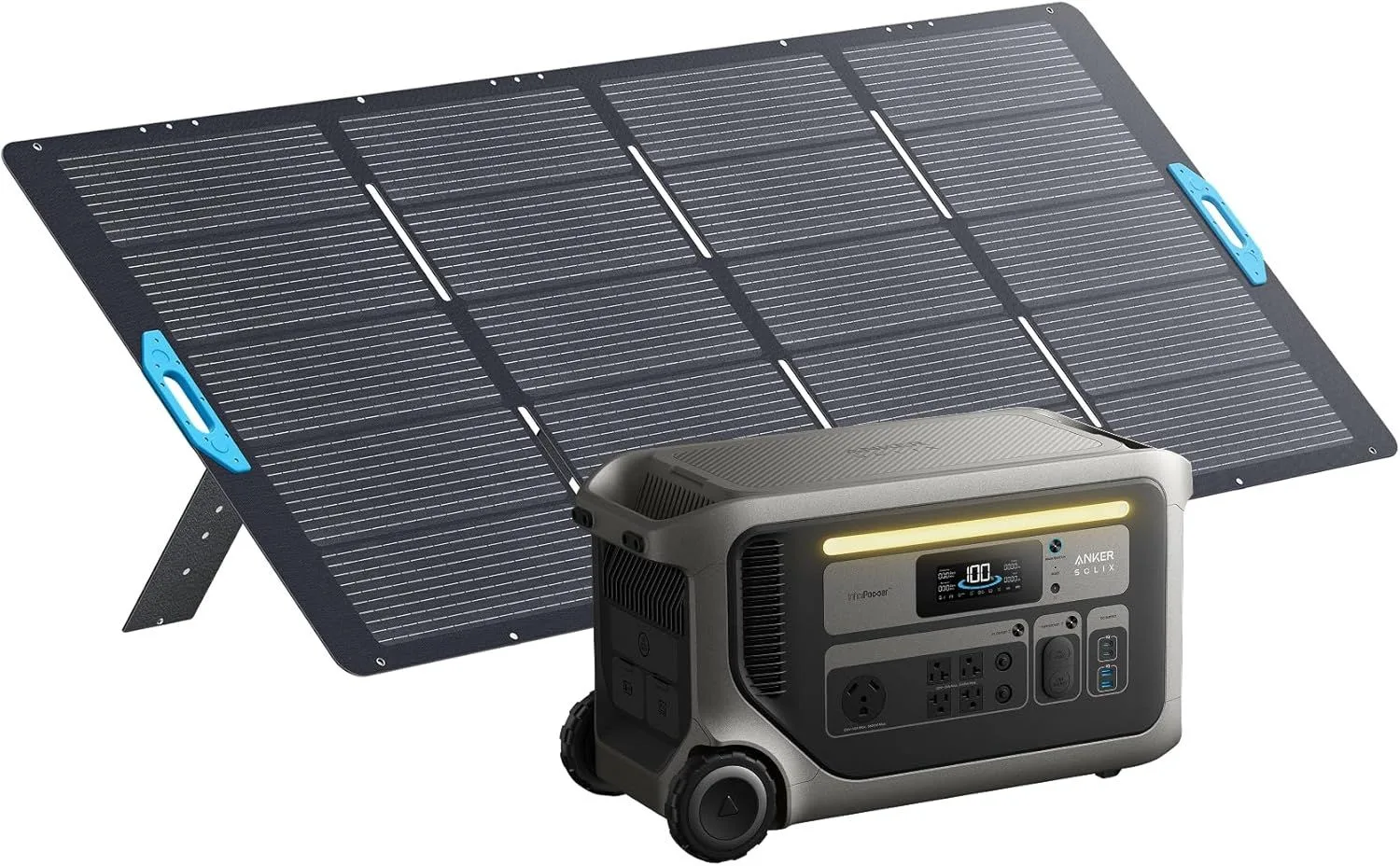
Anker SOLIX F3000
Specs at a Glance
The capacity gap is the headline: 4,608Wh from the Guardian 6000 versus 3,072Wh from the F3000 — the OUPES holds 50% more energy. Output is equally one-sided on paper: 6,000W at 240V versus 3,600W at 120V. But the numbers below the surface — idle draw, efficiency, noise — tell a more complex story.
| Feature | OUPES Guardian 6000 Portable Power Station | Anker SOLIX F3000 with 400W Solar Panel |
|---|---|---|
| Price Range | $500+ | $500+ |
| Battery Capacity | 4,608Wh | 3,072Wh |
| Battery Type | LiFePO4 | LiFePO4 |
| Output Power | 6,000W (240V) / 3,600W (120V) | 3,600W |
| Surge Power | 9,000W | 7,200W (two units) |
| Weight | 111 lbs | 91.5 lbs |
| Solar Input | 2,400W max (12-140V, 15A) | 2,400W dual MPPT |
| Check Price | Check Price |
Head-to-Head Breakdown
Battery Capacity and Output Power
Guardian 6000 WinsThe OUPES Guardian 6000 packs 4,608Wh into a single unit — 50% more stored energy than the Anker F3000's 3,072Wh. To understand what those watt-hours mean in practice, consider what each unit runs. In a power outage, that extra 1,536Wh translates to roughly 12-15 additional hours of running a refrigerator, or 3-4 more cycles of a well pump, or an entire extra night of essential lighting and device charging.
Output power is equally decisive. The Guardian 6000 delivers 6,000W at 240V split-phase from a single unit — true whole-home backup without additional hardware. It can run central HVAC systems, well pumps, electric ranges, and other heavy 240V loads directly. The 9,000W surge rating handles motor startups for air conditioners and refrigerator compressors without flinching.
The Anker F3000 delivers 3,600W at 120V only from a single unit. To achieve 240V output, you need two F3000 units plus the Double Voltage Hub — an additional investment that pushes the total system cost well above the Guardian's price. For buyers who specifically need 240V capability, this distinction alone may be the deciding factor.
The F3000's TT-30R outlet is a standout feature for RV owners — it delivers a true 30A connection that doubles as a 3,600W fast-charge input when not in use. The Guardian 6000 also includes a TT-30R, plus a NEMA 14-50R and L14-30E that the F3000 lacks.
Energy Efficiency and Idle Consumption
Anker F3000 WinsThe Anker F3000 achieves 84% inverter efficiency with a measured idle draw of just 20.5W. Over a 24-hour standby period, the F3000 consumes roughly 492Wh — about 16% of its total capacity. After three days of standby, it retains over half its stored energy.
The OUPES Guardian 6000's 75W idle consumption is nearly four times higher. Over the same 24-hour standby period, the Guardian consumes approximately 1,800Wh — a full 39% of its 4,608Wh capacity. Its larger battery partially compensates for the inefficiency, but the math is unfavorable. After two days of idle standby, the Guardian has lost 78% of its stored energy to self-consumption — more than the F3000 loses in three days.
This efficiency gap profoundly impacts multi-day outage scenarios. If you are running essential loads at 200W average and experiencing a three-day outage:
- •Guardian 6000: 200W load + 75W idle = 275W total draw. The 4,608Wh battery lasts about 16.7 hours per charge cycle before needing recharging.
- •F3000: 200W load + 20.5W idle = 220.5W total draw. The 3,072Wh battery lasts about 13.9 hours per charge cycle.
The Guardian still lasts longer per cycle thanks to its larger battery — but it wastes 54.5W more every hour doing so. Over extended outages, the F3000's efficiency means far more of your stored and solar-harvested energy actually reaches your appliances instead of being consumed by the unit itself.
Noise Level and Indoor Comfort
Anker F3000 WinsThe Anker F3000 is confirmed by multiple expert reviewers to operate near-silently — quiet enough to use as a bedside CPAP power source without disturbing sleep. This is not a small claim. CPAP users depend on their machines nightly, and many power stations generate enough fan noise to disrupt the light sleep stages that CPAP therapy is designed to protect.
The OUPES Guardian 6000 does not publish an official decibel rating, but the 75W idle consumption and 6,000W inverter capacity require more active thermal management. Reports from Amazon reviewers describe audible fan noise during operation, particularly during charging and moderate-to-heavy loads. It is not loud enough to be a dealbreaker in a garage or utility room, but it is noticeable in a living space.
For installation locations where noise matters — bedrooms, home offices, open-plan living spaces — the F3000 is materially better to live with. During overnight outages, the F3000 can sit in a hallway or even a bedroom doorway without disrupting sleep. The Guardian is better suited to dedicated utility closets, garages, or basement installations where the unit operates behind a closed door and fan noise dissipates before reaching occupied rooms. If your home layout forces the power station into a shared living space, the noise gap between these two becomes a daily quality-of-life factor rather than an abstract spec.
Expansion Path and System Growth
Guardian 6000 WinsThe OUPES Guardian 6000 expands to 41.4kWh with eight G5 expansion batteries — enough stored energy to power an average American home for approximately 1.5 days without any solar recharging. Our whole-home roundup ranks both systems against the full competitive field. The Anker F3000 expands to 24kWh with BP3000 batteries — impressive, but the Guardian offers a 72% larger ceiling.
The expansion path matters for buyers planning a phased investment. Starting with the Guardian's 4,608Wh base and adding batteries over time lets you scale capacity as budgets and needs evolve. The higher ceiling means you are less likely to outgrow the system, even as your household's power consumption increases with electric vehicles, heat pumps, or new appliances.
One important caveat: the BP3000 batteries are only compatible with the F3000 — they do not work with Anker's F3800 system. If you start with the F3000 and later want to upgrade to the F3800 platform, your BP3000 batteries become stranded assets. The Guardian's G5 batteries are specific to the Guardian platform as well. Both ecosystems lock you in.
Solar expansion is also lopsided. The Guardian 6000 accepts 2,400W of solar input. The F3000 also accepts 2,400W with dual MPPT controllers. Solar input is a draw — both units handle large panel arrays equally well. The Guardian's advantage here is that its larger battery gives more headroom to store a full day's solar harvest without hitting capacity limits.
The Charging-While-Running Problem
Anker F3000 WinsThe OUPES Guardian 6000 has a critical operational limitation: it cannot charge via AC while simultaneously outputting 240V split-phase power. During a multi-day outage, you must disconnect all loads, recharge the unit from a generator or solar, then reconnect loads. This forced cycling creates gaps in power delivery that can be disruptive — especially for refrigerators that need continuous power to maintain safe food temperatures.
The Anker F3000 does not have this limitation for 120V operation. It charges and outputs simultaneously, allowing solar panels or a generator to supplement battery power in real time. Loads continue running while the battery recharges — no disconnection, no cycling, no gaps.
For users who pair their power station with solar panels for extended off-grid use, this distinction is the difference between set-and-forget operation (F3000) and active power management (Guardian 6000). During a three-day outage with intermittent solar charging, the F3000 maintains continuous power to connected loads while topping off the battery. The Guardian requires deliberate intervention each time it needs recharging.
This limitation is the Guardian 6000's most serious drawback for its intended whole-home backup use case. A 240V backup system that must disconnect from the home panel to recharge is a system that leaves your home without power during every recharge cycle. For short outages (overnight), this is manageable. For multi-day events like hurricanes or ice storms, it creates operational complexity.
Pricing Strategy and Cost per Watt-Hour
Guardian 6000 WinsThe value proposition is stark. The OUPES Guardian 6000 delivers 4,608Wh with 6,000W 240V output at a top-tier investment price point. The Anker F3000 delivers 3,072Wh with 3,600W 120V output at a top-tier investment price point that is modestly more expensive.
On a per-watt-hour basis, the Guardian delivers roughly 50% more stored energy for less money. Adding the F3000's Double Voltage Hub (needed for 240V output) pushes the Anker's total system cost even higher — while the Guardian achieves 240V from a single box at its base price.
The F3000 includes a 400W solar panel in its bundle, which partially offsets the price gap. The Guardian ships as a standalone unit. But even accounting for the panel, the Guardian's capacity-per-dollar ratio is the best in the whole-home category.
Where the F3000 recaptures value is in long-term operating costs. Its lower idle draw means less wasted energy over years of use. Its higher efficiency means more of every stored kilowatt-hour reaches your appliances. For daily-cycling solar self-consumption systems, the F3000's efficiency advantage compounds. For occasional emergency backup, the Guardian's capacity advantage is more relevant.
Installation costs add another layer to the value calculation. Both units benefit from a transfer switch for whole-home integration, and the electrician's bill for that work typically runs several hundred dollars regardless of which station you choose. But the Guardian's single-unit 240V output means one transfer switch connection and one set of wiring. Achieving 240V with the F3000 requires two units, the Double Voltage Hub, and potentially more complex panel wiring — pushing total installation labor higher. For buyers on a fixed budget, the Guardian delivers whole-home 240V capability at a lower total system cost once you factor in hardware and labor beyond the station itself.
Brand Confidence and After-Sale Support
Anker F3000 WinsAnker has spent over a decade building its reputation in consumer electronics. The company's customer support infrastructure, warranty fulfillment, and firmware update pipeline are well-established and consistently praised across review platforms. When something goes wrong with an Anker product, there is a clear, responsive support path.
OUPES is a newer entrant to the power station market. The Guardian 6000 represents an ambitious product from a growing company, and the specs are legitimately impressive. But some Amazon reviewers have flagged slower customer service response times and firmware update concerns. For a product at this price level that you depend on during emergencies, the support infrastructure matters.
Both units carry 5-year warranties. The Guardian 6000 extends to 6 years with product registration. The Anker F3000's 5-year coverage is backed by the brand's track record of honoring warranty claims efficiently. A warranty is only as valuable as the company standing behind it — and Anker's track record is currently stronger.
The F3000's build quality also reflects Anker's manufacturing standards. Smooth-rolling wheels, refined fit and finish, and quiet operation all signal a premium product. The Guardian 6000 is well-built for its price class, but the Anker's physical refinement is noticeably higher in side-by-side comparison. Anker also provides regular firmware updates through its app — addressing bugs, improving charging algorithms, and occasionally unlocking new features. OUPES firmware updates have been less frequent, and some Amazon reviewers have reported difficulties applying them. For a product you may depend on during emergencies years from now, the manufacturer's commitment to ongoing software maintenance is a factor worth weighing alongside hardware specs. A well-maintained firmware pipeline means your unit gets smarter over time; a stagnant one means the unit you bought is the unit you keep, bugs and all.
Which Approach Fits Your Situation?
Get the OUPES Guardian 6000 if you...
- ✓Need true 240V split-phase output from a single unit without additional hardware
- ✓Want the most watt-hours per dollar — 4,608Wh at the best price-to-capacity ratio in its class
- ✓Plan to build a large expandable system (up to 41.4kWh)
- ✓Will install in a garage or utility room where fan noise is acceptable
- ✓Primarily need overnight or short-outage backup where the charge-while-running limitation is manageable
Get the Anker SOLIX F3000 if you...
- ✓Prioritize near-silent operation for living spaces, bedrooms, or CPAP use
- ✓Want the lowest idle draw (20.5W) for maximum energy preservation during multi-day outages
- ✓Need to charge while simultaneously outputting power — no forced cycling during outages
- ✓Value Anker's established brand reliability and customer support infrastructure
- ✓Can work with 120V output from a single unit (or are willing to invest in two units plus the Double Voltage Hub for 240V)
Two Real-World Scenarios
Scenario 1 — Rural homestead with well pump and freezer: You lose grid power for 36 hours after an ice storm. Your well pump draws 1,200W at 240V, your chest freezer pulls 80W, and you need lights and phone charging. The Guardian 6000 runs all of this from a single unit — the well pump starts at 240V without extra hardware, and the 4,608Wh battery supports roughly 10 cycles of 15-minute well pump runs alongside continuous freezer and lighting loads. The F3000 cannot power the well pump at all from a single unit (120V only), and even with two units plus the Double Voltage Hub, the total system cost exceeds the Guardian's by a wide margin.
Scenario 2 — Suburban home office during a 3-day rolling blackout: You need to keep a desktop computer (300W), modem and router (25W), two monitors (50W), and a lamp running through intermittent 4-hour blackout windows. The F3000's 20.5W idle draw and pass-through charging mean you plug it in, connect your gear, and forget about it — the unit charges from the wall when grid is up and automatically switches to battery when power drops. The Guardian's 75W idle draw bleeds 300Wh per 4-hour window just keeping itself awake, and its inability to charge while outputting power means you must manually cycle between grid charging and load powering. For continuous, hands-off UPS-style operation, the F3000 is the clear winner.
OUPES Guardian 6000 vs Anker SOLIX F3000 FAQ
Which unit delivers better value per watt-hour?
The OUPES Guardian 6000 delivers substantially better value per watt-hour. It provides 4,608Wh at a price point where the Anker F3000 delivers 3,072Wh — roughly 50% more capacity for less money. On a pure cost-per-Wh basis, the Guardian 6000 is the clear value leader in the whole-home backup category.
Can the Anker F3000 output 240V from a single unit?
No. The Anker SOLIX F3000 outputs 120V only from a single unit. To achieve 240V split-phase output, you need two F3000 units plus the Double Voltage Hub accessory (sold separately). The OUPES Guardian 6000 delivers true 240V split-phase from a single box — a substantial advantage for whole-home backup without additional hardware purchases.
How much noise difference is there between these two?
The difference is dramatic. The Anker F3000 is near-silent — multiple expert reviewers confirmed it is quiet enough for bedside CPAP use. The OUPES Guardian 6000 does not publish a dB rating, but its 75W idle power consumption suggests more active cooling fan operation. For living spaces, bedrooms, or noise-sensitive environments, the F3000 is the far better choice.
Can the OUPES Guardian 6000 charge while outputting 240V power?
No — and this is its most serious limitation for extended outages. The Guardian 6000 cannot charge via AC while simultaneously outputting 240V split-phase power. You must disconnect all loads to recharge. During multi-day outages, this means deliberate power cycling: run appliances until battery depletes, disconnect everything, recharge from solar or generator, then reconnect. The Anker F3000 does not have this limitation for 120V operation.
Which has better long-term expansion potential?
The OUPES Guardian 6000 expands to 41.4kWh with eight G5 expansion batteries. The Anker F3000 expands to 24kWh with BP3000 batteries. The Guardian has a 72% larger expansion ceiling. Both systems use proprietary batteries — there is no cross-brand compatibility. For buyers planning to scale up over time, the Guardian offers more growth runway.
Which brand has better customer support and reliability?
Anker has the stronger reputation for customer support and product reliability. The company has decades of consumer electronics experience and well-established US support infrastructure. OUPES is a newer brand with growing customer service capabilities, but some Amazon reviewers have reported slower response times and firmware update concerns. For buyers who weigh brand reliability heavily, Anker carries lower risk.
Can I connect either unit to a home transfer switch for automatic switchover?
Both units can connect to a manual transfer switch installed at your electrical panel — this is the recommended approach for whole-home backup. The Guardian 6000 connects directly via its NEMA 14-50R or L14-30E outlets and delivers 240V split-phase to your panel without additional hardware. The F3000 requires two units plus the Double Voltage Hub to feed 240V to a transfer switch. Neither unit supports automatic transfer switching like a standby generator — you must manually start the power station and switch over.
How much solar panel wattage do I need to keep either unit topped off during daily use?
Both accept up to 2,400W of solar input. For daily solar self-consumption at a 200W average household load, you need roughly 800-1,200W of panels depending on your location and sun hours. The F3000 makes better use of that solar harvest because its 20.5W idle draw wastes less of your collected energy compared to the Guardian's 75W idle overhead. With 1,000W of panels and 5 peak sun hours, the F3000 nets roughly 4,700Wh of usable energy daily — the Guardian nets about 4,425Wh from the same panels due to higher self-consumption.
See Current Pricing for Both
The Guardian 6000 is the specs-and-value champion with native 240V output and massive expandability. The Anker F3000 is the refinement champion with near-silent operation, low idle draw, and Anker's trusted brand behind it. Both serve the whole-home backup mission — through opposite design philosophies. Your priorities determine your pick.
Prices and availability change frequently. Check Amazon for the most current pricing.