Jackery 1000 v2 vs OUKITEL P1000 Plus: The Brand Premium vs the Bundle Bargain
Our Verdict
The OUKITEL P1000 Plus delivers more power (1,800W vs 1,500W), faster AC charging (39 min to 80% vs 60+ min), better surge handling (3,600W vs 3,000W), and a better battery spec (4,000 cycles to 80% vs 70%) — all at a lower price with an included solar panel. The Jackery Explorer 1000 v2 counters with a far superior 200W bifacial solar panel, lighter weight (24.5 vs 26.5 lbs), and the most trusted brand name in portable power. For raw value per dollar, the OUKITEL wins. For the best solar charging experience and brand peace of mind, the Jackery wins.
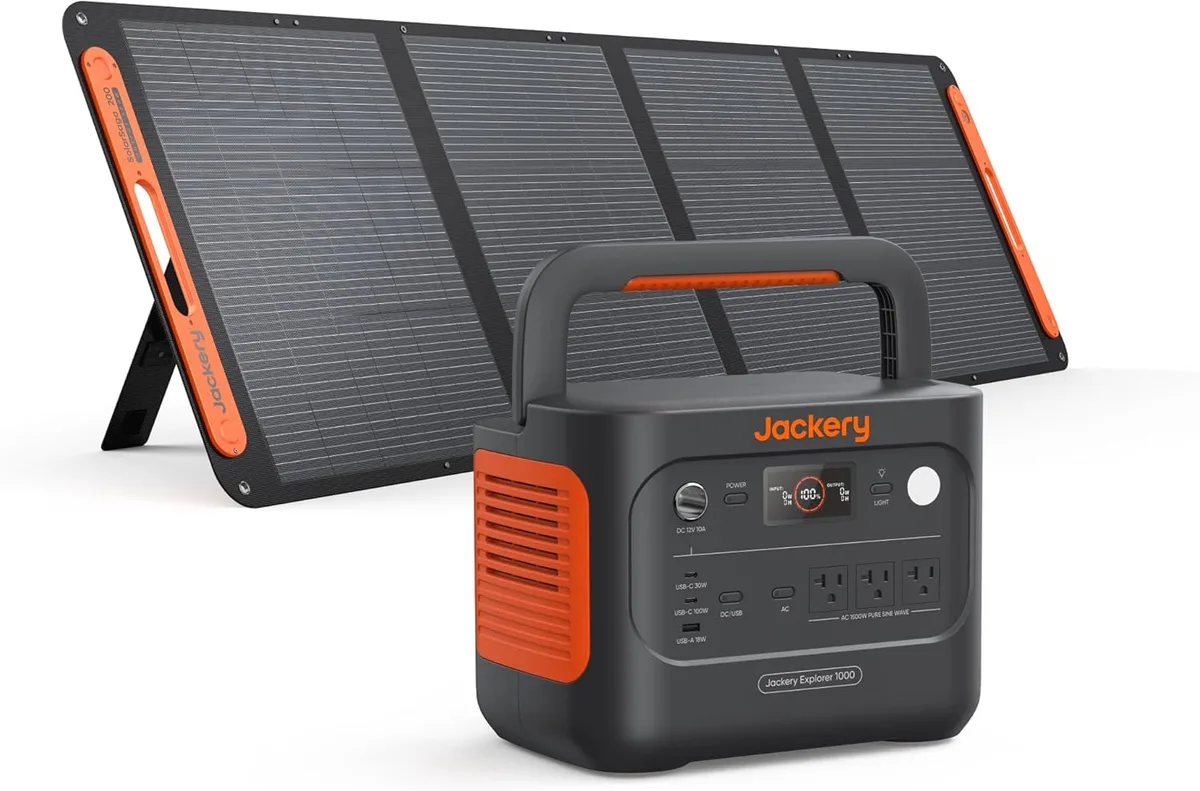
Jackery Explorer 1000 v2
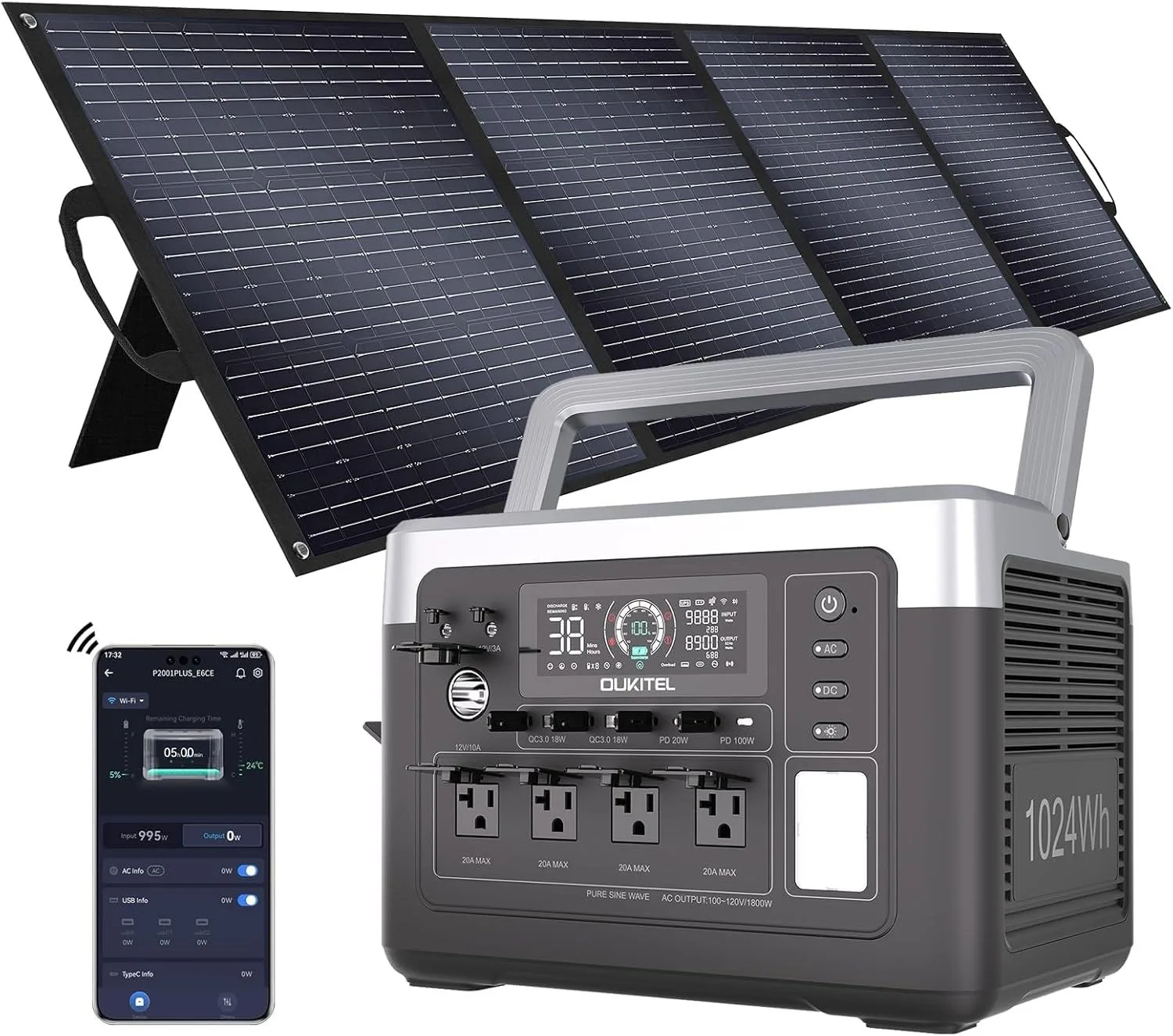
OUKITEL P1000 Plus
Two Solar Bundles, Two Different Priorities
Both the Jackery Explorer 1000 v2 and the OUKITEL P1000 Plus ship with a solar panel included. Both run quiet enough for bedside use. Both use LiFePO4 chemistry with 4,000+ cycle ratings. And both sit in the mid-range price band. On a feature checklist, they look like twins.
The differences emerge when you start digging. Jackery invested in the best bundled panel on the market — a 200W bifacial SolarSaga with 26.7% efficiency and IP68 waterproofing. OUKITEL invested in more output watts, faster AC charging, and a lower total price. One is built for solar-first buyers who charge primarily from sunlight. The other is built for value-first buyers who want maximum capability per dollar.
We analyzed 2947+ Jackery Amazon ratings and 500+ OUKITEL ratings, plus hands-on coverage from Android Police, T3, Ryan Mercer, and the broader YouTube review community. Here is where each unit earns its money.
Head-to-Head Specifications
| Feature | Jackery Solar Generator 1000 v2 with 200W Solar Panel | OUKITEL P1000 Plus Portable Power Station with 100W Solar Panel |
|---|---|---|
| Price Range | $500+ | $250–$500 |
| Battery Capacity | 1,070Wh | 1,024Wh |
| Battery Type | LiFePO4 | LiFePO4 |
| Output Power | 1,500W | 1,800W |
| Surge Power | 3,000W | 3,600W |
| Weight | 24.5 lbs | 26.5 lbs |
| Solar Input | 400W max | 500W max (XT60) |
| Check Price | Check Price |
The Panel Gap: 200W Bifacial vs 100W Standard
The Jackery SolarSaga 200W panel is not just bigger — it is a fundamentally different class of panel. IBC bifacial technology captures light from both sides, achieving 26.7% conversion efficiency. The IP68 waterproof rating means it survives rain, splashes, and dust storms. T3 called it "the standout accessory" in their review, and they are right. A comparable standalone 200W panel costs more than the price difference between these two bundles.
The OUKITEL 100W panel is a standard monocrystalline foldable — functional, portable, and adequate for trickle-charging in camp. But at 100W input, it takes twice as long to charge the same capacity. Under real-world conditions (partial shade, cloud cover, non-ideal angle), the 100W panel delivers 60-70W effectively. The Jackery's 200W panel under the same conditions delivers 130-150W effectively — enough to fully charge the station during a single afternoon.
For buyers whose primary charging source is solar (off-grid cabins, multi-day camping, overlanding), the Jackery's panel alone justifies the price premium. For buyers who primarily charge from wall outlets and treat solar as a backup, the OUKITEL's included panel is a free bonus rather than the main selling point.
Running Heavy Appliances: 1,800W vs 1,500W
The OUKITEL P1000 Plus delivers 1,800W continuous with a 3,600W surge. The Jackery Explorer 1000 v2 delivers 1,500W continuous with a 3,000W surge. That 300W gap determines which appliances you can run.
A typical portable space heater draws 1,500W on its high setting. The OUKITEL handles it with 300W of headroom to spare. The Jackery runs right at its ceiling — the heater may work, or it may trip the overload protection. A 1,200W microwave? Both handle it. A 1,800W hair dryer? Only the OUKITEL. A standard kitchen blender at 1,000W? Both. The gap narrows for moderate loads but widens for anything above 1,500W.
The OUKITEL's 3,600W surge is also 600W higher than the Jackery's 3,000W. Compressor-based appliances (refrigerators, freezers, window AC units) draw 3-5x their rated watts during startup. The higher surge ceiling means the OUKITEL can start larger compressors without tripping.
Appliance stacking makes the gap more apparent. Running a mini fridge (60W average) alongside a laptop charger (65W) and LED lighting (20W) totals about 145W — both units handle that without breaking a sweat. But add a microwave reheat at 1,200W and the total jumps to 1,345W. Both still survive. Now swap the microwave for a portable induction burner at 1,800W: the OUKITEL keeps everything running simultaneously at 1,945W total, while the Jackery trips its overload protection at anything above 1,500W. For camp kitchens and tailgate setups where you run multiple devices at once, the OUKITEL's extra 300W continuous gives you a practical buffer the Jackery cannot match.
Plugging Into the Wall: Who Refills Faster?
The OUKITEL P1000 Plus reaches 80% in 39 minutes and full in approximately 55 minutes via 1,200W AC input. Ryan Mercer's hands-on review confirmed sub-55-minute full charges. The Jackery Explorer 1000 v2 reaches full in about 60 minutes using its emergency fast-charge mode (app-enabled), or 1.7 hours in standard mode.
The Jackery's emergency mode pushes the battery harder and generates more heat — Jackery recommends using standard mode for daily charging to preserve battery longevity. The OUKITEL's 55-minute charge is its standard mode, no special setting required. That distinction matters more than it sounds: the OUKITEL's fastest charge is also its default charge, so you never have to think about whether speed is costing you cycle life. The Jackery forces a trade-off every time you plug in — fast charge that wears the cells, or gentle charge that takes nearly twice as long. For daily plug-in-and-go usage, the OUKITEL provides consistently faster turnaround without needing to toggle modes in an app.
The practical difference shows up in day-before-trip scenarios. You get home from work at 6 PM and leave for a camping trip at 7 AM. The OUKITEL reaches full by 7 PM — done before dinner. The Jackery in standard mode takes until roughly 7:45 PM, and in emergency mode finishes around 7 PM but at the cost of extra thermal stress. Over years of pre-trip charges, using emergency mode every time shortens the Jackery's effective lifespan. The OUKITEL's fastest charge is also its gentlest — no forced choice between speed and battery health.
Carrying Comfort on the Trail
The Jackery Explorer 1000 v2 is the lightest power station in the entire mid-range lineup at 24.5 lbs. The OUKITEL P1000 Plus weighs 26.5 lbs. Two pounds might not sound like much, but after carrying either from a parking lot to a campsite, the difference registers in your arms. T3 specifically praised the Jackery's "perfect balance between power and weight."
The Jackery is also more compact: 12.9 × 8.8 × 9.7 inches versus the OUKITEL's 13.6 × 8.9 × 9.4 inches. Both fit in a car trunk or RV bay without issue, but the Jackery leaves slightly more room for coolers, bags, and other camping gear. Stacking matters too — the Jackery's flat top surface sits flush under a storage bin or cooler, while the OUKITEL's slightly taller profile can wobble under stacked gear in a packed vehicle.
For home backup use where the unit sits on a shelf, weight is irrelevant. For car camping, overlanding, tailgating, or any scenario where you carry the unit, the Jackery's 2-lb advantage and slightly smaller footprint add up over a weekend of loading and unloading. A typical car camping trip involves at least four carries — from the house to the car, car to the campsite, campsite back to the car, and car back into the house. At 24.5 lbs, the Jackery stays comfortable as a one-handed carry with the other hand free for a cooler lid or tent bag. At 26.5 lbs, the OUKITEL pushes into two-hands-or-nothing territory for most people after the second trip.
Ports and Outputs: What You Can Plug In Simultaneously
Both stations provide a healthy spread of output options. The Jackery offers two AC outlets, two USB-A ports, two USB-C ports (one at 100W PD), and a 12V car port. The OUKITEL matches with two AC outlets, two USB-A ports, two USB-C ports, and a car port. On paper, the port counts are nearly identical.
The Jackery's 100W USB-C PD output stands out for laptop charging — it powers a MacBook Pro at full speed without touching the AC inverter. Bypassing the inverter is more energy-efficient: a USB-C laptop charge draws directly from the battery through the DC-DC converter at roughly 90-95% efficiency, while routing through the AC inverter drops to 85-88% efficiency. Over a full laptop charge cycle, that difference adds 30-40 minutes of extra runtime from the same battery capacity. For remote workers and digital nomads who charge laptops daily, the Jackery's USB-C path squeezes more useful energy from every watt-hour. A typical 60Wh laptop battery charged via 100W USB-C consumes about 65Wh from the station; the same charge routed through the AC outlet and a wall adapter consumes closer to 75Wh. That 10Wh gap adds up when you are working through a multi-day power outage on finite stored energy.
Silent Running: Both Are Among the Quietest
The OUKITEL operates at 29dB. The Jackery operates at approximately 30dB. Both are barely perceptible at arm's length — quieter than a whispered conversation. Android Police confirmed the OUKITEL is usable in a bedroom without disturbing sleep. Jackery reviewers report the same experience, with the added benefit of a dedicated quiet overnight charging mode in the app that further reduces fan speed.
Compare this to the Anker C1000 Gen 2 at 35dB or EcoFlow DELTA 2 at 45dB under load, where fan noise is the most commonly cited complaint across all reviewers. Both the Jackery and OUKITEL solved the noise problem that their competitors could not. For perspective, 29-30dB sits below the ambient noise floor of most rooms — your refrigerator hum, air conditioner, or even outdoor crickets will mask it completely. For CPAP users, overnight campers in tents, and anyone who values silence, either unit works.
Under heavy load (above 1,000W output), both units spin their fans up noticeably — thermal management demands it. The Jackery climbs to roughly 40-42dB at 1,200W sustained, similar to a quiet desktop computer. The OUKITEL reaches about 38-40dB at the same draw, helped by its slightly larger internal heat sink area. Neither is loud enough to disrupt conversation across a picnic table, but the sub-30dB bedroom quiet disappears once you run appliances that push the inverter hard. The key insight: both are silent during the use cases that matter most for noise sensitivity — overnight CPAP, phone charging in a tent, running LED lights. High-draw cooking and power tool sessions are inherently noisy environments where fan sound is irrelevant.
Brand Trust: Jackery's Biggest Advantage
Jackery is the most recognized name in portable power. The Explorer 1000 v2 holds the Amazon #1 Best Seller badge in Outdoor Generators with 2947+ ratings and a 4.6-star average. You can walk into a Best Buy, Home Depot, or Costco and buy one off the shelf. Warranty claims go through a major US-supported brand with established customer service.
OUKITEL is a newer entrant to the portable power market, better known for rugged smartphones. The P1000 Plus has 500+ ratings — growing, but a fraction of Jackery's review base. Warranty terms vary between 2 and 5 years depending on the listing, which creates uncertainty. Customer support is less established, and you will not find the OUKITEL at major retail stores.
For first-time buyers, Jackery's brand infrastructure — easier returns, broader retail availability, larger community of users, and proven 3+ year track record — provides genuine peace of mind. For experienced power station buyers comfortable with direct-from-Amazon brands, OUKITEL's hardware speaks for itself.
Resale value follows brand recognition. A used Jackery Explorer 1000 v2 in good condition sells for 60-70% of its original price on Facebook Marketplace and eBay. OUKITEL units, lacking brand recognition among casual buyers, sell for closer to 40-50%. If you upgrade power stations every few years and sell the old one, the Jackery's name-brand premium partially pays for itself through higher resale. If you plan to use the station until the battery degrades, resale value is irrelevant and the OUKITEL's lower upfront cost wins outright.
Total Value: What Each Dollar Buys You
The OUKITEL P1000 Plus at $250–$500 delivers 1,800W output, 3,600W surge, 39-minute fast charging, and a 100W solar panel. The Jackery Explorer 1000 v2 at $500+ delivers 1,500W output, 3,000W surge, 60-minute fast charging, and a 200W solar panel. The Jackery costs roughly modestly more expensive to the OUKITEL.
On raw specs per dollar, the OUKITEL wins. More watts, faster charging, better surge, lower price. But factor in the Jackery's 200W bifacial panel (worth far more than the OUKITEL's 100W panel as a standalone accessory), its lighter weight, its brand warranty infrastructure, and its 30dB quiet mode — and the Jackery's premium buys tangible advantages for the right buyer. Consider the long-term math: running a 100W load for 10 hours daily drains about 1,000Wh. The OUKITEL's 80% capacity retention at 4,000 cycles means it still delivers roughly 820Wh a decade from now. The Jackery's 70% retention means approximately 750Wh at the same milestone — a 70Wh daily gap that translates to roughly 45 fewer minutes of runtime per full charge.
Your Use Case Picks the Winner
Get the Jackery Explorer 1000 v2 if you...
- ✓ Charge primarily from solar and want the best panel in any bundle (200W bifacial)
- ✓ Value the lightest carry weight (24.5 lbs) for frequent transport
- ✓ Prefer a major brand with retail availability and established customer support
- ✓ Are a first-time buyer who wants a safe, proven choice with 2,947+ ratings
Get the OUKITEL P1000 Plus if you...
- ✓ Need more output power (1,800W vs 1,500W) for heavy appliances
- ✓ Want faster AC charging (39 min to 80%) without toggling app modes
- ✓ Prioritize total value — more watts, faster charging, and a panel for less money
- ✓ Want better long-term battery spec (4,000 cycles to 80%, not 70%)
Questions Buyers Ask About These Two
Which included solar panel is better — the Jackery 200W or the OUKITEL 100W?
The Jackery SolarSaga 200W panel is substantially better. It uses IBC bifacial technology with 26.7% conversion efficiency and an IP68 waterproof rating — the most capable panel bundled with any power station in this class. The OUKITEL 100W panel is a standard monocrystalline foldable. The Jackery panel delivers roughly twice the solar wattage, charges the station twice as fast from sunlight, and is built to survive harsher conditions.
Can the OUKITEL P1000 Plus run a space heater?
Most portable space heaters draw 1,500W on their high setting. The OUKITEL P1000 Plus delivers 1,800W continuous with a 3,600W surge, so it handles a 1,500W space heater without issue. The Jackery Explorer 1000 v2 maxes at 1,500W continuous — a 1,500W heater will run right at the ceiling and may trip the overload protection. The OUKITEL has 300W of headroom; the Jackery has none.
Which is quieter for bedroom CPAP use?
Both are among the quietest in the mid-range class. The OUKITEL P1000 Plus operates at 29dB — quieter than a library whisper. The Jackery Explorer 1000 v2 also operates at approximately 30dB, with a dedicated quiet overnight charging mode available in the app. Either works for bedside CPAP use. The Jackery's app-controlled quiet mode gives it a slight edge for overnight charging scenarios.
How long does each take to charge from its included solar panel?
The Jackery 200W panel charges the 1,070Wh station in roughly 6-8 hours of direct sunlight — far faster than the OUKITEL. The OUKITEL 100W panel takes approximately 10-12 hours under ideal conditions to fully charge the 1,024Wh station. For practical solar-only charging, the Jackery's panel delivers a full charge within one long summer day. The OUKITEL's panel needs nearly two full days.
Which has better long-term battery life?
The OUKITEL wins on this metric. It is rated for 4,000 cycles to 80% capacity retention. The Jackery is rated for 4,000 cycles to 70% capacity — a lower retention threshold. At the 80% benchmark that most manufacturers use, the Jackery's effective cycle count is lower. Over a decade of daily use, the OUKITEL maintains more usable capacity.
Is the Jackery brand premium worth the extra cost?
Jackery is the most recognized portable power brand — Amazon's #1 Best Seller, available at Best Buy, Home Depot, and Costco, with well-established customer support. That brand infrastructure means easier returns, more accessible repair services, and broader community support. Whether that is worth the price difference depends on how much you value the safety net of a major brand versus the raw value-per-dollar of the OUKITEL.
Can either unit power a mini fridge continuously during a multi-day outage?
A typical mini fridge draws 50-80W when the compressor cycles, averaging around 35-45W over 24 hours. That translates to roughly 850-1,080Wh per day. The Jackery's 1,070Wh capacity covers about 24 hours before needing a recharge. The OUKITEL's 1,024Wh covers roughly 23 hours. Neither lasts a full two days without supplemental charging. With the Jackery's 200W panel, you can harvest 800-1,000Wh on a sunny day — nearly enough to run the fridge indefinitely on solar alone. The OUKITEL's 100W panel harvests 400-500Wh, covering about half the daily draw. For true multi-day fridge operation, the Jackery's solar setup is the more self-sufficient option.
Do either of these support EV charging in an emergency?
Neither can meaningfully charge an EV. A Tesla Model 3 battery holds 50,000-75,000Wh. The Jackery's 1,070Wh adds approximately 3-4 miles of range — enough to reach a charging station if you are stranded close by, but not practical transportation charging. The OUKITEL's 1,024Wh provides similar emergency-only range. Both units can power a Level 1 EV charger (120V, 12A = 1,440W), which the OUKITEL handles comfortably and the Jackery runs near its 1,500W ceiling. But with either unit, you are looking at hours of draw for single-digit miles of range.
How do the mobile apps compare between Jackery and OUKITEL?
The Jackery app is more polished and offers more granular control. You can monitor input and output wattage in real time, toggle the emergency fast-charge mode, enable quiet overnight charging, set discharge limits to preserve battery health, and view charge cycle history. The OUKITEL app provides basic monitoring — battery percentage, input/output status, and firmware updates — but lacks the advanced scheduling and battery management features. For set-it-and-forget-it users, the OUKITEL app is adequate. For users who want to fine-tune charging behavior and track long-term battery health, the Jackery app is noticeably more capable.
Ready to Pick Your Solar Bundle?
The Jackery delivers the best panel and brand trust. The OUKITEL delivers more power and better value. Both run whisper-quiet and both include a solar panel.
Over five years of regular use, the OUKITEL's superior cycle retention (80% vs 70% at the 4,000-cycle mark) means it holds roughly 820Wh of usable capacity while the Jackery holds about 750Wh. The OUKITEL starts with more power, charges faster from AC, and retains more capacity over time. The Jackery starts with a better solar panel, lighter body, stronger app, and the security of a proven brand. Neither choice is wrong — they serve different priorities.