Understanding Watt-Hours and Power Station Math
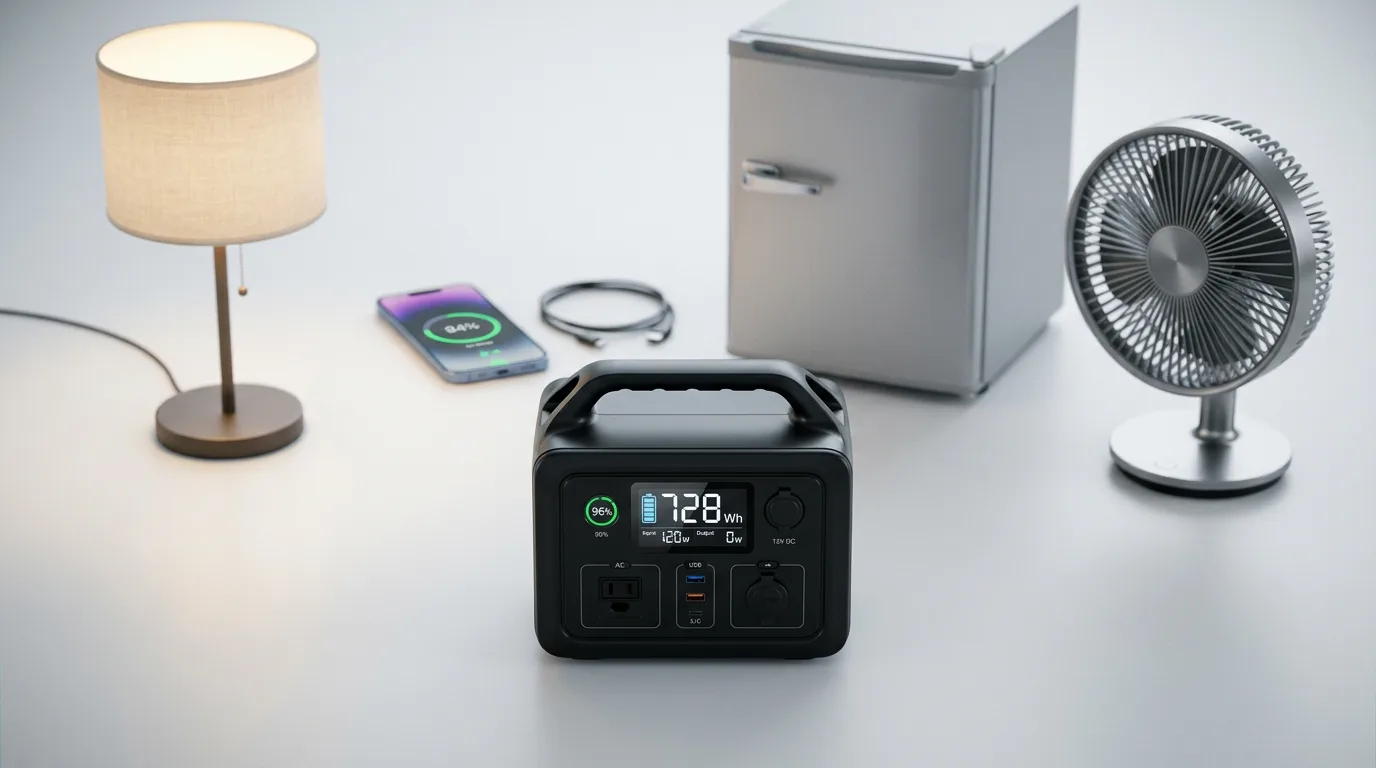
The single biggest mistake solar generator buyers make has nothing to do with brand selection or battery chemistry. It is buying a power station without knowing how much power they actually need. A 500Wh station can run a CPAP machine for a full night or drain completely in 40 minutes trying to power a space heater. Same station, wildly different results — and the difference is just math.
This guide covers the four electrical concepts you need — watts, watt-hours, volts, and amps — and shows you how to calculate device runtime, account for real-world efficiency losses, and size a power station to your actual needs. No electrical engineering degree required. Just arithmetic.
Watts: The Rate of Energy Flow
A watt (W) measures how fast energy flows at any given instant. Think of it as the speedometer of electricity. A 60W light bulb uses energy at a rate of 60 watts every moment it is turned on. A 1,500W space heater uses energy 25 times faster than that bulb.
When you look at a power station's "output" rating (e.g., "1,200W continuous, 2,400W surge"), that number tells you the maximum rate at which the station can deliver power. It does not tell you how long it can sustain that rate — that depends on the battery capacity in watt-hours.
The continuous wattage rating is the maximum sustained load the inverter can handle. The surge rating (often double the continuous) handles the brief spike when a motor-driven device starts up. A refrigerator rated at 150W continuous might draw 400-500W for the first half-second when the compressor kicks on.
Watt-Hours: The Total Energy in the Tank
A watt-hour (Wh) measures the total amount of energy stored or consumed over time. If watts are the speedometer, watt-hours are the fuel gauge. A power station rated at 1,000Wh contains 1,000 watt-hours of stored energy — enough to deliver 1,000 watts for 1 hour, or 100 watts for 10 hours, or 50 watts for 20 hours.
The formula is straightforward:
Runtime (hours) = Station Capacity (Wh) / Device Wattage (W)
A 500Wh station powering a 50W fan: 500 / 50 = 10 hours of theoretical runtime. But this calculation ignores efficiency losses (covered below), so the actual runtime will be shorter.
Watt-hours are the most useful unit for comparing power stations because they normalize capacity regardless of voltage. A station with a 12.8V / 40Ah LiFePO4 battery and a station with a 25.6V / 20Ah battery both store 512Wh — the same total energy, despite the different voltage and amp-hour ratings.
Volts and Amps: The Underlying Components
Voltage (V) is the electrical "pressure" that pushes electrons through a circuit. Current, measured in amperes or amps (A), is the quantity of electrons flowing. Power (watts) is the product of the two:
Watts = Volts x Amps
This relationship appears everywhere in power station specs:
- Battery specs: A 51.2V / 20Ah battery stores 51.2 x 20 = 1,024Wh
- USB output: A USB-A port at 5V / 2.4A delivers 12W
- USB-C PD: A 20V / 5A USB-C PD port delivers 100W
- AC output: A US wall outlet at 120V / 10A delivers 1,200W
- Solar input: A panel rated 18V / 5.5A produces 99W
For power station buyers, the most practical application of this formula is converting between milliamp-hours (mAh) and watt-hours — because phone batteries and power banks are almost always rated in mAh while power stations use Wh.
Converting mAh to Wh
Wh = mAh x Voltage / 1,000
Your phone has a 5,000mAh battery at 3.7V nominal: 5,000 x 3.7 / 1,000 = 18.5Wh. A "20,000mAh" power bank at 3.7V contains 74Wh — not 20,000 of anything particularly useful. Manufacturers use mAh because the bigger number looks more impressive in marketing. Always convert to Wh for apples-to-apples comparison.
Calculating Device Runtime: The Real Formula
The simple formula (Station Wh / Device W = hours) gives a theoretical maximum. Real-world runtime is always shorter because of three efficiency losses that compound.
Loss 1: Inverter Efficiency (10-15%)
The inverter inside a power station converts DC battery power to AC outlet power. This conversion is not free — it generates heat, which represents wasted energy. Most power station inverters operate at 85-90% efficiency. A station rated at 1,000Wh delivers roughly 850-900Wh of usable AC power.
USB output is more efficient because it stays in DC — no inverter needed. A station powering devices via USB typically delivers 90-95% of its rated capacity.
Loss 2: Battery Management Overhead (5-10%)
The BMS (Battery Management System) consumes a small amount of power continuously — monitoring cell voltages, temperatures, and balancing charge across cells. Additionally, most power stations shut down when the battery drops to 5-10% remaining capacity to prevent over-discharge damage. That bottom 5-10% is energy you paid for but cannot access.
Loss 3: Power Factor and Surge Consumption
Devices with motors (fans, refrigerators, blenders, power tools) have a power factor less than 1.0, meaning they draw more apparent power than their rated wattage suggests. A fan rated at 50W might draw 55-60 "apparent" watts from the station. And every time a motor starts, it draws a surge that can be 2-3x the rated wattage for a fraction of a second. Those surges drain the battery slightly faster than steady-state calculations predict.
Putting It All Together
Real-world runtime formula for AC devices:
Runtime (hours) = (Station Wh x 0.80) / Device Wattage
Examples with a 1,000Wh power station:
- LED light (10W): (1,000 x 0.80) / 10 = 80 hours
- Laptop (45W): (1,000 x 0.80) / 45 = 17.8 hours
- CPAP machine (40W average): (1,000 x 0.80) / 40 = 20 hours
- Mini fridge (50W average): (1,000 x 0.80) / 50 = 16 hours (compressor cycles on/off)
- Electric kettle (1,200W): (1,000 x 0.80) / 1,200 = 0.67 hours (40 minutes)
- Space heater (1,500W): Cannot run — exceeds 1,200W station output limit
Note the space heater: even if the station had enough watt-hours, the device wattage exceeds the inverter's continuous output rating. Watts (power rate) and watt-hours (energy stored) are independent constraints — both must be satisfied.
Multiple Devices: Adding Up Total Load
When running multiple devices simultaneously, add their wattages to find the total load. Then check two things: does the total load exceed the station's continuous output wattage, and how long will the combined load drain the battery?
Example camping setup:
- Phone charging: 15W
- LED lantern: 8W
- Portable fan: 30W
- CPAP machine: 40W
Total simultaneous load: 93W
With a 500Wh station: (500 x 0.80) / 93 = 4.3 hours of runtime with all four devices running simultaneously. That is not enough for a full night of CPAP use plus fan. You would need either a larger station, a solar panel for daytime recharging, or to stagger device use (run the fan while the CPAP is off, and vice versa).
Real-World Power Consumption Reference
This table shows typical wattage draws for common devices. Use these numbers for planning — but always check your specific device's label for accuracy.
| Device | Typical Wattage | Runtime on 500Wh Station | Runtime on 1,000Wh Station |
|---|---|---|---|
| Smartphone charge | 10-15W | 27-40 hrs | 53-80 hrs |
| Laptop | 30-65W | 6-13 hrs | 12-27 hrs |
| LED lantern | 5-15W | 27-80 hrs | 53-160 hrs |
| CPAP machine | 30-60W | 7-13 hrs | 13-27 hrs |
| Portable fan | 20-50W | 8-20 hrs | 16-40 hrs |
| Mini fridge | 40-60W avg | 7-10 hrs | 13-20 hrs |
| Electric blanket | 40-100W | 4-10 hrs | 8-20 hrs |
| TV (32" LED) | 30-55W | 7-13 hrs | 15-27 hrs |
| Coffee maker | 600-1,200W | 20-40 min | 40-80 min |
| Microwave | 700-1,200W | 20-34 min | 40-69 min |
| Hair dryer | 800-1,800W | 13-30 min | 27-60 min |
| Space heater | 750-1,500W | 16-32 min | 32-64 min |
Runtimes use the 80% efficiency factor. Notice that heating appliances (coffee makers, heaters, hair dryers) drain batteries in minutes, not hours. Resistive heating is the most energy-hungry application and is the primary reason people undersize their power stations.
Capacity Tiers: Matching Watt-Hours to Your Needs
Power stations fall into rough capacity tiers. Knowing which tier you need prevents both undersizing (running out of power) and oversizing (paying for capacity you never use).
- Under 300Wh (Compact): Phone and laptop charging, LED lights, small fans. One night of CPAP. Day trips, picnics, basic car camping. Light enough to carry one-handed.
- 300-600Wh (Mid-Compact): Everything above plus a small TV, electric blanket, or mini fridge for several hours. Weekend camping trips. A full night of CPAP with margin.
- 600-1,200Wh (Mid-Range): Extended camping, basic RV supplement, brief home backup. Can run a mini fridge overnight, power a CPAP for 2-3 nights, or handle a coffee maker for a few cups. The sweet spot for most recreational users.
- 1,200-2,500Wh (High-Capacity): Serious home backup (12-24 hours for essential loads), extended off-grid stays, RV full-time supplement. Can run a full-size refrigerator for 12-18 hours or power multiple devices for days.
- 2,500Wh+ (Whole-Home): Full home backup during outages, off-grid primary power, construction sites, and outdoor events. Often expandable with add-on batteries. Can power refrigerator, lights, router, and devices for 1-3+ days depending on load.
The Solar Recharging Factor
A solar panel changes the capacity equation entirely. Instead of needing a station large enough for your entire trip duration, you need a station large enough for overnight use — because the panel recharges it during the day.
If your nightly draw is 200Wh and your solar panel produces 400Wh per day in good conditions, a 300Wh station is sufficient for indefinite camping — the panel replenishes more than you use each night. Without the panel, that same 300Wh station lasts only 1.5 nights.
Solar recharging shifts the sizing question from "how much capacity do I need for the whole trip?" to "how much capacity do I need between sunsets?" This is why experienced off-grid campers often choose a mid-range station with a large solar panel over a high-capacity station with no panel.
Solar panel output varies by season and latitude. A 200W panel in June at 35 degrees north latitude (roughly southern Tennessee or Albuquerque) produces peak output for about 5-6 usable hours per day, generating 600-720Wh in ideal conditions. That same panel in December at the same latitude drops to 3-4 usable hours, producing 360-480Wh. Planning for winter off-grid use requires either more panel wattage or a larger battery to compensate for shorter solar windows.
Combining panel wattage with station capacity gives you the daily energy balance equation: if your panels produce more watt-hours per day than your devices consume, the system is self-sustaining. If consumption exceeds production, you draw down the battery each day and eventually run out. The math is the same whether you are running a weekend campsite or sizing a permanent off-grid cabin system — just different numbers in the formula.
Watt-Hours and Power Math FAQ
What is the difference between watts and watt-hours?
Watts (W) measure the rate of energy use at any given moment — like the speedometer in a car. Watt-hours (Wh) measure the total energy consumed over time — like the odometer. A 60W light bulb running for 2 hours consumes 120Wh. A power station rated at 500Wh can deliver 500 watts for 1 hour, 100 watts for 5 hours, or 50 watts for 10 hours (minus efficiency losses).
How do I convert milliamp-hours (mAh) to watt-hours (Wh)?
Multiply milliamp-hours by the battery voltage, then divide by 1,000. Formula: Wh = mAh x V / 1,000. A phone battery rated at 4,500mAh at 3.7V contains 16.65Wh. A power bank rated at 20,000mAh at 3.7V contains 74Wh. Phone and power bank manufacturers often use mAh because the numbers look bigger — 20,000mAh sounds more impressive than 74Wh, even though they describe the same energy.
Why does my power station not last as long as the watt-hour rating suggests?
Three reasons. First, the inverter that converts DC battery power to AC outlet power consumes 10-15% of the energy as heat — this is inherent to all power stations. Second, most power stations stop discharging at 5-10% remaining capacity to protect the battery cells. Third, if you are powering devices with motors (fans, blenders, compressors), they draw surge power on startup that can exceed their rated wattage by 2-3x, draining the battery faster than steady-state calculations predict.
How many watt-hours do I need for a camping trip?
A typical weekend camping setup — charging two phones daily, running an LED lantern for 4 hours per night, and powering a small fan for 6 hours — draws roughly 150-200Wh per day. A 3-day trip needs 450-600Wh before accounting for efficiency losses. With a 20% efficiency buffer, target 540-720Wh of station capacity, or a smaller station with a solar panel for daytime recharging.
What is the 80% rule for power stations?
Multiplying a power station rated capacity by 0.80 gives a more realistic estimate of usable energy. A 1,000Wh station delivers roughly 800Wh of actual power to your devices after accounting for inverter losses, BMS overhead, and the minimum charge reserve. Some manufacturers are beginning to quote "usable capacity" instead of total capacity, which already accounts for this gap.
Does a higher wattage device drain the battery faster?
Yes, proportionally. A 100W device drains a 500Wh battery in roughly 4 hours (after efficiency losses). A 500W device drains the same battery in roughly 45 minutes. The watt-hour capacity does not change, but the rate of consumption determines runtime. This is why knowing your devices actual wattage — not just the marketing description — is critical for runtime planning.
Ready to Buy? Start Here
Based on this guide, our #1 recommendation:
EcoFlow DELTA 2 The most feature-rich expandable station to put your watt-hour knowledge to use Read Full Review →