UL Certification for Power Stations: What It Means and Why It Matters
Every portable power station on Amazon has a spec sheet full of numbers — watt-hours, output watts, solar input. But one spec is missing from most marketing pages: whether the product passed independent safety testing. UL 2743 certification is the standard that answers that question for portable power packs. Some brands have it on every model. Others skip it entirely. The difference is not about performance — it is about what happens when something goes wrong.
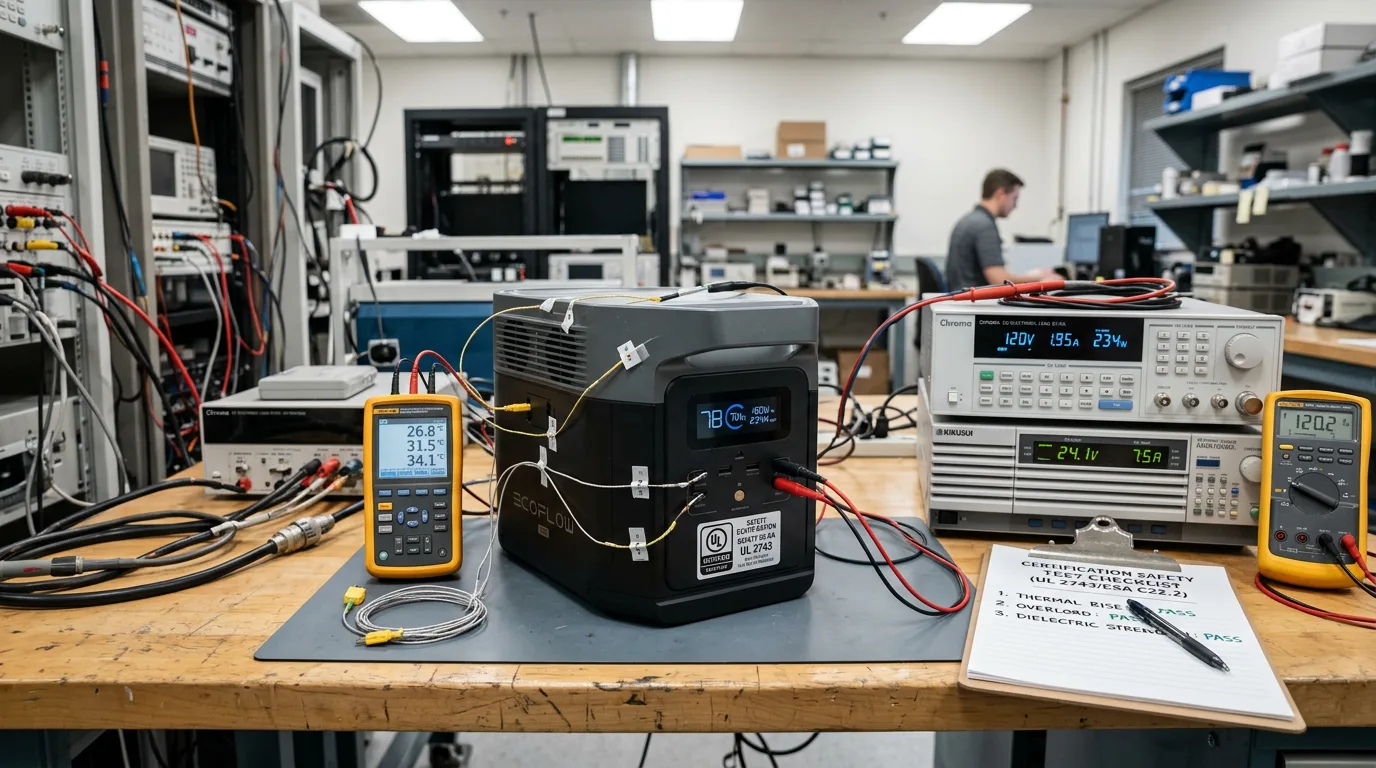
A lithium battery stores a tremendous amount of energy in a small space. That energy is useful when it flows through a well-designed inverter to your appliances. It is dangerous when it flows uncontrolled through a short circuit, a damaged cell, or a faulty BMS board. Safety certifications exist because the difference between those two outcomes depends on engineering decisions that are invisible to the buyer. You cannot tell from the outside whether a power station has adequate overcurrent protection, proper thermal management, or a fire-resistant enclosure. UL testing answers those questions with controlled laboratory conditions, not marketing promises.
What UL 2743 Covers
UL 2743 is the Underwriters Laboratories standard for "Portable Power Packs" — battery-powered devices intended for general consumer use. It was created because lithium battery products did not fit cleanly under older UL standards written for lead-acid equipment. The standard covers the full product as sold: battery cells, battery management system, inverter, charge controller, wiring, connectors, and enclosure. Testing a component is not enough — UL 2743 tests the assembled system.
Electrical safety tests. Insulation resistance between live parts and accessible surfaces. Grounding continuity. Leakage current at maximum rated load. Input/output overcurrent protection verification. These tests confirm that the product does not electrocute the user under normal or foreseeable misuse conditions. A charger with a cracked insulation layer or an inadequate ground path fails here.
Battery abuse tests. This is the section that matters most for portable power stations. UL subjects the battery pack to conditions far beyond normal use: overcharging past the rated voltage, short-circuiting the terminals, dropping from 1 meter onto concrete, thermal cycling between -40°C and 72°C, and forced discharge below the safe voltage floor. Each test is designed to trigger the failure mode it targets — and the product must not catch fire, explode, or vent toxic gases in a way that endangers the user. The battery management system is the first line of defense in every abuse test. If the BMS does not cut power fast enough during a short circuit, the test fails.
Fire enclosure testing. If an internal component does catch fire — a rare but possible event in any lithium product — the enclosure must contain or resist propagation. The housing material is rated for flammability. Ventilation openings are checked to ensure flames cannot escape through gaps. This test separates well-built enclosures from cosmetic plastic shells that would melt in a thermal event.
Marking and labeling. Every UL Listed product must carry specific labels: voltage rating, watt-hour capacity, charging instructions, and safety warnings in the correct format. Mislabeled or missing warnings fail the certification. This may sound trivial, but a power station that claims 2,000W output while actually delivering 1,800W sustained is a labeling failure with real safety implications — the user may connect loads that exceed the inverter's true capacity.
UL Listed vs UL Recognized vs FCC — the Distinction That Matters
Marketing materials often blur the lines between different certifications. Three terms appear on power station listings, and they mean very different things.
UL Listed. The complete, assembled product was submitted to UL laboratories, tested under UL 2743, and passed every applicable test. The product carries a UL listing mark with a file number. This is the gold standard for consumer safety verification. When a retailer or insurance company asks "Is this product UL certified?" they mean UL Listed.
UL Recognized. A component inside the product was tested in isolation. Typically the battery cells themselves, or the BMS circuit board. "UL Recognized cells" means the cells were tested under UL 1642 (lithium battery cell standard) — they passed crush, nail penetration, and overcharge tests at the cell level. But the assembled product — the cells wired together with the BMS, inverter, charge controller, cooling system, and enclosure — was never tested as a complete unit. A power station built with UL Recognized cells and a poorly designed BMS can still fail catastrophically.
FCC certification. Federal Communications Commission testing covers electromagnetic interference — it confirms the product does not emit radio frequency noise that disrupts other electronics. FCC Part 15 is required for any electronic device sold in the US. It has nothing to do with battery safety, fire risk, or electrical shock protection. A power station that is "FCC certified" has passed an EMI test, not a safety test. When a listing mentions only FCC and not UL, the product has not undergone independent safety testing.
Why Brands Skip Certification
UL 2743 certification is expensive and slow. The testing and listing process costs tens of thousands of dollars per model depending on product complexity and the number of models submitted. A brand with 8 power station models in its lineup can face certification costs in the hundreds of thousands. The process takes 3 to 12 months from submission to listing, during which the product cannot be sold through channels that require certification.
For established brands with high sales volume, the cost is absorbed easily. EcoFlow, Jackery, Bluetti, and Anker certify their flagship models because the sales revenue justifies the expense — and because Amazon and Costco require it for prominent placement. The certification cost per unit on a model that sells 100,000 units is under $1.
For smaller brands, startups, and budget manufacturers, the equation is different. A new brand with an unproven product and uncertain sales volume may spend more on UL certification than on the entire first production run. The temptation is to launch without certification, build sales volume, and certify later — if ever. Some budget brands maintain this approach permanently: their products sell on Amazon without UL listing, relying on customer trust and Amazon's own product safety programs instead.
There is also a design cost. UL testing sometimes reveals design flaws that require engineering changes — a BMS response time too slow, an enclosure material that fails the flammability test, a charging circuit without adequate isolation. Fixing these problems adds cost to the bill of materials. A brand that skips certification avoids discovering those flaws. The product may be perfectly fine. Or it may have the exact failure mode that UL testing would have caught.
What UL Certification Does Not Guarantee
UL 2743 is a safety baseline, not a quality guarantee. A UL Listed power station will not electrocute you, will not catch fire under the tested abuse conditions, and meets minimum standards for insulation and enclosure integrity. But UL does not test: inverter efficiency, actual runtime versus claimed watt-hours, solar charge controller performance, build quality durability over 3 years of use, customer service responsiveness, or whether the advertised wattage is sustainable or just a peak surge number.
A UL Listed power station can still have a lousy inverter that produces noisy modified sine wave output. It can still have a fan that runs at irritating volume. It can still have a poorly calibrated fuel gauge that reads 20% when the battery is actually at 5%. Safety and quality overlap but are not the same thing. UL certification tells you the product will not harm you. It does not tell you the product will impress you.
UL testing also happens at a point in time. The sample submitted for testing was manufactured under specific conditions. If the manufacturer later changes suppliers for a cheaper BMS chip, swaps the enclosure plastic for a lower-grade material, or reduces the wire gauge to cut costs, the production units may not match the tested sample. UL conducts follow-up factory inspections, but these occur quarterly or annually — changes between inspections can go undetected. This is rare among reputable brands but has happened with budget manufacturers.
Other Safety Standards You Will See
UL 2743 is the primary standard for portable power stations in the US market, but it is not the only safety mark on the box.
DOE (Department of Energy) compliance. Since 2016, external power supplies and battery chargers sold in the US must meet DOE efficiency standards. This affects the AC adapter that comes with the power station — not the station itself. DOE compliance means the charger converts wall power to DC at a minimum efficiency level (typically 85%+ for chargers above 49W). Not a safety test, but a regulatory requirement.
UN 38.3 transportation testing. Required for shipping lithium batteries internationally. Tests include altitude simulation (low pressure at 11.6 kPa), thermal shock (-40°C to 75°C), vibration, shock, short circuit, and overcharge. UN 38.3 is not a consumer safety standard — it confirms the battery will not catch fire during air freight. Every lithium power station sold legally has passed UN 38.3 (or it could not have been imported). It is a shipping safety standard, not a use safety standard.
CE marking (European). The Conformité Européenne mark indicates the product meets EU safety directives. For power stations, this involves the Low Voltage Directive (LVD) and the Electromagnetic Compatibility Directive (EMC). CE marking is required for sale in the European Economic Area. The testing is broadly comparable to UL standards but follows different test procedures (IEC standards rather than UL standards). A CE-marked power station has undergone independent safety testing — just under a different framework than UL.
ETL Listed (Intertek). Some power stations carry an ETL mark instead of a UL mark. ETL is issued by Intertek, a competing testing laboratory. ETL-listed products are tested to the same UL 2743 standard — the difference is which lab performed the testing, not what was tested. Retailers and insurance companies accept ETL and UL interchangeably. If you see an ETL mark with a UL 2743 scope, the product has passed identical safety tests.
The Practical Buying Decision
For home backup use, UL certification is close to non-negotiable. A power station connected to your home (even as a portable backup during outages) sits alongside your furniture, your sleeping family, and your irreplaceable belongings. The fire risk from a defective lithium product — while statistically small — has severe consequences when the product is inside a home. Insurance coverage, fire safety, and peace of mind all favor a UL Listed unit.
For outdoor and camping use, the risk profile is different. A power station on a picnic table at a campsite is surrounded by open air, not enclosed walls. A thermal event outdoors is serious but far less catastrophic than one inside a bedroom. Budget-conscious buyers who use power stations exclusively outdoors may reasonably accept a non-certified unit from a reputable brand — understanding that they are trusting the manufacturer's quality control rather than independent verification.
For van life and vehicle use, consider the environment. A power station installed inside a van conversion operates in an enclosed space with limited ventilation, often near sleeping areas and flammable materials (bedding, curtains, wood paneling). This environment is closer to a home than a campsite. UL certification carries more weight here. A thermal event in a van at 2 AM is an emergency with very limited escape options.
How to Verify Certification Yourself
Do not trust the product listing or the box alone. Verification takes 60 seconds.
Step 1: Find the model number on the product itself (bottom label or rear panel). Marketing model names ("EcoFlow DELTA 2") are not always the same as the certified model number. The certification label will show the exact tested designation.
Step 2: Go to productiq.ulprospector.com (free, no account required). Search by company name or model number. The database returns all UL listings for that manufacturer, including the standard (UL 2743 for power stations), the scope (which models are covered), and the listing file number.
Step 3: Match the file number on the database to the file number printed on the product label. They must match. A product claiming UL certification with a file number that does not appear in the database is either mislabeled or fraudulent.
For ETL-listed products, use the Intertek directory at intertek.com/directories. The process is identical — search by manufacturer, match the model and file number.
If the product has no listing in either database, it is not independently safety-certified — regardless of any marks printed on the packaging. Some counterfeit products carry fake UL logos. The database is the only reliable source.
UL Certification Questions
Is UL 2743 required by law for portable power stations?
No. There is no federal law in the United States requiring UL 2743 certification for portable power stations sold to consumers. It is a voluntary standard. But major retailers like Amazon, Costco, and Home Depot often require UL certification as a condition of listing. Some states reference UL standards in their building and fire codes for energy storage devices used indoors. The practical effect: most brands pursue UL listing not because the law demands it, but because their sales channels do.
What does UL 2743 actually test?
UL 2743 covers portable power packs — battery-powered devices intended for general consumer use. Testing includes electrical safety (insulation, grounding, current protection), battery abuse tests (overcharge, short circuit, crush, drop from 1 meter, thermal cycling from -40°C to 72°C), fire enclosure testing (the housing must contain or resist fire propagation), and marking/labeling requirements. A unit that passes all tests earns the UL listing mark, which tells buyers the product was independently verified under controlled laboratory conditions.
What is the difference between UL Listed and UL Recognized?
UL Listed means the complete finished product was tested and certified — the entire power station as assembled. UL Recognized means a component inside the product was tested in isolation — typically the battery cells or the BMS board. A power station using UL Recognized cells is not the same as a UL Listed power station. The cells passed, but the assembled product with its wiring, inverter, cooling system, and enclosure was never tested as a complete unit. Some brands advertise UL Recognized cells as if the whole product is UL certified — read carefully.
Do all major power station brands have UL certification?
The major brands — EcoFlow, Jackery, Bluetti, Anker — carry UL 2743 or equivalent certification (such as FCC Part 15 for EMI and DOE compliance for efficiency) on their flagship models. Smaller brands and budget models sometimes skip UL certification entirely or certify only select models while selling non-certified variants alongside them. The certification process costs $30,000 to $100,000+ and takes 3 to 12 months, which is why newer brands or budget lines may launch without it.
Can a power station be safe without UL certification?
Yes — certification is about verified safety, not guaranteed safety. A well-engineered power station from a reputable manufacturer can be perfectly safe without a UL sticker. But without third-party testing, you are trusting the manufacturer quality control entirely. UL certification means a neutral laboratory subjected the product to abuse scenarios — overcharge, short circuit, drop tests, extreme temperatures — and it passed. Without that testing, you have no independent confirmation that the BMS, wiring, and enclosure will handle real-world failure modes correctly.
Does UL certification affect my insurance coverage?
It can. If a non-UL-certified power station causes a house fire, your insurance company may deny the claim or pursue subrogation against the manufacturer. Insurance adjusters and fire investigators check whether devices involved in fires carry recognized safety certifications. A UL Listed product has a paper trail showing it met safety standards — this strengthens your position in any claim. Some homeowner insurance policies specifically mention UL-listed devices in their terms for energy storage. Check your policy if you plan to use a power station for home backup.
Shop Certified Power Stations
Every power station in our compact, mid-range, and high-capacity roundups notes its certification status. For the full safety picture beyond certification, read our safety guide covering LiFePO4 thermal stability, charging best practices, and storage protocols.
Ready to Buy? Start Here
Based on this guide, our #1 recommendation:
Anker SOLIX F3800 Premium UL-certified build with wheels for portable whole-home backup Read Full Review →