Solar Generators for Beginners: Everything You Need to Know Before Your First Buy
A solar generator is a rechargeable battery with built-in outlets. Plug in your devices, and it powers them from stored electricity — no gas, no emissions, no noise. You charge it from a wall outlet, a car adapter, or solar panels. That is the entire concept. Everything else is details, and this guide covers all of them.
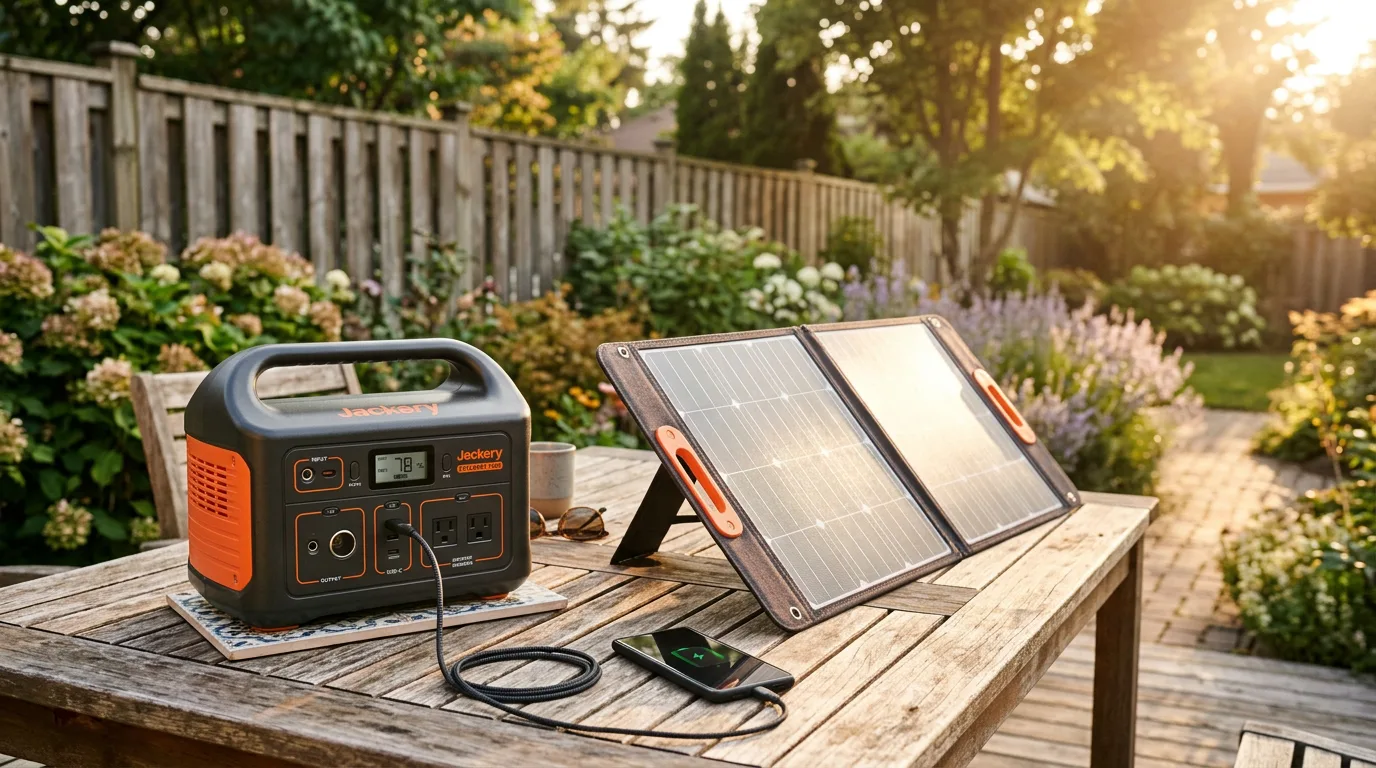
If you have never owned a portable power station before, the spec sheets are intimidating. Watt-hours, continuous watts, surge watts, MPPT, LiFePO4 — the terminology reads like an engineering manual. But the buying decision is simpler than the specs suggest. You need to answer three questions: what will I power, for how long, and where will I use it? The rest follows naturally.
What a Solar Generator Actually Does
Strip away the marketing and a solar generator is three things in one box: a battery that stores electricity, an inverter that converts stored DC power to the AC power your household devices need, and a charge controller that manages incoming power from outlets and solar panels.
That box has outlets on the outside — standard AC plugs (the same kind on your wall), USB ports (for phones and tablets), and usually a 12V car-style port (for coolers and car accessories). You plug in whatever you need to power, and the battery drains as those devices draw electricity.
When the battery runs low, you recharge it. The three recharging methods — wall outlet, car adapter, and solar panels — give you flexibility. At home, plug into the wall. On the road, plug into your car's 12V outlet. At a campsite with sun, connect solar panels. Most people use wall charging as their primary method and solar as a supplement.
The Three Numbers That Matter: Capacity, Output, and Surge
Every solar generator spec sheet leads with three numbers. Understand these and you can evaluate any unit on the market.
Capacity (Wh — watt-hours) is battery size. A 500Wh battery stores 500 watt-hours of energy. To calculate how long it powers a device: divide capacity by the device's wattage. A 500Wh battery runs a 50W device for about 10 hours (500 ÷ 50 = 10). Real-world efficiency is about 85-90%, so expect slightly less in practice.
Output (W — watts, continuous) is the maximum power the inverter can deliver at any moment. A 1,000W unit can power devices that collectively draw up to 1,000 watts. Plug in a 1,200W microwave and the unit either throttles it, shuts down, or triggers an overload warning. Match output to your highest-draw device.
Surge (W — watts, peak) is the brief burst the inverter can handle for 1-2 seconds during motor startup. Refrigerators, air conditioners, and power tools draw 2-3x their rated wattage for a fraction of a second when the motor kicks on. A unit with 2,000W continuous and 4,000W surge handles the startup spike of a device rated at up to roughly 3,500W.
Battery Types: LiFePO4 vs Lithium-Ion NMC
Modern solar generators use one of two battery chemistries. Understanding the difference takes 30 seconds and affects your purchase for the next decade.
LiFePO4 (lithium iron phosphate) is the current standard. It lasts 3,000-4,000 charge cycles (10-15 years of regular use), handles heat better, and is physically safer — it does not catch fire under fault conditions. It weighs slightly more per watt-hour than NMC. Every station we recommend in 2026 uses LiFePO4.
NMC (nickel manganese cobalt) was the previous standard. It lasts 500-1,000 cycles (2-4 years of regular use), is lighter per watt-hour, and costs less. Older or budget units still use NMC. Unless you are buying specifically for short-term use and want the lowest possible price, LiFePO4 is the better investment.
Charging Methods: How You Refill the Battery
Every solar generator supports at least two charging methods, and most support three or four. Understanding each method helps you plan around real-world constraints — not every situation gives you access to every charger.
AC wall charging is the fastest method for most units. You plug the station into a standard household outlet using the included cable, and the internal charger draws 200-1,600W depending on the unit. Entry-level stations take 4-8 hours from empty to full. Mid-range and high-capacity stations with fast-charging technology can reach full charge in under 90 minutes. This is the method you use at home before a camping trip, before a forecasted storm, or between weekend uses.
Car charging uses the 12V cigarette lighter port in your vehicle. It is the slowest method — typically 50-120W input, meaning a 1,000Wh battery takes 10-20 hours to charge from a car adapter. Car charging is a trickle, not a sprint. It works best for topping up during long road trips — adding 10-20% over a 3-hour drive rather than attempting a full charge. Keep your engine running while car-charging; drawing from a parked car's battery for hours can drain it enough to prevent starting.
Solar charging connects external panels to the station's DC input. Speed varies wildly based on panel wattage, sunlight angle, cloud cover, and temperature. A 200W panel in ideal conditions produces about 150W of actual input. Real-world solar charging is slower than wall charging but costs nothing after the initial panel investment. Solar is your backup method in extended outages and your primary method during multi-day off-grid trips.
Solar Panels: Optional but Valuable
Despite the name "solar generator," most units ship without solar panels. The battery station charges from wall outlets or car adapters perfectly fine. Solar panels add a recharging option — free electricity from sunlight — but they are a separate purchase and a separate decision.
If you plan to use your generator primarily at home for power outages, solar panels are a nice-to-have, not a necessity. You charge from the wall before a storm and use the stored power during the outage. If you plan to use it off-grid — camping, boating, remote work — solar panels become much more valuable because you have no wall outlet to fall back on.
Panel sizing follows a simple ratio: a 100W panel produces roughly 60-80W in real-world sun (clouds, angle, and heat reduce rated output). To charge a 1,000Wh battery from a 100W panel takes about 12-15 hours of direct sun — roughly two full sunny days. A 200W panel cuts that to 7-8 hours. A 400W panel array drops it to 3-4 hours. Match panel wattage to your patience and your off-grid frequency.
Sizing Your First Generator: A Decision Tree
I just need phone and laptop charging on camping trips: A compact 200-500Wh unit is all you need. Light, affordable, and enough for electronics and LED lights over a long weekend. Look at the VTOMAN FlashSpeed 600 or Anker SOLIX C1000 Gen 2 at the low end.
I want to run a portable fridge and charge devices: Step up to 1,000-1,200Wh. A portable fridge draws 40-60W continuous — combined with phone charging and lights, you need 500-800Wh per day. A 1,000Wh unit covers this with margin. The Jackery Explorer 1000 v2 and Oukitel P1000 Plus sit in this range.
I need home backup for outages: Start at 2,000Wh. A typical outage load — refrigerator, router, phone chargers, a few lights — draws 200-400W. A 2,000Wh battery runs that for 8-12 hours. For longer outages or more appliances, look at 3,000Wh+ units like the pecron F3000LFP or GROWATT HELIOS 3600.
I need to power everything in my house during multi-day outages: You are in whole-home backup territory — 3,000Wh+ with expandability. The GROWATT HELIOS 3600 expands to 36kWh with additional batteries. At this scale, solar panels become essential for recharging during extended outages.
Ports and Connections: What the Outlets Mean
AC outlets (120V): Standard household plugs. These power everything that plugs into your wall — lamps, fans, small appliances, TVs, routers. The number varies from 2-6 depending on the unit. For most users, 4 AC outlets covers any realistic scenario.
USB-C ports: Fast charging for phones, tablets, laptops, and newer devices. Look for at least one 100W USB-C port — that is enough to charge a MacBook Pro at full speed. Multiple USB-C ports let you charge several devices simultaneously without hogging the AC outlets.
USB-A ports: Older USB standard. Still useful for basic phone chargers, LED string lights, fans, and accessories. Most devices have moved to USB-C, but USB-A backward compatibility is nice to have.
12V car port: Powers car-style accessories — portable coolers, tire inflators, car vacuums. If you use any 12V accessories for camping or road trips, make sure your unit has one. Not all do.
Anderson/XT-60 solar input: Where solar panels connect. Most units use XT-60 or Anderson connectors. Check that your panels use the same connector type — or budget for an adapter.
Weight and Portability: What Numbers Mean in Practice
Weight matters more than spec sheets suggest. A 20-lb compact station goes in a backpack. A 45-lb mid-range unit needs two hands and some commitment to carry from car to campsite. A 65-lb+ high-capacity station needs two people or wheels.
The practical threshold for one-person portability is about 40-45 lbs. Below that, you can carry it from a car to a picnic table without stopping. Above that, you are either using a hand truck, getting help, or leaving it in the truck bed. If you plan to move your generator frequently, weight should be a primary decision factor — not an afterthought.
Your First Solar Generator Checklist
Before you buy, run through this quick list of essentials. If you can confidently check all five items, you have made a good match:
1. Capacity matches your highest-priority use case. Calculate your daily watt-hour need by adding up your devices and their runtimes. Add a 15% buffer for inverter efficiency. The number should fit within the generator's rated capacity.
2. Output covers your most power-hungry device. Check the wattage of the biggest thing you will plug in. The generator's continuous output must exceed it. The surge rating should handle the startup spike if it has a motor.
3. Weight is acceptable for how you will move it. If it goes in a car every weekend, 40 lbs is reasonable. If it goes on a boat or up stairs, lighter is better. If it stays in one spot, weight barely matters.
4. Battery chemistry is LiFePO4. In 2026, there is no reason to buy NMC for a primary solar generator. LiFePO4 costs slightly more upfront and lasts 3-5x longer.
5. Budget includes accessories you actually need. A solar panel if you need off-grid charging, an extension cord for placement flexibility, and port adapters if your devices use non-standard connectors. The station price is not your total cost.
Beginner Questions Answered
What is a solar generator exactly?
A solar generator is a rechargeable battery pack with built-in outlets — AC plugs, USB ports, and sometimes 12V car-style ports. It stores electricity and lets you power devices anywhere. Despite the name, solar panels are usually sold separately. Most units charge from wall outlets, car adapters, and solar panels.
How is a solar generator different from a gas generator?
Solar generators produce zero emissions, run silently, and need no fuel. Gas generators are louder, produce carbon monoxide (dangerous indoors), and require gasoline. Solar generators cost more upfront but have zero ongoing fuel costs. Gas generators produce more sustained power but cannot be used inside homes, tents, or vehicles safely.
Do I need to buy solar panels separately?
Usually yes. Most solar generators ship as station-only — the battery unit with outlets. Solar panels are a separate purchase. The EcoFlow DELTA 3 MAX is the notable exception in our catalog — it includes a 220W panel in the box. You can use any solar generator without panels by charging from a wall outlet or car adapter.
How long does a solar generator last on a single charge?
It depends on what you are running. A 500Wh generator runs a phone charger (20W) for about 25 hours, an LED light (10W) for 50 hours, or a mini-fridge (60W) for 8 hours. A 1,000Wh unit doubles those numbers. To calculate your runtime: divide the battery capacity by the wattage of your device.
Can I use a solar generator indoors?
Yes — this is one of their biggest advantages over gas generators. Solar generators produce no exhaust or emissions. You can safely run them in your bedroom during an outage, inside a tent while camping, or in a van. Just ensure adequate ventilation around the unit for cooling, especially under heavy loads.
What should my first solar generator be?
For most beginners, a mid-range 1,000Wh unit balances capability with cost. It powers phones, laptops, lights, small fans, and small appliances for 8-12 hours. The Jackery Explorer 1000 v2 and Anker SOLIX C1000 Gen 2 are both solid starting points in this class — proven reliability without premium pricing.
How much does a good solar generator cost?
Compact units (200-600Wh) run in the budget range. Mid-range units (1,000-1,200Wh) cost more but handle larger loads. High-capacity stations (2,000Wh+) handle full-size appliances but carry premium pricing. The best value per watt-hour often sits in the mid-range tier.
Ready to Pick Your First Solar Generator?
Now that you understand the basics, dive deeper into our complete buying guide for the full decision framework. Or jump straight to our best compact generators for beginner-friendly options that balance capability with simplicity.
Ready to Buy? Start Here
Based on this guide, our #1 recommendation:
Jackery Explorer 300 Brand trust and dead-simple operation for first-time solar generator buyers Read Full Review →