Solar Generator Safety: What Every Owner Should Know
LiFePO4 portable solar generators are among the safest consumer electronics you can own. No combustion, no exhaust, no fuel storage, no carbon monoxide, and a battery chemistry that resists thermal runaway. But "safe" does not mean "indestructible." Charging at the wrong temperature degrades the battery. Water intrusion damages electronics. Overloading the inverter triggers protection shutdowns. Understanding the safety boundaries — and staying inside them — is the difference between a generator that lasts a decade and one that fails in a year.
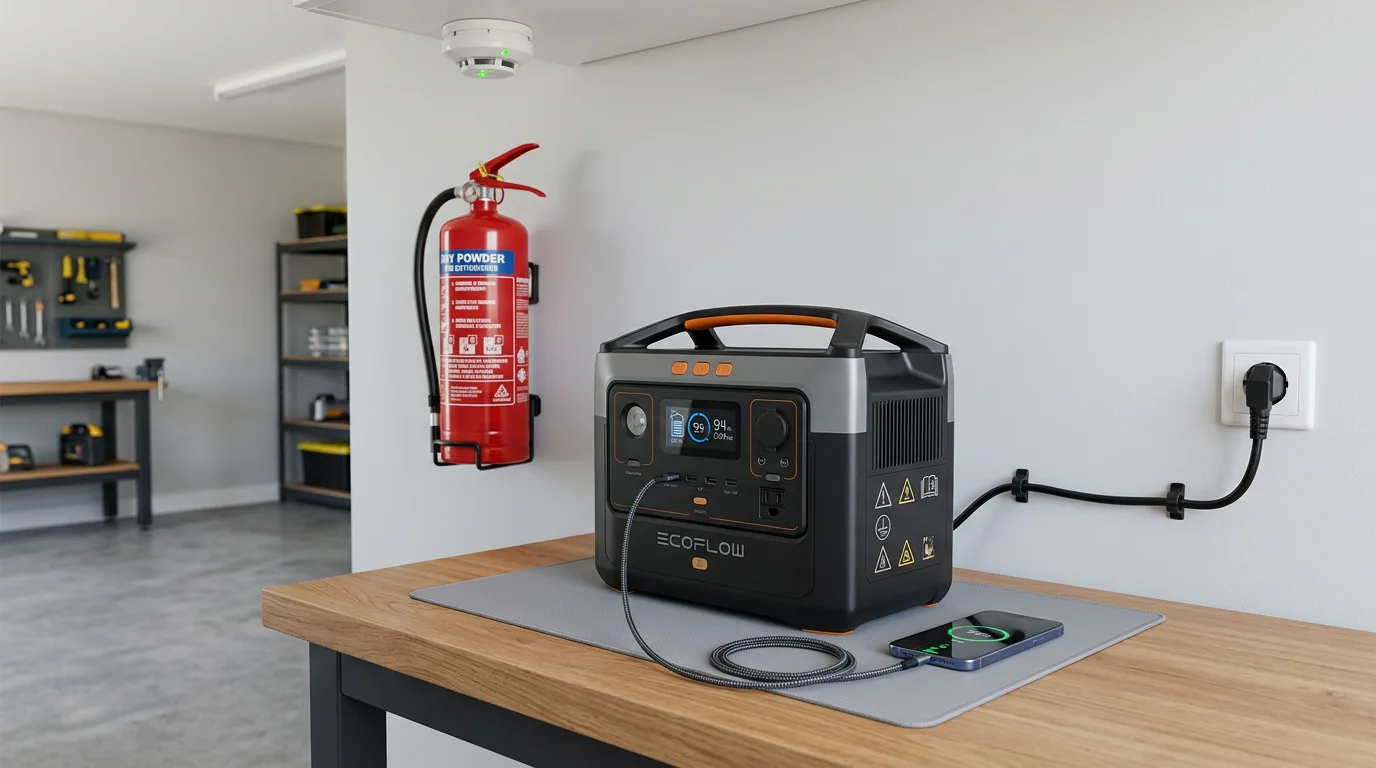
This guide covers the real safety considerations for portable LiFePO4 power stations. Not the theoretical worst-case scenarios that manufacturers print in liability-driven user manuals, but the practical safety knowledge that matters for camping, home backup, boating, van life, and everyday use.
The LiFePO4 Safety Advantage
Every solar generator we review uses lithium iron phosphate (LiFePO4) battery cells. This is not an arbitrary choice — it is the safest lithium battery chemistry commercially available. Understanding why requires a brief comparison with the alternative.
Lithium-ion NMC (nickel manganese cobalt) batteries — the type in your phone, laptop, and older power stations — store more energy per pound but have a dangerous failure mode called thermal runaway. If an NMC cell is punctured, overcharged, or heated above 150°C (302°F), the cathode releases oxygen internally, feeding an exothermic reaction that heats neighboring cells, creating a chain reaction. The result is an intense fire that is extremely difficult to extinguish. This is why lithium-ion laptop batteries occasionally make the news.
LiFePO4 cells do not experience thermal runaway. The iron phosphate cathode has an inherently stable crystal structure that does not release oxygen when heated. A LiFePO4 cell can be punctured, overcharged, or heated to 270°C (518°F) before reaching thermal instability — and even then, the failure mode is gas venting, not self-sustaining fire. In practical terms: a LiFePO4 battery that is abused will swell, vent gas, and stop working. It will not catch fire in a chain reaction.
This chemistry-level safety is why every major power station manufacturer has transitioned to LiFePO4 for their portable generators. The cost is lower energy density (LiFePO4 is 20-30% heavier per watt-hour than NMC), but for a product that sits next to a tent, in a boat, or inside a home, the fire safety advantage is worth the extra weight.
Charging Temperature Limits
Temperature is the single most important safety factor for LiFePO4 batteries. The battery management system (BMS) enforces temperature limits, but understanding them helps you avoid situations that trigger protective shutdowns.
Charging range: 32°F to 113°F (0°C to 45°C). Below 32°F, lithium ions cannot intercalate into the anode properly — forcing charge at sub-freezing temperatures causes lithium plating on the anode surface, permanently reducing capacity and creating internal short-circuit risk. The BMS will refuse to charge below 32°F on properly designed units. Above 113°F, the electrolyte degrades faster and internal resistance increases, generating excess heat during charging.
Discharging range: -4°F to 140°F (-20°C to 60°C). LiFePO4 batteries can discharge (power devices) at much lower temperatures than they can charge. At -4°F, capacity drops to about 60% of rated capacity, but the battery is not damaged. At 140°F, the BMS shuts down to prevent electrolyte degradation. Normal use in any climate between these extremes is safe.
The cold charging trap. This is the most common safety-relevant mistake. A generator left overnight in a vehicle during winter (below 32°F) cannot be solar charged in the morning until it warms up. The BMS blocks charging, the solar panel produces power with nowhere to go, and the user is left with a dead generator on a cold morning. The fix: bring the generator inside overnight, or warm it in the vehicle with the heater running before attempting to charge.
Indoor Use: What Is and Is Not Safe
Solar generators produce zero emissions. No carbon monoxide, no nitrogen oxides, no particulate matter, no combustion byproducts of any kind. They are completely safe to use and charge indoors. This is their fundamental advantage over gas generators, which produce lethal carbon monoxide and must never be used indoors.
The indoor safety considerations for solar generators are modest: heat management and ventilation for the cooling fan.
Cooling fan airflow. Every generator has a cooling fan that activates under load or during charging. The fan draws air through intake vents on one side and exhausts warm air from the other. Do not block either set of vents — place the generator on a hard surface (table, floor, countertop) with at least 4 inches of clearance on all sides. Do not place the generator on a bed, couch, carpet, or pillow — soft surfaces can block intake vents and cause overheating.
Heat output under load. A generator running at 50-80% capacity produces noticeable warmth from the case. In a small enclosed space (a closet, a tiny bathroom, a sealed tent), this heat can raise the ambient temperature enough to trigger the BMS thermal protection. Normal rooms, garages, basements, and even tent interiors with mesh ventilation are fine.
Never charge inside a sealed, airtight container. This is not about fumes — it is about heat. A generator in a sealed pelican case, zipped dry bag, or closed toolbox will overheat during charging because the heat has nowhere to go. If you use a protective case, ensure it has ventilation openings.
Water and Moisture Protection
No portable solar generator is waterproof. This is worth repeating because the number of generators damaged by water exposure each year is substantial. IP21 (the highest rating on most units) means protection against vertical dripping only — not rain, not splash, not spray.
The vulnerable points: AC outlets (unsealed openings), USB ports (recessed but not sealed), solar input port (often exposed on the top or back panel), ventilation grilles (open by design for airflow), and the LCD display (sealed behind glass but the surrounding bezel may not be watertight).
Rain protection: Under a canopy, tarp, tent vestibule, vehicle, or any overhead cover. Do not rely on the generator's housing to shed rain — water will enter through the ventilation grilles even if the ports are covered with silicone caps.
Condensation: Moving a generator from a cold environment to a warm, humid one (cold vehicle into a warm, humid morning) can cause condensation inside the case. This internal moisture can bridge electrical contacts. Allow 30 minutes for the generator to reach ambient temperature before turning it on after a significant temperature change.
Cable and Connection Safety
The most common real-world safety issue with portable generators is not the battery or the inverter — it is damaged cables and loose connections. A frayed cable carrying 15A at 120V can arc, overheat, and start a fire. A loose solar panel connection can spark and damage the charging port.
Inspect cables before every use. Check the AC power cord, solar panel cables, and 12V car charging cable for: exposed copper wire, cracked insulation, bent or corroded connector pins, and loose plug fit. Replace any cable that shows damage — do not tape over exposed wire.
Do not use extension cords on the AC output. Extension cords add resistance, which creates heat at the connection points. A 1,000W load through a 16-gauge household extension cord is within the cord's rating — but the connection point between the extension cord and the generator's AC outlet can generate enough heat to soften plastic housings. If you need distance between the generator and the load, use a heavy-gauge (14 or 12 AWG) outdoor-rated extension cord, and keep total cord length under 25 feet.
Solar panel connections. MC4 connectors (the standard for portable solar panels) are designed for a secure, weatherproof connection. But they are NOT designed for repeated daily connection and disconnection — the contact springs weaken over hundreds of cycles. If your solar panel connector feels loose or does not click firmly, replace the connector. A poor MC4 connection reduces charging efficiency and can arc under high current.
Overload Protection: What Happens When You Exceed the Limit
Every generator has an overload protection circuit that shuts down the AC inverter when the connected load exceeds the rated output. This is a safety feature, not a defect. A generator rated at 1,000W continuous with a 2,000W surge will shut down if you connect a 1,200W load. The shutdown is immediate — the inverter turns off, the display shows an overload warning, and all AC outlets go dead.
To recover from an overload shutdown: Disconnect the overloading device. Wait 10-30 seconds for the protection circuit to reset. Press the AC output button to restart the inverter. Reconnect a load within the generator's rated capacity.
Surge overloads are different from continuous overloads. Most generators tolerate a brief surge (0.5-2 seconds) above the continuous rating — this handles motor startup spikes from refrigerators, power tools, and compressors. But if the surge exceeds the surge rating, the protection circuit trips immediately. If a device repeatedly triggers overload protection on startup, the device draws more surge than the generator can handle — you need a higher-rated generator, not a workaround.
Never bypass overload protection. Some online guides suggest connecting high-draw devices through a soft-start adapter to prevent the protection from tripping. This works for motor startup surges but can mask a genuine overload condition where the continuous draw exceeds the rating. Running a generator above its continuous rating for extended periods overheats the inverter components and voids the warranty.
Storage Safety: When the Generator Sits Idle
LiFePO4 batteries self-discharge at about 2-3% per month — far slower than NMC lithium-ion (5-10% per month) or lead-acid (15-20% per month). A fully charged LiFePO4 generator left on a shelf for 6 months retains 85-90% of its charge.
Optimal storage charge level: 50-80%. Storing at 100% places the cells at their highest voltage, which creates slightly more chemical stress over months. Storing below 20% risks the cells dropping below minimum voltage during the self-discharge period, which can trigger the BMS low-voltage cutoff. The 50-80% range balances longevity with safety margin.
Storage temperature: 50-77°F (10-25°C). A climate-controlled room, basement, or closet is ideal. Avoid garages that reach extreme temperatures — a summer garage at 130°F (54°C) degrades the battery faster than normal use. A winter garage at -10°F (-23°C) is fine for storage (the battery is not being charged), but bring the generator indoors and let it warm to 32°F before charging.
Check stored generators every 3-4 months. Turn it on, check the charge level, and top up to 50-80% if it has dropped below 40%. This takes 5 minutes and prevents deep-discharge damage during long storage periods.
Safety Questions
Can a solar generator catch fire?
LiFePO4 batteries (used in every generator we review) are the safest lithium chemistry available. They do not experience thermal runaway — the chain reaction that causes lithium-ion NMC batteries to catch fire. LiFePO4 cells can be punctured, overcharged, or short-circuited without igniting. But no battery is immune to abuse. Charging a damaged unit, using a frayed cable, or exposing the generator to extreme heat above 140°F (60°C) can still create hazardous conditions. Follow the charging temperature limits and inspect cables regularly.
Is it safe to charge a solar generator indoors?
Yes. LiFePO4 solar generators produce no emissions during charging — no carbon monoxide, no hydrogen gas, no fumes. They are safe to charge in any indoor space with normal ventilation. The generator produces a small amount of heat during charging (the case may feel warm to the touch), which requires the cooling fan to operate. Do not charge inside an enclosed, airtight space like a sealed closet or a zipped tent — not because of fumes, but because the fan needs airflow to prevent overheating.
Can I leave a solar generator plugged in all the time?
Modern LiFePO4 generators have battery management systems (BMS) that stop charging when the battery reaches 100% and resume when it drops slightly. Leaving the generator plugged into an AC outlet is safe — the BMS prevents overcharging. For long-term storage (months), most manufacturers recommend storing at 50-80% charge and unplugging. Keeping a LiFePO4 battery at 100% for extended periods does not damage it (unlike NMC lithium), but 50-80% minimizes stress on the cells.
What should I do if my solar generator gets wet?
Disconnect all cables immediately. Do not turn the generator on or press any buttons. Wipe the exterior with a dry cloth and leave all port covers open. Place the generator in a dry, ventilated area for at least 48 hours. Do not use a hair dryer or heat source — excess heat can damage the battery or melt internal components. After drying, inspect all ports for corrosion before reconnecting. If the generator was submerged or took serious water intrusion, contact the manufacturer before using it.
Can I use a solar generator in the rain?
No portable solar generator is rated for rain exposure. Most carry an IP21 rating at best — protection from vertical dripping water. Horizontal rain, spray, or puddles will enter the ventilation grilles, charging ports, and AC outlets. Use the generator under a canopy, inside a tent vestibule, or inside a vehicle during rain. If caught in unexpected rain, cover the generator with a waterproof bag or tarp and disconnect all cables until conditions improve.
How long does a LiFePO4 solar generator last?
LiFePO4 batteries are rated for 2,500-3,500 charge cycles to 80% original capacity. One cycle equals draining from 100% to 0% and recharging to 100%. Partial cycles count proportionally — draining to 50% and recharging counts as half a cycle. At one full cycle per day (heavy use), a generator lasts 7-10 years before the battery degrades to 80% capacity. At 2-3 cycles per week (typical recreational use), the generator outlasts every other component — 15-20 years before battery degradation becomes noticeable.
Safe Power Starts with the Right Generator
Every generator in our reviews uses LiFePO4 batteries and pure sine wave inverters — the safest combination available. Browse our compact picks for camping and travel, or our whole-home systems for backup power. Need to understand the battery chemistry? Our LiFePO4 vs lithium-ion explainer covers the details.
Ready to Buy? Start Here
Based on this guide, our #1 recommendation:
Anker SOLIX C1000 Gen 2 LiFePO4 chemistry, UL certification, and enterprise-grade safety features Read Full Review →