Pure Sine Wave vs Modified Sine Wave: What Your Devices Need
The electricity from a wall outlet is a smooth, continuous wave — a pure sine wave oscillating at 60 Hz. Some portable generators replicate this waveform exactly. Others produce a cheaper approximation — a modified sine wave that looks like a staircase instead of a smooth curve. Most devices cannot tell the difference. Some devices can, and they protest with buzzing, overheating, reduced performance, or outright refusal to turn on. Knowing which of your devices cares — and which does not — determines whether the inverter type matters for your use case.
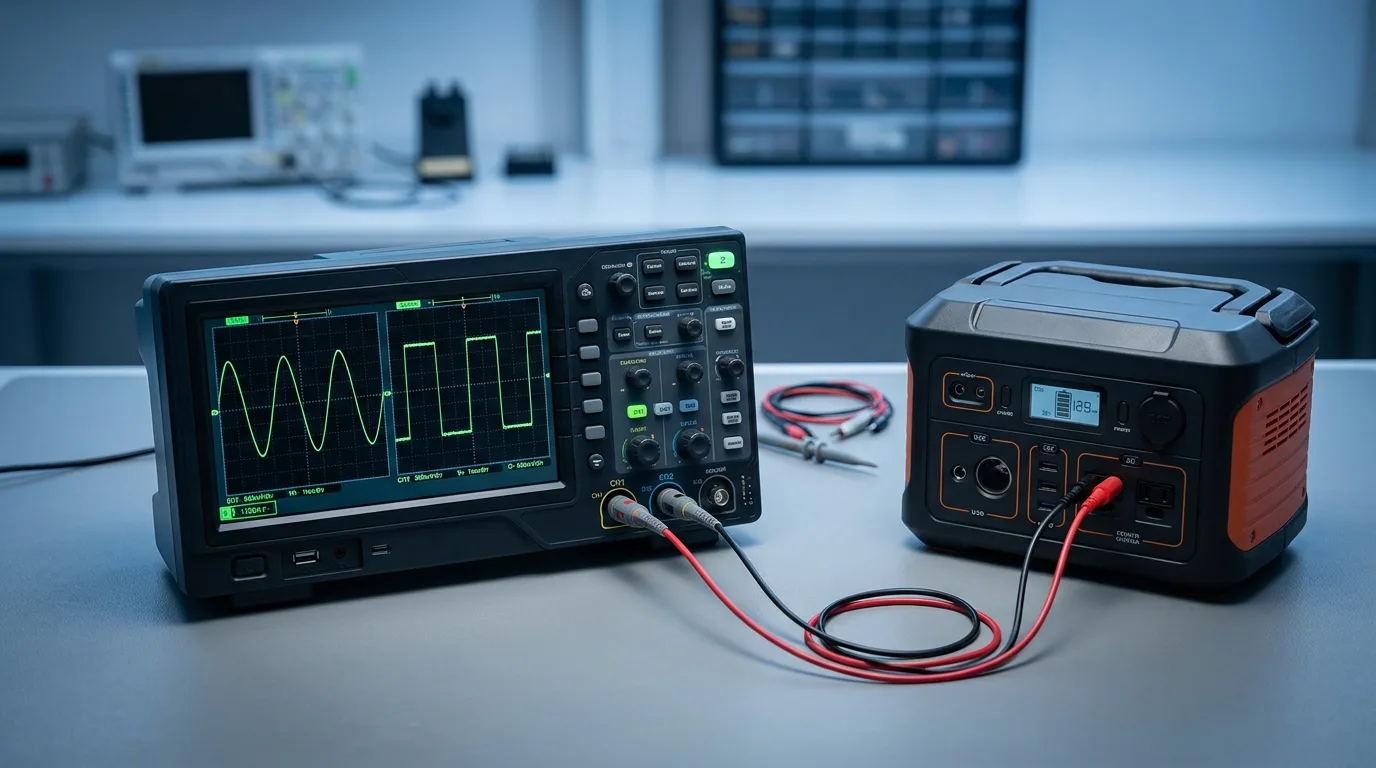
The short answer for portable solar generator buyers: every major brand now uses pure sine wave inverters across their entire product line. If you are buying a generator from EcoFlow, Anker, Jackery, Bluetti, VTOMAN, or any other well-known manufacturer, you are getting pure sine wave. The distinction matters when comparing against cheap off-brand units, car power inverters, or older generators from the pre-2020 era. It also matters if you already own a modified sine wave unit and want to know what you can safely run on it.
What a Sine Wave Actually Is
Alternating current (AC) electricity changes direction 60 times per second in North America (50 Hz in most of the rest of the world). The voltage rises smoothly from zero to a positive peak (+170V for a 120V outlet), falls back through zero to a negative peak (-170V), and returns to zero — tracing a smooth S-shaped curve. One complete cycle takes 1/60th of a second. This smooth, continuous oscillation is a pure sine wave.
The "120V" you see on the outlet is the RMS (root mean square) voltage — an average that accounts for the wave spending time at all voltages between zero and peak. Devices designed for 120V AC expect this smooth waveform. Their power supplies, motors, and transformers are optimized for it.
A pure sine wave inverter recreates this smooth curve electronically. It uses high-frequency switching circuits and filtering to produce a waveform that is virtually identical to grid power. Measured on an oscilloscope, the output looks like a perfect sine wave. Total harmonic distortion (THD) is typically under 3% — meaning the wave is 97%+ pure. Devices cannot tell the difference between this output and a wall outlet.
A modified sine wave inverter takes a shortcut. Instead of the smooth curve, it produces a stepped waveform: the voltage jumps from zero to positive peak, holds for a period, drops back to zero, pauses, jumps to negative peak, holds, and returns to zero. The result looks like a blocky approximation — a staircase attempting to mimic a curve. THD is typically 20-40%. Devices can tell the difference.
One detail that confuses buyers: the RMS voltage of a modified sine wave can be identical to a pure sine wave — both deliver 120V RMS. The difference is in how they deliver that voltage. A pure sine wave spends the most time near zero and the least time at peak. A modified sine wave spends equal time at peak and at zero, with abrupt transitions between them. Devices that measure voltage only (simple heaters, incandescent bulbs) see no difference. Devices that measure the shape of the waveform (motors, transformers, sensitive power supplies) see an entirely different input.
What the Stepped Waveform Does to Electronics
The sharp voltage transitions in a modified sine wave — the instantaneous jumps from zero to peak and back — cause specific problems in specific device types. Understanding the mechanism helps predict which devices are affected.
Motors run hotter and louder. AC motors (found in refrigerators, fans, power tools, and pumps) are wound to operate with the smooth torque delivery of a sine wave. Modified sine wave causes the magnetic field to pulse instead of rotating smoothly, creating vibration, audible buzz (a distinct hum at the step frequency), and additional heat in the windings. The motor still turns, but it works harder. In a refrigerator compressor, this means higher startup current, more noise, and shortened motor life.
Transformers buzz and waste energy. The iron cores in transformers vibrate at the harmonic frequencies created by the stepped waveform. This is the source of the audible buzzing from laptop chargers, battery chargers, and wall adapters on modified sine power. The vibration also generates heat in the core — energy wasted as noise and warmth instead of delivered to the load.
Sensitive electronics misbehave. Devices that measure the AC waveform for timing, synchronization, or power quality — like medical CPAP machines, audio equipment, and some smart home devices — can detect the modified waveform and respond unpredictably. A CPAP machine might display a power quality error. An audio amplifier might introduce a 60 Hz hum into the output. A dimmer switch might behave erratically.
Charging circuits run less efficiently. Switching power supplies (inside laptop chargers, phone chargers, and most modern electronics) can handle modified sine wave input — they rectify it to DC internally anyway. But the rectification is less clean, the filtering capacitors work harder, and overall charging efficiency drops by 5-15%. The charger gets warmer. The device charges slower. The generator's battery drains faster per unit of charge delivered.
Clocks and timers drift. Devices that use the AC frequency (60 Hz) as a time reference — older digital clocks, some microwave ovens, certain sprinkler timers — may keep inaccurate time on modified sine wave. The stepped waveform's zero-crossing points (where the voltage passes through zero) do not occur at the same intervals as a pure sine wave. A clock that gains or loses a few minutes per day is a minor annoyance. A sprinkler timer that misses its schedule wastes water. Modern devices with quartz crystal oscillators are unaffected — they keep their own time.
Device Compatibility: The Complete Breakdown
Works fine on modified sine wave (no practical issues):
Simple resistive loads — devices that convert electricity directly to heat — do not care about waveform shape. Space heaters, incandescent bulbs, electric kettles, toasters, hair dryers, and heating pads run identically on pure or modified sine. The element gets hot regardless of how the voltage oscillates. Battery chargers with dedicated charging circuits (car battery chargers, power tool battery chargers) also tolerate modified sine wave — the charger's internal rectifier converts to DC before doing anything with it.
Works but with compromises on modified sine wave:
Laptop and phone chargers function but run warmer and less efficiently. Ceiling fans and box fans spin but may buzz audibly. LED bulbs work but may flicker imperceptibly. Microwave ovens heat food but the magnetron may buzz louder. Power tools with universal motors (drills, circular saws) operate at full power but slightly louder. Internet routers and modems work fine — their power adapters are switching supplies that tolerate the waveform. Televisions display normally — the internal power supply handles the conversion.
Needs pure sine wave (problems on modified sine):
CPAP and BiPAP machines — the motor runs roughly and some models shut down with a power error. Oxygen concentrators — the compressor is sensitive to waveform quality. Audio equipment — amplifiers, mixers, and studio monitors introduce audible hum. Laser printers — the fuser heater and precision motor require clean power. Variable-speed motors (inverter-type refrigerators, variable-speed AC units) — the motor controller expects pure sine. Sensitive measurement instruments — oscilloscopes, lab equipment, medical diagnostic tools.
One category catches people off guard: electric blankets with automatic temperature controllers. The controller samples the AC waveform to regulate heating element duty cycle. On modified sine wave, the sampling is inaccurate, causing the blanket to overheat or cycle erratically. A simple non-regulated heating pad is fine. An electric blanket with a dial or digital temperature controller may misbehave on modified sine wave — not dangerously (safety cutoffs still function), but annoyingly.
Another overlooked category: garage door openers. Most modern openers use DC motors controlled by circuit boards that rectify incoming AC power. A modified sine wave passes through the rectifier without issue — the motor runs, the door opens. But the logic board that handles remote signals, safety sensors, and travel limit calibration can behave erratically on stepped waveforms. Some openers reset their programmed limits or fail to respond to remote commands. The motor works; the brains behind it may not. If your backup plan includes opening a garage door during an outage, test your specific opener on your generator before relying on it.
Why Modern Generators All Use Pure Sine Wave
In 2015, portable power stations were split roughly 50/50 between pure and modified sine wave output. Budget units used modified sine to cut costs. By 2020, the split was 80/20 in favor of pure sine. Today, it is effectively 95/5 — with modified sine wave surviving only in the cheapest car inverters and no-name budget units.
Three factors drove the shift. First, the cost of pure sine wave inverter chips dropped as production scaled. The semiconductor components that generate a clean waveform cost pennies at volume. The price premium that once justified modified sine wave — a $50-100 difference on a $300 generator — shrank to under $5 at manufacturing scale.
Second, consumer expectations changed. As people started powering laptops, CPAP machines, and sensitive electronics — not just lights and phone chargers — the buzzing and compatibility issues of modified sine wave became deal-breakers. One-star Amazon reviews mentioning "buzzing laptop charger" and "CPAP won't start" pushed manufacturers to switch.
Third, LiFePO4 battery chemistry (which dominates modern power stations) pairs better with pure sine wave inverters. The battery management systems (BMS) that protect LiFePO4 cells communicate more reliably with the more sophisticated control circuits in pure sine wave inverters. The pairing is natural — both technologies represent the current generation of portable power engineering.
Checking Your Existing Equipment
If you already own a portable generator or car inverter and are unsure about its output type, here is how to find out.
Check the label or spec sheet. Look for "Pure Sine Wave," "True Sine Wave," or "PSW" on the unit itself, the box, or the product listing. Manufacturers who use pure sine wave always advertise it — it is a competitive advantage. If the inverter type is not mentioned anywhere, assume modified sine wave.
Listen to a device. Plug in a device with a transformer (a laptop charger, a phone charging brick, or a small desk lamp with a transformer base). If you hear a pronounced buzzing or humming from the charger, the output is modified sine wave. Pure sine wave produces at most a faint electrical hum — often inaudible.
Try a sensitive device. If your CPAP machine runs without errors, your generator is pure sine wave. If it displays a power quality warning or behaves erratically, it is modified sine. This is not a recommended test method for medical devices — but if the CPAP already works on your generator, you have your answer.
What About "Simulated Sine Wave" and Other Marketing Terms?
Some product listings use terms like "simulated sine wave," "quasi sine wave," or "pure modified sine wave." These are marketing labels, not engineering specifications. "Simulated sine wave" and "quasi sine wave" are modified sine wave with a fancier name. "Pure modified sine wave" is a contradiction — the word "pure" adds nothing to "modified sine wave." If a product does not explicitly say "pure sine wave" or "true sine wave," assume it outputs a modified waveform.
A few mid-priced inverters use a multi-step modified sine wave — instead of two voltage steps, they use four or six. This reduces THD from 40% down to 15-20% and softens the harsh transitions that cause motor buzz and transformer vibration. The result is better than a standard 2-step modified sine wave but still measurably worse than a true pure sine wave. These multi-step inverters are occasionally described as "quasi-pure" — still not pure, but less problematic for most loads.
The clearest specification to look for is THD percentage. Pure sine wave inverters publish THD under 3% (often under 2%). Modified sine wave inverters typically fall between 20-40%. Multi-step modified sits around 15-20%. If a manufacturer publishes THD, you can evaluate waveform quality objectively regardless of marketing labels.
The Efficiency Factor
Beyond device compatibility, waveform type affects how efficiently the generator converts stored battery energy to usable AC power. A pure sine wave inverter typically achieves 88-92% efficiency — for every 100Wh drawn from the battery, 88-92Wh reaches the device. A modified sine wave inverter achieves 80-85%. The difference: 5-10% more runtime from the same battery capacity on pure sine wave.
On a 1,000Wh generator running a 200W load, pure sine wave (90% efficiency) delivers 4.5 hours of runtime. Modified sine wave (82% efficiency) delivers 4.1 hours. That half-hour difference compounds over long-duration use — overnight medical devices, multi-day camping, emergency backup situations.
The efficiency gap exists because modified sine wave inverters dump energy into harmonics that devices cannot use — the stepped waveform contains frequency components beyond 60 Hz that do useful work in zero devices. The energy spent creating those harmonics is wasted. Pure sine wave inverters concentrate nearly all output energy at 60 Hz, where devices actually use it.
The efficiency difference matters most when running inductive loads — anything with a motor or transformer. A modified sine wave inverter running a 100W fan motor actually draws 115-120W from the battery because the motor converts the harmonic energy into heat and vibration instead of rotation. A pure sine wave inverter running the same motor draws 108-112W. The gap is smaller with resistive loads (heaters, simple lights) — both waveforms deliver heat at similar efficiency because resistors do not care about waveform shape.
Sine Wave Questions
Will a modified sine wave damage my laptop?
Modern laptop power adapters (the brick between the outlet and the laptop) contain switching power supplies that tolerate modified sine wave input without damage. The laptop will charge and run. But the power adapter may produce an audible buzzing sound, run warmer than normal, and operate at reduced efficiency (5-10% more energy wasted as heat). Over years of daily use, the extra heat could shorten the adapter lifespan. For occasional use, it is fine. For daily use, pure sine wave is better.
Do CPAP machines need pure sine wave?
Yes. CPAP machines with heated humidifiers and pressure-sensitive blowers are designed for pure sine wave power. Modified sine wave causes the motor to vibrate at audible frequencies, the humidifier to heat unevenly, and the pressure delivery to become less precise. Some CPAP models include protection circuits that shut down entirely on modified sine input. Medical device manufacturers universally recommend pure sine wave power for CPAP, BiPAP, and similar therapy equipment.
Can I run a refrigerator on modified sine wave?
Refrigerators with compressor motors run on modified sine wave — but poorly. The compressor motor draws more startup current, runs louder, vibrates more, and operates less efficiently. Over months of use, the added stress shortens compressor life. Modern inverter-compressor refrigerators (most mini fridges and newer full-size models) are more sensitive — some refuse to start on modified sine wave entirely. For short-term emergency use, a standard refrigerator on modified sine works. For daily use, use pure sine.
Do LED lights work on modified sine wave?
Simple LED bulbs (dimmable and non-dimmable) work on both sine wave types. Some LED bulbs may flicker at a barely perceptible rate on modified sine wave — the stepped waveform causes the LED driver circuit to pulse at the step frequency. CFL bulbs (compact fluorescent) are more affected — buzzing and reduced lifespan are common on modified sine wave. LED strip lights with external drivers may also buzz.
Why are modified sine wave inverters still sold?
Cost. A modified sine wave inverter costs 30-50% less to manufacture than a pure sine wave inverter of the same wattage. For specific applications — powering basic tools, running simple heaters, charging batteries through dedicated chargers — modified sine is adequate and cheaper. Car power inverters (the 150-300W units that plug into a cigarette lighter) are often modified sine because the loads they serve (phone chargers, laptop adapters) tolerate it.
How can I tell if my power station outputs pure sine wave?
Check the product specifications under "AC Output" or "Inverter Type." Pure sine wave output is a selling point — manufacturers always advertise it. If the specs say "pure sine wave" or "true sine wave," you are covered. If the specs do not mention the waveform type, assume modified sine wave. Every generator reviewed on this site lists the inverter type in the specs section. All major brands (EcoFlow, Anker, Jackery, Bluetti, VTOMAN) use pure sine wave across their current product lines.
Every Generator We Recommend Uses Pure Sine Wave
Browse our compact generator roundup or mid-range picks — every unit outputs clean pure sine wave power compatible with all your devices. Need to size the generator for your specific load? Our watt-hours guide covers the math.
Ready to Buy? Start Here
Based on this guide, our #1 recommendation:
Anker SOLIX C1000 Gen 2 Pure sine wave output with the fastest charging and best expandability in its class Read Full Review →