MPPT vs PWM Charge Controllers: What Actually Matters
Every solar generator has a charge controller between the solar panel input and the battery. This controller regulates how energy flows from the panel to the battery — and the type of controller determines how much of the panel's potential energy actually ends up stored. MPPT controllers extract 15-30% more energy than PWM controllers from the same panel under the same sun. That is not a marketing number — it is physics.
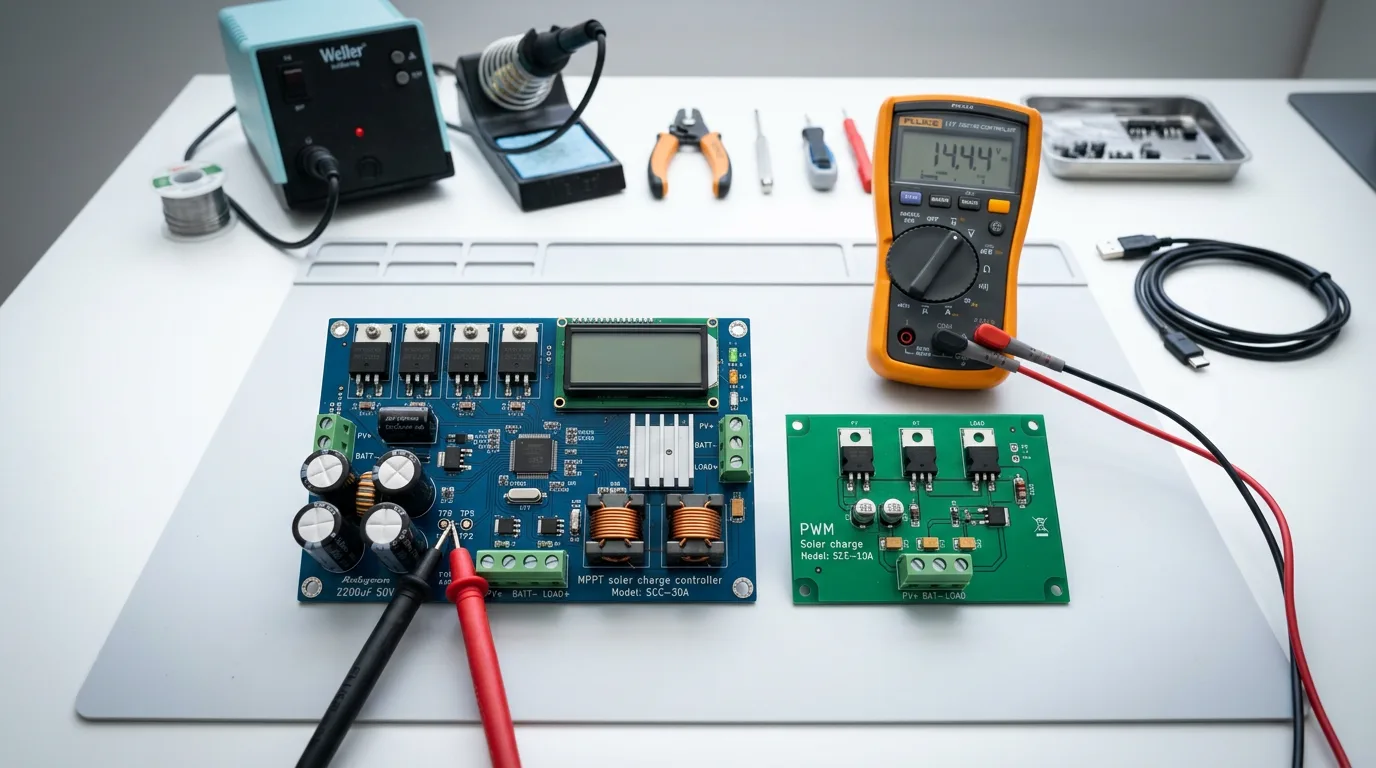
The good news for portable power station buyers: nearly every modern generator uses MPPT. The technology cost has dropped to the point where manufacturers include it by default. But understanding WHY it matters — and where the efficiency gain comes from — helps you get the most from your solar setup, choose compatible panels, and troubleshoot when your charging speeds are lower than expected.
The Fundamental Problem Both Controllers Solve
A solar panel does not produce a fixed voltage. A typical 100W panel is rated at about 18-20V at "maximum power voltage" (Vmp) — but the actual voltage varies with temperature, sunlight intensity, and load. On a cold morning in direct sun, that panel might produce 22V. On a hot afternoon, it drops to 16V. Under clouds, it might produce the rated voltage but at a fraction of the rated current.
Meanwhile, the battery inside your generator wants a specific voltage range. A 12V LiFePO4 battery charges between 13.0V and 14.6V. A 24V battery wants 26.0-29.2V. The battery does not care what voltage the panel wants to produce — it needs the voltage it needs. The charge controller bridges this gap: it takes whatever the panel produces and converts it into what the battery requires.
How the controller performs this conversion is where MPPT and PWM diverge — and where the efficiency difference originates.
How PWM Works: The Simple Approach
A PWM controller is essentially a fast switch. It connects the solar panel directly to the battery and rapidly toggles the connection on and off — hundreds of times per second. When the battery needs more charge, the switch stays on for a larger percentage of each cycle (wider pulse width). When the battery approaches full, the switch stays on for shorter periods.
The critical limitation: because the panel connects directly to the battery, the panel is forced to operate at the battery voltage, not its own optimal voltage. A 100W panel rated at 18V and 5.56A (18V × 5.56A = 100W) connected to a 12V battery through a PWM controller operates at 12V × 5.56A = 66.7W. The other 33.3W is lost — the panel never gets to operate at its intended voltage. That is a 33% loss before you even factor in conversion inefficiency.
PWM works best when the panel voltage closely matches the battery voltage — an 18V panel on a 12V battery loses the least. But modern portable power stations often use internal battery voltages of 24V, 48V, or higher, while bundled solar panels may produce 30-50V at open circuit. The mismatch grows larger, and the PWM losses grow with it.
How MPPT Works: The Smart Approach
An MPPT controller is a DC-to-DC converter. Instead of connecting the panel directly to the battery, it allows the panel to operate at whatever voltage produces maximum power — the "maximum power point" — and then converts that voltage down (or up) to what the battery needs.
Back to the 100W panel example: the MPPT controller lets the panel run at 18V × 5.56A = 100W. It then converts this to 14.2V × 6.7A = 95.1W (after about 5% conversion loss). The battery receives 95W instead of 67W. Same panel, same sun, 42% more power to the battery.
The "tracking" in Maximum Power Point Tracking refers to the controller continuously adjusting the input voltage to find the point where voltage × current = maximum watts. This point shifts throughout the day: it changes with temperature (cold panels have higher voltage, hot panels lower), sunlight intensity (clouds reduce current), and panel age (degradation slightly shifts the curve). A good MPPT controller samples the power curve 10-100 times per second and adjusts within milliseconds.
The result is that an MPPT controller wrings out every available watt from the panel under all conditions — not just ideal noon sun, but also the lower-output hours of morning, evening, and overcast conditions where PWM leaves the most energy on the table.
There is a subtlety in how MPPT handles changing conditions that goes beyond static efficiency numbers. When a cloud passes over your panel, the maximum power point shifts — voltage stays roughly stable, but current drops. A good MPPT controller re-locks onto the new maximum power point in under 100 milliseconds. During a partly cloudy day with shadows moving across the panel every few minutes, the MPPT controller recalculates and adjusts dozens of times per hour. A PWM controller has no tracking mechanism — it simply passes whatever the panel produces at the clamped battery voltage. On partly cloudy days, this dynamic re-optimization is where MPPT earns its largest real-world advantage over PWM.
Where the 20-30% Advantage Comes From
The headline number — "MPPT produces 20-30% more energy" — is not a constant. It varies with conditions. Understanding where the gain comes from helps you predict when MPPT matters most.
Voltage mismatch (always present, 10-30% gain). Anytime the panel's maximum power voltage is higher than the battery voltage, PWM wastes the difference. A 36V panel (common for 24V systems) on a 24V battery: PWM wastes 33%. MPPT converts the full 36V output down to 24V, keeping nearly all the energy. Larger voltage mismatches = larger MPPT advantage.
Cold weather (15-25% gain). Solar panels produce higher voltage in cold temperatures. A panel rated at 18V might produce 22V on a cold morning. Through PWM, that extra 4V is wasted — the panel is clamped to battery voltage. Through MPPT, the controller harvests the higher voltage and converts it, capturing energy that PWM throws away. Winter and high-altitude solar setups benefit most from MPPT.
Partial shade and cloud cover (10-20% gain). When clouds pass over a panel, the current drops but the voltage stays relatively stable. MPPT re-finds the optimal operating point on the shifted power curve within milliseconds. PWM has no mechanism to optimize — it just passes whatever the panel produces at the clamped voltage. The result: MPPT recovers faster from shading events and extracts more from variable conditions.
Morning and evening hours (15-30% gain). Low sun angles mean low current but the panel still produces voltage. MPPT captures this low-current energy efficiently. PWM at low current with voltage mismatch produces almost nothing usable. Over a full day, the first and last 2 hours of sunlight are where MPPT adds the most marginal energy — extending the effective solar window by 1-2 hours on either side.
When PWM Is Actually Fine
PWM is not obsolete technology. It has legitimate use cases where the simplicity outweighs the efficiency loss.
Panel voltage matches battery voltage closely. If your panel Vmp is within 2V of the battery charging voltage, PWM loses very little. An 18V panel on a 14.6V LiFePO4 battery loses about 19% through PWM — noticeable, but not catastrophic.
Very small systems. A 10-20W panel keeping a 12V battery topped up (trail cameras, gate openers, small LED signs) does not justify an MPPT controller. The absolute energy difference is measured in single-digit watt-hours per day. A PWM controller costs $10-15 and does the job.
Trickle maintenance charging. Maintaining charge on a boat battery, RV battery, or vehicle battery during storage requires minimal power — 2-5W continuous. PWM handles this without issue. The battery is already full; the controller just replaces self-discharge losses.
For portable solar generators specifically, the PWM question is mostly academic. The generator manufacturer chose the controller, and you cannot swap it. If your generator has MPPT (check the specs), you benefit automatically. If it has PWM (rare in units released after 2022), you can still use it effectively — just pair it with a panel whose voltage closely matches the unit's input range.
One area where PWM still appears in 2026: ultralight and ultra-budget power stations under 200Wh. Manufacturers targeting the lowest possible price point sometimes use PWM to save a few dollars at the board level. The Powkey 200W and Apowking 200W, for example, both use PWM charge controllers — acceptable for their included 40W panels that closely match their internal battery voltage, but a limitation that prevents pairing with higher-voltage third-party panels. If you own one of these budget units, maximizing panel angle toward direct sun is your best compensating strategy, since you cannot recapture the energy that PWM leaves on the table through hardware changes. On a 40W panel, the absolute loss from PWM versus MPPT is roughly 6-10W under typical conditions — noticeable but not catastrophic at this scale.
Degradation Over Time: How Age Affects Both Controllers
Solar panels degrade slowly — typically losing 0.5-0.7% of output per year. After 10 years, a 100W panel might produce 93-95W under identical conditions. This gradual decline shifts the maximum power point on the panel's IV curve. An MPPT controller adapts to this shift automatically — it re-optimizes for the degraded panel's actual output characteristics every time the sun hits the panel. A PWM controller, which never tracked the optimal point in the first place, simply receives less power as the panel ages.
Panel soiling — dust, pollen, bird droppings, and mineral deposits from rain — creates a similar effect. A dirty panel produces less current at the same voltage, shifting the power curve. After a rainstorm cleans the panel, the curve shifts back. MPPT tracks these daily fluctuations. PWM does not. The practical result: an MPPT-connected panel that goes 6 months between cleanings loses less total energy than a PWM-connected panel with the same cleaning schedule, because MPPT extracts the best available output even from a partially soiled panel.
How to Tell What Your Generator Uses
Check the product specifications under "Solar Input" or "Solar Charging." MPPT-equipped generators almost always advertise it — it is a selling point. Look for "MPPT charge controller" or "built-in MPPT." If the specs list a wide solar input voltage range (12-60V or similar), the unit almost certainly uses MPPT — PWM cannot handle that range efficiently.
If the specs only list a narrow voltage range (12-22V) and do not mention the controller type, the unit likely uses PWM. Budget generators from lesser-known brands are the most likely to use PWM without disclosing it. This is not a deal-breaker for a $150 generator paired with a matching-voltage panel — but it is worth knowing so you can set realistic solar charging expectations.
Every generator we review on this site lists the charge controller type in the specs section. If the manufacturer does not specify, we note it as "unspecified" — which usually means PWM.
Panel Compatibility and Voltage Matching
The charge controller type determines which panels you can pair with your generator.
MPPT generators accept a wide voltage range — typically 12-60V for mid-range units, up to 150V for whole-home systems. This means you can use almost any solar panel or panel combination. Series-wiring two 18V panels to produce 36V works fine — the MPPT controller steps the voltage down. Parallel-wiring for more current at the same voltage also works. MPPT gives you flexibility.
PWM generators need the panel voltage to be close to (but slightly above) the battery voltage. Using a 36V panel on a PWM-controlled 12V generator wastes 67% of the panel's output. Always match the panel to the generator's expected input range. If you are buying a separate panel for a PWM generator, choose one rated at 18-22V for a 12V system or 36-40V for a 24V system.
The safe default: Buy the solar panel kit recommended by the generator manufacturer. These are always voltage-matched. If you are mixing brands, check that the panel's maximum power voltage (Vmp) falls within the generator's listed solar input range.
Series vs parallel wiring with MPPT. When connecting multiple panels to an MPPT generator, series wiring (connecting positive to negative) adds voltages while keeping current the same. Parallel wiring (connecting positive to positive, negative to negative) adds current while keeping voltage the same. MPPT controllers handle both configurations, but series wiring is usually preferred because the higher combined voltage falls well within the controller's input range and experiences less line loss over cable runs. Two 100W panels in series produce 36V at 5.56A — the MPPT controller steps this down to battery voltage while capturing the full 200W minus conversion losses.
The Bottom Line for Solar Generator Buyers
If you are buying a portable solar generator today, you are almost certainly getting MPPT. The technology cost has dropped to near-zero at manufacturing scale, and every major brand (EcoFlow, Anker, Jackery, Bluetti, VTOMAN, Goal Zero) includes it in their current product lines. The practical impact: your solar panels produce 15-25% more usable energy per day compared to PWM, with the biggest gains in cold weather, partial shade, and during the low-sun hours of early morning and late afternoon.
For buyers considering a budget generator that does not specify its controller type: ask before buying. If the answer is PWM, factor in 20% less solar charging efficiency when sizing your panel — a 100W panel through PWM performs like an 80W panel through MPPT. The generator still works, and the battery still charges. You just get less energy per hour of sun, which means longer charge times or more panel area needed to hit the same daily target.
Charge Controller Questions
What does MPPT stand for?
Maximum Power Point Tracking. The controller continuously adjusts the voltage and current it draws from the solar panel to find the "maximum power point" — the exact voltage-current combination that extracts the most watts at any given moment. Cloud cover, temperature, panel age, and time of day all shift this point, and the MPPT controller tracks it dozens of times per second.
What does PWM stand for?
Pulse Width Modulation. The controller connects the solar panel directly to the battery and chops the connection on and off rapidly (hundreds of times per second) to regulate charging voltage. When the battery is low, the connection stays on longer (wider pulse). When the battery is nearly full, the pulses get shorter. It is a simpler regulation method that wastes some of the panel voltage as heat.
Can I use a PWM controller with any solar panel?
PWM controllers require the solar panel voltage to be close to the battery voltage — typically an 18-22V panel for a 12V battery. Higher-voltage panels (30-50V, common in portable power station bundles) waste the excess voltage as heat through a PWM controller, losing 30-50% of potential energy. If your panel is rated above 24V, you need MPPT.
Do portable solar generators use MPPT or PWM?
Nearly every portable power station released after 2022 uses an MPPT charge controller. The cost difference between MPPT and PWM has dropped below $5 at manufacturing scale, so even budget generators include MPPT. Check the spec sheet — if it lists "MPPT" under solar charging, you are getting the more efficient controller. If it does not mention the controller type, it is likely PWM.
How much more power does MPPT actually produce?
In ideal conditions (panel voltage matched to battery, warm temperature, direct sun), MPPT produces 10-15% more than PWM. In non-ideal conditions (cold weather, partial shade, high-voltage panels, morning and evening), the advantage jumps to 20-30%. Over a full day with varying conditions, expect 15-25% more total watt-hours from the same panel through an MPPT controller compared to PWM.
Is MPPT worth the extra cost for a small system?
For a single 100W panel charging a small generator, the absolute energy difference between MPPT and PWM is about 30-60Wh per day. That is real but modest — the equivalent of one extra phone charge. For systems with 200W+ of panels or in climates with variable cloud cover, MPPT pays for itself faster because the percentage gain applies to a larger base. At the prices modern generators charge, MPPT is almost always included anyway.
Put the Theory to Work
See how MPPT efficiency translates to real-world charging in our solar panel guide, or calculate your exact daily energy budget with our watt-hours explainer. Looking for a generator with confirmed MPPT? Every unit in our mid-range roundup uses MPPT controllers.
Ready to Buy? Start Here
Based on this guide, our #1 recommendation:
Jackery Solar Generator 1000 v2 Best bundled solar panel experience with MPPT controller for optimal solar charging Read Full Review →