How to Choose a Solar Generator: The Complete Decision Framework
Picking the right solar generator comes down to four decisions: how much capacity you need, how much output your devices demand, which battery chemistry fits your usage pattern, and how you plan to recharge. Get those four right, and everything else — ports, weight, brand — falls into place. Get them wrong, and you end up with an expensive paperweight or an overspend you will never fully use.
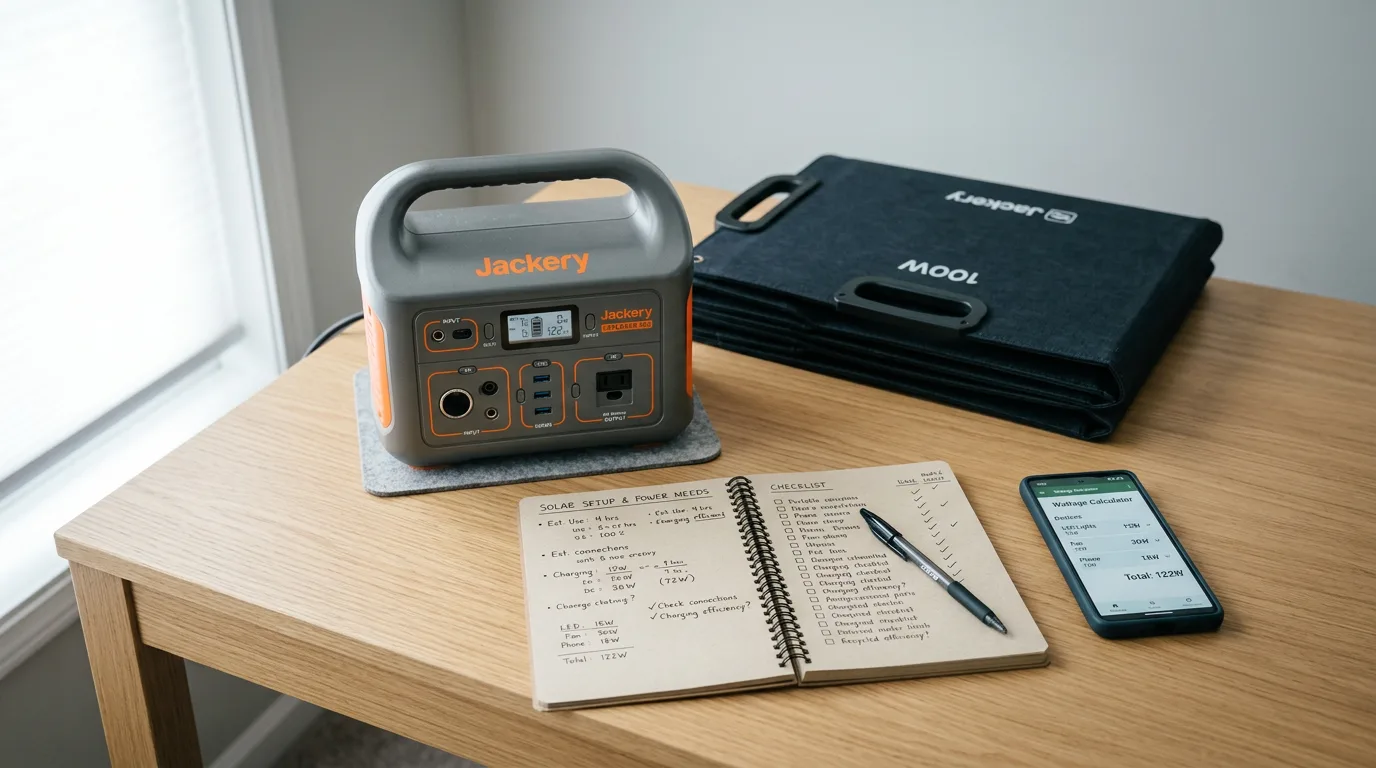
We have reviewed 35 solar generators across 4 categories, and the single most common buyer regret is mismatched capacity. People buy a 300Wh unit expecting to power a mini-fridge, or a 3,000Wh whole-home system when they only need phone charging at a campsite. Both mistakes cost real money.
This guide walks through each decision point in order, with the math and context you need to buy once and buy right.
Why Capacity Is the First Question — Not Brand or Price
Every solar generator purchase starts with one number: watt-hours. This is your battery size — the total energy the unit stores. A 500Wh generator holds 500 watt-hours of energy. A 2,000Wh unit holds four times as much.
Capacity determines what you can run and for how long. A phone charges at roughly 15Wh per cycle. A laptop takes 50-60Wh. A CPAP machine draws 30-60Wh per night. A mini-fridge runs at 40-60W continuously, burning through 960-1,440Wh in a single 24-hour period. Match your daily consumption to the battery size, and you have a working system. Mismatch it, and you are either running out of power mid-trip or hauling capacity you never touch.
The four capacity tiers in the current market map to distinct use cases:
- Under 500Wh (compact portable): Phones, laptops, LED lighting, camera gear, small fans. Best for day trips, weekend camping, and emergency phone charging kits.
- 500-1,200Wh (mid-range): Everything above plus CPAP machines, portable fridges, small TVs, blenders, and basic power tools. The sweet spot for RV trips and short home backup during outages.
- 1,200-3,000Wh (high-capacity): Full kitchen appliances, space heaters, medical equipment, and multi-day off-grid living. Serious home backup for 12-24 hour outages.
- 3,000Wh+ (whole-home): Air conditioners, electric water heaters, well pumps, and 120V/240V split-phase loads. Multi-day whole-home backup or full-time off-grid power systems.
Understanding Output Wattage: Continuous vs. Surge
Capacity tells you how much energy is stored. Output wattage tells you how much power the generator can deliver at any given moment. These are different specifications, and confusing them is one of the most common mistakes first-time buyers make.
Continuous output is the sustained wattage the inverter can deliver indefinitely — or at least until the battery is empty. A generator rated at 1,000W continuous will power any combination of devices that draws up to 1,000W simultaneously. Exceed that, and the unit triggers its overload protection and shuts down the AC outlets.
Surge (or peak) wattage is the brief spike the inverter can handle during motor startup. Refrigerators, air conditioners, power tools, and anything with a compressor draw 2-5x their running wattage for the first one to three seconds when they kick on. A fridge rated at 150W running might pull 1,200W at startup. If your generator cannot handle that surge, the fridge will not start — even if 150W is well within the continuous rating.
Match your output needs to the right tier:
- 200-300W continuous: Phones, laptops, LED lights, small electronics. No motors or heating elements.
- 600-1,000W continuous: Small appliances, blenders, portable fridges, CPAP machines, small power tools.
- 1,500-2,000W continuous: Full-size refrigerators, microwaves, coffee makers, hair dryers, most residential appliances.
- 3,000W+ continuous: Air conditioners, well pumps, electric heaters, 240V equipment, multiple large appliances simultaneously.
One practical test: add up the wattage of every device you expect to run at the same time. That is your simultaneous load. Your generator continuous output must exceed that total. Then check that its surge rating can handle the highest-startup device in the group.
Battery Chemistry: LiFePO4 vs. NMC Lithium-Ion
The battery inside your solar generator determines its lifespan, safety profile, weight, and long-term cost. Two chemistries dominate the market in 2026: LiFePO4 (lithium iron phosphate) and NMC (nickel manganese cobalt) lithium-ion. The difference between them is not marketing — it is a fundamental trade-off between longevity and weight.
LiFePO4 delivers 3,000-4,000+ charge cycles before capacity degrades to 80%. At one cycle per day, that is 8-10 years of daily use. LiFePO4 cells are also more thermally stable — they do not enter thermal runaway as easily as NMC, making them safer in high-temperature environments. The catch: LiFePO4 cells are heavier per watt-hour, so a 1,000Wh LiFePO4 unit weighs more than its NMC equivalent.
NMC lithium-ion offers higher energy density, meaning lighter weight for the same capacity. But cycle life drops to 500-1,000 cycles — a third to a fifth of LiFePO4. For a unit used weekly, NMC degrades noticeably within 2-3 years. Models like the Jackery Explorer 300 use NMC chemistry with only 500 rated cycles, which limits their long-term value despite the lighter build.
For most buyers in 2026, LiFePO4 is the right choice. The weight penalty matters only if you are backpacking (and most solar generators are too heavy for that regardless). For car camping, RV use, home backup, and any stationary application, the extra weight is irrelevant and the 3-5x longer lifespan saves money over time.
Solar Charging: Panels, Input Wattage, and Real-World Expectations
Solar charging is the feature that separates solar generators from standard battery packs — but it is also the feature most often misunderstood. The time it takes to charge from sunlight depends on three variables: your panel wattage, the generator maximum solar input, and actual weather conditions.
Panel wattage is the rated output under ideal laboratory conditions (1,000W/m2 irradiance, 25C cell temperature). Real-world output is 60-80% of rated wattage. A "200W" panel produces 120-160W on a clear day at optimal angle. On partly cloudy days, expect 40-60% of rated output. On heavily overcast days, 10-25%.
Maximum solar input is the bottleneck on the generator side. If your unit accepts 200W max solar input, connecting a 400W panel array still delivers only 200W. Check this spec before buying panels — oversizing panels slightly (10-20%) compensates for real-world derating, but doubling the panel capacity beyond the generator input ceiling wastes money.
Some generators include a solar panel in the box — units like the Anker SOLIX C300 and OUKITEL P1000 Plus come with a panel, while others like the BLUETTI Elite 30 V2 require a separate panel purchase. Bundled panels are convenient for first-time buyers but often underpowered relative to the battery. A 100W panel charging a 1,000Wh battery takes a full day under perfect sun — fine as a supplement, but not as a primary recharge method.
Two charge controller types also affect efficiency: MPPT (Maximum Power Point Tracking) and PWM (Pulse Width Modulation). MPPT controllers extract 20-30% more energy from your panels by dynamically adjusting voltage and current to the panel optimal operating point. Every modern power station above the entry-level tier uses MPPT. If you see PWM on a spec sheet, expect slower charging and lower panel efficiency.
Ports and Connectivity: Matching Outputs to Your Devices
The port layout on a solar generator determines how many devices you can charge simultaneously and how fast each charges. This is one of the most overlooked specs during purchase but one of the most frustrating to get wrong in the field.
AC outlets (120V): The standard three-prong outlets that power most household devices. Count matters — running a fridge and a phone charger simultaneously requires two outlets. Most compact generators offer two AC outlets; mid-range units provide four to six.
USB-C PD (Power Delivery): The fast-charging standard for modern laptops, tablets, and phones. Wattage matters here — a 20W USB-C port charges a phone fast but a laptop slowly. Look for 60W+ USB-C PD for laptop charging and 100W+ for demanding devices like the MacBook Pro 16-inch. Units like the Anker SOLIX C1000 Gen 2 offer dual 140W USB-C ports that charge even the most power-hungry laptops at full speed.
USB-A: The older standard. Still useful for flashlights, small fans, and older devices. Quick Charge 3.0 (QC3.0) USB-A ports deliver faster charging than standard 5V/2.4A ports.
12V DC / Car socket: Powers 12V appliances designed for vehicle use — camping fridges, tire inflators, CB radios, and CPAP machines with DC adapters. Running these from the DC port avoids the efficiency loss of the AC inverter, stretching your battery capacity 10-15% further.
Weight vs. Capacity: The Portability Compromise
Every watt-hour adds weight. That is the fundamental physical constraint no amount of engineering eliminates — only battery chemistry and efficiency gains soften the curve. Understanding where your use case sits on the portability spectrum prevents the most common size-related regrets.
The weight-per-watt-hour ratio varies by chemistry and brand, but rough benchmarks help set expectations:
- Compact (under 500Wh): 3-16 lbs. Portable — most can be carried one-handed. The Powkey 200W at 3.3 lbs is pocket-sized. The VTOMAN FlashSpeed 600 at 15.9 lbs pushes the limits of "compact."
- Mid-range (1,000-1,200Wh): 24-30 lbs. Luggable but not light. Fine for car-to-campsite or room-to-room, but not something you want to carry on a trail. The Anker SOLIX C1000 Gen 2 at 24.9 lbs is the lightest in its class.
- Whole-home (3,000Wh+): 60-135 lbs. Stationary equipment with wheels. You position it once and leave it.
The question is not "how much capacity do I want?" — it is "how much capacity do I need, given how far I have to carry it?" Car campers can buy the biggest unit that fits their budget. Tailgaters want something one person can lift from a truck bed. Van lifers need a unit that fits a fixed footprint without shifting during transit.
Be honest about your mobility requirements. Buying a 60-pound unit because the capacity is appealing, then leaving it at home because it is too heavy to haul, wastes the investment.
Budget Considerations: What Each Tier Actually Costs
Solar generator pricing follows a rough pattern: capacity scales with cost, but premium brands and faster charging technology add steep premiums at every tier. Understanding the price landscape prevents overpaying for features you do not need.
Entry-level compact (under 300Wh): The most affordable units start under the mid-range price point. At this level, you get basic phone and laptop charging with limited output wattage. The key differentiator is whether the unit includes a solar panel — bundled kits like the Apowking 300W save the separate panel purchase.
Premium compact (300-500Wh): Stepping up brings faster charging, LiFePO4 chemistry, app control, and higher output. Brands like Anker and BLUETTI charge a premium for build quality and 5-year warranties that budget brands cannot match.
Mid-range (1,000-1,200Wh): The sweet spot for most buyers balancing home backup and outdoor use. Prices range widely. Bundled solar panel kits offer the best total value for buyers who need solar charging.
Whole-home (3,000Wh+): A serious investment that rivals traditional standby generators. The per-watt-hour cost is actually lower at this scale, but the absolute spend is substantial. Consider expandable systems that let you start with a base unit and add capacity over time rather than buying maximum capacity upfront.
Two value metrics cut through marketing noise. First, cost per watt-hour — divide the price by the capacity. Lower is better for raw storage value. Second, cost per cycle — divide the price by the rated cycle count. This reveals long-term value that the sticker price alone misses. A LiFePO4 unit that costs more upfront often delivers a fraction of the cost per cycle compared to a cheaper NMC alternative.
Features That Matter vs. Features That Sound Good
Marketing lists are long. Your actual needs are short. Here is what matters and what is mostly noise.
Features worth paying for:
- Fast AC charging (sub-60-minute 0-80%): Practical between stops on road trips or before storms. The EcoFlow DELTA 2 and Anker SOLIX C1000 Gen 2 lead here.
- UPS (Uninterruptible Power Supply) mode: Sub-20ms switchover keeps devices running during power transitions. Critical for CPAP machines, desktop computers, and network equipment.
- Expandable battery: Lets you start small and add capacity later. The EcoFlow DELTA 2 and OUPES Mega 1 both expand to multiple kilowatt-hours with add-on batteries.
- App connectivity: Real-time monitoring, charge scheduling, and remote port control are useful for home backup scenarios where the generator sits in a closet or garage.
Features that sound good but rarely matter:
- Wireless charging pad: Slow (5-10W) and ties up a surface on the generator. A USB cable charges your phone 3-4x faster.
- Built-in LED flashlight: Convenient once, then forgotten. A dedicated flashlight is brighter and more useful.
- Car jump starter: The VTOMAN Jump 600X includes this, and while it is a nice safety net, a dedicated jump pack costs a fraction of the price premium.
- Bluetooth-only app: Range is too limited for practical remote monitoring. Wi-Fi apps (EcoFlow, Anker) are far more useful for home backup monitoring from another room.
The Decision Flowchart
Pulling it all together, here is the decision sequence that leads to the right purchase:
- Calculate your daily watt-hour need. List devices, multiply watts by hours of use, add 20% buffer. This determines your capacity tier.
- Identify your highest-wattage single device. This determines your minimum continuous output — and the surge rating needed if that device has a motor or compressor.
- Choose your battery chemistry. LiFePO4 for anything you use weekly or store for emergencies. NMC only if weight is your absolute top priority and you accept shorter lifespan.
- Determine your recharging priority. Primarily solar? Match panel wattage to the generator solar input. Primarily wall outlet? Prioritize fast AC charging. Both? Look for dual-input or high-wattage units that accept 400W+ solar.
- Set your weight limit. Be honest about how far you will carry it. This narrows the field within your capacity tier.
- Compare within the remaining set. Now — and only now — compare port counts, brand warranty, app features, and price. These are tiebreakers, not starting criteria.
Frequently Asked Questions
What size solar generator do I need for camping?
For weekend car camping, a 200-500Wh unit handles phone charging, LED lights, and a small fan. For extended trips or running a portable fridge, step up to 1,000Wh or more. Calculate your daily watt-hour usage first — most weekend campers use 150-300Wh per day.
Is LiFePO4 better than lithium-ion for solar generators?
LiFePO4 lasts 3,000-4,000+ charge cycles versus 500-1,000 for standard lithium-ion NMC. It is also safer and more stable at high temperatures. The downside is slightly more weight per watt-hour. For anything you plan to use regularly, LiFePO4 pays for itself through longevity.
How long does it take to charge a solar generator with solar panels?
Charge time depends on panel wattage, sunlight conditions, and the unit maximum solar input. A 100W panel in direct sun produces about 60-80W in practice. A 1,000Wh battery with a single 100W panel takes roughly 12-15 hours of direct sunlight. Pairing multiple panels or choosing a unit with higher solar input cuts this time proportionally.
Can a solar generator power a refrigerator?
Yes, but sizing matters. A standard home refrigerator draws 100-400W while running and surges to 1,200W or more at startup. You need a generator with at least 1,500W continuous output and 2,000W surge capability. A 1,000Wh battery keeps a typical fridge running for 8-12 hours. Larger 2,000Wh+ units can sustain it for a full day or more.
What is the difference between watts and watt-hours?
Watts measure instantaneous power draw — how much energy a device uses at any moment. Watt-hours measure total energy capacity — how much energy the battery stores. A 100W light bulb running for 10 hours consumes 1,000Wh. Watts tell you what you can run; watt-hours tell you how long you can run it.
Do solar generators work on cloudy days?
Solar panels still generate power on cloudy days, but output drops to 10-25% of their rated capacity. A 200W panel might produce only 20-50W under heavy overcast. For consistent off-grid power in cloudy regions, oversize your panel array or pair solar with AC charging before trips.
How many years does a solar generator last?
A LiFePO4 solar generator lasts 10-15 years with proper care, retaining 80% capacity after 3,000-4,000 cycles. Lithium-ion NMC models last 3-5 years at the same usage rate. Storage habits matter — keeping the battery between 20-80% charge and avoiding extreme temperatures extends lifespan considerably.
Start With Your Numbers
The best solar generator is the one that matches your actual power needs — not the one with the most impressive spec sheet or the lowest price tag. Run the watt-hour calculation for your specific use case, check the output requirements for your highest-draw device, decide on LiFePO4 vs. NMC based on how often you will use it, and then narrow the field.
If you want the full math on calculating your power needs, our Solar Generator Sizing Guide walks through the watt-hour calculation step by step. And if you are brand new to portable power entirely, the Beginner's Guide covers every key term without jargon.
Ready to Buy? Start Here
Based on this guide, our #1 recommendation:
Anker SOLIX C1000 Gen 2 Best overall balance of features, speed, and expandability Read Full Review →