History of Portable Power Stations: From Car Batteries to Smart Power
The idea of portable electricity is not new. People have been strapping inverters to car batteries since the 1980s. What changed — and changed fast — is the technology that makes it work. In less than 15 years, portable power went from a 45-lb lead-acid box that delivered 200 cycles before dying to a 10-lb LiFePO4 station that charges in an hour, lasts 4,000 cycles, and fits in a backpack. That transformation involved three complete chemistry changes, a manufacturing revolution in Chinese battery factories, and a pandemic that made millions of people realize how fragile the grid actually is.
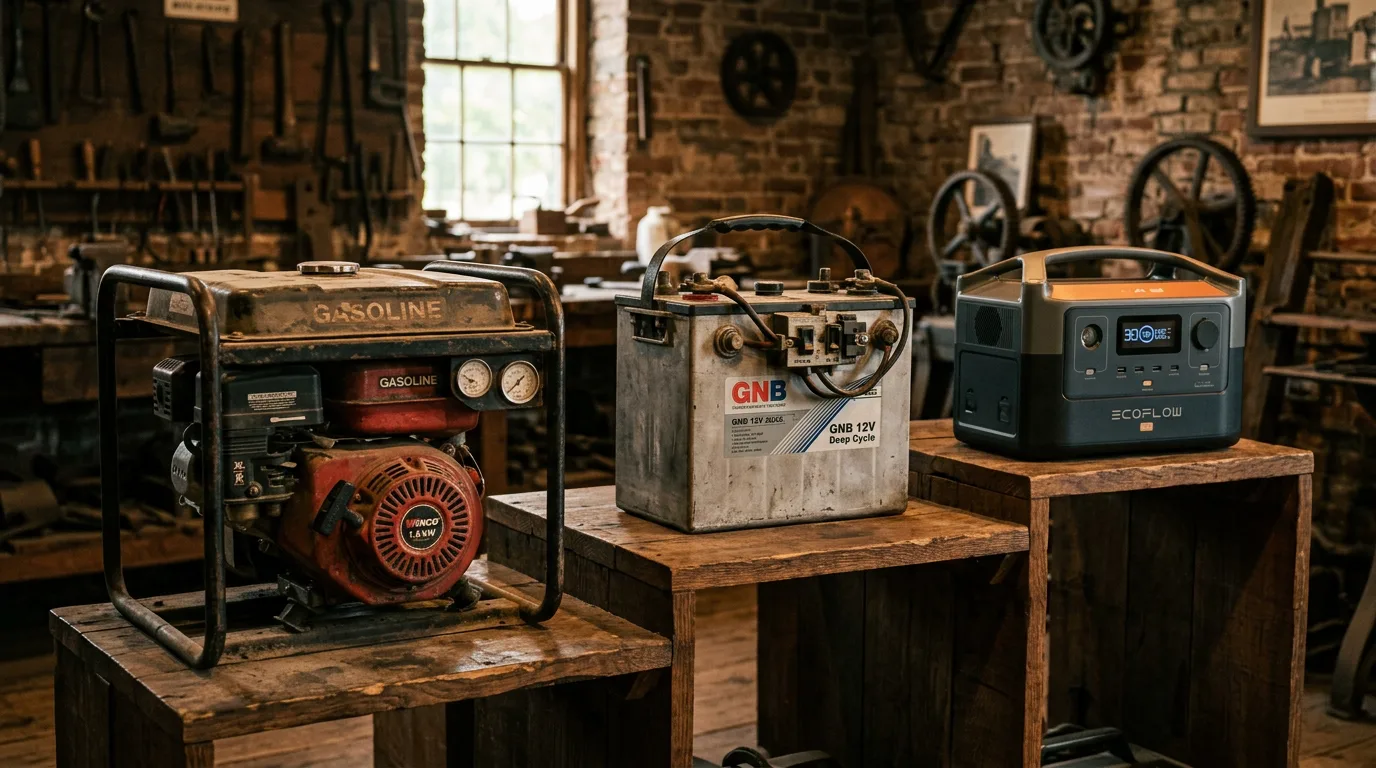
Before Power Stations: The DIY Era (1980s-2012)
Before portable power stations existed as a product category, people who needed electricity away from the grid had two choices: a gas generator or a homemade battery box. Gas generators — loud, smelly, dangerous indoors, and requiring fuel — dominated construction sites, RV parks, and emergency backup. For quieter, indoor-safe power, the only option was DIY.
The typical DIY setup was a sealed lead-acid battery (the kind found in cars and boats) connected to an aftermarket inverter using alligator clips or ring terminals. A deep-cycle marine battery providing 500-600Wh of usable capacity weighed 40-60 lbs. The inverter — usually a modified sine wave unit — added another 2-5 lbs and cost $50-150 depending on wattage. Total cost for a functional 500Wh portable power setup: $150-300 plus the weight of a small child.
The problems were real. Lead-acid batteries vent hydrogen gas when charging — using one in an enclosed space risks explosion. The batteries had no built-in protection: overcharging, over-discharging, or short-circuiting was the user's problem. Inverter quality varied wildly. Connections corroded. The whole setup looked exactly like what it was — a car battery on the floor with wires running to a box.
Jump-start packs — sealed lead-acid batteries with built-in 12V outlets and sometimes a small AC inverter — represented the first commercial attempt at self-contained portable power. But these were designed for one job: starting a dead car. Their AC outlets, when present, could barely power a phone charger. They pointed in the right direction without actually solving the problem.
The First Generation: Sealed Lead-Acid Stations (2012-2016)
Goal Zero changed the category in 2012-2013 with the Yeti series. The Yeti 400 and Yeti 1250 were the first products designed from the ground up as portable power stations — sealed lead-acid batteries integrated with pure sine wave inverters, USB ports, 12V outputs, and solar charge controllers in a single enclosure. No alligator clips. No exposed terminals. Plug in a device, and it works.
The Yeti 400 packed 396Wh into a 29-lb box with a 300W pure sine wave inverter. By DIY standards, this was elegant — everything in one unit with proper safety circuits. By modern standards, it was primitive. The lead-acid cells lasted 200-400 cycles before losing serious capacity. The unit took 8-10 hours to charge from a wall outlet. Solar charging through the integrated MPPT controller was limited to 120W input. And 29 lbs for 400Wh was not what most people would call portable.
But the concept worked. Goal Zero proved there was a market for self-contained portable power beyond the gas generator crowd. RV owners, van lifers, and emergency preppers bought the Yeti series despite its limitations. The market signal was clear: people wanted portable electricity without the DIY hassle.
The Lithium Revolution: NMC Chemistry (2016-2021)
Lithium-ion NMC (nickel manganese cobalt) batteries — the same cells powering laptops and early electric vehicles — arrived in portable power stations around 2016-2017. The improvement over lead-acid was dramatic. A 500Wh NMC battery pack weighed 10-15 lbs instead of 40-50 lbs. Cycle life jumped from 200-400 cycles to 500-1,000 cycles. Energy density roughly tripled.
Jackery launched the Explorer series in 2018-2019 and quickly became the consumer-friendly face of portable power. The Jackery Explorer 500 offered 518Wh in a 13.3-lb unit with clear displays, orange branding, and a design language communicating "consumer electronics" instead of "industrial equipment." It looked like something you would find at Best Buy, not an auto parts store.
EcoFlow entered in 2019 with the RIVER series and immediately pushed on charging speed. Where competing units took 6-10 hours to charge from AC, EcoFlow's X-Stream technology charged the RIVER in under 2 hours. This reframed portable power from a "charge overnight before your trip" device to a "charge while packing the car" tool. The convenience factor expanded the market beyond outdoor enthusiasts to everyday consumers.
By 2020, a dozen brands competed in the lithium portable power space: Goal Zero, Jackery, EcoFlow, Bluetti, Anker (entering via the PowerHouse line), VTOMAN, and a growing roster of budget brands manufacturing in Shenzhen. Prices dropped as manufacturing scaled. A 1,000Wh lithium station that sat firmly in the premium tier in 2019 dropped to mid-range pricing by 2021.
The LiFePO4 Shift: Iron Phosphate Takes Over (2020-Present)
Lithium iron phosphate — LiFePO4, sometimes written as LFP — was not new. The chemistry existed since the late 1990s. Chinese battery manufacturers had produced LiFePO4 cells for electric buses, grid storage, and industrial applications for years. What changed around 2020 was cost: Chinese cell manufacturers like CATL and BYD scaled LiFePO4 production so aggressively that per-cell costs dropped below NMC for the first time.
The advantages of LiFePO4 over NMC for portable power were compelling. Cycle life jumped from 500-1,000 cycles to 3,000-4,000+ cycles — meaning a station used daily would last 8-10 years instead of 2-3 years. Thermal stability improved: LiFePO4 cells do not experience thermal runaway (the failure mode where NMC cells can overheat and catch fire). The iron phosphate cathode is stable up to 270°C versus 150°C for NMC. No cobalt means fewer supply chain ethics concerns.
The cost was energy density. LiFePO4 stores roughly 15-20% less energy per kilogram than NMC. A 1,000Wh LiFePO4 station weighs 2-4 lbs more than its NMC equivalent. For a product category where every pound matters — especially for camping and hiking — this was a real concern. But the 3-7x improvement in cycle life overwhelmed the weight penalty for most buyers. A power station that lasts a decade is worth carrying an extra 3 lbs.
Bluetti's AC200P in 2020 was among the first mainstream LiFePO4 portable stations. By 2022, every major brand had LiFePO4 options. By 2024, LiFePO4 dominated new releases entirely. In 2026, finding a new portable power station with NMC chemistry requires actively searching the budget tier. The shift was faster than the lead-acid-to-lithium transition because LiFePO4 dropped into existing product designs — same form factors, same electronics, better cells.
The Manufacturing Revolution Behind the Price Drops
No history of portable power stations is complete without understanding the factory floor. The consumer-facing brands — Jackery, EcoFlow, Bluetti, Anker — design products and build ecosystems. But the battery cells inside those products come overwhelmingly from a handful of Chinese manufacturers. CATL, BYD, EVE Energy, and CALB produce the vast majority of LiFePO4 prismatic cells used across the entire portable power industry.
Between 2018 and 2024, Chinese LiFePO4 cell production capacity increased roughly tenfold. Electric vehicle demand drove most of this expansion — portable power stations account for a small fraction of total cell production — but the portable power industry benefited enormously from the scale. When a factory produces millions of cells per month for EV packs, the marginal cost of diverting a few thousand cells to a portable power station manufacturer drops to a fraction of what a standalone order would cost.
This supply chain dynamic explains why so many brands emerged between 2020 and 2025. The barrier to entry dropped: a hardware team in Shenzhen could source quality LiFePO4 cells from established suppliers, pair them with off-the-shelf BMS boards and inverter modules, design a housing, and bring a product to market in 6-12 months. Brands like VTOMAN, FOSSiBOT, AFERIY, pecron, and UPOPOWER all followed this model. The result was fierce price competition that pushed consumer prices down 60-70% in under a decade.
The Feature Race: Smart Stations and Fast Charging (2022-2026)
With battery chemistry largely settled on LiFePO4, competition shifted to features. Charging speed became the primary battleground. EcoFlow pushed AC charging under 1 hour for 1,000Wh units. Anker's HyperFlash technology matched it. VTOMAN introduced SuperFast charging on mid-range units. The result: a 1,000Wh station that took 8 hours to charge in 2019 takes 45-70 minutes in 2026.
App connectivity arrived around 2021-2022. EcoFlow, Anker, and Bluetti all released companion apps that show real-time power draw per outlet, remaining runtime estimates, charging status, and firmware update controls. The app turned a battery box into a smart device. Some units added Bluetooth and Wi-Fi simultaneously, with the app able to manage settings from across a room (Bluetooth) or across the house (Wi-Fi).
Expandable battery systems emerged for home backup use cases. Instead of buying one massive unit, buyers could start with a base station and add expansion batteries as needed. EcoFlow's DELTA Pro and Bluetti's AC500 pioneered this modular approach. A homeowner could start with 2,000Wh for essentials and expand to 10,000Wh+ for whole-home backup — spreading the investment over time.
Solar input capacity jumped by an order of magnitude. Early stations accepted 100-200W of solar input. Current models accept 400-2,400W, enabling full recharge from solar panels in 2-4 hours of direct sun. This made true off-grid living practical — a 2,000Wh station with 800W of solar panels generates enough daily power for a small household's essential circuits.
Where Portable Power Is Heading
Three trends are shaping the next 3-5 years. First, sodium-ion batteries are entering pilot production. Sodium is abundant and cheap — no lithium mining needed. Energy density is currently 10-20% below LiFePO4, but costs could drop 30-40% at scale. CATL already has sodium-ion cells in production for electric vehicles. Portable power stations using sodium-ion could appear by 2028.
Second, vehicle-to-home (V2H) technology blurs the line between a portable power station and an electric vehicle. A standard EV battery pack holds 40,000-100,000Wh — dwarfing even the largest portable station. Ford's F-150 Lightning already powers homes during outages through its Pro Power Onboard system. As bidirectional charging becomes standard across EVs, the need for a separate home backup power station diminishes for EV owners.
Third, solar panel efficiency continues climbing. Residential panels averaging 22-24% efficiency in 2026 are heading toward 30%+ with perovskite tandem cells in development. Higher panel efficiency means more energy from smaller, lighter panels — making portable solar more practical for backpacking, kayaking, and other weight-sensitive applications where current panels are too heavy to justify.
The portable power station market is still growing. Global sales roughly quadrupled between 2019 and 2025, reaching the multi-billion dollar range. Grid instability, remote work, outdoor recreation, and climate-driven weather events all push demand higher. The product category that started as a better car battery has become a mainstream consumer electronics segment.
Home integration is the newest frontier. EcoFlow and Anker both sell transfer switches and smart home panels that let a portable power station serve as a UPS for critical circuits — refrigerator, internet router, medical equipment. The station sits in standby mode on a shelf, charged and ready, and switches to battery power within milliseconds of a grid failure. This transforms the portable power station from a camping accessory into permanent home infrastructure, blurring the line between portable backup and stationary battery storage systems like the Tesla Powerwall.
Portable Power History Questions
When was the first portable power station made?
The first purpose-built portable power stations appeared in the early 2010s. Goal Zero launched the Yeti 400 in 2013 — a sealed lead-acid battery with AC outlets, USB ports, and solar input in a single box. It weighed 29 lbs for 400Wh of capacity. Before that, portable power meant either a gas generator or a car battery with an aftermarket inverter clamped to the terminals.
Why did lithium batteries replace lead-acid in power stations?
Weight and cycle life. A lead-acid battery providing 500Wh weighs 35-45 lbs. A lithium-ion NMC battery providing the same 500Wh weighs 10-15 lbs. Lead-acid batteries also degrade after 200-400 deep cycles, while lithium-ion NMC lasts 500-1,000 cycles. The weight reduction alone made portable power stations practical to carry — you could carry one in a backpack instead of needing a dolly.
What was the first LiFePO4 portable power station?
Bluetti introduced the AC200P in 2020 with a 2,000Wh LiFePO4 battery — one of the first mainstream portable stations using iron phosphate chemistry. By 2021, EcoFlow, Jackery, and others followed with their own LiFePO4 models. The chemistry shift happened because LiFePO4 offered 3,000-4,000+ cycle life compared to 500-1,000 for NMC, plus better thermal stability and no risk of thermal runaway.
How much have portable power station prices dropped?
Prices have dropped roughly 60-70% over a decade. In 2015, a 500Wh lithium station sat in the premium range. By 2020, equivalent capacity moved into the mid-range. In 2026, 500Wh LiFePO4 stations — with better chemistry and more features — are solidly budget-tier. The cost per watt-hour has fallen by more than half, driven primarily by battery cell manufacturing scale in China.
What is the biggest change in portable power stations over the last 5 years?
Charging speed. In 2020, a 1,000Wh power station took 8-12 hours to charge from a wall outlet. By 2026, the same capacity charges in 45-90 minutes using GaN chargers and advanced BMS that can accept 1,000W+ input. EcoFlow X-Stream and Anker HyperFlash technologies both pushed AC charging under 1 hour. This single improvement transformed power stations from plan-ahead devices to grab-and-go tools.
Will portable power stations eventually replace gas generators?
For most residential and recreational uses, they already have. Gas generators still dominate in two areas: sustained multi-day high-wattage applications (construction sites, full-home backup for days) and total capacity per dollar at the 5,000W+ level. But for camping, tailgating, emergency backup under 3,000W, remote work, and home office backup, portable power stations outsell gas generators in the consumer market. The crossover point moves higher every year as battery costs drop.
See Where Portable Power Stands in 2026
Browse our best compact generators for the latest in lightweight LiFePO4 technology, or start with our beginners guide to understand the current market. Ready to buy? Our buying guide walks you through every decision.
Ready to Buy? Start Here
Based on this guide, our #1 recommendation:
EcoFlow DELTA 2 The modern benchmark — fastest charging, most expandable mid-range station Read Full Review →