Best High-Capacity Power Stations 2026: Expert Picks
We ranked 7 high-capacity portable power stations in the 1,500-3,000Wh class — cross-referencing manufacturer claims with independent measurements from The Solar Lab, TechRadar, NotebookCheck, and ChargerLab to find the stations that actually deliver on their spec sheets. These are the units worth buying for serious home backup, RV boondocking, and extended off-grid power in 2026.
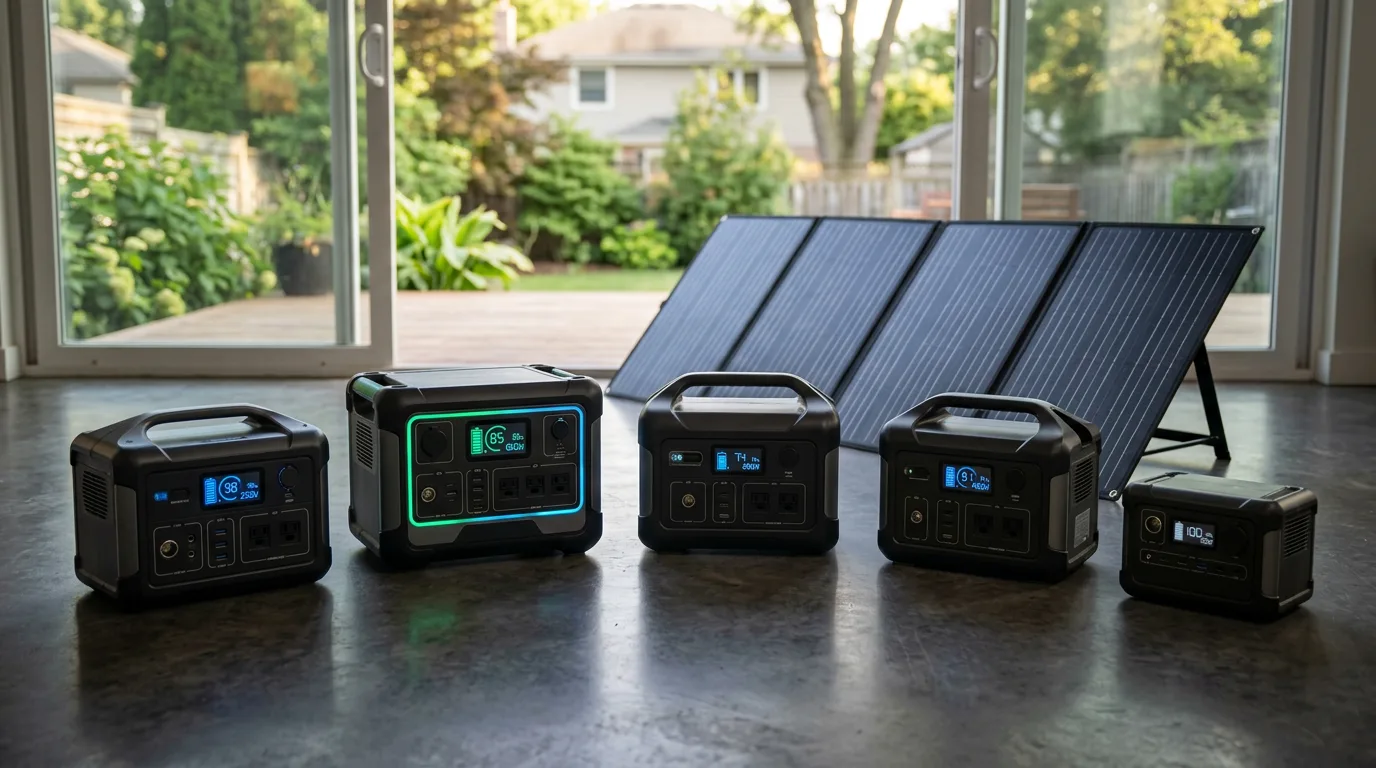
High-capacity power stations sit in the sweet spot between compact portables and permanent home battery installations. Every unit here stores at least 1,548Wh of LiFePO4 energy and outputs 1,500W or more — enough to run a refrigerator, power tools, a window AC unit, or an entire RV kitchen without flinching. Several reach 3,072Wh and 3,600W continuous output, encroaching on territory that once required a gas generator.
The price spread across this class is enormous. The cheapest unit costs a third of the most expensive, and the specs gap does not track linearly with price. The best value station delivers nearly three times more capacity per dollar than the most expensive option at the same 2,048Wh storage. Knowing what you are actually paying for — and what you are not — is the difference between a smart purchase and an expensive regret.
We dissected each station's real-world output efficiency, charging speed, idle draw, solar input ceiling, and expansion potential — pulling measurements from independent reviewers who test with calibrated loads, not just marketing screenshots. The rankings reflect genuine performance differences verified by third-party testing.
Quick Comparison: All 7 High-Capacity Stations
Side-by-side specs for every high-capacity power station we reviewed. Capacity ranges from 1,548Wh to 3,072Wh, all using LiFePO4 chemistry.
| Feature | VTOMAN FlashSpeed 1500 Portable Power Station | FOSSiBOT F2400 Portable Power Station | AFERIY P280 Portable Power Station | Anker SOLIX F2000 (PowerHouse 767) Portable Power Station | Anker SOLIX C2000 Gen 2 Portable Power Station | pecron F3000LFP Portable Power Station | EcoFlow DELTA 3 MAX with 220W Solar Panel |
|---|---|---|---|---|---|---|---|
| Price Range | $250–$500 | $500+ | $500+ | $500+ | $500+ | $500+ | $500+ |
| Battery Capacity | 1,548Wh | 2,048Wh | — | 2,048Wh | — | 3,072Wh | 2,048Wh |
| Battery Type | LiFePO4 | LiFePO4 (EVE cells) | — | LiFePO4 (GaN) | — | LiFePO4 (51.2V 60Ah) | LiFePO4 (automotive-grade) |
| Output Power | 1,500W | 2,400W continuous | 2,800W continuous | 2,400W | 2,400W continuous | 3,600W continuous | 2,400W continuous |
| Surge Power | 3,000W (V-Beyond) | 4,800W peak | 5,600W peak | 2,400W | 4,000W peak | 4,500W peak | 4,800W (3,200W X-Boost 3.0) |
| Weight | 41.5 lbs | 48.5 lbs | 47.6 lbs (21.6 kg) | 67.2 lbs | 41.7 lbs (18.9 kg) | 63.3 lbs | 44.8 lbs (station only) |
| Solar Input | 400W max (Anderson) | 500W max | 1,200W max (dual MPPT) | 1,000W max | 800W max | 1,600W max (XT60 to MC4, 25-120V) | 500W max |
| Check Price | Check Price | Check Price | Check Price | Check Price | Check Price | Check Price |
Every High-Capacity Power Station, Ranked
1. pecron F3000LFP — Best Value in the Entire Category
3,072Wh LiFePO4 · 3,600W Output · $500+
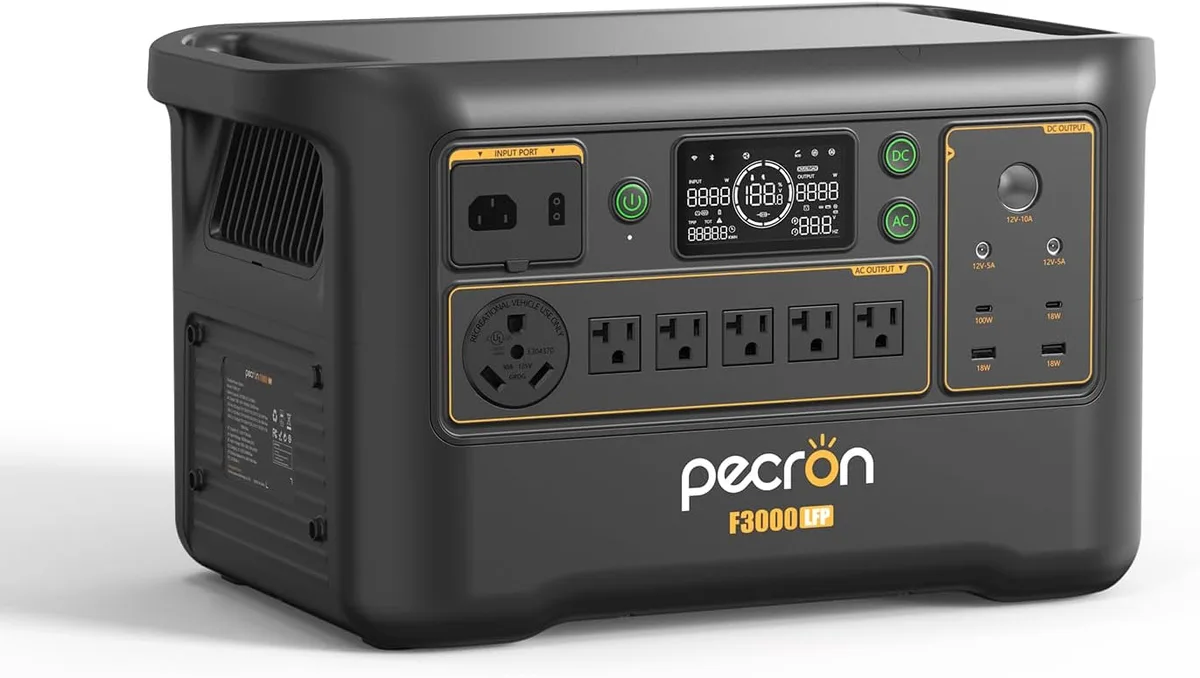
The pecron F3000LFP delivers the most capacity and the highest continuous output in this roundup at a price that undercuts 2,048Wh competitors. It has the lowest cost per watt-hour across every category we cover. The Solar Lab ran it at a sustained 3,600W and measured 83% efficiency — a strong result that matches or beats stations costing twice as much.
The 1,600W solar input is the highest in this class by a wide margin. The Solar Lab confirmed it accepts full rated solar wattage from a 2,000W panel array on a clear day. The dedicated NEMA TT-30 30A outlet connects directly to an RV without adapters — a feature most competitors either skip or fake with a lower-amperage plug wearing the same connector. Expandable to 9,216Wh with two EP3000-48V batteries, the pecron scales from portable station to semi-permanent home backup.
At 63 lbs, this station stays put once you place it. Two-person lifting is the norm. The 37W idle draw bleeds roughly 890Wh per day doing nothing — measurable parasitic loss that stations like the Anker C2000 Gen 2 (9W idle) avoid entirely. The Bluetooth app gives false readings when off-grid, and there are no charge-level limits for battery longevity optimization. For buyers who want the most watt-hours and watts per dollar spent, the pecron is the math winner by a comfortable margin.
2. AFERIY P280 — Most Powerful Inverter in the 2kWh Class
2,048Wh LiFePO4 · 2,800W Output · $500+
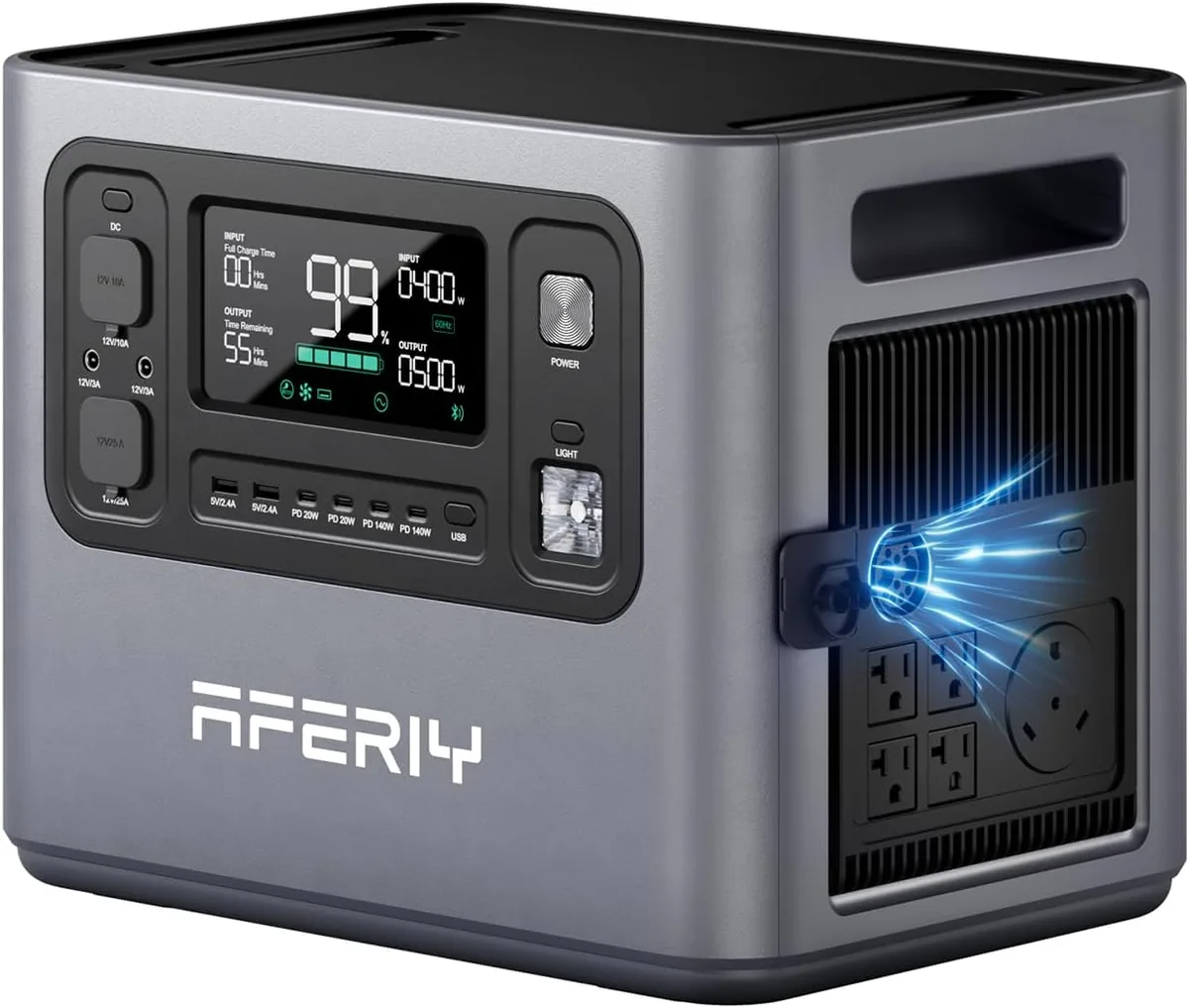
The AFERIY P280 has the highest inverter output of any 2,048Wh station on the market. At 2,800W continuous with 5,600W surge, it starts appliances that trip every 2,400W competitor in this roundup — including RV air conditioners, large space heaters, and simultaneous high-draw kitchen loads. One reviewer ran a ham radio amplifier at intermittent 800W draws without a single trip or reset.
The dual 1,200W MPPT solar input accepts 50% more solar power than the Anker C2000 Gen 2 and charges from 0-80% via AC in just 38 minutes. Expandability to 10,240Wh with four batteries shifts the P280 from portable station to modular home energy system. The 7-year warranty — the longest in this roundup — backs a product that undercuts premium brands by hundreds of dollars while exceeding their output specifications.
The weak points are real. NotebookCheck reported "massive problems" with the iOS app, including connection failures and unreliable monitoring. The faux-chrome power button feels cheap against the otherwise solid construction. Car socket charging is painfully slow — useless for road trips without an aftermarket alternator charger. At 47.6 lbs, it is manageable but not light. For buyers who need raw appliance-running power and long-term expansion potential at a price well below Anker or EcoFlow, the P280 delivers more watts per dollar than any 2kWh competitor.
3. Anker SOLIX C2000 Gen 2 — Best Premium Build and App Experience
2,048Wh LiFePO4 · 2,400W Output · $500+
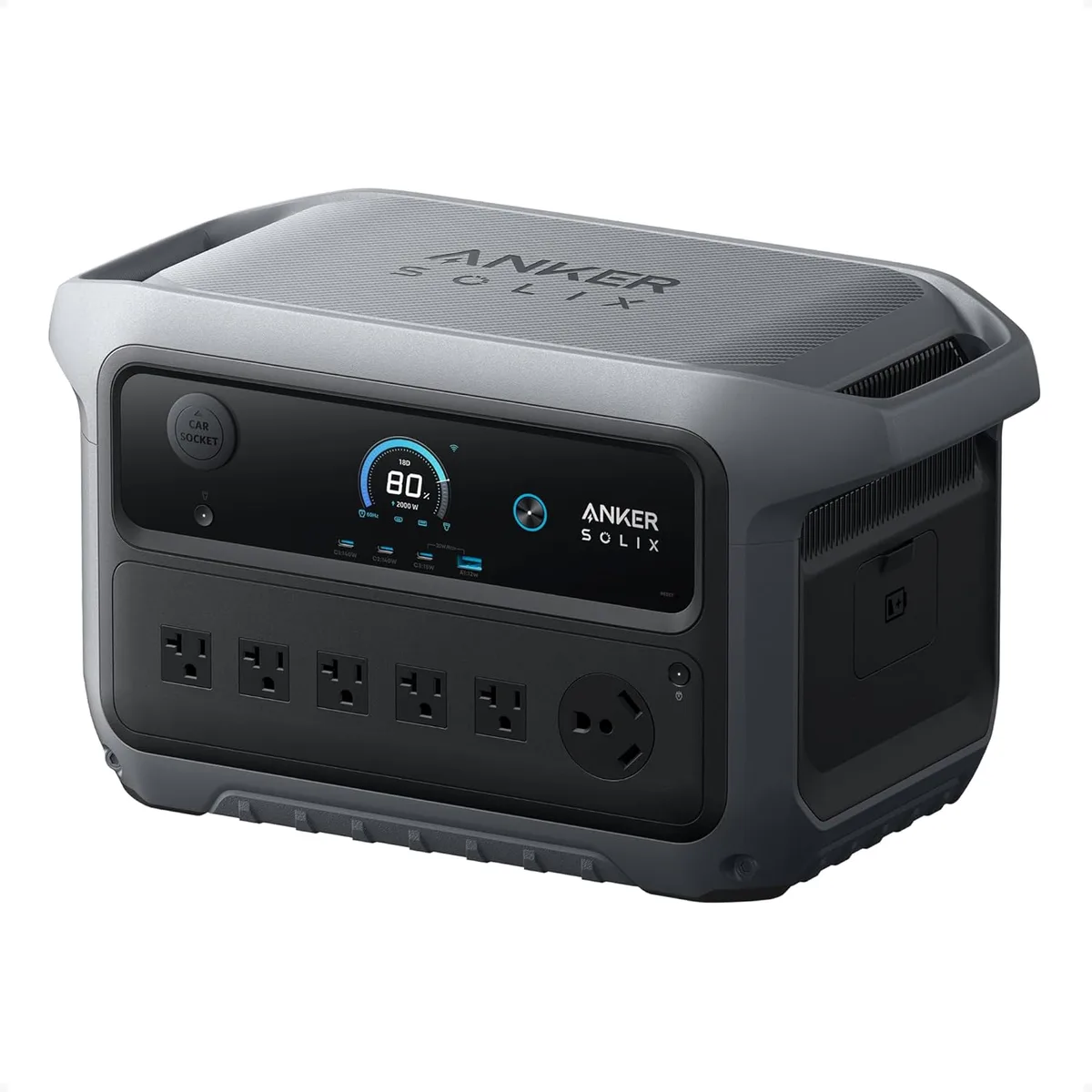
The Anker SOLIX C2000 Gen 2 is the most refined power station in this roundup. The 9W idle draw — less than a nightlight — makes it viable as an always-on UPS that barely sips stored energy. The Solar Lab called the display "probably one of the best in the portable power industry, bright and easy to read outdoors." Storm Guard mode auto-charges the battery when severe weather alerts hit your area, turning a passive appliance into a proactive emergency preparedness tool.
At 41.7 lbs, it shed 25 lbs compared to its predecessor (the Anker F2000) while keeping the same 2,048Wh capacity. Sub-hour full charge via AC+solar, four operating modes in the app, and Anker's 5-year warranty infrastructure make this the station for buyers who treat power backup as a set-and-forget appliance. A reviewer using it as a home office UPS reported the 10ms switchover kept dual monitors, a desktop, and a NAS running through a 3-second power flicker without losing a pixel.
The premium you pay buys refinement, not raw capability. The 2,400W inverter output trails the AFERIY P280 (2,800W) by a wide margin. The 800W solar input cap is half what the pecron F3000LFP accepts. Anker removed the built-in LED light that made the F2000 popular for camping. And the TT-30 RV outlet does not handle a full 30A continuous draw — misleading for buyers expecting true RV compatibility. At its asking price, the C2000 Gen 2 is a premium brand tax applied to mid-range specifications. Worth it for Anker loyalists and UPS-first buyers. Harder to justify for raw power seekers.
4. FOSSiBOT F2400 — Best Budget 2kWh Entry
2,048Wh LiFePO4 · 2,400W Output · $500+
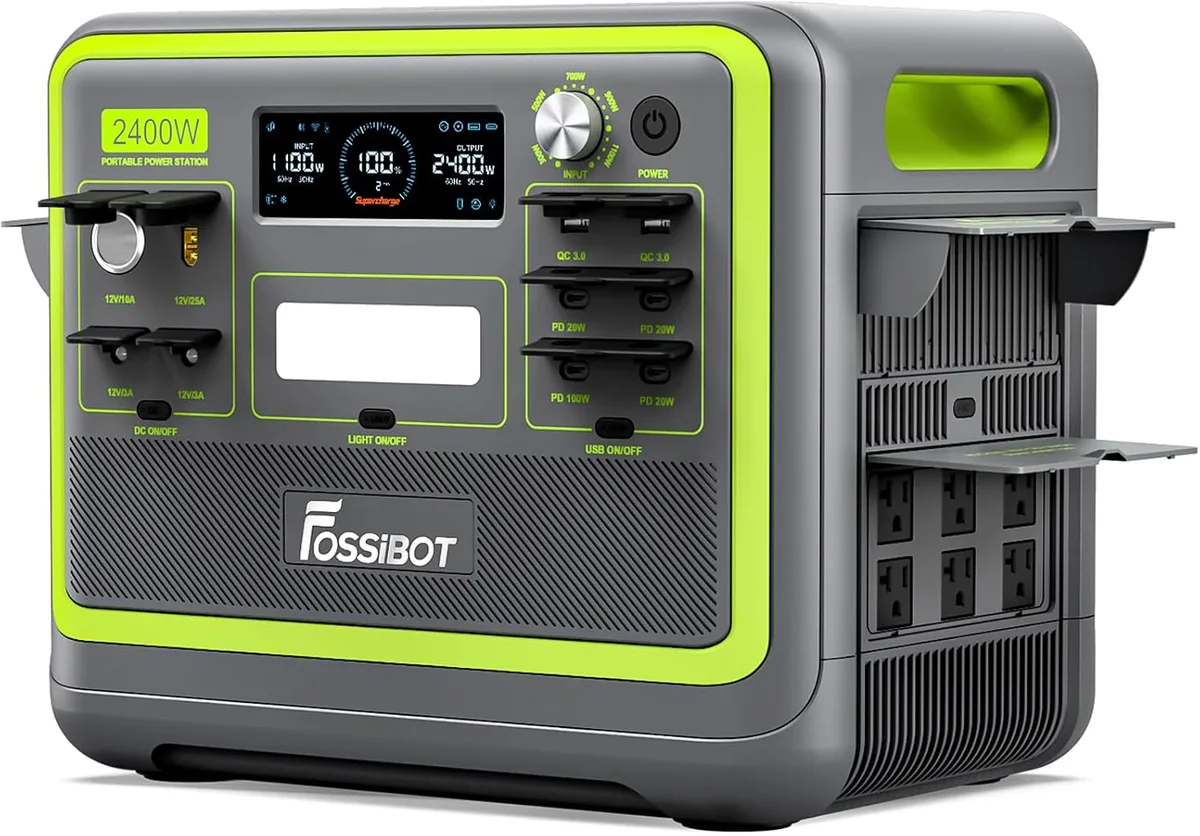
The FOSSiBOT F2400 packs 2,048Wh and 2,400W continuous output into the lowest price point in the 2kWh class. The 4,800W surge beats the Anker C2000 Gen 2 and matches the EcoFlow DELTA 3 MAX. Sixteen output ports — including a dedicated 12V/25A RV outlet — give it the highest port count in this roundup. The adjustable AC input dial (300W to 1,100W) is a standout feature that lets you avoid tripping household breakers during charging.
TechRadar highlighted the F2400's specs-to-price ratio as exceptional. Build quality surprised reviewers at this price point, with rubber port covers and manual fan flaps providing dust and splash resistance. The 4,000+ cycle battery and 4-year warranty (with registration) provide long-term backing. For van life, car camping, or stationary home backup where raw capacity per dollar matters most, the FOSSiBOT delivers.
No expansion batteries means 2,048Wh is the ceiling — forever. One Amazon reviewer measured only 1,200Wh delivered to a 60W load, well below the rated capacity, suggesting possible quality control variance across units. The manual fan flaps that must be opened before every use are a daily annoyance that risks overheating if forgotten. And a strong chemical smell from the casing takes days to dissipate after unboxing. At this price, these are tolerable drawbacks. But buyers expecting premium-brand consistency should budget accordingly.
5. VTOMAN FlashSpeed 1500 — Fastest AC Charge in the Budget Tier
1,548Wh LiFePO4 · 1,500W Output · $250–$500
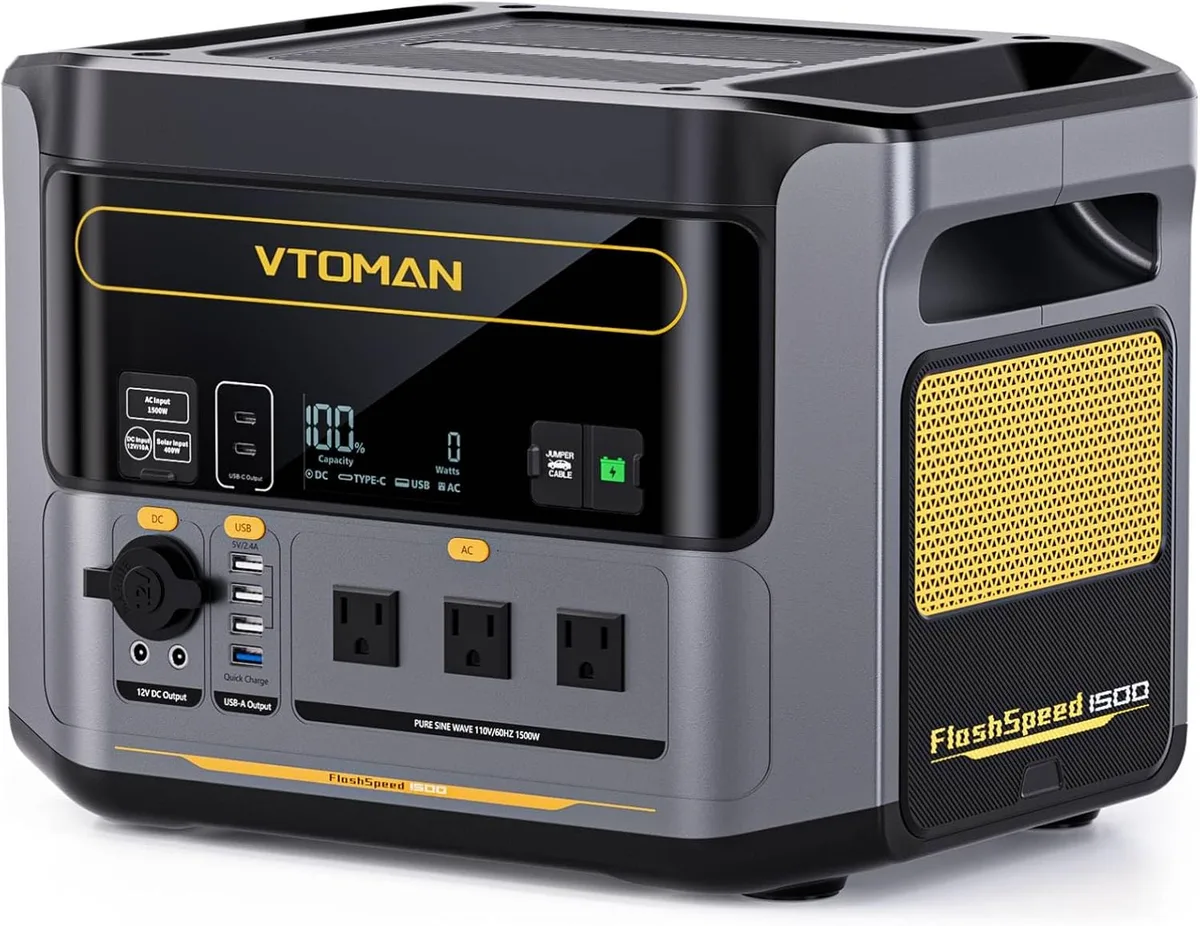
The VTOMAN FlashSpeed 1500 charges from empty to full in approximately 67 minutes — CNET called it "the fastest charging product among more than 90 portable power stations tested." At 1,548Wh, its battery outsizes most 1,500W competitors that ship with roughly 1,000Wh cells. V-Beyond Technology extends effective output to 3,000W for resistive loads like space heaters and toasters, verified by multiple independent reviewers.
The flat-top design with integrated cable storage and stackable form factor with the expansion battery (bringing total capacity to 3,096Wh) give it practical advantages for organized setups. At its price point, no other station matches the combination of sub-hour charging and 1,548Wh capacity. For tailgating, short-duration home backup, and budget camping, the speed-to-capacity ratio is unmatched.
The LCD screen is frustratingly dim — difficult to read outdoors and sometimes even indoors, with no estimated-time-to-empty display. PhoneArena and The Gadgeteer both flagged this as the primary usability weakness. Cooling fans run loud during charging and high-output operations. Inverter efficiency hovers around 80% under sustained loads — below the 83-85% that competitors achieve. And mixed Trustpilot reliability reports combined with a 2-year warranty (shortest in this roundup) mean you are accepting more risk for the lower price. A speed-focused value play for buyers who prioritize charging time and capacity over polish.
6. EcoFlow DELTA 3 MAX — Best Solar Bundle and Quietest Operation
2,048Wh LiFePO4 · 2,400W Output · $500+
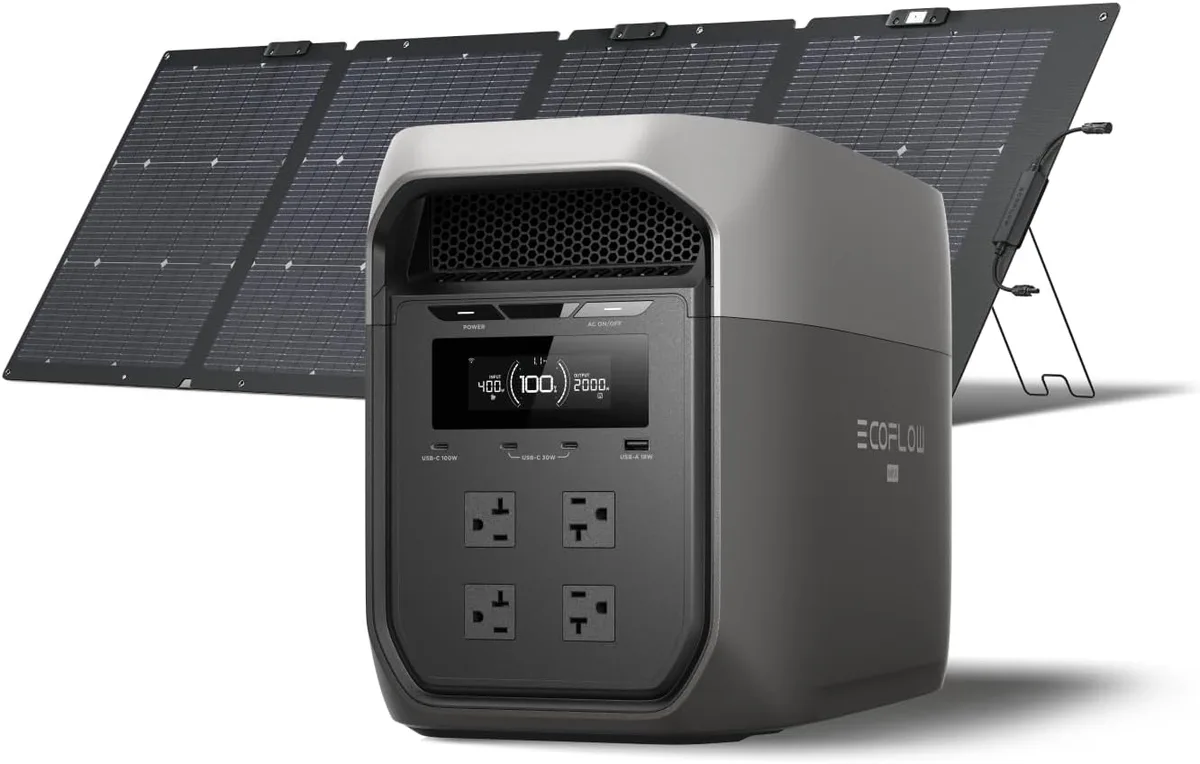
The EcoFlow DELTA 3 MAX is the only station in this roundup that ships with a solar panel — a 220W bifacial model with TOPCon cells at 25% conversion efficiency. For buyers who want a complete solar charging setup out of the box, nothing else in this class includes one. Sub-25dB operation at loads up to 600W makes it near-silent, verified by independent testing — ideal for bedside CPAP use or quiet camping.
The 68-minute full AC charge via X-Stream technology was confirmed by The Solar Lab to match advertised specs. Front-facing port design eliminates cables protruding from both sides — a genuine ergonomic improvement over older EcoFlow models. The 4,800W surge (3,200W via X-Boost 3.0) handles most motor startup loads.
The price is the central issue. At nearly double the cost of the AFERIY P280 for the same 2,048Wh capacity, the premium is steep even accounting for the bundled panel (roughly a mid-range value). The 500W solar input cap is the lowest in this roundup — meaning even adding panels beyond the included 220W provides diminishing returns. No expandability locks capacity at 2,048Wh. And only 9 output ports (with no USB-A) trail competitors offering 13-16 ports. The DELTA 3 MAX is the right choice for buyers who value silence, a complete solar bundle, and EcoFlow's polished ecosystem over raw specifications per dollar.
7. Anker SOLIX F2000 — Superseded by Its Successor
2,048Wh LiFePO4 · 2,400W Output · $500+
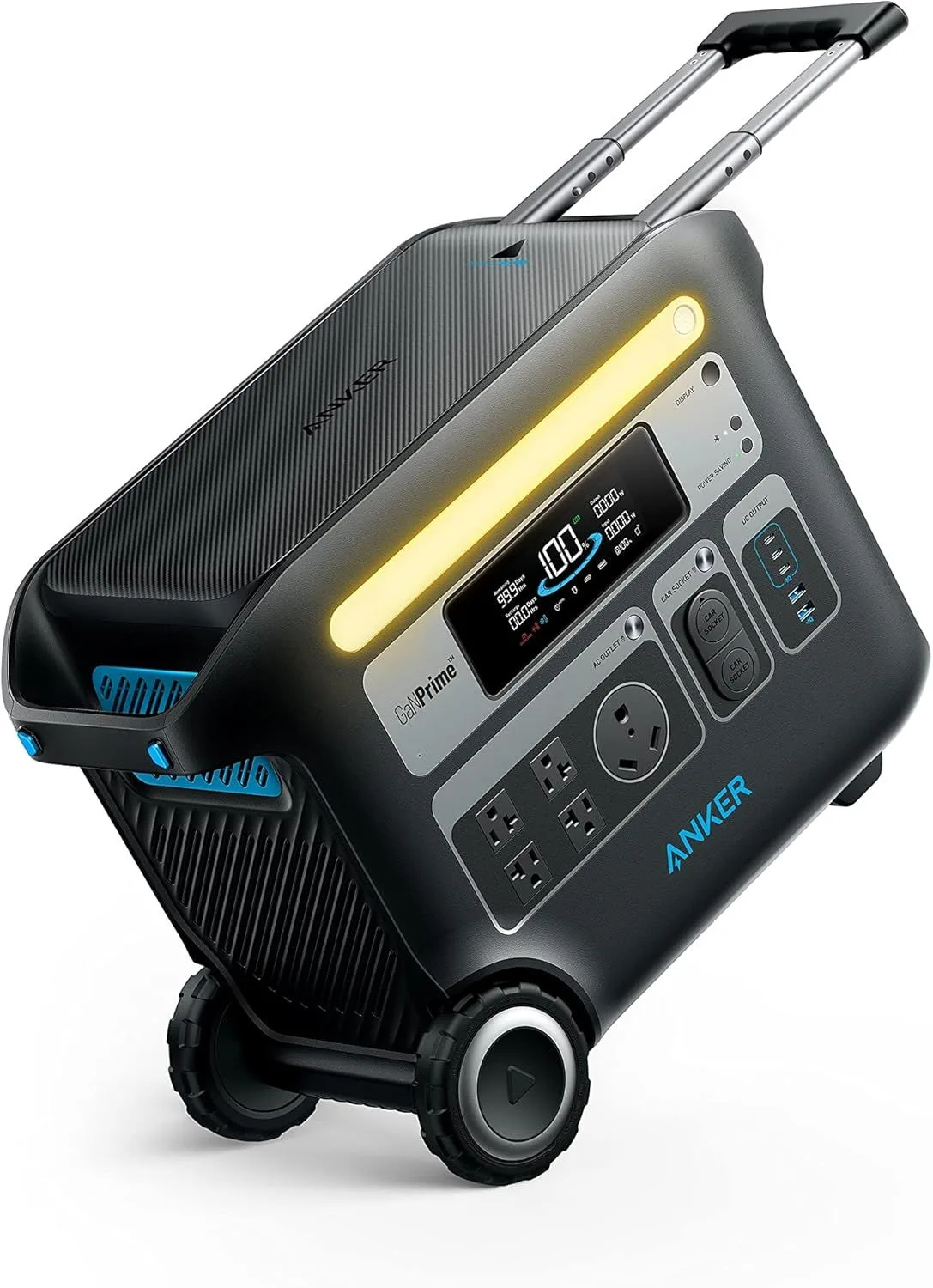
The Anker SOLIX F2000 was a top pick when it launched. GaN technology delivers 25% lower fan noise and cooler operating temperatures than conventional designs. The retractable handle and 4.72-inch wheels make its 67-lb weight manageable for repositioning. WiFi and Bluetooth app control, a large LED light bar with SOS mode, and smart power management round out a premium feature set.
But the market moved fast. Anker's own C2000 Gen 2 sheds 25 lbs from the same 2,048Wh capacity while adding 4,000W surge (versus the F2000's flat 2,400W ceiling), ultra-low 9W idle draw, Storm Guard weather alerts, and faster charging. The F2000 cannot charge from AC and DC simultaneously, eliminating the speed benefit of combined AC+solar. The solar XT-60 parallel adapter leaves exposed live pins — a safety oversight that requires insulating tape to fix. At current MSRP, the C2000 Gen 2 is the better buy in every dimension except expansion support (the F2000 accepts an expansion battery; the C2000 Gen 2 does as well via the BP2000 Gen 2). If you find the F2000 at a deep discount, it remains a solid Anker-backed station. At full price, the math does not work.
How We Ranked These Stations
High-capacity stations need to justify their size and weight with real performance. A 2,048Wh station that delivers only 1,200Wh to your devices (70% efficiency) is functionally smaller than a 1,548Wh station at 85% efficiency. We weighted our criteria to surface stations that deliver the most usable power per dollar spent:
- Value per usable watt-hour (25%): Price divided by real-world deliverable capacity (factoring measured efficiency). The pecron F3000LFP at 83% efficiency delivering ~2,550Wh at a budget-tier price leads this metric. The EcoFlow DELTA 3 MAX at a premium price for the same 2,048Wh base trails badly even with the bundled panel factored in.
- Inverter output and surge capability (20%): Continuous wattage determines which appliances run. Surge determines which motor loads start. The AFERIY P280's 2,800W/5,600W handles loads that trip every 2,400W competitor. Surge capability is verified against independent test results, not manufacturer claims.
- Charging speed — AC and solar (20%): The AFERIY P280's 38-minute 0-80% AC charge and the pecron's 1,600W solar input represent category-leading numbers. Slow charging (2+ hours for 2kWh) limits real-world flexibility during outages and between stops on road trips.
- Expandability and longevity (15%): The AFERIY P280 scales to 10,240Wh. The pecron reaches 9,216Wh. The FOSSiBOT and EcoFlow offer zero expansion. Cycle life ranges from 3,000 to 4,000+ — a 33% difference in total lifetime energy delivery. We weight both expansion ceiling and cycle count.
- Weight, portability, and idle draw (10%): The Anker C2000 Gen 2 at 41.7 lbs with 9W idle draw is the portability leader. The pecron F3000LFP at 63 lbs with 37W idle draw is the heavyweight. For home backup, weight matters less than idle draw. For camping and RV use, both matter.
- Brand trust, warranty, and ecosystem (10%): Anker's 5-year warranty and established support infrastructure carry weight. The AFERIY 7-year warranty is the longest but from a newer brand. FOSSiBOT's 4-year warranty is solid. The VTOMAN 2-year warranty is the shortest and a concern at any price.
High-Capacity Power Station Buying Guide
Who Needs 1,500-3,000Wh of Capacity
This class serves buyers whose power needs exceed what a 1,000Wh mid-range station can sustain. Full-day refrigerator operation during outages requires roughly 1,800Wh. Running an RV with a fridge, lights, fan, and device charging for 24 hours draws 2,000-2,500Wh. Powering a remote work setup (laptop, dual monitors, router, lighting) for two full days needs 1,500-2,000Wh. If you have done the math on your daily watt-hour consumption and it exceeds 1,200Wh, you belong in this category.
If your needs are lower — mostly device charging, a few hours of fridge runtime, and occasional appliance use — the mid-range class at 1,000-1,200Wh offers the same battery chemistry at lower weight and cost. If you need 240V output, whole-house transfer switch compatibility, or capacity beyond 3,000Wh, look at the whole-home backup category.
Inverter Output: The Appliance Compatibility Gate
Continuous wattage determines which appliances you can run simultaneously. A 1,500W inverter (VTOMAN FlashSpeed 1500) runs a refrigerator and charges devices, but cannot handle a microwave at the same time. A 2,400W inverter (Anker C2000 Gen 2, FOSSiBOT F2400, EcoFlow DELTA 3 MAX) adds microwaves, most window AC units, and many power tools. A 2,800W inverter (AFERIY P280) or 3,600W inverter (pecron F3000LFP) handles large space heaters, circular saws, and demanding RV AC compressors. Match the inverter to your highest single-appliance draw plus a 20% headroom buffer.
Solar Input: Sizing Your Off-Grid Recovery
Solar input wattage determines how fast you recharge from panels when the grid is down. The pecron F3000LFP accepts 1,600W — enough to fully recharge 3,072Wh in about 2.5 hours under ideal sun. The AFERIY P280 accepts 1,200W via dual MPPT controllers. The EcoFlow DELTA 3 MAX caps at 500W — meaning a 2,048Wh recharge takes 4+ hours even with optimal panels. If solar is your primary backup charging method, prioritize stations with 800W+ solar input and invest in panels that match.
Idle Draw: The Silent Battery Killer
When a power station is on but not delivering heavy load, it still draws power to run its display, control board, and standby circuits. The Anker C2000 Gen 2 pulls just 9W idle — roughly 216Wh per day, or 10% of its capacity in 24 hours. The pecron F3000LFP pulls 37W — about 890Wh per day, nearly 29% of its capacity while doing nothing useful. For UPS applications where the station stays powered on 24/7, idle draw determines whether you have a viable always-on backup or a device that drains itself empty in three days.
Expandability: Fixed Ceiling vs Growth Platform
Three stations in this lineup offer expansion: AFERIY P280 to 10,240Wh, pecron F3000LFP to 9,216Wh, and Anker C2000 Gen 2 to 4,096Wh. Three do not: FOSSiBOT F2400, VTOMAN FlashSpeed 1500, and EcoFlow DELTA 3 MAX (the VTOMAN does expand to 3,096Wh). Expansion batteries typically cost 50-70% of the base unit per 2kWh added. If you anticipate power needs growing — adding an RV, extending backup duration, or building an off-grid cabin system — buy an expandable platform now. Replacing a non-expandable station later wastes the original investment entirely.
Weight vs Capacity: The Portability Trade-off
Weight ranges from 41.5 lbs (VTOMAN FlashSpeed 1500) to 67.2 lbs (Anker F2000) in this class. The Anker C2000 Gen 2 hits the best balance at 41.7 lbs for 2,048Wh — light enough for one person to carry between rooms. The pecron F3000LFP at 63 lbs is a two-person lift but delivers 50% more capacity. For home backup where the station sits in a closet or garage, weight matters less than capacity and output. For camping and RV use where you load and unload regularly, every pound counts.
Common Questions About High-Capacity Stations
How long will a 2,000Wh power station keep my refrigerator running?
A standard household refrigerator draws roughly 150W on average (with compressor cycling between 50W idle and 400W active). A 2,048Wh station delivers approximately 1,700Wh of usable power after inverter losses, which translates to roughly 11-12 hours of continuous fridge operation. Pairing with a 400W+ solar panel extends this to multi-day coverage during daylight hours. For extended outages, prioritize stations with low idle draw — the Anker C2000 Gen 2 pulls just 9W in standby, while the pecron F3000LFP draws 37W doing nothing.
Is the pecron F3000LFP reliable despite its low price?
The Solar Lab conducted extensive real-world testing and measured 83% efficiency at a sustained 3,600W load — a strong result for any power station, let alone a budget one. The 3,500+ cycle LiFePO4 battery and 5-year warranty (with registration) provide tangible backing. The main reliability concern is the Bluetooth app, which gives inaccurate readings when off-grid. WiFi mode works better but requires network access. For the core function of storing and delivering power, independent testing confirms the F3000LFP performs as advertised.
What is the difference between expandable and non-expandable stations?
Expandable stations accept additional battery packs that multiply total capacity — the AFERIY P280 scales from 2,048Wh to 10,240Wh with four expansion batteries. Non-expandable stations like the FOSSiBOT F2400 and EcoFlow DELTA 3 MAX are fixed at their base capacity. Expansion batteries typically cost 50-70% of the base unit per additional 2kWh. Buy expandable if you anticipate growing power needs within 2-3 years. Buy non-expandable if the base capacity covers your needs and you prefer a lower upfront cost.
Can a high-capacity power station run an air conditioner?
A portable 5,000 BTU window AC unit draws 400-600W continuously with startup surges around 1,200-1,800W. Any station in this roundup handles that. A 10,000 BTU unit draws 900-1,200W with surges up to 3,000W — requiring at least 2,400W continuous output and 3,000W+ surge capability. The AFERIY P280 (2,800W/5,600W) and pecron F3000LFP (3,600W/4,500W) handle even large window units. Runtime depends on capacity: a 2,048Wh station runs a 5,000 BTU AC for about 3-4 hours; the pecron at 3,072Wh extends that to roughly 5-6 hours.
How much solar panel wattage do I need for a high-capacity station?
Match your panel array to the station solar input maximum for fastest charging. The pecron F3000LFP accepts 1,600W — the highest in this class — and can full-charge in about 2.5 hours with adequate panels. The Anker C2000 Gen 2 caps at 800W, limiting solar recharge to about 3 hours. As a minimum, aim for 400W of panels to noticeably supplement grid charging during an outage. For full off-grid independence, invest in panels matching at least 50% of the station solar input cap.
Which high-capacity station charges fastest from a wall outlet?
The AFERIY P280 leads at 0-80% in just 38 minutes and full charge in about 55 minutes via 1,800W AC input. The Anker C2000 Gen 2 follows at roughly 90 minutes AC-only (or 58 minutes with simultaneous solar). The VTOMAN FlashSpeed 1500 reaches 0-100% in approximately 67 minutes. The slowest is the pecron F3000LFP at roughly 2 hours — though its 3,072Wh battery is 50% larger than competitors, so the actual watt-hours-per-minute intake is comparable.
Is the Anker C2000 Gen 2 worth the premium over budget alternatives?
The Anker C2000 Gen 2 costs 40-80% more than the FOSSiBOT F2400 and AFERIY P280 for the same 2,048Wh capacity. What you get: the lightest weight in its class (41.7 lbs vs 47-48 lbs), the lowest idle draw (9W vs 25-37W), Storm Guard weather alerts, a refined app with four operating modes, and Anker 5-year warranty support infrastructure. What you give up: lower solar input (800W vs 1,200-1,600W), fewer ports, and less raw inverter output. Buy the Anker if app quality, idle efficiency, and brand trust matter most. Buy the AFERIY or pecron if you want maximum watts and capacity per dollar.
Our #1 Pick: pecron F3000LFP
3,072Wh capacity, 3,600W continuous output, 1,600W solar input, true 30A NEMA TT-30 plug, expandable to 9,216Wh — all at the lowest cost per watt-hour in the category. The high-capacity value champion for home backup, RV use, and off-grid power in 2026.