The Whole-Home Heavyweight Championship: Anker's Brute Force vs EcoFlow's Polish
These are the two most powerful portable power stations money can buy in 2026. The Anker SOLIX F3800 leads with 6,000W single-unit output and the largest expansion ceiling in the industry. The EcoFlow DELTA Pro 3 counters with the fastest charging, the quietest operation, and the most efficient power conversion. Both promise whole-home backup — but they take fundamentally different paths to deliver it.
Quick Verdict
This matchup splits by priority. The Anker SOLIX F3800 wins on raw output, port variety, and expansion ceiling — pick it if maximum single-unit wattage and long-term system building are your primary goals. The EcoFlow DELTA Pro 3 wins on charging speed, efficiency, noise levels, and ecosystem maturity — pick it if daily livability, refinement, and smart home integration matter more than brute-force specs.
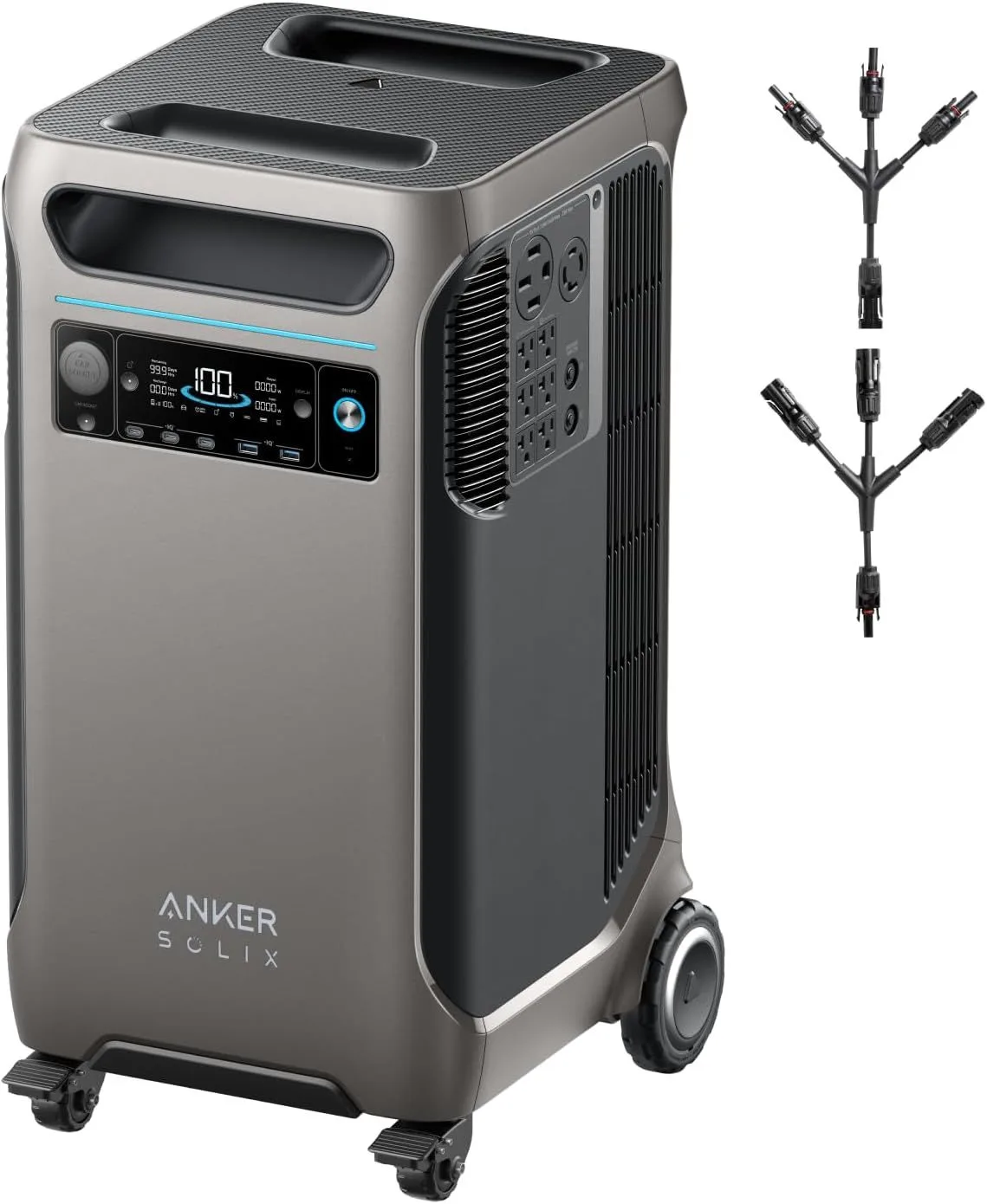
Anker SOLIX F3800
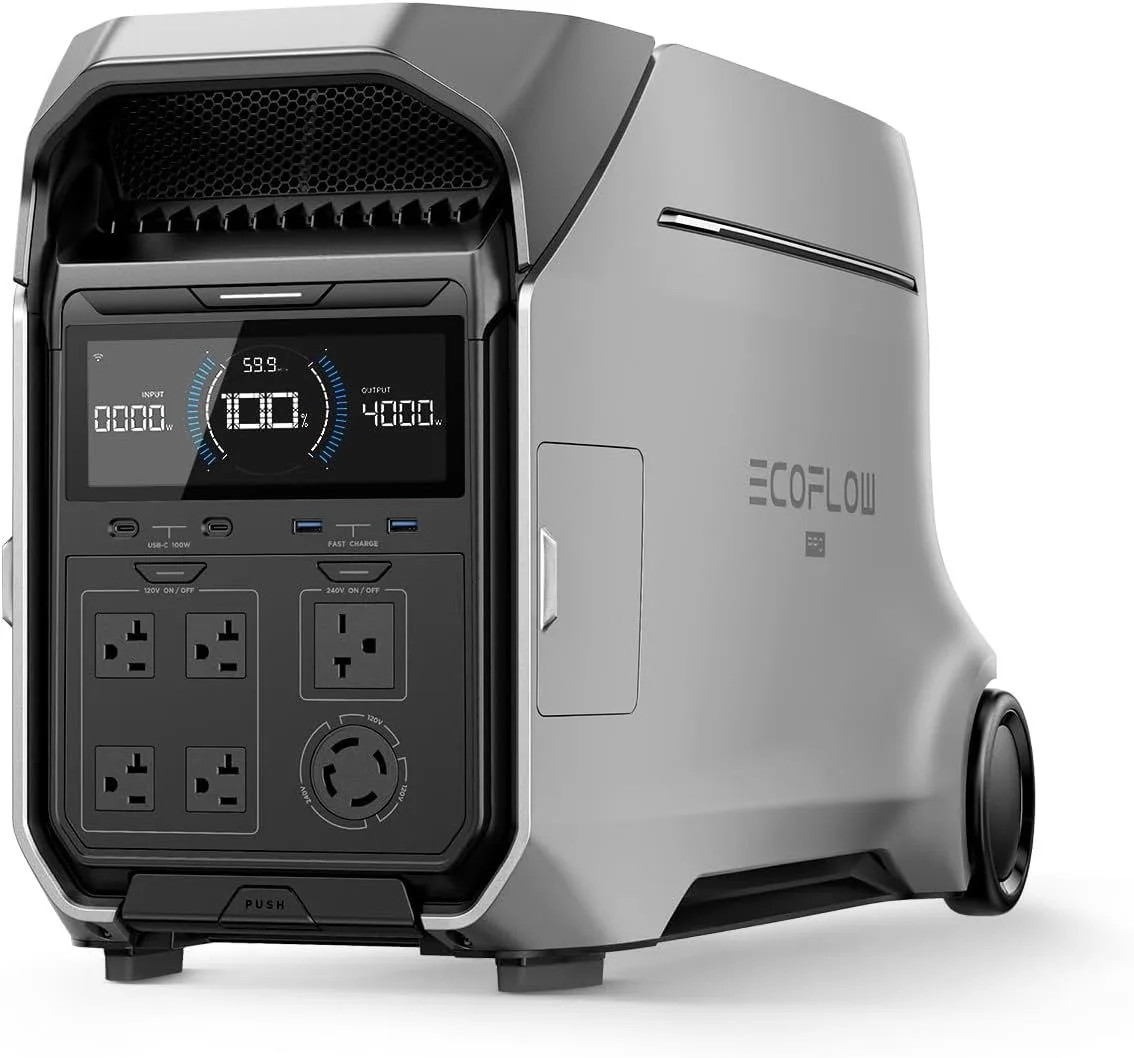
EcoFlow DELTA Pro 3
Specs at a Glance
The F3800 brings 3,840Wh of raw capacity with 6,000W output. The DELTA Pro 3 counters with 4,096Wh and 4,000W output (6,000W with X-Boost). On paper, these flagships are closer than their price tags suggest. The real differences emerge in how they charge, how they sound, and how efficiently they convert stored energy into usable power.
| Feature | Anker SOLIX F3800 Portable Power Station | EcoFlow DELTA Pro 3 Portable Power Station |
|---|---|---|
| Price Range | $500+ | $500+ |
| Battery Capacity | 3,840Wh | 4,096Wh |
| Battery Type | LiFePO4 | LiFePO4 |
| Output Power | 6,000W (120V/240V) | 4,000W (6,000W X-Boost) |
| Surge Power | 6,000W sustained | 8,000W |
| Weight | 132 lbs | 113.5 lbs |
| Solar Input | 2,400W dual MPPT (11-60V per port) | 2,600W dual MPPT |
| Check Price | Check Price |
Head-to-Head Breakdown
Raw Output Power
Anker F3800 WinsThe Anker SOLIX F3800 delivers 6,000W of continuous 240V output from a single unit — no expansion batteries, no hubs, no additional hardware. Plug it into a transfer switch, and it powers your entire electrical panel at full capacity from day one.
The EcoFlow DELTA Pro 3 rates at 4,000W continuous with X-Boost pushing to 6,000W for compatible loads. X-Boost works by reducing voltage to maintain power delivery within the inverter's thermal limits — effective for resistive loads like heaters but less reliable for motor-driven loads that need consistent voltage. The F3800's 6,000W sustained output does not require the same compromise.
Port selection reinforces the gap. The F3800 includes a NEMA 14-50 outlet (the same plug used for EV chargers and dryer connections) and an L14-30R outlet — both absent from the DELTA Pro 3 without adapters. For users who need to plug in an EV or run a 240V appliance directly, the F3800 is ready out of the box.
The F3800 also offers 14+ ports total — the most extensive selection in its class. Three dedicated UPS outlets, three standard AC outlets, three USB-C ports, two USB-A ports, DC outputs, and the heavy-duty 240V outlets create a versatile connection hub that handles everything from phone charging to EV charging simultaneously.
One practical scenario illustrates the gap: running a 240V well pump during a winter outage. The F3800 plugs directly into the transfer switch and powers the pump at full voltage from minute one. The DELTA Pro 3 can do the same job, but its 4,000W base output means a high-draw well pump (many run at 3,000-3,500W continuous with 6,000W+ startup surges) pushes closer to the unit's limits. X-Boost helps with startup surges, but sustained heavy loads at reduced voltage stress motor windings over time.
Charging Speed and Recovery
EcoFlow DELTA Pro 3 WinsThe EcoFlow DELTA Pro 3's X-Stream charging technology fills its 4,096Wh battery to 80% in approximately 50 minutes from a standard AC outlet. That is a staggering rate for a battery this size — 3,277Wh of usable energy recovered in under an hour.
The Anker F3800 reaches full charge in roughly 2 hours from 240V or 3-4 hours from a standard 120V outlet. Fast by any standard, but the EcoFlow's 50-minute-to-80% capability is in a different league. During intermittent power outages where grid power returns in unpredictable windows, the DELTA Pro 3 recovers far more stored energy in the same time window.
Solar charging tells a more nuanced story. The EcoFlow accepts 2,600W of solar input to the F3800's 2,400W — a modest advantage. But the EcoFlow's flexible voltage range works with a wider array of standard residential panels, while the F3800's 60V-per-port limitation restricts compatibility and may require additional combiner hardware.
Car charging adds another dimension. Both accept 12V vehicle input, but neither charges quickly from a vehicle alternator alone. The real recovery scenario during an extended outage is grid → battery, and here the DELTA Pro 3's speed advantage compounds. If grid power returns for a 2-hour window, the DELTA Pro 3 recovers roughly 6,500Wh (80% twice). The F3800 recovers about 3,840Wh (one full charge). That difference could mean the next 24 hours of backed-up appliances — or not.
Efficiency, Noise, and Daily Livability
EcoFlow DELTA Pro 3 WinsThe EcoFlow DELTA Pro 3 achieves 93% discharge efficiency — meaning 3,790Wh of its rated 4,096Wh reaches your devices as usable power. That is the best efficiency figure in the whole-home category. The Anker F3800 does not publish an official efficiency figure, but its 80W idle draw suggests lower overall efficiency, particularly during extended low-load operation.
Noise levels separate these units decisively. The DELTA Pro 3 operates at 30dB — quieter than a whispered conversation. Multiple reviewers confirmed it is viable as a bedside unit for CPAP users. The F3800 has reported buzzing and rattling from its BP3800 expansion batteries under heavy AC loads, and the main unit's cooling system is audibly present during charging and high-draw operation.
That 80W idle draw on the F3800 is a genuine concern for sustained use. Over a 24-hour standby period, the F3800 consumes approximately 1,920Wh just sitting idle — nearly half its total capacity. For multi-day outages where conservation matters, the DELTA Pro 3's lower idle consumption preserves substantially more stored energy for actual use.
The difference in daily livability is the gap between a power station you tolerate in your living space and one you forget is there. For homes where the unit sits in a closet or garage between uses, the F3800's noise and idle draw are less relevant. For homes where the unit runs continuously as part of a solar self-consumption system, the DELTA Pro 3 is materially easier to live with.
Expansion Ceiling and Ecosystem
Anker F3800 WinsThe Anker SOLIX F3800's expansion ceiling is the highest in the industry — 53.8kWh across two main units and twelve BP3800 expansion batteries. That is enough stored energy to power an average American home for approximately two full days without any solar recharging.
The EcoFlow DELTA Pro 3 expands to 48kWh across three units plus extra batteries — also extraordinary, but the Anker's 53.8kWh ceiling is 12% higher. More importantly, the F3800 achieves its maximum capacity with fewer connection points and a simpler configuration.
EcoFlow holds an edge on ecosystem maturity. The DELTA Pro 3 is backward compatible with original DELTA Pro batteries — protecting the investment of existing EcoFlow owners. The app experience, third-party integrations, and community support have had more years to develop. Anker's ecosystem is growing aggressively but is newer.
Both manufacturers are building toward comprehensive home energy management — solar panels, expansion batteries, transfer switches, smart home panels, and mobile monitoring. The choice between ecosystems is as much about which direction you want to grow as about today's specs. Anker offers more raw capacity headroom. EcoFlow offers more established integration pathways.
The app experience reflects the maturity gap. EcoFlow's mobile app provides real-time power flow visualization, historical energy usage charts, scheduled charging windows (charge during off-peak electricity rates, discharge during peak), and firmware updates pushed over WiFi. Anker's app covers the essentials — monitoring, basic scheduling, and firmware — but lacks the depth of analytics and automation that EcoFlow has refined over three product generations. For buyers who want granular control over charge and discharge behavior, time-of-use optimization, and detailed consumption tracking, EcoFlow's software layer is measurably ahead. For buyers who prefer a simple set-and-forget installation, either app is adequate.
A hidden factor: battery interoperability. EcoFlow's backward compatibility with original DELTA Pro batteries means buyers who already own the first-generation DELTA Pro can add the Pro 3 and immediately reuse their existing battery investment. Anker's ecosystem is self-contained — the BP3800 expansion batteries only work with the F3800. Neither ecosystem plays well with the other, so this is a long-term platform commitment, not a one-time purchase decision.
Build Quality and Environmental Protection
EcoFlow DELTA Pro 3 WinsThe EcoFlow DELTA Pro 3's IP65 dust and water resistance rating is a concrete advantage for practical installation. Garages, basements, and utility rooms subject the unit to temperature swings, humidity, and airborne particulates. The IP65 rating means dust ingress and low-pressure water jets (like splashing from nearby fixtures) will not compromise the battery pack.
The Anker F3800 carries no formal IP rating. While the build quality is solid — Anker's manufacturing standards are well-established — the lack of rated environmental protection means climate-controlled indoor installation is the safer choice. For users planning garage or semi-outdoor placement, the DELTA Pro 3 is the more appropriate unit.
Both units carry 5-year warranties. The F3800's 3,000+ cycle life is slightly lower than the DELTA Pro 3's 4,000+ cycles — a gap that becomes meaningful over a decade of daily cycling. For solar self-consumption systems that cycle the battery daily, the EcoFlow's extra 1,000 rated cycles represent roughly three additional years of expected service life.
Thermal management is another practical distinction. The DELTA Pro 3's IP65 enclosure keeps dust and moisture out of the cooling channels, which means its fans pull clean air even in a dusty garage. The F3800's open ventilation design works fine in a climate-controlled basement, but in a workshop environment with sawdust, pet dander, or construction debris, the intake vents can accumulate particulates over months of operation. Periodic compressed-air cleaning of the F3800's vents is a maintenance step that the DELTA Pro 3's sealed design avoids entirely.
Pricing and Long-Term Value
Anker F3800 WinsThe Anker SOLIX F3800 is priced as a top-tier investment investment, while the EcoFlow DELTA Pro 3 is similarly priced. On a per-watt-hour basis, the F3800 delivers slightly better value — 3,840Wh at its price versus 4,096Wh at the EcoFlow's higher cost. The EcoFlow has 256Wh more capacity, but the price gap more than accounts for that difference.
The F3800 also ships with a more comprehensive port selection — including the NEMA 14-50 and L14-30R outlets that the DELTA Pro 3 lacks without adapters. Adding those adapters to the EcoFlow is an extra cost and another point of failure.
Long-term value tilts back toward EcoFlow when daily efficiency is factored in. The DELTA Pro 3's 93% discharge efficiency and lower idle draw mean more of every stored kilowatt-hour actually reaches your devices. Over years of daily cycling, the cumulative energy savings from higher efficiency offset some of the higher purchase price. Which factor matters more — purchase price or lifetime operating efficiency — depends on how intensively you plan to use the unit.
Expansion costs shift the calculation again. Building toward maximum capacity costs substantially more with either system — expansion batteries in the multi-thousand-dollar range for both. But the F3800's 53.8kWh ceiling means you can keep adding capacity without hitting a wall, while the DELTA Pro 3 tops out at 48kWh. For buyers planning a phased build-out over 2-3 years, the F3800 offers more runway before you exhaust the platform's potential.
Installation costs are the hidden equalizer. Both units benefit from professional transfer switch installation (typically several hundred dollars for parts and labor), which connects the unit to your home's electrical panel. Without a transfer switch, you are limited to plugging individual appliances directly into the unit's outlets — fine for a few devices, but not the whole-home experience these flagships are designed for. Budget for installation regardless of which unit you choose.
Which Powerhouse Belongs in Your Home?
Get the Anker SOLIX F3800 if you...
- ✓Need the highest single-unit output (6,000W sustained at 240V) without expansion batteries
- ✓Want direct EV charging capability via the built-in NEMA 14-50 outlet
- ✓Plan to build the largest possible backup system (53.8kWh expansion ceiling)
- ✓Prioritize port variety — 14+ ports covering every connection type
- ✓Will install indoors in a climate-controlled space where noise and idle draw are less critical
Get the EcoFlow DELTA Pro 3 if you...
- ✓Need the fastest possible recharging — 0-80% in under an hour from a wall outlet
- ✓Prioritize quiet operation for living spaces, bedrooms, or CPAP use (30dB)
- ✓Want the best discharge efficiency (93%) to maximize usable energy from every charge
- ✓Plan to install in a garage or semi-outdoor space where IP65 protection matters
- ✓Already own EcoFlow DELTA Pro batteries — the Pro 3 is backward compatible
Real-World Scenario: Hurricane Season in the Southeast
You lose power for 3-5 days, grid returns in short unpredictable windows, and you need to keep a refrigerator, well pump, HVAC blower, and home office running. The DELTA Pro 3's 50-minute-to-80% charging means every grid window — even a 1-hour flicker — recovers substantial energy. Its 93% efficiency stretches every stored watt-hour further. Its 30dB operation lets it run in your hallway without disrupting sleep. For intermittent outage scenarios where speed and efficiency determine survival comfort, the DELTA Pro 3 is the stronger pick.
But change the scenario: you have rooftop solar panels producing 4,000W+ daily and need to run an EV charger, a dryer, and a central air handler simultaneously during a prolonged grid failure. The F3800's 6,000W sustained 240V output and its NEMA 14-50 EV outlet handle that load from a single box. The DELTA Pro 3 would need supplemental units or load management. For high-peak-draw households with dedicated solar arrays, the F3800's brute-force approach is the path of least resistance.
What Buyers Ask About These Two
Which unit can actually power an entire house during an outage?
Both deliver true 240V split-phase output for whole-home backup, but through different approaches. The Anker F3800 outputs 6,000W from a single unit at 240V. The EcoFlow DELTA Pro 3 delivers 4,000W standard (6,000W with X-Boost) but achieves it through native dual-voltage design. Both can run central HVAC, well pumps, and EV chargers — the F3800 simply has more raw headroom before hitting limits.
Can I charge these from rooftop solar panels?
Both accept solar input, but with different compatibility profiles. The EcoFlow DELTA Pro 3 accepts 2,600W of solar with flexible voltage ranges that work with most standard residential panels. The Anker F3800 accepts 2,400W but restricts input to 60V per port — a limit that excludes many standard residential panels without additional hardware. For solar-first buyers, this is a deciding factor favoring the EcoFlow.
How do the smart home ecosystems compare?
EcoFlow has the more mature smart home ecosystem in 2026. The DELTA Pro 3 offers backward compatibility with original DELTA Pro batteries, Smart Home Panel integration, and a well-reviewed mobile app for monitoring and scheduling. Anker is building out its ecosystem rapidly — the F3800 works with the Home Power Panel and supports upcoming features — but EcoFlow currently has more third-party integrations and a longer track record.
Which is safer to keep in a garage or utility room?
The EcoFlow DELTA Pro 3 has an edge here with its IP65 dust and water resistance rating on the battery pack — a genuine advantage for garage or semi-outdoor placement where humidity, dust, and temperature swings are factors. The Anker F3800 lacks a formal IP rating, making it better suited for climate-controlled indoor installation.
What about the reported safety concerns with the EcoFlow?
There is a documented fire incident and reported neutral-ground bonding concerns when using the DELTA Pro 3 with transfer switches. EcoFlow has addressed some concerns through firmware updates, but buyers planning permanent transfer switch installation should consult a licensed electrician familiar with portable power station grounding requirements. The Anker F3800 has not had equivalent safety incidents reported, though its UPS mode is limited to three 120V outlets at 1,440W.
Which has better portability for occasional relocation?
Neither is truly portable — the Anker F3800 weighs 132 lbs and the EcoFlow DELTA Pro 3 weighs 113.5 lbs. Both require two people to move any distance. The EcoFlow is about 19 lbs lighter, which matters when moving between floors or loading into a vehicle. Both units have wheels, but these are permanent-installation machines that happen to have handles.
How does idle power consumption compare over multi-day outages?
The Anker F3800 draws approximately 80W while idle — that is roughly 1,920Wh consumed over 24 hours just sitting in standby, which is nearly half of its 3,840Wh capacity. The EcoFlow DELTA Pro 3 draws substantially less at idle, preserving more stored energy for actual use. Over a 3-day outage without recharging, the F3800 loses a larger percentage of its capacity to idle draw alone. For multi-day emergency scenarios where conservation matters, the DELTA Pro 3 stretches its reserves further.
Do either of these work as a daily solar self-consumption system?
Both can function as solar self-consumption systems, but the DELTA Pro 3 is better suited to daily cycling. Its 93% efficiency means less energy is lost in each charge-discharge cycle, its 4,000+ cycle rating outlasts the F3800 by roughly 1,000 cycles, and its 30dB operation is livable for 24/7 indoor use. The F3800 works for solar self-consumption too, but its higher idle draw and audible cooling system make it less economical and less pleasant for always-on daily operation. The F3800 is better positioned as a backup system that sits charged and waiting, activated only when the grid fails.
Make Your Decision
Both of these flagships deliver genuine whole-home backup capability — a feat that required a gas generator just five years ago. The Anker F3800 is the raw power champion with the broadest port selection and largest expansion path. The EcoFlow DELTA Pro 3 is the refined daily driver with faster charging, lower noise, and better efficiency. Your priority determines your pick.
If you still cannot decide: think about your worst-case outage scenario. If it involves running every appliance at full bore through a transfer switch and building the largest possible battery bank over time, the F3800's brute-force design is purpose-built for that mission. If it involves intermittent grid outages where fast recharging, quiet operation, and efficient energy use determine how comfortably you ride it out, the DELTA Pro 3's engineering refinement pays dividends every hour the power is out.
Prices and availability change frequently. Check Amazon for the most current pricing.