Is the Anker SOLIX F3800 Plus Upgrade Actually Worth the Premium?
Same brand. Same battery platform. Same 53.8kWh expansion ceiling. The Anker SOLIX F3800 Plus is positioned as the "fixed" version of the original F3800 — with better solar input, weather-aware charging, and tighter ecosystem integration. But the Plus also costs more and delivers less standalone output. We break down exactly what you gain and what you lose to help you decide which F3800 deserves your investment.
Both units sit at the top of Anker's home battery lineup, with the original running top-tier investment and the Plus commanding modestly more expensive for its upgraded solar architecture. The price gap shrinks during Amazon sales events, but the engineering trade-offs do not change regardless of what you pay.
Quick Verdict
The Plus is the better buy for solar-first households. If you plan to charge primarily from solar panels — rooftop or portable — the F3800 Plus's MC4-compatible 3,200W input at 165V resolves the original's most frustrating limitation. If you need maximum standalone wattage and do not prioritize solar, the original F3800 delivers 6,000W from one unit at a lower price.
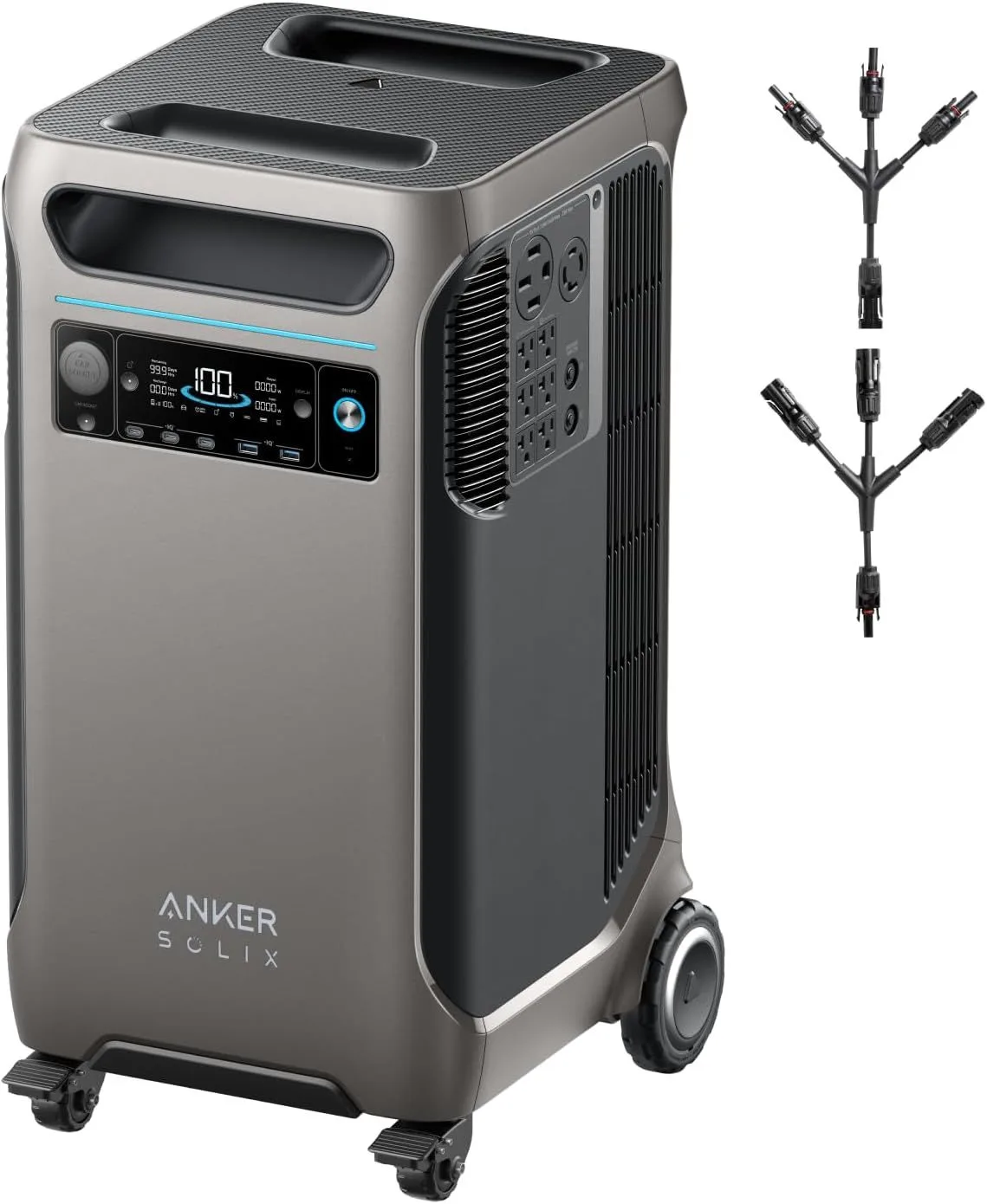
Anker SOLIX F3800
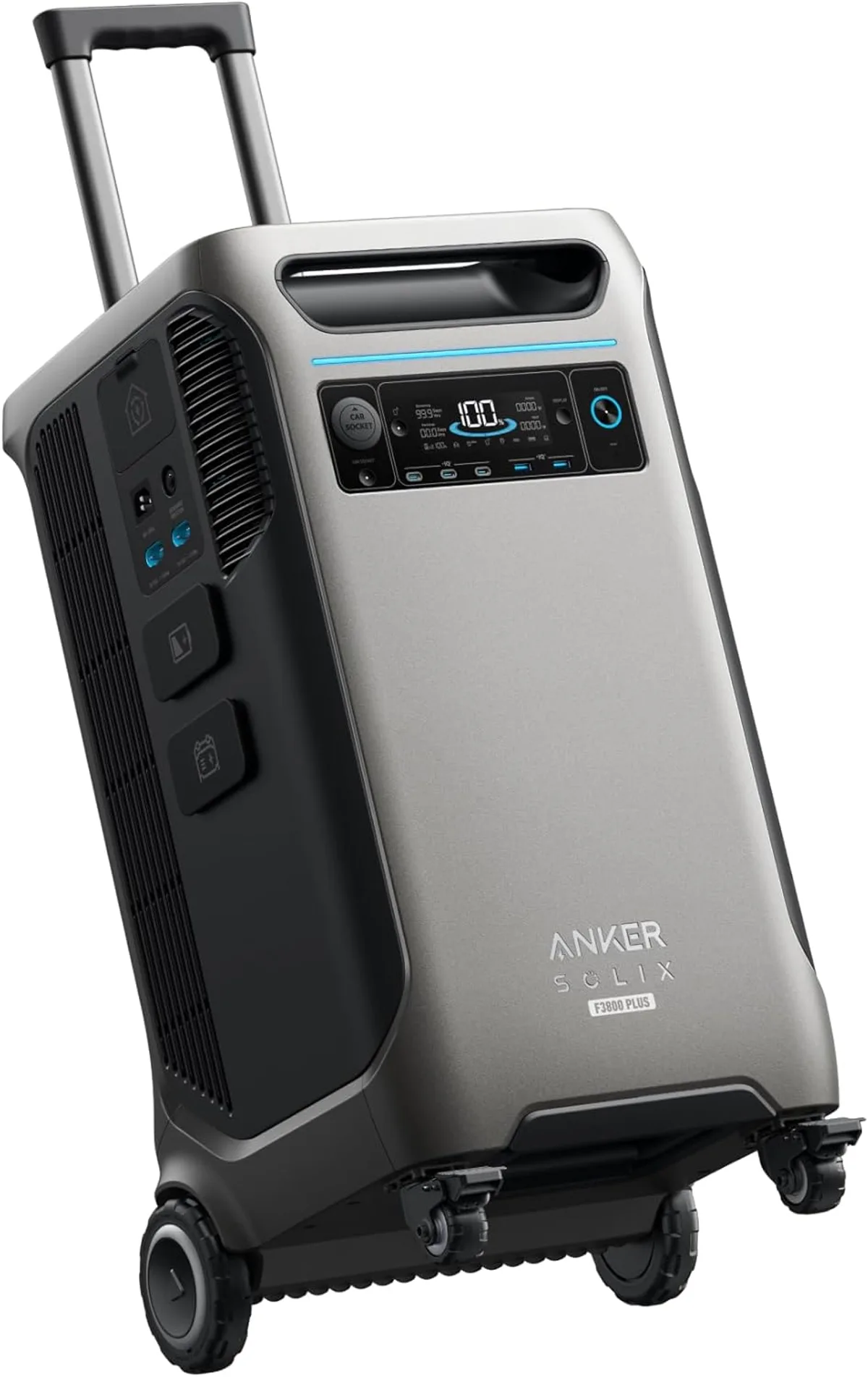
Anker SOLIX F3800 Plus
Specs at a Glance
Both units share the same 3,840Wh LiFePO4 battery, 3,000+ cycle rating, 5-year warranty, and BP3800 expansion battery compatibility. The differences are concentrated in solar input architecture, standalone output, and smart features. Look at the solar input row — that is where the Plus earns its name.
| Feature | Anker SOLIX F3800 Portable Power Station | Anker SOLIX F3800 Plus Portable Power Station |
|---|---|---|
| Price Range | $500+ | $500+ |
| Battery Capacity | 3,840Wh | 3,840Wh |
| Battery Type | LiFePO4 | LiFePO4 |
| Output Power | 6,000W (120V/240V) | 3,300W (6,000W with expansion) |
| Surge Power | 6,000W sustained | 12,000W (two units) |
| Weight | 132 lbs | 136.7 lbs |
| Solar Input | 2,400W dual MPPT (11-60V per port) | 3,200W dual 165V MPPT (MC4 compatible) |
| Check Price | Check Price |
What Anker Changed — and What They Did Not
Understanding this comparison requires knowing the original F3800's biggest complaint: its 60V-per-port solar input limit made it incompatible with most standard residential solar panels in series strings. The Plus was designed to fix that flaw — but fixing it required trade-offs elsewhere.
Solar Input: The Defining Upgrade
F3800 Plus WinsThe original F3800 restricts solar input to 11-60V per MPPT port. Most standard residential solar panels output 30-50V open circuit. In theory, one panel per port works. In practice, the 60V limit means you cannot series-string panels — the most common and efficient way to wire a solar array. The result: more combiner boxes, more wiring, more complexity, and slower real-world charging than the 2,400W spec suggests.
The F3800 Plus raises the MPPT voltage to 165V with standard MC4 connectors. This is a fundamental architectural change, not a firmware tweak. MC4 connectors are the universal standard for solar panel wiring — every residential panel, every portable panel, and every solar installation company uses them. The original F3800's proprietary connectors required adapters. The Plus plugs in directly.
Total solar input also jumps from 2,400W to 3,200W — a 33% increase. For solar-first households building a comprehensive home energy system, this single improvement is worth the price premium on its own. More solar capacity means faster off-grid recharging, more daily solar harvest, and better solar self-consumption ratios.
If your use case does not involve solar panels at all — if you charge exclusively from wall outlets or generators — this improvement has zero value to you. And that is the crux of the decision between these two units.
Standalone Output Power
Original F3800 WinsThe original F3800 delivers 6,000W continuous at 240V from a single box. Plug it in, turn it on, and it powers your entire electrical panel at maximum rated output with nothing else connected.
The F3800 Plus reduces standalone output to 3,300W. To reach the full 6,000W, you need at least one BP3800 expansion battery connected. This is not a minor concession — an expansion battery adds substantial cost to the total system price.
For buyers who need a single-unit backup solution that handles heavy 240V loads from day one without additional purchases, the original F3800 remains the more capable standalone unit. The Plus is designed as the hub of a system — powerful alone, but reaching its potential only with expansion.
At 3,300W standalone, the Plus still runs most household loads comfortably. Refrigerators, well pumps, sump pumps, lighting circuits, and HVAC blower fans all operate within that envelope. Use our sizing guide to calculate your actual load requirements. The gap matters most for heavy 240V loads like electric dryers, large AC compressors, or EV charging — those require expansion on the Plus but work immediately on the original.
Here is the scenario where this matters most: a sudden outage hits and you need to power your home right now. The original F3800 delivers 6,000W at 240V the moment you connect it to your panel. The F3800 Plus, without an expansion battery installed, caps at 3,300W — enough for essential circuits (fridge, lights, internet, phone charging) but not enough for high-draw 240V appliances. If you buy the Plus, budget for at least one BP3800 battery from day one. Without it, the Plus is a capable but incomplete system.
Wall Outlet Charging Speed
F3800 Plus WinsThe F3800 Plus charges from a 240V outlet to full in approximately 1.5 hours. The original F3800 takes roughly 2 hours from 240V. On 120V outlets, the gap widens — the Plus finishes in about 2 hours while the original needs 3-4 hours.
This 25-50% speed improvement comes from the Plus's support for 240V generator and wall outlet input charging — the same type of high-power input that professional installations use. The faster recharging cycle means more energy recovered during brief grid-power windows and faster turnaround between uses.
For users who primarily charge from wall outlets between power events, the Plus's faster AC charging is a practical everyday improvement. For users who charge primarily from solar, the AC charging speed is less relevant — but the solar input improvements already covered that scenario decisively.
The speed difference becomes critical during storm season. When a severe weather alert gives you 4-6 hours of warning, the Plus charges from empty to full in 1.5 hours — leaving time to charge expansion batteries too. The original F3800 needs 2 hours for the base unit alone. With Storm Guard enabled on the Plus, charging starts automatically as soon as the alert triggers — no manual intervention needed. That automation can mean the difference between facing a storm at full capacity versus scrambling to plug things in when you notice the sky darkening.
Smart Features and Weather Integration
F3800 Plus WinsThe F3800 Plus introduces automatic storm preparation through weather alert integration with the Home Power Panel. When the National Weather Service issues severe weather warnings for your area, the system automatically begins charging from grid power to ensure maximum stored energy before the event arrives.
This is not a gimmick. The single most common failure mode in emergency backup is the unit sitting at 40% charge when the outage hits because nobody remembered to plug it in when the forecast turned bad. Automated weather-triggered charging eliminates that human failure point entirely.
The Plus also offers tighter integration with the full Anker ecosystem — batteries, solar arrays, generators, and circuit-level power management through the Home Power Panel. The original F3800 supports many of these features, but the Plus was designed from the ground up as an ecosystem hub rather than a standalone product.
The original F3800 has a functional app and supports basic monitoring and scheduling. It is not lacking in smart features — the Plus simply adds an additional layer of automation that benefits users who want set-and-forget reliability.
Weight and Physical Dimensions
Original F3800 WinsNeither unit is light. The original F3800 weighs 132 lbs. The F3800 Plus weighs 136.7 lbs — nearly 5 lbs heavier, making it the heaviest portable power station in our entire comparison. Both require two people for any relocation.
The additional weight on the Plus comes from the upgraded solar charge controllers and enhanced internal power management hardware. The external dimensions are nearly identical — 27.6" deep with similar height and width profiles.
In practical terms, the 4.7 lb difference is irrelevant. Both of these units are permanent or semi-permanent installations. You position them once, connect them, and leave them in place. If you are planning to move your whole-home backup system between locations regularly, neither F3800 variant is the right product.
What Did Not Change
Several features — and limitations — carry over from the original to the Plus without modification:
- •Battery: Same 3,840Wh LiFePO4 with 3,000+ cycle rating
- •Expansion: Same BP3800 batteries, same 53.8kWh ceiling, full cross-compatibility
- •UPS limitation: Still limited to three 120V ports at 1,440W max — no 240V UPS capability
- •BP3800 buzzing: Reports of expansion battery buzzing under heavy AC loads persist
- •Port selection: Same comprehensive 14+ port layout with NEMA 14-50, L14-30R, USB-C, USB-A, and DC outputs
- •Warranty: Same 5-year coverage from Anker
The UPS limitation is the most notable shared weakness. Neither unit provides instantaneous switchover protection for 240V loads. For equipment that cannot tolerate any power interruption — medical devices, server equipment, sensitive electronics — a dedicated UPS remains necessary alongside either F3800 model.
Noise performance is another shared characteristic. Both units run fans continuously under any meaningful load, producing approximately 45-50dB at a distance of 3 feet. That is comparable to a quiet conversation — not disruptive in a garage or utility room, but noticeable in a living space. Under peak loads above 4,000W, fan speed ramps higher and both units can reach 55-60dB. Neither F3800 variant is suitable for bedroom placement during overnight outage backup. The noise output is a function of the thermal load from running a 6,000W inverter — no firmware update or hardware revision has changed this, and physics makes it unlikely to change in future models at this power class.
Long-term maintenance costs are identical for both units. The LiFePO4 cells carry the same 3,000+ cycle rating with 80% capacity retention. At one full cycle per day, that is 8+ years before noticeable degradation. Neither unit requires consumable replacements — no filters, no coolant, no oil changes. The only recurring cost is electricity to recharge. At typical US residential rates, a full recharge from empty costs less than a dollar depending on your local rate. Over a decade of ownership, electricity costs dwarf the purchase price difference between the original and Plus models. The real total cost of ownership is dominated by how many expansion batteries you add and how much solar infrastructure you install — not by which base unit you chose.
Installation and Setup Complexity
F3800 Plus WinsThe original F3800's solar wiring is the single biggest source of owner frustration. The 60V-per-port restriction means each panel gets its own dedicated input — creating a spider web of cables running from your roof or ground-mount array to the unit. For a 6-panel array, that is 6 individual cable runs, each needing its own weatherproof routing and strain relief. Electricians who install these systems report spending 2-3 hours on wiring alone, compared to 30-45 minutes for a standard MC4 string inverter.
The F3800 Plus eliminates this problem entirely. MC4 connectors allow series-stringing panels — 3 panels become one cable run instead of three. A 6-panel array becomes two strings of three, each with a single MC4 connection to the unit. The result: cleaner routing, fewer potential failure points, and a setup that any solar installer recognizes immediately without reading an Anker-specific manual.
Transfer switch installation is identical for both units. Both connect to a Home Power Panel or a manual transfer switch via the same electrical interface. A licensed electrician installs either one in roughly 4-6 hours, including panel mounting, breaker assignment, and grounding. The labor cost and code compliance process do not change between models.
The app setup experience differs slightly. The F3800 Plus ships with a newer firmware baseline that includes the Storm Guard weather integration, streamlined WiFi provisioning, and a guided setup wizard for first-time Anker ecosystem users. The original F3800 received Storm Guard support through a firmware update, but the implementation is less polished — the update requires a stable Bluetooth connection and can take 15-20 minutes to complete. First-time setup on the Plus is the smoother experience.
For DIY-inclined homeowners who plan to do their own solar panel wiring (a common approach for ground-mount portable arrays), the Plus's MC4 compatibility is the clear win. MC4 connectors crimp with an inexpensive crimping tool available at any hardware store, and every online solar tutorial assumes MC4 wiring. The original F3800's proprietary connectors require Anker-specific adapters that are harder to source and unfamiliar to general solar resources. That adapter dependency adds cost, adds a failure point, and makes troubleshooting harder if a connection goes bad two years from now.
The Decision Framework
Stick with the original F3800 if you...
- ✓Need 6,000W from a single unit without buying expansion batteries first
- ✓Charge primarily from wall outlets or generators — not solar
- ✓Want the most output per dollar for a standalone backup solution
- ✓Do not need MC4 solar panel compatibility or can work with adapters
Upgrade to the F3800 Plus if you...
- ✓Plan to charge primarily from solar panels — rooftop or portable
- ✓Want MC4-compatible 3,200W solar input that works with standard panels
- ✓Are building a comprehensive Anker home energy ecosystem
- ✓Value automated storm preparation and weather-aware charging
- ✓Already own or plan to buy BP3800 expansion batteries for full 6,000W output
Frequently Asked Questions
What exactly did Anker fix in the F3800 Plus?
The single biggest change is solar input compatibility. The original F3800 restricts solar input to 60V per port, which is too low for most standard residential panels in series. The F3800 Plus raises this to 165V MPPT with standard MC4 connectors, accepting 3,200W of solar — a 33% increase over the original. This one change transforms the solar charging experience from frustrating to practical.
Does the F3800 Plus output more power than the original?
Actually less from a single unit. The original F3800 delivers 6,000W continuous at 240V from one box. The F3800 Plus outputs 3,300W standalone, requiring an expansion battery to reach the full 6,000W. If raw single-unit output is your primary need, the original F3800 is the stronger choice.
Are the expansion batteries interchangeable between the two?
Both use BP3800 expansion batteries and share the same 53.8kWh expansion ceiling. The batteries, expansion cables, and Home Power Panel are cross-compatible. If you already own BP3800 batteries for the original F3800, they work with the Plus and vice versa.
Is the automatic storm preparation feature on the Plus worth it?
The F3800 Plus integrates weather alert monitoring through the Anker app. When severe weather is detected in your area, the system automatically begins charging to full capacity from grid power — ensuring maximum stored energy before the storm hits. For users in hurricane, tornado, or ice storm regions, this automated preparation eliminates the "I forgot to charge it" failure mode that makes many backup systems useless during actual emergencies.
Which is better if I already have rooftop solar panels?
The F3800 Plus, without question. Its 165V MPPT controllers with MC4 connectors connect directly to standard residential panels — the same panels already on your roof. The original F3800 is limited to 60V per port, which is incompatible with most standard panel configurations without additional combiner hardware and voltage management.
Do both units have the same UPS limitation?
Yes — both limit UPS mode to three 120V outlets at a maximum of 1,440W. Neither offers 240V UPS capability. This means neither unit provides instantaneous switchover protection for 240V loads like central HVAC. For UPS-dependent equipment, a separate dedicated UPS is still recommended alongside either F3800 model.
How loud are these units during operation?
Both F3800 models run fans under load, and neither is designed for quiet bedroom operation. At moderate loads (1,000-2,000W) expect 40-50dB from either unit — roughly the volume of a quiet conversation. Under heavy 240V loads or fast AC charging, fan noise climbs higher. These are garage, basement, or utility room units. If noise is a primary concern, the F3800 line is not the right product — look at the C2000 Gen 2 or DELTA 3 MAX instead.
Can I run a central AC unit off either F3800?
Most residential central AC compressors draw 2,000-4,000W continuous with startup surges of 6,000-8,000W. The original F3800 at 6,000W can sustain medium AC units once past startup, but startup surges may trip the overload protection on larger units. The F3800 Plus at 3,300W standalone cannot handle most central AC compressors — you need expansion batteries to reach 6,000W. For whole-house AC backup, the original F3800 is the more practical standalone option. For either unit, test your specific compressor before relying on it during a real outage.
What is the real-world daily solar harvest difference between the two?
In a location averaging 5 peak sun hours with an 800W panel array: the original F3800 (limited by its 60V input and wiring complexity) realistically harvests 2,500-3,000Wh per day. The same 800W array on the F3800 Plus (MC4 direct connect, 165V MPPT) harvests 3,200-3,800Wh — roughly 25% more. The gap widens further with larger arrays because the Plus accepts up to 3,200W of solar versus the original's 2,400W cap. Over a month, that 25% difference adds up to tens of kilowatt-hours of free energy.
The Long-Term Cost Picture
The Plus commands a higher sticker price, but the total cost of ownership depends on how you plan to use the system. For solar-first households, the Plus saves money over time because its MC4-compatible, 165V MPPT input harvests roughly 25% more energy per day from the same panel array. Over a year of daily solar charging, that extra harvest adds up to hundreds of kilowatt-hours — equivalent to tens of dollars in avoided grid electricity. The original F3800's lower solar efficiency (due to the 60V limitation and wiring losses from combiner hardware) costs you free energy every day.
For grid-only users who never plan to add solar, the original F3800 at its lower price point is the better value. You get more standalone output (6,000W vs 3,300W) for less money. The Plus's solar improvements and storm automation are wasted if the unit lives permanently plugged into a wall outlet. See our whole-home roundup for how both F3800 models compare against competitors from other brands.
Both units share the same LiFePO4 longevity — 3,000+ cycles to 80% capacity. At one cycle per day, that is over 8 years of daily use. Our maintenance guide covers storage and charging habits that extend this lifespan further. Both carry 5-year warranties from Anker. The BP3800 expansion batteries are cross-compatible, so whichever base unit you choose, your expansion investment carries forward. Neither choice locks you into a dead-end platform.
Check Current Pricing
Both F3800 models frequently see promotional pricing on Amazon — especially during seasonal sales events. The price gap between the original and Plus narrows at times, shifting the value calculation. Check current availability for both before deciding.
Prices and availability change frequently. Check Amazon for the most current pricing.